
You are here
You’re first‑gen. You’re pre‑med. No one in your family is a doctor. No family friends who are physicians. No uncle at Kaiser. No neighbor who’s an attending.
Your pre‑med group chat is trading stories: “My dad’s cardiologist said he’ll let me shadow,” “My aunt is writing one of my letters,” “My PI is a surgeon and already offered to recommend me.”
You? You’re staring at your phone thinking: I don’t even know a single doctor well enough to say hi. And every med school website keeps chanting the same thing: “Strong letters of recommendation. Evidence of mentorship. Clinical exposure. Shadowing.”
Here’s the situation: you need at least one real mentor (and future letter writer) who is a physician or close enough to medicine that admissions will respect it. But you don’t have built‑in access. So you’re going to have to build it. From scratch.
Let’s go step by step. No fluff. Just exactly what to do if you’re a first‑gen pre‑med starting at zero.
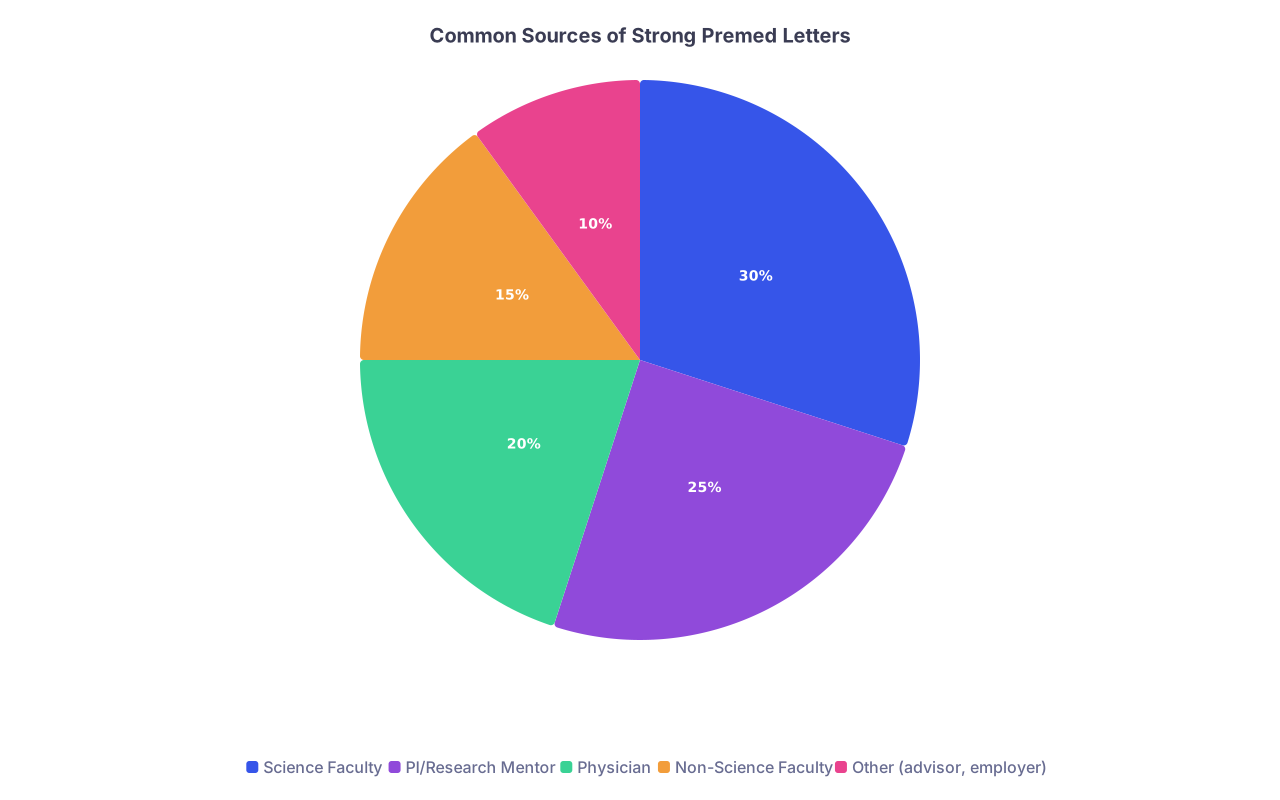
| Category | Value |
|---|---|
| Science Faculty | 30 |
| PI/Research Mentor | 25 |
| Physician | 20 |
| Non-Science Faculty | 15 |
| Other (advisor, employer) | 10 |
Step 1: Get clear on what kind of mentor you actually need
You’re not just looking for “a doctor.” You’re looking for:
- A person who can see your work over time (months, ideally a year+)
- Someone who can directly observe you in a real role (not just “shadowing silently”)
- Someone med schools will take seriously as a letter writer
Most pre‑meds waste time chasing one‑off shadowing days with random doctors they’ll never see again. That’s exposure, not mentorship. Helpful, but it will not solve your letter problem.
You want one or more of the following:
- A physician you consistently volunteer/work with
- A PI or research mentor (MD, DO, or PhD) who actually supervises you
- A non‑physician clinical supervisor (NP/PA/clinic manager) plus at least one strong faculty letter
Med schools care more about depth than title. A detailed letter from a PhD PI who’s seen you grind for 18 months is stronger than a generic paragraph from a big‑shot surgeon you followed for two afternoons.
So your target is: regular contact + meaningful responsibility + someone who writes letters often. Keep that in your head; it’ll guide every move.
Step 2: Use what you already have (that you’re probably underusing)
You think you have “no contacts.” That’s not entirely true. You just don’t see the chains yet.
Here’s the basic rule: you rarely go directly to a physician. You usually go:
You → someone non-physician → they open door → you prove yourself → then physician becomes mentor
Start with these existing entry points.
1. Your school’s pre‑health or pre‑med office (even if it sucks)
Is your pre‑health office disorganized and slow? Probably. Use it anyway.
Email subject: “First‑Gen Premed Seeking Clinical Mentor – Looking for Concrete Next Steps”
Body (rough idea, don’t copy word for word):
I’m a first‑generation college student interested in medicine and I don’t have any family or personal physician contacts.
I’m specifically looking for:
– A consistent clinical or hospital volunteer role where I can work with the same team over time
– Opportunities that have led previous students to physician mentors or strong lettersCould you point me toward 2–3 programs or contacts (hospitals, clinics, physicians, research PIs) where students historically develop longer‑term mentorship relationships?
You’re not asking for “any opportunity.” You’re asking where students have actually found mentors and letters. Big difference. People answer concrete asks.
If they say, “We don’t track that,” ask for the names of hospitals/clinics where they regularly send students. That’s your map.
2. Professors you’ve already had
You might think, “They’re not doctors, how does this help?” Here’s how: professors know people. Especially:
- Biology, biochem, physiology
- Public health
- Psychology (especially clinical / health psych)
Ask for a 15–20 minute Zoom or office hours. Script:
I’m first‑gen, pre‑med, and I don’t have any personal physician contacts. I’m trying to find a situation where I can work with a physician, researcher, or clinical team consistently and eventually build mentorship.
Since you work in [X field], I wanted to ask: are there physicians, clinics, or labs you collaborate with or know well that might be open to a reliable undergrad helping out over time?
You’re not begging for a letter. You’re asking them to connect you to someone who needs help. People like sending good students to their friends.
If they say no, ask: “Is there anyone else you think I should talk to about this?” Keep the chain going.
3. Student orgs as a backdoor, not a social club
Premed clubs, MAPS, AMSA, minority pre‑health orgs – those are not just for free pizza and bad Kaplan presentations. They’re networks.
You’re not going to the meeting to “be involved.” You’re going with a specific objective: talk to 1–2 older students who already have physician mentors or letters. Ask:
- “Where did you actually meet your mentor?”
- “If you lost all your connections tomorrow, how would you rebuild?”
- “Which volunteer or job led to your best letter?”
Then ask a very direct question:
“Could you introduce me to your supervisor / volunteer coordinator / lab manager by email? I just want to see if they’re looking for more students.”
You’re not asking them to share their physician. You’re asking them to share the gatekeeper who might know multiple physicians.

| Step | Description |
|---|---|
| Step 1 | You: First-gen premed |
| Step 2 | Pre-health office |
| Step 3 | Professors |
| Step 4 | Student org leaders |
| Step 5 | Volunteer coordinator |
| Step 6 | Research PI or collaborator |
| Step 7 | Consistent clinical role |
| Step 8 | Research role |
| Step 9 | Physician mentor |
Step 3: Hit the three highest-yield environments for mentor-level contact
If you’re starting at zero, these are your best bets:
- Hospital volunteer programs (especially longitudinal ones)
- Free clinics / FQHCs / community health centers
- Research labs with clinical focus
1. Hospital volunteer programs – but with filters
Not all volunteer programs are created equal. Some are “wipe down wheelchairs and disappear.” Useless for mentorship. You’re hunting for roles that keep you in one place, on one unit, with one team.
Look for:
- Patient transport teams
- Emergency department volunteers
- Unit‑based volunteers (same floor, same nurses, same residents)
When you apply or email their volunteer coordinator, target the structure:
I’m hoping to be in a role where I can work consistently with the same team over at least 6–12 months. Are there unit‑based positions where volunteers tend to work with the same nurses/physicians regularly?
You want repetition. People need to see you dozens of times, not twice.
Once you start:
- Show up early
- Ask simple, clean questions: “Is there anything I can do that would be especially helpful to the team today?”
- Learn names; use them
After a couple of months, you’re not going to the attending and asking for a letter. You’re going to:
- The charge nurse
- The volunteer coordinator
- The resident who actually knows who you are
Ask:
I’m really interested in medicine long term, and I’ve really appreciated working with this team. Do you know any physicians here who enjoy teaching students or might be open to having a consistent student shadow or help with projects?
In a hospital, everyone knows which docs like teaching. Let them point you.
2. Free clinics and community health centers: hidden gold
If you’re first‑gen or underrepresented, these places tend to be friendlier and less elitist than big academic hospitals.
Search terms:
“[your city] free clinic volunteer premed”
“student‑run clinic [your university]”
“community health center volunteers”
These clinics often:
- Need reliable people
- Have fewer layers of bureaucracy
- Have attendings and NPs who remember what struggling up looked like
Apply. Once you’re in, do not act like a tourist. Act like part of the team.
Over a few months, there will be 1–2 physicians who you see repeatedly, who actually learn your name. That’s your potential mentor pool.
At the right moment (after months of showing up), you say:
I really appreciate how you explain things to patients and to us as students. I’m a first‑generation student without many connections to medicine, and I’m trying to find a longer‑term mentor in this field.
Would you be open to me occasionally asking you about career questions or feedback on how I’m preparing for medical school?
You’re not asking for a letter yet. You’re asking for a relationship. Much easier to say yes to.
3. Clinical research labs
If your school is attached to an academic medical center, this is one of the most realistic ways to get in a room with physicians:
Search:
- Your university hospital website → “Research” → “Clinical trials”
- Departments like cardiology, oncology, EM, pediatrics → “research opportunities for undergraduates”
Email template, cleaned up and short:
Dear Dr. X,
I’m an undergraduate at [school], majoring in [X], very interested in [specific field]. I’m first‑generation and don’t have family in medicine, so I’m trying to build experience by contributing meaningfully to a lab or clinical project.
I read your work on [brief specific paper or topic – one sentence max]. I’d be very interested in helping with data collection, chart review, or any tasks useful to your team. I can commit [X] hours/week for at least [6–12] months.
Would you be open to a brief conversation to see if there might be a good fit on your team, or anyone else you’d recommend I contact?
Best,
[Name]
[Year, major]
[GPA if it’s decent]
You’ll get ignored a lot. That’s fine. You only need one.
Once in a lab, your main mentor is often a fellow, resident, or PhD. That person can:
- Teach you real skills
- Pull you into projects
- Introduce you to the attending PI properly
PIs write letters all the time. Their letters carry weight when they can say “this student was the only undergrad I trusted with X.”

Step 4: How to turn “I kind of know them” into “this is my mentor”
Most students screw this part up. They either:
- Never ask for anything and stay invisible
- Or jump from “Hi, I’m premed” to “Will you write my letter?”
You’re going to do something smarter: slow escalation.
Think of it in three levels.
Level 1: Visibility and reliability
For 1–3 months, your only job is to:
- Show up every time, on time
- Do unglamorous tasks without complaining
- Let people see you are dependable
Say things like: “If there are any recurring tasks that are annoying but important, I’m happy to take them on regularly.”
People trust you when you help solve their annoying problems.
Level 2: Curiosity and initiative
Once they recognize you, start adding:
- Occasional, focused questions:
- “How did you end up in this specialty?”
- “What would you tell your younger self about getting into med school?”
- Offers to help more:
- “If anyone needs help with data, projects, or extra shifts, I’m around and interested.”
At this stage, you ask for a short meeting, not a letter.
I’ve really appreciated working with you over the last few months and learning from you on shift. If you ever have 20–30 minutes, I’d love to ask about your path to medicine and get your thoughts on how I’m preparing.
That’s the mentor ask, disguised as career advice. If they agree, that’s your opening.
During the meeting:
- Bring 2–3 thoughtful questions
- Be honest that you’re first‑gen and had to figure this out without a roadmap
- Ask: “If I wanted to be helpful to you or your team in a deeper way, what would that look like?”
Let them tell you how to be valuable to them. That’s where real mentorship starts.
Level 3: The letter conversation
This only happens after:
- 6+ months of consistent work
- They’ve seen your reliability and growth
- You’ve had at least one “career/advice” conversation
Then the ask is:
I’m starting to prepare for medical school applications in [month/year]. Because you’ve seen my work in [clinic/lab/volunteer] over the last [X] months, I was wondering if you’d feel comfortable writing a strong letter of recommendation for me when the time comes?
The word “strong” matters. It gives them an out if they can’t truly advocate for you. If they hesitate, you say:
If you don’t feel you know me well enough yet, I completely understand. I’d appreciate any feedback on what I could do over the next few months to get to that level.
Readable between the lines: “Tell me how to earn it.”
| Setting | Mentor Potential |
|---|---|
| Unit-based hospital volunteering | High |
| Free/community clinic volunteering | Very High |
| Clinical research lab (MD/DO PI) | Very High |
| One-off shadowing days | Low |
| Health fair / single event outreach | Very Low |
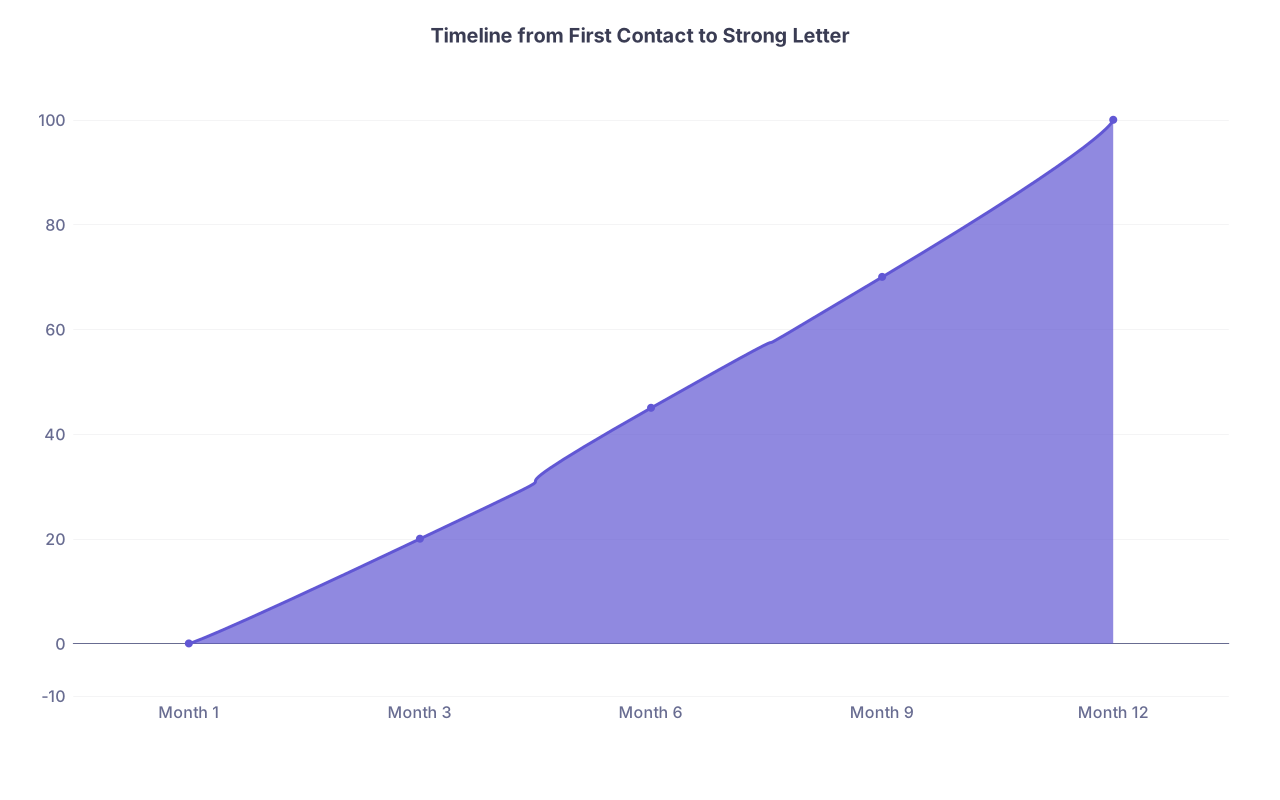
| Category | Value |
|---|---|
| Month 1 | 0 |
| Month 3 | 20 |
| Month 6 | 45 |
| Month 9 | 70 |
| Month 12 | 100 |
Step 5: If you’re at a tiny school or have zero local hospitals
Some of you are at rural colleges, commuter schools, or places with no big teaching hospital attached. That’s harder, but not hopeless.
Option A: Scribe, MA, or tech jobs
If you can work, these positions are mentorship factories if you stay long enough.
Scribe companies, urgent cares, EDs – you’ll see:
- The same physicians repeatedly
- How they chart, think, and talk to patients
Show up, be the reliable one, and then slowly do the same 3‑level progression: visible → curious → ask for career talk → later, letter.
Option B: Summer programs with built‑in mentors
Look for programs that explicitly say “mentorship” in their description, especially for first‑gen/URM students:
- SHPEP (Summer Health Professions Education Program)
- Local pipeline programs through med schools
- NIH or university research programs with a clinical angle
These programs are designed for people like you – people without connections. They pair you with physicians or researchers who are expected to mentor students.
Letters from those mentors carry weight because med schools know the programs.
Option C: Remote research with physicians
Post‑COVID, more PIs are okay with remote chart review, data projects, etc.
You can cold email at other institutions, but you need to be up front:
- Time zone
- Tech access
- How many hours you can commit
This can absolutely lead to letters, but only if:
- You consistently hit deadlines
- You show up to Zoom lab meetings
- You get on one or two serious projects
Step 6: Playing the long game as first‑gen (without burning out)
Being first‑gen means:
- No one is quietly fixing your mistakes behind the scenes
- No automatic hookups for shadowing or letters
- More emotional fatigue, because you’re building a ladder and climbing it at the same time
So you have to be more intentional.
Do three things:
Keep a simple “mentor log”
One Google Doc. List people you meet who could be mentors: name, role, where you met, how often you see them, last contact. Update once a month. You’ll see who’s actually turning into a real relationship.Decide on 1–2 “anchor” environments
Don’t try to volunteer in five places, be in three labs, and shadow ten doctors. That scatters you and no one really knows you.
Pick one clinical setting + one academic/research or faculty setting where you’ll show your face again and again.Remember: mentorship is earned, not owed
Mentors don’t appear because you “need” one. They appear because someone notices: “This student keeps showing up. This one actually cares. This one does what they say they’ll do.”
As a first‑gen student, you don’t have shortcuts. But you can absolutely out‑consistency and out‑reliability plenty of people with connections. I’ve seen committee letters where the family‑doctor letter was obviously generic and the PI’s letter on a first‑gen student glowed. Guess whose letter mattered more.
FAQ (exactly 5 questions)
1. What if I’m introverted and terrified of talking to physicians?
You don’t need to be charming; you need to be clear and prepared. Script your first sentences in your notes app. Example: “Hi Dr. X, I’m [name], I volunteer here on Tuesdays. I’ve really appreciated how you explain things to patients. If you ever have 15–20 minutes, I’d love to ask about your path to medicine.” Say it enough times, it stops feeling ridiculous. Also, start with residents and fellows – they’re usually less intimidating than attendings.
2. How many mentors do I actually need for my med school application?
You don’t need an army. You need 2–3 people who know you well enough to write detailed letters, plus maybe one or two additional letter writers who can cover specific requirements (like a non‑science professor). Quality over quantity. One truly invested mentor who can call an admissions office or write a killer letter can outweigh three “fine, I guess” letters.
3. Is it okay if my strongest mentor is not a physician (like a PhD or NP)?
Yes, but you still want at least one letter from someone clearly in medicine if possible. A research PhD who supervised you for 2 years can absolutely be your primary mentor and letter writer. Pair that with a solid letter from a physician you worked with clinically (even if that relationship is more limited) and you’re fine. Committees understand that not everyone has an army of doctors on call.
4. When should I first mention letters to a potential mentor?
Not early. You build the relationship for several months first. Focus on being useful and learning. Once they’ve seen you work repeatedly and you’ve had at least one sit‑down conversation about your goals, then you can float the “strong letter” question, ideally 3–6 months before you actually need it. Early enough for them to watch you with that in mind.
5. What if I put in time somewhere and the potential mentor just isn’t that into me?
That happens. Not everyone will click with you or invest in you, and sometimes they’re just too burned out. Don’t take it personally, but don’t cling, either. Get what you can from the experience (skills, insight, maybe a basic letter), then shift your “anchor” effort to another environment. The fact you had one lukewarm experience doesn’t mean you won’t find a strong mentor; it just means you haven’t found your person yet.
Bottom line:
- Stop chasing random shadowing and start anchoring yourself in 1–2 places where people see you regularly.
- Use the people you do have access to (professors, pre‑health office, older students) to open doors you can then walk through consistently.
- Treat mentorship as something you earn over months of reliability and initiative, then ask directly – but respectfully – when you’ve put in the time.