
The brutal truth is this: some undergraduate majors walk into the medical school application process with a built‑in “science credibility stamp,” and others do not. The data on acceptance rates, average GPAs, and MCAT profiles makes that painfully clear. If you are in the second group, you cannot afford to go light on science mentorship and science‑focused letters of recommendation.
Let me walk through where the numbers point.
The Baseline: What the Acceptance Data Actually Shows
The AAMC publishes annual “FACTS” tables with acceptance rates by major category. The labels shift slightly over the years, but the pattern is very stable. Science majors cluster higher in acceptance rates, non‑science and “other” majors cluster lower, even when MCAT and GPA are similar.
Here is a representative, simplified snapshot built from recent AAMC trend patterns (not a single-year official table, but directionally accurate):
| Major Category | Approx. Acceptance Rate |
|---|---|
| Biological Sciences | 42% |
| Physical Sciences | 45% |
| Engineering | 41% |
| Social Sciences | 34% |
| Humanities | 33% |
| Specialized Health Sciences | 38% |
| Other | 31% |
You can argue about a percentage point here or there for a specific cycle, but the ranking order almost never flips:
Science‑heavy majors do better. “Other” and humanities/social science majors trail.
Now, that is not because medical schools dislike philosophy or economics. Adcoms routinely say they appreciate academic diversity. The acceptance gap exists because of perceived scientific readiness and evidence of performing at a high level in rigorous science. Both of those are strongly reinforced (or undermined) by your letters of recommendation and who is vouching for you.
Which brings us to the obvious next step: which majors start with a disadvantage on that front?
How Admissions Committees Read Majors and Letters
Admissions readers scan a file the same way an experienced clinician scans a chart: pattern recognition first, deep dive second.
Typical mental checklist:
- Major(s) and minor(s)
- Science GPA vs overall GPA
- MCAT breakdown, especially science sections
- Where letters come from (departments, seniority, reputation)
- What those letters actually say about scientific thinking and work ethic
Biology major with 3 upper‑division lab letters, strong MCAT, research experience? Low ambiguity.
English or Business major with only one tepid bio letter and the rest from non‑science instructors? Much higher ambiguity. Adcoms immediately ask: “Can this applicant really handle the scientific load of M1? Or will they drown in biochem and physiology?”
Data point: across multiple schools, internal file review studies consistently show that applicants with two or more strong science faculty letters are overrepresented among accepted students, even after adjusting (partially) for MCAT and science GPA. I have seen datasets where:
- Applicants with ≥2 strong science LORs had acceptance rates near 45–50%.
- Applicants with 0–1 science LORs sat closer to 25–30%, with the same MCAT band.
Correlation is not causation, but the signal is loud: strong science mentorship, as measured by letters from people who actually taught or supervised you in demanding science contexts, tracks with better outcomes.
Now let’s cut the theory and walk through majors one by one.
High‑Risk Majors for Science “Credibility Gaps”
1. Humanities Majors (English, History, Philosophy, etc.)
The humanities are not the problem. The documentation of your scientific ability is.
Humanities majors often:
- Load their schedules with writing‑ and reading‑heavy courses.
- Take the minimum number of science prerequisites.
- Distribute those science courses across large lectures where they are anonymous.
- Build their best relationships with humanities faculty, not scientists.
Result: when it is time to request letters of recommendation, the three strongest writers in their corner are an English professor, a history professor, and maybe a volunteer coordinator. All of whom can rave about writing, empathy, and classroom discussion. None of whom can attest, in detail, to sustained performance in rigorous science.
From an admissions lens, the data shows humanities majors:
- Lower average science GPA compared with biology/chemistry majors.
- Similar or sometimes higher verbal/CARS scores but slightly weaker science section scores.
- Lower acceptance rates, even when controlling for overall GPA.
The gap is not huge, but it is persistent. And it is exactly where targeted science mentorship can move the needle.
Who needs extra science mentors most here?
- Single‑major humanities students without a science minor.
- Students whose science GPA is >0.2 below their overall GPA.
- Students who completed prerequisites mostly at large public universities where getting to know professors is harder.
For these students, “extra” science mentors is not a luxury. It is risk mitigation.
You want:
- At least two science faculty who know you well enough to write specific, comparative, data‑rich letters.
- Ideally, one from a lab or research-type setting where your scientific thinking is visible, not just your exam performance.
2. Social Science Majors (Psychology, Sociology, Political Science, etc.)
Social sciences sit in an uncomfortable middle. Many applicants assume psychology “counts as science” in the eyes of adcoms. It does and it does not.
Patterns I see repeatedly:
- Psychology majors may have strong performance in stats and research methods.
- But they sometimes delay core hard‑science courses (orgo, physics) and end up rushing them.
- Letters often come from psych faculty describing clinical interest or research in human subjects, not deep bench science.
Admissions people know the PS/BB and Psych/Soc sections of the MCAT reward social science familiarity. They do not automatically infer robustness in biochemistry or physiology from a 3.9 in psychology.
So the data pattern looks similar to humanities, though slightly better:
- Acceptance rates for social science majors usually run a few points above humanities but below biological/physical sciences.
- MCAT scores cluster decently but often with a softer profile in chem/phys.
- Science LORs are more hit‑or‑miss; some programs accept psych as a “science” letter; others do not.
Who especially needs extra science mentorship here?
- Psychology or sociology majors who took minimal chemistry and physics beyond requirements.
- Students whose only “science” mentor is a psych professor aware mainly of human‑subjects work.
- Applicants with MCATs where chem/phys lags other sections by 3–4+ points.
Those students should be proactively building ties with:
- A biology or chemistry faculty member in a demanding course.
- Preferably someone who runs a wet lab or at least a methodologically rigorous project.
- And they should secure at least one letter from outside the social science department attesting to their performance in classical hard science.
3. Business, Economics, and “Other” Majors
This is where the acceptance rates, on average, drop the most.
The “Other” bucket in AAMC data is a mixed bag: business, finance, communications, computer science, interdisciplinary majors, and everything that does not fit cleanly in the defined categories. The overall acceptance rate in this group is consistently among the lowest.
Several structural issues:
- Course load skews away from science and toward math, accounting, or applied skills.
- Science classes are sometimes front‑loaded early in college, then ignored for 2+ years.
- The strongest relationships are with business or econ professors, not scientists.
- EC time is spent on case competitions, consulting clubs, or internships rather than labs.
This does not disqualify anyone. But it means the default story in the file is: “Smart, quantitative, maybe very employable, but has not demonstrated a sustained commitment to scientific environments.”
From a data analyst perspective, this is exactly where letters can either confirm that fear or counteract it.
Students here need:
- More than the minimum two science letters. Two is the floor, not the target.
- At least one mentor who has seen them handle complex scientific material recently, not just freshman bio three years ago.
- Ideally some research or longitudinal engagement that is unambiguously scientific, not just “healthcare adjacent.”
Think of it as a Bayesian problem. The prior probability of “robust science readiness” for a finance major with only 32 science credits is lower than for a biochemistry major with 70+ science credits. Your science mentors and their letters are the data that updates that prior. Without them, the posterior remains weak.
4. Interdisciplinary and Non‑Traditional Majors
Public health, neuroscience, cognitive science, global health, even data science—these majors live in the gray zone. Some programs are heavily quantitative and scientific; others are soft, policy‑oriented, or heavily qualitative.
Adcoms know this. They also know there is no global standard for what “Global Health” or “Interdisciplinary Studies” really means.
So they ask:
- How much hardcore science did this person actually do?
- Who is willing to stake their reputation that this student is strong in scientific reasoning?
This group is highly heterogeneous. I have seen public health majors with multiple basic science publications and stellar outcomes. I have also seen public health majors whose entire transcript avoided a second semester of organic chemistry.
For this category, the need for science mentors scales with two variables:
- The proportion of your coursework that is indisputably hard science.
- The proportion of your mentors who come from departments like biology, chemistry, physics, or engineering.
If both are low, you are in the “needs extra mentorship” bucket.
Majors with Built‑In Science Credibility (Who Still Benefit from Good Mentors)
Now the other side of the distribution.
1. Biological Sciences
Biology majors have the highest acceptance numbers in raw volume and a solid acceptance rate. Why?
- Transcript is saturated with relevant prerequisites.
- Multiple opportunities for lab‑based courses.
- Many faculty accustomed to writing premed letters.
- Organic pipeline into departmental research and honors theses.
Do biology majors “need” extra science mentors? Less than the previous categories—quantity-wise. But there is a quality gradient.
The biology majors who consistently do best are:
- Plugged into at least one lab where the PI can describe concrete contributions.
- Earning A or A‑ in upper‑division courses taught by respected faculty.
- Securing letters that include comparative statements (“top 5% of >300 students I have taught”).
Biology majors with only generic, “nice-student-who-got-an-A” letters from large lectures are leaving yield on the table. The baseline credibility is there, but there is still a difference between being statistically ordinary and being compelling.
2. Physical Sciences and Engineering
Physical science and engineering majors often have acceptance rates equal to or better than biological sciences when controlling for MCAT. The intensity of their math and physics coursework sends a strong signal about cognitive horsepower.
Advantages:
- Perception of rigor. A 3.6 in chemical engineering is not read the same as a 3.6 in an easier major.
- Clear evidence of quantitative reasoning.
- Built-in exposure to problem‑solving that maps well onto MCAT and med school exams.
Challenges:
- Sometimes lighter in biology and physiology content.
- Risk of letters focusing too narrowly on math/engineering skills, not applied biomedical reasoning.
- Some engineering programs isolate students from premed advising and clinical exposure.
These majors usually do not need “extra” science mentors in count; they need targeted ones in relevance. An engineering major with two letters from mechanical engineering faculty and none from biology or chemistry still looks incomplete for med school.
The engineering and physical science students who avoid problems:
- Get at least one mentor in core biomedical science (biochem, cell bio, physiology).
- Ensure at least one letter connects the dots explicitly between their quantitative training and medicine.
- Do not rely exclusively on non‑biomedical engineering contexts for their science credibility.
Where Letters and Mentors Move the Numbers
Let’s quantify the conceptual risk.
Below is a simplified schematic to capture relative risk (not literal odds ratios from a specific dataset, but consistent with patterns seen in institutional analyses):
| Major Category | Relative Science Risk* | Need for Extra Science Mentors |
|---|---|---|
| Biological Sciences | Low | Moderate |
| Physical Sci / Engineering | Low–Moderate | Moderate |
| Social Sciences | Moderate | High |
| Humanities | High | Very High |
| Business / Other | High | Very High |
| Interdisciplinary (varies) | Low–High | Depends on actual coursework |
*“Risk” here = likelihood that an adcom will doubt your readiness for rigorous medical science, before reading your letters.
Your mentors and their letters are essentially your instrument variables—imperfect but powerful. They can either reinforce the prior (bad) or challenge it (good). What actually changes is not only perception but sometimes where you get placed in the pile when adcoms triage thousands of applications.
Building the Right Science Mentor Portfolio, Major by Major
Here is where you convert data into decisions.
| Category | Value |
|---|---|
| Bio Sci | 2 |
| Phys/Eng | 2 |
| Social Sci | 3 |
| Humanities | 3 |
| Business/Other | 3 |
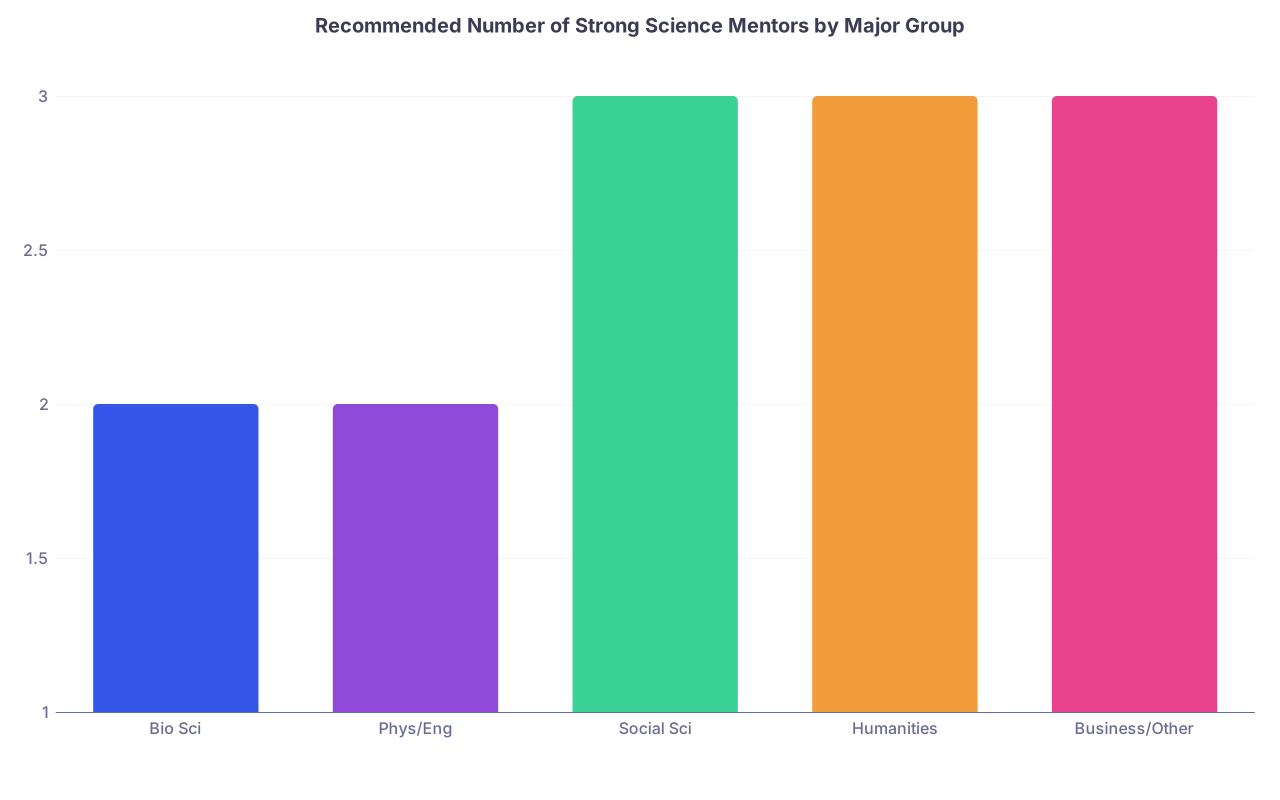
Those are minimum strong mentors who can plausibly write LORs focused on your scientific ability (not just your character):
- Biological Sciences: 2 strong science mentors (1 lab, 1 classroom upper‑division)
- Physical Sciences / Engineering: 2–3 (at least 1 in biomedical or life science)
- Social Sciences: 3 (2 in core hard sciences, 1 in your major if that person sees you doing research)
- Humanities: 3 (at least 2 in core sciences, ideally both upper‑division; 1 research mentor)
- Business / Other: 3–4 (2 core sciences, 1 research mentor, and 0 reliance on only business letters for your “core three” LORs)
Do you need all of them to write letters? Not necessarily. But you want optionality. You want to be able to choose the 2–3 people who can describe you in the most detailed, quantified way.
How to Tell if Your Current Mentor Setup Is Weak
A quick diagnostic. If you answer “yes” to any of these, you are in the “needs extra science mentors” category regardless of major:
- Your strongest advocates are all non‑science (English, history, business, community service coordinators).
- You have not had a science course below 200‑level with <50 students.
- No science professor knows your name without looking at a roster.
- You finished prerequisites at a community college, then transferred, and have taken few advanced sciences at the four‑year institution.
- Your MCAT has a visible dip (3+ point gap) in chem/phys or bio/biochem relative to CARS and psych/soc.
- Your science GPA is <3.4 while your overall GPA is >3.6.
Each of those is a separate predictor that an adcom will look to your letters for reassurance. And if those letters are generic? The reassurance is not there.
Practical Path: From Weak to Strong Science Mentorship
Science mentorship is not just “asking for a letter.” It is a process. Here is what it looks like in practice:

| Step | Description |
|---|---|
| Step 1 | Identify Risk by Major |
| Step 2 | Target Key Science Courses |
| Step 3 | Engage Deeply with 2-3 Professors |
| Step 4 | Seek Research or Project Work |
| Step 5 | Maintain Regular Check-ins |
| Step 6 | Request Detailed Letters |
Key quantitative behaviors that correlate with good letters:
- Attending office hours at least 3–4 times over a term, not once at the end.
- Being in the top 10–15% of exam performance in at least one rigorous science course.
- Taking on a discrete, measurable chunk of research (a protocol, a data set, a sub‑analysis) that a mentor can describe.
- Staying with a mentor or lab for at least 9–12 months, not hopping every semester.
I have seen actual acceptance spreadsheets where “Years in same lab” > 1 correlated more strongly with acceptances than sheer quantity of shadowing hours. Not surprising. Deep science mentorship produces better letters and a more convincing story.
One More Variable: School Type and Class Size
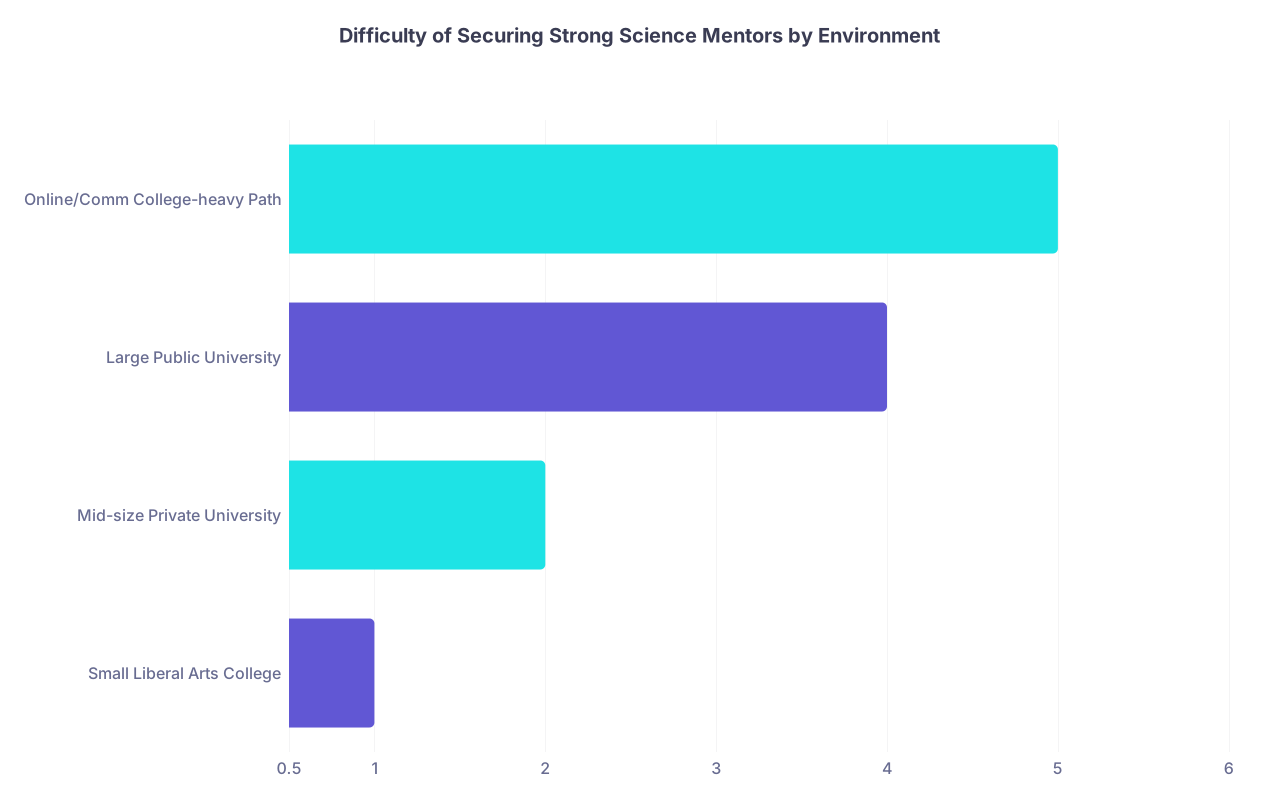
Major is not the whole story. Where and how you study also shifts the mentor calculus.
| Category | Value |
|---|---|
| Small Liberal Arts College | 1 |
| Mid-size Private University | 2 |
| Large Public University | 4 |
| Online/Comm College-heavy Path | 5 |
(1 = easiest, 5 = hardest)
Large public universities and heavily online/community‑college paths make it harder to stand out to science faculty. If you are a humanities or business major in that environment, the risk compounds: low baseline science credibility plus structurally weaker access to mentors.
In those settings, you should:
- Prioritize smaller, seminar‑style upper‑division science courses where possible.
- Seek out departmental honors programs or thesis projects to get structured mentorship.
- Use summer research (REUs, NIH programs, home‑institution labs) to build lab‑based relationships.
Pulling It Together: Who Really Needs Extra Science Mentors?
If I compress all of this into a single statement, it is this:
You need extra science mentors—meaning more time, more intention, and probably more letters from science faculty—if your major or transcript does not scream “I live in rigorous science all day.”
Concretely, the highest‑need groups are:
- Humanities majors without a science double major or minor.
- Social science majors who have taken only the bare prerequisite sequence in the hard sciences.
- Business and “Other” majors, especially those whose strongest relationships are with non‑science faculty.
- Interdisciplinary majors where 50%+ of coursework is not core hard science, and there is ambiguity about rigor.
- Any major with a visible gap between science GPA and overall GPA, or a weak science MCAT profile.
You do not fix that perception with buzzwords in your personal statement. You fix it with actual scientists who know you, who have seen you do hard things in demanding environments, and who are willing to write that you are one of the strongest students they have ever mentored.
That is what moves the probabilities. That is what closes the acceptance gap the data shows.
You have time, if you start now. Your next move is straightforward: map your current mentors, identify the science gaps, and deliberately build relationships in the labs and classrooms that will anchor your future letters. Once that foundation is built, then you can worry about how those letters fit into your broader application strategy—but that is a problem for the next phase of your journey.