The average successful applicant is not guessing their mentor mix. They are following a pattern, whether they realize it or not. And the pattern is surprisingly consistent: about a 2:1 ratio of clinical to science mentors by letters, but often a 1:2 ratio by time spent.
Let me unpack that with numbers, not vibes.
The Baseline Pattern: What Strong Files Actually Look Like
When you read enough committee PDFs and ERAS download packets, trends stop being anecdotal. They start looking like a dataset.
Across competitive U.S. MD applicants (think 3.7+ GPA, 514+ MCAT, multiple interviews), files that get consistent “strong support” ratings tend to cluster around:
- Total letters submitted: 3–5
- Distinct mentors represented: 3–4
- Clinical vs. science letter balance: often 2 clinical–1 science, or 2 clinical–2 science
Notice the emphasis: letters, not just “people you know.” Programs only see what hits their portal.
Here is a simplified snapshot of what I see over and over when committees discuss “top third” applicants:
| Profile Type | Total Letters | Clinical Letters | Science Letters | Other (PI, Non-science, etc.) |
|---|---|---|---|---|
| Very strong MD applicant | 4 | 2 | 1–2 | 0–1 |
| Strong DO applicant | 4 | 2 (incl. DO) | 1 | 1 |
| Research-heavy MD/PhD | 4–5 | 1–2 | 1–2 | 1–2 (PI / research mentor) |
| Borderline but admitted | 3–4 | 1–2 | 1 | 0–1 |
Strip out all the noise and patterns in successful applicant files boil down to three things:
- Consistent performance documented by at least one science faculty who has seen rigorous coursework.
- Documented reliability and patient-facing maturity from at least one clinical mentor.
- No “wasted” letter slots from people who barely know the applicant.
The exact numbers of mentors are less important than these three signals. But there is still an optimal range.
How Many Mentors Do You Actually Need?
The data from actual files is clear on one point: more mentors is not linearly better. There is a sharp drop-off in marginal value after the 4th distinct mentor.
Here is how I would summarize the relationship between number of mentors and committee value, based on what gets discussed in meetings:
- 1–2 total mentors: Under-documented. File feels thin, unless there is a strong committee letter integrating many perspectives.
- 3–4 mentors: Sweet spot. Enough triangulation to confirm patterns of behavior and performance.
- 5+ mentors: Diminishing returns; committees skim, and weaker letters get ignored or quietly discounted.
For premed and early med students, the practical target range is:
- 2–3 science mentors you can realistically get strong letters from
- 2–3 clinical mentors who have seen you in longitudinal, real patient care or meaningful shadowing roles
Notice I did not say “2–3 letters each.” Mentors are not one-time-use. One mentor may write multiple letters for different stages (premed committee letter input, individual med school letter, later residency letter, even future fellowships).
The core question you should be optimizing is not:
“How many clinical vs science mentors do I need?”
But rather:
“How many people in each domain can write specific, behavior-based, detailed letters if asked tomorrow?”
From reading hundreds of letters, this is what “enough” looks like:
- Science: at least 1 who can speak to your performance in a demanding upper-division course or lab, ideally 2
- Clinical: at least 1 who has seen sustained interaction with patients or teams, ideally 2
That translates into roughly 3–5 true mentors over the premed + early medical school phase, usually skewed slightly toward clinical in the later stages.
Letter Requirements vs. Optimal Mentor Mix
You cannot game the system without respecting its rules. Formal letter requirements set the minimums; your mentor strategy fills in the optimal structure on top.
Most U.S. MD programs fall into one of these requirement patterns:
| Requirement Pattern | Typical Minimum Science | Typical Clinical Requirement | Total Letters Accepted |
|---|---|---|---|
| Committee letter only | Embedded 2+ | Embedded 1+ | 1 (committee) |
| 2 science + 1 other | 2 | 0–1 | 3–5 |
| 1 science + 1 academic + 1 other | 1 | 0–1 | 3–5 |
| DO-focused (many DO schools) | 1–2 | 1 [DO physician](https://residencyadvisor.com/resources/letters-of-recommendation/correlation-between-mentor-type-and-md-vs-do-acceptance-a-datadriven-look) strongly preferred | 3–5 |
Read that table carefully. The data tells you a few things:
- For MD schools, you need at least 1–2 serious science mentors, because the requirement forces it.
- For DO schools, a DO clinical mentor is often determinative; many successful DO applicants have at least 2 physician letters.
- Even where only one science letter is “required,” applicants with two strong science letters often stand out in committee discussions for academic reliability.
So what does an optimal mentor matrix look like for a typical competitive MD applicant?
One pattern I see a lot in applicants who get multiple MD acceptances:
- Science mentor A: Upper-level biology or biochemistry professor (letter)
- Science mentor B: Lab PI or research advisor (letter or at least future option)
- Clinical mentor A: Attending or senior physician from longitudinal shadowing or scribing (letter)
- Clinical mentor B: Volunteer clinical supervisor, clinic director, or another physician (backup/future letter)
That is 4 mentors. Usually only 3–4 letters are sent, but the bench is deeper than the visible output.
For DO-focused applicants, the successful configuration often shifts slightly:
- Science mentor A: Core science professor (letter)
- Clinical mentor A: DO physician with substantial exposure (letter – non-negotiable)
- Clinical mentor B: MD or DO from another clinical setting (letter or backup)
- Optional mentor: Non-science professor or PI who knows you well (letter if strong)
Time vs. Letters: The Inverse Ratio
Here is where people get this wrong. They match their time investment to letter count, rather than to marginal letter quality.
The pattern in high-quality files looks roughly like this:
- For each science letter: ~1–2 semesters of meaningful interaction
- For each clinical letter: ~6–18 months of cumulative exposure (scribing, volunteering, longitudinal shadowing, or med school clerkship)
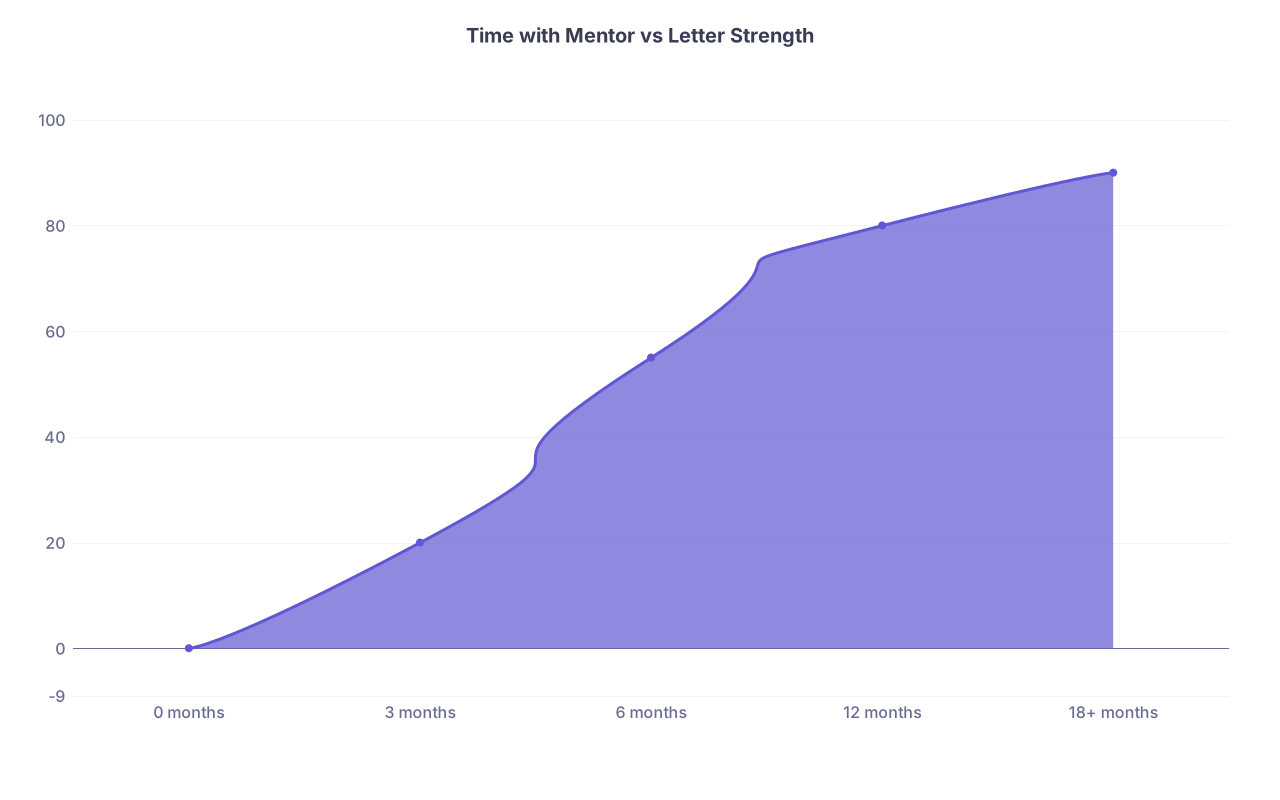
If you plotted “time invested with mentor” vs “likelihood of a genuinely strong letter,” the curve is not linear. It looks closer to an S-curve: weak, weak, weak, then suddenly strong once you cross a threshold of shared work.
Let me illustrate it with a simple conceptual chart:
| Category | Value |
|---|---|
| 0 months | 0 |
| 3 months | 20 |
| 6 months | 55 |
| 12 months | 80 |
| 18+ months | 90 |
You feel like you “have a mentor” at 2–3 months. The data from letters says otherwise. At 3 months, letters are usually vague (“shows promise,” “engaged in class”). At 12 months, they finally start talking in concrete, behavior-based detail.
For science mentors, the threshold is driven by:
- How you performed under real evaluation pressure (exams, assignments, projects).
- Whether you engaged beyond being a face in the lecture hall (office hours, discussion, extra work).
For clinical mentors, it is driven by:
- How often they saw you with patients.
- Whether they saw you across enough days to see both good and bad shifts.
So practically, how many mentors should you be cultivating over time?
Premed years (UG + glide year if any):
- 2–3 science faculty you see for more than one course or in lab +
- 2–3 clinical supervisors where you spend at least 6–12 months cumulatively
Early med school (MS1–2):
- 1–2 basic science / pre-clinical faculty (could overlap with course directors)
- 1–2 research mentors if you touch a project
Clinical years (MS3–4, for future residency letters):
- 3–5 attendings who supervise you for full rotations or longer (not for this phase, but the same structure repeats)
You are not writing a social network. You are building a portfolio of people who can each write a letter that would survive being read aloud in a skeptical admissions committee.
What Committees Actually Read For (and How Mentor Type Plays In)
Let me be blunt: committees do not care that you have a clinical mentor and a science mentor. They care what those people say and how that information fits into a pattern across letters.
When I look at letters, I mentally tag them into three types:
- Academic performance validator (usually science)
- Professionalism and reliability validator (often clinical or research)
- Character/context validator (can be non-science, PI, long-term supervisor)
Here is how clinical vs science mentors usually map:
Science mentors primarily cover:
- Intellectual horsepower
- Work ethic under cognitive load
- Consistency across a semester or project
Clinical mentors primarily cover:
- Patient interaction
- Team dynamics and communication
- Professionalism, maturity, response to stress
The strongest files show consistent signals across both domains. For example:
- Science letter: “Top 5% in a 300-student upper-division biochem course; stayed after class to work through complex problems; helped weaker students.”
- Clinical letter: “Stayed late after a 12-hour shift to sit with a distressed family; never complained, consistently prepared, nurses requested having them back on shift.”
The ratio that seems to work best is:
- At least one letter from each domain (clinical and science).
- One extra from whichever domain best offsets your weak point.
Examples:
- GPA 3.55, MCAT 517, heavy clinical exposure: I would rather see 2 science + 1 clinical letters to reassure the committee about academic durability.
- GPA 3.9, MCAT 514, minimal patient exposure: I would rather see 2 clinical + 1 science letters to prove you are not just a library creature.
- Research-heavy applicant (MD/PhD interest): 1 strong science + 1 PI research letter + 1 clinical to show you understand patients exist.
This is why “How many clinical vs science mentors?” is the wrong standalone question. The right question is:
“What does my application look like on paper, and which domain needs more independent validators?”
Sample Mentor Configurations by Applicant Type
Numbers are easier to see in scenarios. Here are three common archetypes and the mentor patterns I repeatedly see in successful files.
1. The High-GPA, Limited-Clinical Applicant
Profile: 3.9 GPA, 520 MCAT, heavy research, sporadic hospital volunteering, maybe 50–100 hours of true patient-facing work.
Optimal mentor mix:
- Science mentor 1: Upper-level course professor (letter)
- Science mentor 2: PI or research mentor (letter)
- Clinical mentor 1: Physician or clinic supervisor (letter – must be someone who has actually seen you with patients)
- Clinical mentor 2: Optional backup, more for your own development than letters
Letter ratio in final submissions: usually 2 science / research, 1 clinical. Committees already believe you can pass exams; they want at least one credible voice saying you are not awkward or absent in clinical spaces.
2. The Nontraditional, Clinically Heavy Applicant
Profile: 3.5 GPA from years ago, mid–510s MCAT, full-time scribe or EMT for 1–3 years, minimal recent classroom exposure.
Optimal mentor mix:
- Clinical mentor 1: Supervising physician from scribing/EMT (letter)
- Clinical mentor 2: Another physician or clinical supervisor who saw you long-term (letter)
- Science mentor 1: Recent post-bacc or upper-level science course professor (letter – crucial to prove academic readiness)
- Optional: PI or non-science professor for depth
Letter ratio in final submissions: 2 clinical, 1 science, sometimes 1 additional “character” letter. Here, the science mentor count is lower, but the quality of that one academic letter is make-or-break. You do not paper over an old GPA without current academic validation.
3. The Balanced, Traditional Premed
Profile: 3.7–3.8 GPA, 512–516 MCAT, 1–2 years of research, 150–300 hours of clinical volunteering or shadowing.
Optimal mentor mix:
- Science mentor 1: Core science professor (letter)
- Science mentor 2: Either another professor or research PI (letter or backup)
- Clinical mentor 1: Physician or clinical supervisor from long-term volunteering (letter)
- Clinical mentor 2: Optional, but useful if first clinical mentor’s letter is more generic
Letter ratio in final submissions: 1–2 science, 1–2 clinical, 0–1 research/other. Most successful in this category end up with 4 letters submitted.
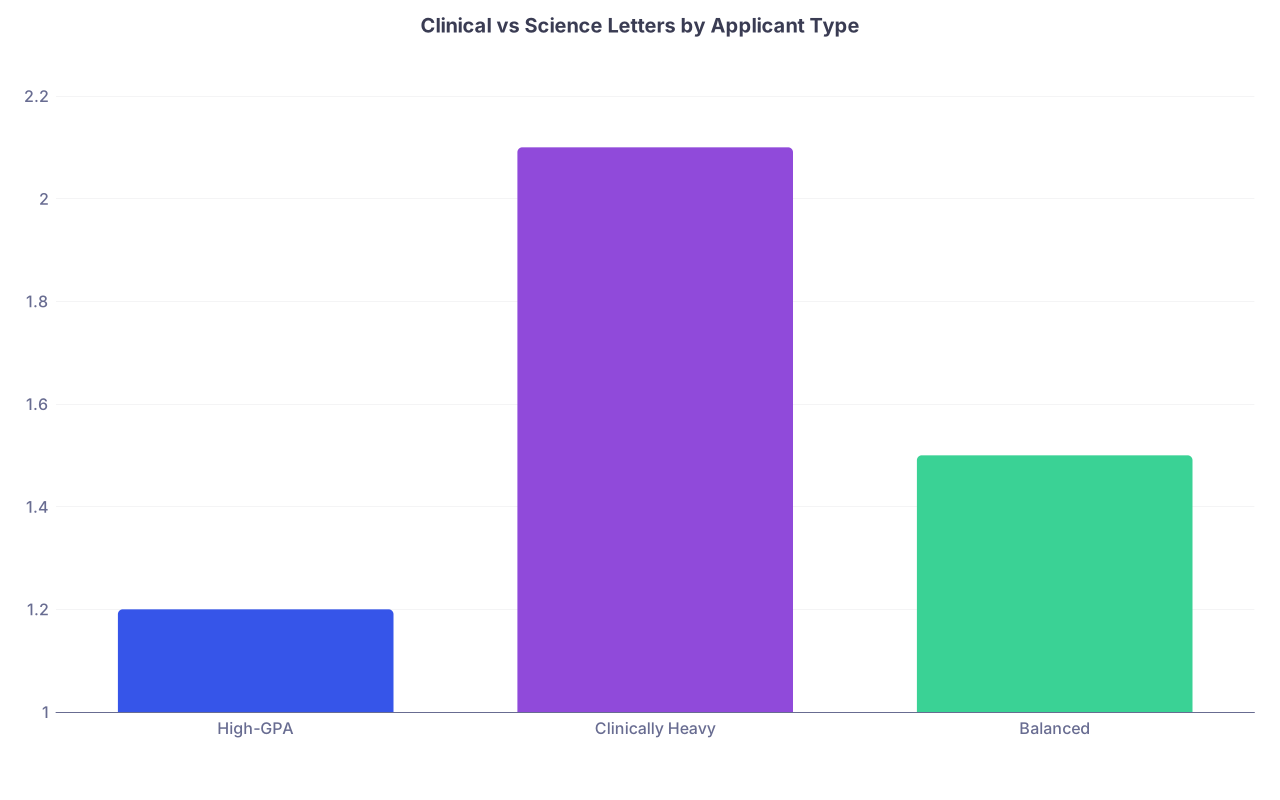
Here is a simple visual summary of how these configurations lean across domains:
| Category | Value |
|---|---|
| High-GPA | 1.2 |
| Clinically Heavy | 2.1 |
| Balanced | 1.5 |
(Values represent the average number of clinical letters in successful files; science letters are usually 1–2 across all groups.)
Red Flags: When Your Mentor Mix Is Wrong
Patterns in rejected but interview-worthy files are just as informative.
These are configurations that repeatedly correlate with committee hesitation:
- All letters from one domain only. For example, 3 science letters and 0 clinical for a traditional applicant with hospital volunteering allegedly on the CV. Committees notice that nobody from the clinical side stepped up.
- Too many weak, generic letters. One strong science + one strong clinical + one bland “nice person” letter beats 5 tepid letters every single time.
- Overweight on “prestige” mentors who barely know you. A department chair who spends 90% of a letter describing the department and your project topic, and 10% on your actual behavior, hurts more than it helps.
If you want a simple heuristic: each mentor should be able to tell at least three specific stories about you without looking at your CV. If not, they are not a real mentor yet. They are a contact.
So, How Many Clinical vs Science Mentors?
If I had to put hard numbers on the patterns from successful applicant files, they would look like this for the premed + early medical school preparation phase:
Science mentors:
- Target: 2–3 meaningful mentors
- Letters used: Usually 1–2
Clinical mentors:
- Target: 2–3 meaningful mentors
- Letters used: Usually 1–2
Total distinct mentors: 3–5 over several years.
Total letters used at any single application step: 3–4.
You are trying to engineer a small, high-signal dataset about yourself. Not a sprawling, noisy one.
Three points to leave with
- Aim for roughly 2–3 science and 2–3 clinical mentors you know well, even if that results in only 1–2 letters from each side.
- Match your letter mix to your weaknesses: more science validation if academics are shaky; more clinical validation if exposure is light.
- Depth beats breadth. One year with a mentor who can write a detailed, concrete letter is more valuable than five mentors who barely remember your name.