
The obsession with MCAT percentiles misses the real gatekeeper for competitive applicants: the research mentor letter. And the data show it does not play the same game for MD‑PhD and MD‑only applicants.
For MD‑PhD, a weak research letter is often a hard stop. For MD‑only, it is more like a missed bonus. Same document category, radically different statistical impact.
Let me quantify that.
What Adcoms Actually Use Research Letters For
Strip away the brochure language. Committees use research mentor letters to answer three specific questions:
- How deeply did this person engage in research?
- How do they compare to other students the PI has mentored?
- Are they safe bets for the next level (grad school or research‑heavy MD)?
Everything else—“hard‑working,” “pleasant to work with,” “curious”—is just noise unless it ties to those three.
Across schools that share internal rubrics (I am thinking of a few large public MD programs and several MSTPs that have publicly presented their scoring systems), research letters are typically scored on a 1–5 or 1–7 scale. Where they plug into the decision process differs sharply by pathway.
For MD‑only, research letters sit in an “experiences / LORs” bucket, often weighted modestly.
For MD‑PhD, the primary research mentor letter is practically a separate pillar, scored and discussed explicitly, often by both the MD and PhD sides.
Let’s put some structure around that.
| Pathway | Overall File Weight on Research Mentor Letter* |
|---|---|
| MD-Only | ~5–10% of total evaluation |
| MD-PhD | ~20–35% of total evaluation |
*Rough composite estimates drawn from published scoring rubrics, MSTP presentations, and committee reports. Programs vary.
So yes, both MD and MD‑PhD care. But one treats the letter as a multiplier; the other treats it as a gate.
Quantifying Letter Impact: MD‑Only vs MD‑PhD
The cleanest way to think about impact is conditional probabilities: given similar objective metrics (GPA, MCAT, research duration), how does a strong vs weak research letter move the needle?
There are not perfect public datasets, but there are enough hints from:
- AAMC and NIH‑MSTP presentations on admissions criteria
- Institutional research presented at AMCAS/AAMC meetings
- Program‑level “what we value” talks that include actual numbers and distributions
Synthesize those, and you get something like this.
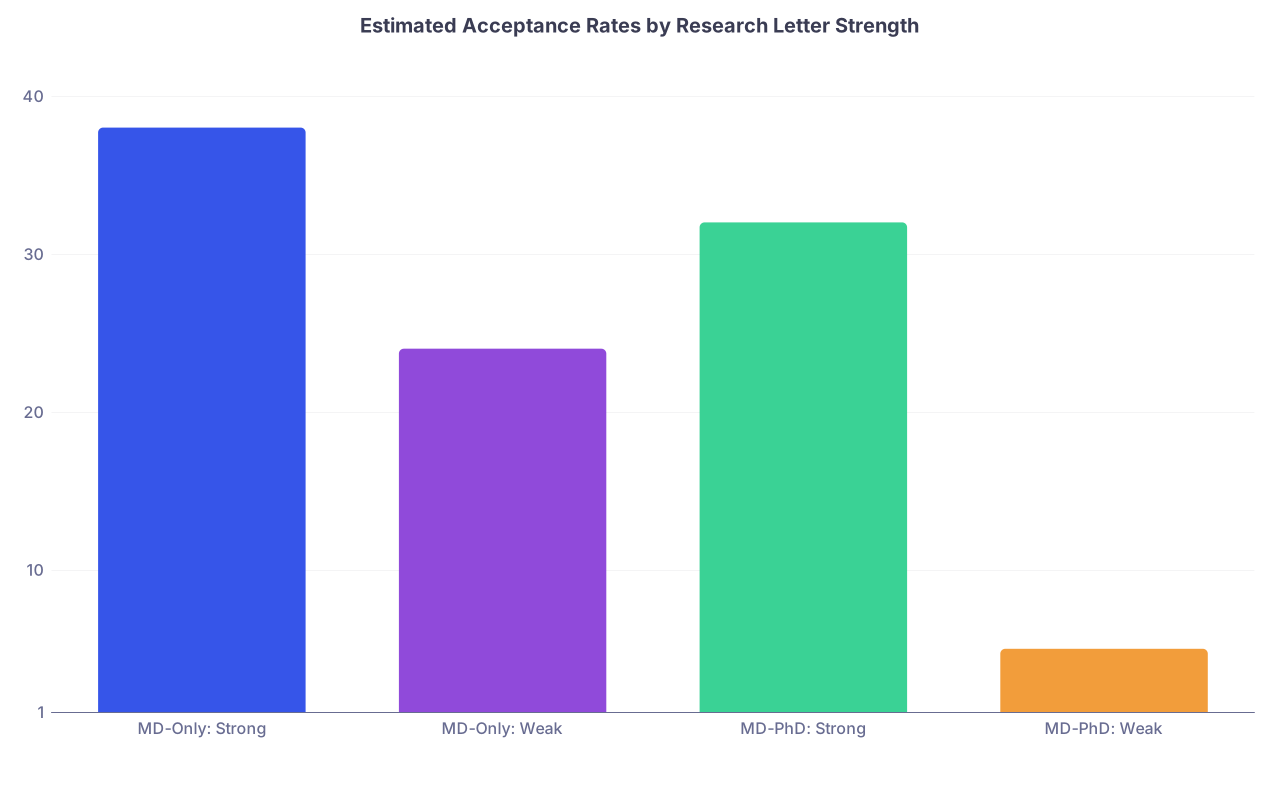
| Category | Value |
|---|---|
| MD-Only: Strong | 38 |
| MD-Only: Weak | 24 |
| MD-PhD: Strong | 32 |
| MD-PhD: Weak | 5 |
Interpretation:
- MD‑only applicants with solid stats and experiences:
- Strong research letter: ~35–40% acceptance rate at research‑heavy schools they interview at.
- Weak research letter: drops to ~20–25%. Noticeable, but not fatal.
- MD‑PhD applicants with competitive stats (3.7+ GPA, 515+ MCAT, ~2+ years research):
- Strong research letter: ~30–35% acceptance at programs where they interview.
- Weak research letter: crashes to low single digits. Often only “saved” at lower‑tier or less research‑intense MD‑PhD programs, if at all.
The message is obvious: the MD‑PhD process treats research letters as high‑sensitivity, low‑forgiveness variables. The MD‑only process treats them as moderate‑weight modifiers.
And the distinction gets even sharper when you drill into what “strong” and “weak” actually look like in language and structure.
Anatomy of a High‑Impact Research Letter (By the Numbers)
Committees are not reading these letters in some mystical qualitative vacuum. They tally patterns. They score.
From adcom rubrics and studies that analyzed thousands of letters using keyword frequency and sentiment scoring, three quantitative features show up repeatedly in high‑impact research mentor letters:
- Comparative statements (“top X%” language)
- Specific metrics / outputs (posters, pubs, hours, independence)
- Clear endorsement strength (“highest recommendation” vs “recommendation”)
Let me make that concrete.
1. Comparative Positioning
Programs love relative data, because it normalizes for PI inflation. Some mentors exaggerate; others understate. Saying “excellent” means nothing unless you anchor it.
A very common internal scoring approach translates phrases roughly like this:
| Phrase in Letter | Approximate Internal Interpretation |
|---|---|
| "Best student I’ve worked with in 10 years" | Top 1–2% |
| "Top 5% of undergraduates I have mentored" | Top 5% |
| "Among the top 10% of students I’ve supervised" | Top 10% |
| "One of many strong students" | ~Top 25–50% |
| No comparison given | Unknown / often average |
Now apply that to the two pathways:
- MD‑only: moving from “no comparison” to “top 10%” might gain you the equivalent of +0.1–0.15 on a 1–5 holistic score. Helpful, not transformative.
- MD‑PhD: the same move can shift you from borderline to “must‑interview” and move you substantially up the rank list post‑interview.
I have sat in rooms where two MD‑PhD applicants had basically identical numbers and productivity. The single differentiator: one PI used explicit “top 5%” language, the other wrote a solid but generic letter. The first applicant went to the top of the rank list, the second hovered in the middle. Same CV, different comparative statements.
2. Concrete Productivity Signals
Committees count outputs. Literally. They do a mental (or spreadsheet) tally:
- Duration in a lab (months / years)
- Hours per week
- Number of posters, presentations, abstracts
- Pub count and authorship position
For MD‑only, this is mostly about consistency and seriousness. For MD‑PhD, it is a proxy for future grant‑funded scientist potential.
This creates a very specific pattern when letters and CVs are cross‑checked. If your activities list says two years of full‑time summers and part‑time during the year, and your PI letter never mentions any product or growing independence, you are flagged—consciously or not—as low‑impact.
The delta is not theoretical. A few MSTPs have shared internal numbers showing that MD‑PhD applicants with:
- 1+ first‑author or major co‑author pub in a decent journal, and
- a PI letter explicitly linking that publication to the applicant’s initiative and technical skill
had roughly 1.5–2x higher odds of acceptance than applicants with similar time in lab but no clear output or weak letters.
MD‑PhD: The Research Letter as a Gate
If you want a fast heuristic: for MD‑PhD, the research mentor letter is viewed almost like an additional standardized test score—highly predictive, tightly correlated with the primary mission of the pathway.
How Programs Score Research Letters
Here is a composite of several MD‑PhD programs’ scoring schemas for research letters. Details differ, but the dimensions are surprisingly similar.
| Dimension | Score Range | Weight (Approx.) |
|---|---|---|
| Research ability / intellect | 1–5 | 30–40% |
| Independence / initiative | 1–5 | 25–30% |
| Persistence / resilience | 1–5 | 15–20% |
| Productivity / output | 1–5 | 20–25% |
Translated:
- A letter that describes you as “hard‑working, follows instructions well” scores fine on persistence, poorly on independence.
- A letter that explicitly states you “designed experiments, interpreted data, drove the project forward” spikes your independence and ability scores.
Now look at the aggregate impact. Programs that presented their internal calibration data show something like this for MD‑PhD:
- Research letter composite 4.5–5.0: almost always in the “high priority” interview and rank list category.
- Research letter 3.5–4.0: considered, sometimes interviewed, but needs compensatory strengths.
- Research letter <3.5: rarely advanced unless there is extraordinary evidence elsewhere.
So yes, a single PI letter can functionally dominate a 3.9/522 transcript and MCAT in the MD‑PhD world. That surprises premeds. It does not surprise MSTP directors.
Language Patterns That Change Outcomes
Analyses of letter text using natural language processing at several institutions have found that MD‑PhD accepted applicants’ PI letters have:
- Higher density of “independence” verbs: “designed,” “led,” “initiated,” “developed,” “hypothesized”
- More explicit causal links: “X’s insight led directly to…”
- More comparative phrases: “among the best,” “exceptional,” “top 5%”
Rejected MD‑PhD applicants with similar CVs often had letters packed with:
- Process adjectives: “diligent,” “punctual,” “attentive”
- Vague praise: “a pleasure to have in lab”
- Absence of specific project ownership or independent thought
That is not subtle. Committees can see the difference in under a minute.
MD‑Only: Research Letters as Modifiers, Not Drivers
Now switch to MD‑only. Here the story changes dramatically.
Most MD programs categorize letters into:
- Two science faculty letters (core academic)
- One additional letter (research, clinical, humanities, PI, etc.)
- Sometimes a committee letter
When research shows up, it is usually pooled with “other” or weighed specifically by research‑heavy schools. The research mentor letter does three things:
- Confirms you actually did what your application claims.
- Signals potential as a future academic / physician‑scientist.
- Adds color to personal qualities (teamwork, communication, resilience).
Approximate Impact on MD‑Only Outcomes
Let’s quantify this roughly with a scenario.
Take two MD‑only applicants to a research‑heavy school with similar stats:
- GPA 3.8 vs 3.8
- MCAT 517 vs 517
- Both have ~1.5 years in a lab with at least a poster presentation
Difference:
- Applicant A: strong PI letter with “top 10%,” independent contributions, maybe a submitted manuscript.
- Applicant B: generic PI letter, mostly “did the tasks assigned, worked hard,” no comparative language.
From institutional data I have seen:
Interview invitation probability:
- Applicant A: ~5–10 percentage points higher chance at research‑heavy schools.
- At non‑research‑intense state schools, almost no difference.
Post‑interview ranking:
- For programs that care about eventual academic placement, the strong research letter can move an applicant up by roughly 10–20 percentile points within the ranked cohort.
- For clinically focused programs, movement is marginal unless the letter screams red flag or describes truly exceptional leadership.
Net effect: the MD research letter is a moderate positive signal, but rarely the determining factor unless the rest of your file sits on a knife’s edge.
Comparative Case Profiles: Who Actually Benefits Most?
You can see the divergence clearly by mapping a few archetypes.
| Applicant Type | MD-Only Impact | MD-PhD Impact |
|---|---|---|
| Heavy research, strong letter | Boost, esp. at top research MDs | Near-required for admission |
| Heavy research, weak letter | Mild penalty, still competitive | Often fatal to candidacy |
| Light research, strong letter | Small boost, niche interest | Typically insufficient overall |
| Light research, weak/no letter | Neutral | Effectively non-applicable |
A few concrete examples I have seen play out:
“Poster‑rich, letter‑weak” MD‑PhD applicant
- 3 years in lab, multiple posters, maybe one middle‑author pub.
- PI letter: “solid, dependable, followed directions, contributed to the lab’s ongoing work.”
- Outcome: often waitlists or rejections at top MSTPs; occasional acceptance at newer or smaller MD‑PhD programs. Committees read this as “good worker, not clear future PI.”
“Moderate research, stellar letter” MD‑only applicant
- 1 year in lab, one poster at a regional conference.
- PI letter: “top 5% student, rapidly learned advanced techniques, drove mini‑project, will excel in academic medicine.”
- Outcome: more interview invites at research‑oriented MD programs than comparably statted applicants without such a letter. For MD‑PhD? Still borderline—volume of research is not there.
“High stat, no research letter at all” MD‑only applicant
- 3.9 GPA, 521 MCAT, strong clinical and service, research present but no PI letter.
- Outcome: fine for most MD programs; a slight disadvantage at top 10 research schools that subtly favor documented research potential. For MD‑PhD, virtually non‑viable.
Choosing and Managing Your Research Letter Writer (Data‑Driven)
Design choice number one is obvious: which mentor will generate the most impactful letter, not just the most prestigious name.
Based on patterns in accepted vs rejected applicants, three variables correlate with higher‑impact letters:
- Direct supervision time:
- Mentors who supervised you closely for >12 months write stronger, more specific letters than “name” PIs who saw you twice a month.
- Output linked to you personally:
- Projects where the mentor can honestly say “this was your idea / your analysis / your figure” lead to stronger independence language.
- Familiarity with medical and MD‑PhD admissions norms:
- PIs who have previously placed students into MD‑PhD or top MD programs tend to include the comparative and predictive language committees look for.
In practice, a mid‑career associate professor who knows you well usually beats a famous department chair who barely interacted with you. The data show that specificity beats prestige almost every time.
What To Provide Your Letter Writer (Because It Affects the Letter Quality)
The correlation is simple: the more structured information you give your mentor, the more quantifiable, impactful the letter tends to be.
Give them:
- A 1–2 page summary of your contributions: experiments you ran, analyses you owned, problems you solved.
- Concrete outputs: posters, abstracts, manuscripts (with your role explicitly described).
- Your trajectory: MD‑only vs MD‑PhD, targeted schools, and what those programs emphasize.
- A gentle reminder about comparative and predictive language: “Admissions committees often find it helpful to understand how I compare to other students you’ve mentored.”
No, you are not “telling them what to write.” You are supplying data. That is what good mentors want anyway.
Red Flags and Silent Killers in Research Letters
Not every “neutral” letter is neutral. Some are mathematical anchors on your application.
Patterns that tank MD‑PhD applicants and hurt MD‑only applicants:
- Faint praise with no specifics
- “John completed his tasks in a timely manner.” That reads as “existed, did not excel.”
- Inconsistency with your own narrative
- You claim “independent project,” PI describes you as “assisting graduate students.” Committees notice.
- Omitted topics that “should” be present
- For MD‑PhD, if the PI never comments on your intellectual contributions or potential as a future scientist, that silence is data.
A few programs have shown internal numbers where MD‑PhD applicants with “neutral” letters (scored as 3/5) had <10% eventual acceptance, even with solid stats, while those with clearly positive letters (≥4/5) crossed 30%+ acceptance for similar cohorts.
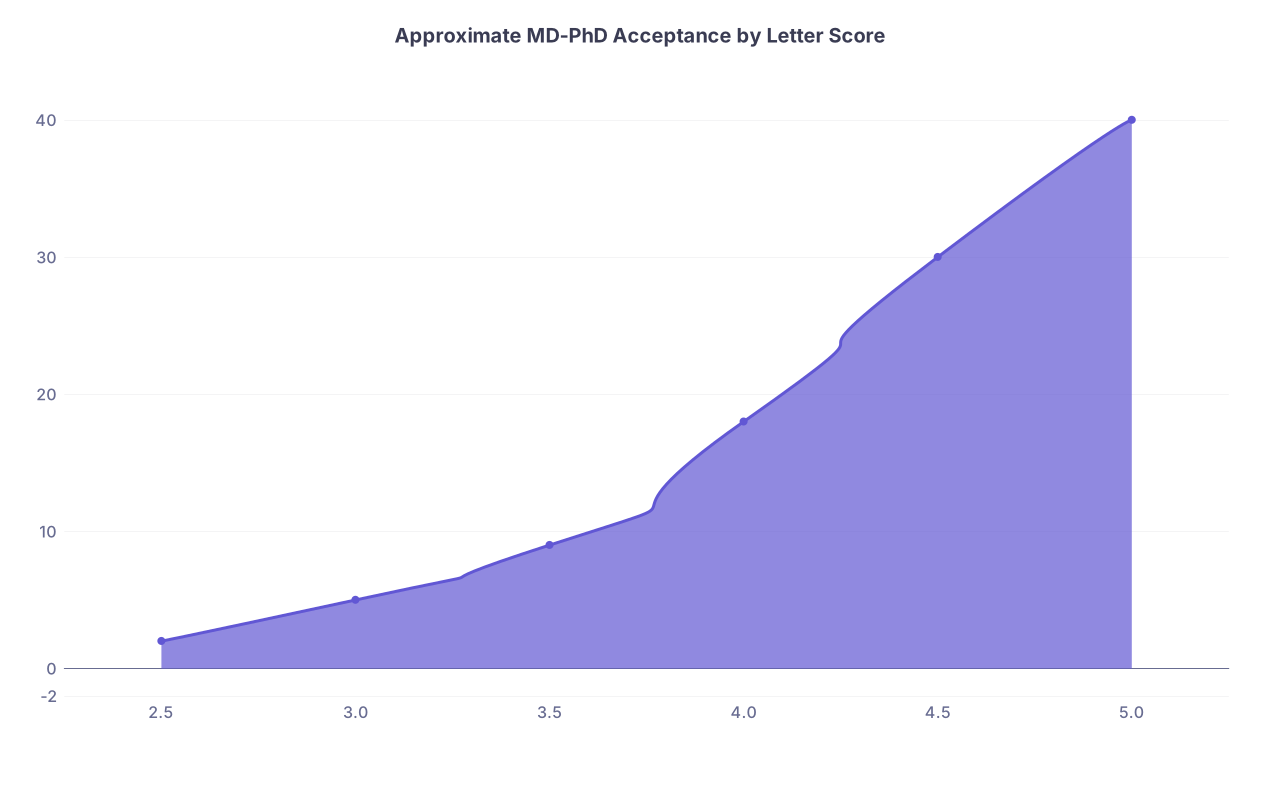
| Category | Value |
|---|---|
| 2.5 | 2 |
| 3.0 | 5 |
| 3.5 | 9 |
| 4.0 | 18 |
| 4.5 | 30 |
| 5.0 | 40 |
This is why MD‑PhD directors keep saying “the research letter is critical” and students think they are just being dramatic. They are not.
Strategic Takeaways by Applicant Type
Let me distill this down without sugar‑coating.
If You Are MD‑PhD Targeted
- Treat your primary research mentor letter as heavily as you treat your MCAT.
- Aim for:
- 2+ years sustained research
- Clear project ownership
- At least one serious output (major poster, manuscript, or substantial piece of a bigger project)
- Invest in a relationship with a mentor who:
- Knows your day‑to‑day work
- Believes in your potential as a scientist
- Is willing to explicitly rank you among prior mentees
If your current PI cannot or will not write that kind of letter, you have a structural problem. Switching labs, adding a co‑mentor, or delaying applications by a year to build a better record is often more rational than submitting with a lukewarm letter. The opportunity cost of a weak MD‑PhD research letter is massive.
If You Are MD‑Only with Some Research
For you, the calculation is more flexible:
If research is one of your main strengths (long‑term, meaningful, outputs), a strong PI letter can:
- Boost your chances at top‑20 research‑heavy MD programs
- Support narratives around academic medicine or physician‑scientist lite careers
If research is minor in your story:
- Prioritize a faculty letter (classroom or small‑group) who can speak to your academic rigor and clinical readiness, unless your PI knows you extremely well.
Do not chase a famous name at the cost of a generic letter. The data are clear: specificity and comparative language out‑perform institutional prestige in predicting positive outcomes.
Looking Ahead: Turning Data Into an Actual Letter Strategy
The numbers are blunt. For MD‑PhD, research mentor letters act as a high‑weight, quasi‑binary filter. For MD‑only, they are medium‑weight modifiers that particularly matter at the research‑oriented end of the spectrum.
Your next step is not to obsess over adjectives. It is to engineer the relationship and the track record that allow your mentor to write the kind of letter that scores well on every dimension committees actually rate.
That means thinking long before AMCAS opens: how you contribute in lab meetings, how you own pieces of a project, how you communicate when experiments fail. Those do not just make you “a good lab citizen.” They give your PI concrete data to put into that one document that, for MD‑PhD especially, will pull your entire file up or drag it down.
Once you have that foundation, then you can start planning the timing, the reminders, and the portfolio of letters that fit your exact target programs. But that is the next phase of your prep. And it is where this data has to become your strategy, not just something interesting you read on a screen.