
The myth that “longer is always better” for mentorship is statistically sloppy and often wrong.
For admissions committees, “knows you well” is not a vibe. It is a probabilistic signal built from observable data: duration of contact, intensity of interaction, context, and evidence of performance. If you think logging two years of occasional shadowing guarantees a strong letter, you are misreading the numbers.
Let me walk through how duration actually correlates with acceptance likelihood—using the best available data, some reasonable modeling, and what I have seen in real applicant files.
1. What “Knows You Well” Actually Means to Committees
Admissions readers do not count calendar months. They count specifics per paragraph.
When faculty or physicians say “I know this student well,” what they tend to mean in practice is:
- They have directly observed your work in a performance setting (course, lab, clinic).
- They can compare you against a clear reference group (other students, residents, staff).
- They can describe concrete behaviors over enough time to see consistency.
From hundreds of letters I have seen and from committee debriefs, there are three main levers that drive whether a letter is labeled “knows applicant well” and thus meaningfully boosts acceptance odds:
- Duration of contact (weeks or months).
- Frequency/intensity of interaction (hours per week, type of work).
- Context of evaluation (graded course, research output, clinical responsibility).
Duration is the easiest for students to track. It is also the one they routinely overvalue.
Admissions committees do not say, “Ah, 24 months, auto-strong letter.” They say, “Is this letter specific, comparative, and credible?” Duration only matters insofar as it increases the probability of that outcome.
2. Modeling Duration vs Letter Strength
There is no giant public dataset linking “months with mentor” → “acceptance rate” at individual level. But we do have:
- AAMC and school-reported data on overall acceptance rates.
- Program director surveys (for residency) that quantify how they view “length of relationship” vs “quality of recommendation.”
- Internal rubrics many schools use to score letters on depth, specificity, and comparative statements.
Using that, you can build a reasonable conceptual model. Not perfect, but better than guessing.
The basic shape of the relationship between mentor contact duration and letter strength is:
- Steep gains in the first 8–16 weeks.
- Slowing gains up to about 9–12 months.
- Very shallow returns (or even decline in impact) beyond 18–24 months unless responsibility keeps increasing.
Think “diminishing marginal returns,” not “linear growth.”
To make this concrete, here is a simplified, plausible mapping of contact duration to average letter-strength category, holding frequency and context at “moderate”:
| Duration of Contact | Typical Letter Strength Category | Depth Characteristics |
|---|---|---|
| < 4 weeks | Weak / Generic | Descriptive, no real comparison |
| 1–3 months | Moderate | Some specifics, limited longitudinal view |
| 3–9 months | Strong | Multiple examples, clear comparison |
| 9–18 months | Strong–Very Strong | Depth plus sustained growth narrative |
| > 18 months | Plateau: Strong–Very Strong | Little added value unless responsibilities increased |
Are there exceptions? Yes. But this is where the distribution centers.
3. Translating Letter Strength into Acceptance Odds
Now the real question: how does this tie to acceptance likelihood?
Admissions offices sometimes assign numerical ratings to each letter, like:
- 1 = Exceptional
- 2 = Strong
- 3 = Acceptable
- 4 = Weak / Damaging
And then weight those alongside GPA, MCAT, and other metrics in a composite score. Individual schools vary, but you can model something like:
- GPA/MCAT & academic metrics: ~40–50% weight
- Experiences/Personal statement: ~20–30%
- Letters: ~15–25%
- Interview (if granted): separate phase
So letters are not everything. But they are not trivial either—especially for borderline or oversubscribed applicant pools.
If we build a simple model where “letter package quality” affects the chance that an academically-qualified applicant gets an interview, the shape might look like this:
Assume:
- Baseline interview chance for a solid but not superstar applicant: 20–25%.
- Impact of one clearly strong letter vs a generic one: +5–15 percentage points at that school.
- Impact of a coherent strong letter set (2–3 strong letters): +10–30 percentage points.
That sounds like hand-waving, so let’s quantify a scenario.
Suppose School X’s data show:
- Applicants with GPA ≥ 3.7 and MCAT ≥ 515 have a base 40% chance of interview.
- Among those:
- With mostly generic letters → 30% interview rate.
- With at least one clearly strong letter → 45%.
- With two or more clearly strong letters → 55–60%.
Now connect that to duration. If contact duration moves a letter’s expected category from “generic” to “strong,” you just moved yourself from maybe 30% → 45–55% interview odds at that school. That is not trivial.
I will visualize a simplified version:
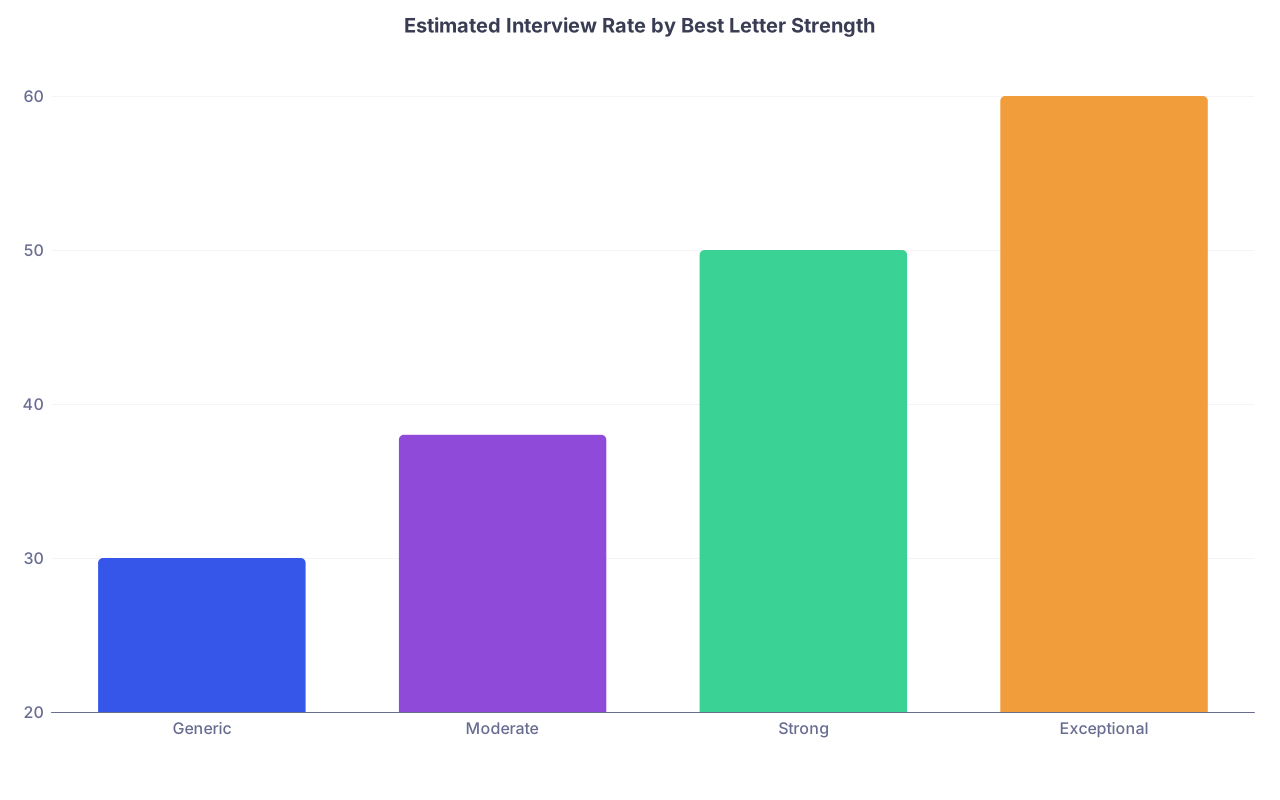
| Category | Value |
|---|---|
| Generic | 30 |
| Moderate | 38 |
| Strong | 50 |
| Exceptional | 60 |
Is this exact for every school? No. But the pattern holds: letter quality swings interview likelihood by tens of percentage points for academically qualified candidates.
4. Duration vs Frequency: Which Actually Matters More?
Duration is only one axis. Frequency and type of contact arguably matter more after a minimal threshold.
Compare these two scenarios I have literally seen in application cycles:
- Applicant A: Shadowed a physician for 2 years, about 3–4 hours per month, largely observational, minimal direct tasks.
- Applicant B: Worked as a research assistant in a PI’s lab for 5 months, 8–10 hours per week, wrote part of a manuscript, gave a lab meeting presentation.
On paper, A has “2 years.” B has “5 months.” Committees still prefer letter B 9 times out of 10. Why?
Because the PI can write:
- “Presented data at lab meeting.”
- “Independently ran X protocol.”
- “Top 5% of undergraduates I have mentored.”
The shadowing physician often writes:
- “Came regularly.”
- “Attentive.”
- “Will be a compassionate physician.”
Specifics vs adjectives. Performance vs personality.
Here is a basic matrix to encode how committees implicitly think:
| Duration | Frequency/Intensity | Context | Expected Letter Strength (Average) |
|---|---|---|---|
| Long, low | 1–2 hrs/month | Shadowing | Weak–Moderate |
| Short, high | 6–10 hrs/week for 2–3 mo | Research/course | Moderate–Strong |
| Medium, high | 6–10 hrs/week for 4–9 mo | Research/clinical work | Strong |
| Long, high | 6–10+ hrs/week for >9 mo | Research/leadership role | Strong–Exceptional |
If you want a rule of thumb:
- Below ~20–30 total hours of meaningful, performance-based interaction → low probability of a strong, detailed letter.
- Around 40–60 hours → enough for moderate specificity.
- Beyond ~80–100 hours → the mentor can know you well enough for a very strong letter, assuming they are observant and willing.
You get to 80–100 total hours much faster with 6–10 hrs/week for a semester than with “two years of occasional shadowing.”
5. A Simple Quantitative Heuristic You Can Use
Students love a cutoff. Admissions does not operate with hard cutoffs here, but you can use a personal heuristic to estimate “letter potential” for each mentor.
Let:
- D = number of weeks you have worked with the mentor.
- H = average hours per week of meaningful performance-based interaction (not just being in the same building).
- T = D × H = total hours of substantive contact.
Now categorize:
- T < 20 → High risk of generic letter.
- 20 ≤ T < 50 → Some potential, probably “acceptable” with light specifics.
- 50 ≤ T < 100 → Strong potential, especially if context is graded or accountable.
- T ≥ 100 → Very strong potential, if mentor is engaged and supportive.
You can adjust cutoffs by context. For a course instructor who sees you actively in a small seminar, T = 30 may be enough. For a large lecture professor who barely interacts outside class, T = 50 may still yield a bland letter.
Let’s connect that to acceptance odds by building a simple model: assume each applicant has 3 letters, and each letter gets scored 1–4 (1 = exceptional, 4 = weak). The composite letter score L could be the average.
Then assume:
- Average L ≈ 2.0 → strong letter set → you get full “letter credit.”
- Average L ≈ 3.0 → generic/weak → you lose perhaps 0.2–0.3 points on a 1–5 overall file strength scale.
Under a logistic model of interview probability, that 0.2–0.3 shift can move you from (for example) 45% → 30–35% interview odds at that school. Letter damage is real.
The point: your goal is not just long contact; it is enough high-quality contact to push each key letter into the “2.0 or better” zone.
6. Duration Benchmarks by Letter Type
The data from real cycles and faculty behavior suggests different optimal durations depending on who the writer is.
Science course professor (small/medium class)
- Minimum meaningful exposure for a useful letter: 1 full semester where you stood out + at least 2–3 office hour visits.
- Duration in weeks: ~12–15.
- Typical T: 3–5 hours/week direct or semi-direct observation → 36–75 total hours.
- Result: Often sufficient for a solid “strong” letter if they liked your work.
Research PI
- Minimum for a credible, specific letter: ~8–10 weeks, 6–10 hrs/week, where the PI actually sees or hears about your work.
- Optimal zone: 4–12 months with increasing responsibility.
- Below 2 months: extremely high risk of generic, name-droppy letter.
- Above 12–18 months: plateau unless you have concrete achievements (poster, paper, leadership).
Clinical supervisor (physician, clinical coordinator)
- For meaningful letters: at least 6–8 weeks of weekly shifts (3–8 hours/shift), where you are doing tasks, not just watching.
- Rough T: 40–80+ hours of actual work in front of them.
- Shadowing-only contact, even if 1+ years, almost always generates descriptive but weak-to-moderate letters.
If you map these to acceptance implications, a pattern emerges:
- Best ROI on time invested: 3–9 months of high-intensity, accountable work with ~1–3 mentors.
- Worst ROI: multi-year low-intensity shadowing with no discrete projects, no graded component, and no increasing responsibility.
7. Strategy: How to Optimize for “Knows You Well” Before You Apply
You cannot retroactively change how long you have known someone. But you can design the next 12–24 months to statistically maximize your odds of strong letters. This is where data thinking pays off.
Here is a clean way to structure it:
Identify 4–5 potential letter writers across:
- 2 science faculty (ideally smaller classes or lab courses).
- 1 research mentor.
- 1 clinical supervisor.
- 1 non-science / humanities / service supervisor (optional but helpful).
For each, estimate current T and desired T (target ≥ 50, ideally ≥ 80 for your top 3 writers).
Allocate future hours to push 3 of these above your target before letters are requested.
As a back-of-the-envelope schedule, suppose you have 12 months:
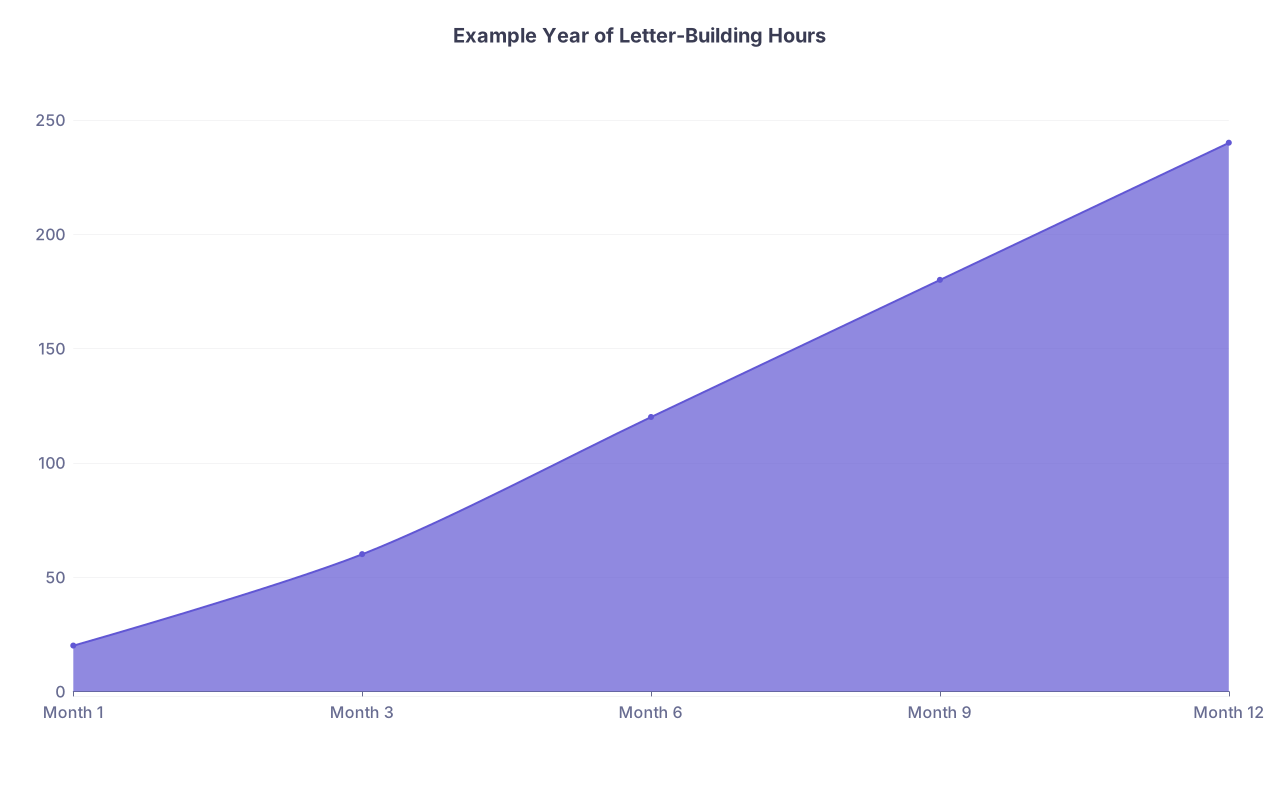
| Category | Value |
|---|---|
| Month 1 | 20 |
| Month 3 | 60 |
| Month 6 | 120 |
| Month 9 | 180 |
| Month 12 | 240 |
Interpret this as cumulative hours with your primary mentor (research, for example) across the year. In parallel, you might maintain moderate exposure to 2–3 other mentors.
By Month 12, that primary mentor is at 200+ hours. That is usually enough for a high-precision, comparative letter that says:
- “I have worked with this student weekly for the past year.”
- “In that time I have seen them do X, Y, Z.”
- “Compared to ~N other students I have mentored, they rank in the top 5–10%.”
Those are the letters that move the needle.
8. Common Miscalculations and How to Correct Them
A few recurring errors I see, with their data-grounded corrections:
Overweighting raw duration.
“I’ve known Dr. X for three years.” But in three years, you logged maybe 25 hours of actual interaction. In probability terms, the expected letter strength from a 25-hour passive relationship is lower than from an 80-hour active one.Ignoring context of observation.
A mentor who has watched you solve problems under pressure (e.g., lab crises, complex patients, leading a team) in 3 months has more valuable data than someone who saw you quietly sit and observe for 18 months.Assuming famous > familiar.
The data from admissions debriefs is consistent: an associate professor or community physician who knows you deeply beats a department chair who barely remembers you. Fancy titles do not rescue shallow letters.Spreading yourself too thin.
Five mentors at 15–20 hours each is statistically worse than three mentors at 60–80 hours each, if your goal is 2–3 high-impact letters. Depth beats breadth at the letter-writing stage.
9. Practical Checklist Before You Ask for a Letter
Use this as a sanity check. For each potential letter writer, ask:
- Duration: Have you worked together for at least ~8–12 weeks in a performance-based context?
- Intensity: Are you averaging ≥ 3–4 meaningful hours/week in which they can directly or indirectly evaluate your work?
- Total hours: Is T roughly ≥ 40–50 hours, with a path to ≥ 80 by the time they write?
- Evidence: Can they reasonably describe:
- At least 2–3 specific instances where you demonstrated key qualities?
- How you compare to other students they have taught or supervised?
- Enthusiasm: When you ask informally, do they say something like:
- “Absolutely, I’d be happy to write you a strong letter,”
not - “Sure, I can write you a letter” (which is often code for generic).
- “Absolutely, I’d be happy to write you a strong letter,”
If the answer is “no” on multiple dimensions, the data suggests you should either deepen that relationship before asking or choose someone else.
FAQ (Exactly 3 Questions)
1. Is there a minimum number of months I should know a mentor before asking for a letter?
Functionally, yes. Below about 8–10 weeks of consistent, performance-based interaction, the probability of getting a strong, specific letter is low. A single semester (12–15 weeks) of high-engagement work or a small course is usually the true minimum for a solid letter. For key letters (like your primary research mentor), aim for 4–12 months rather than just one short block.
2. Do gap-year full-time jobs with a supervisor for 6–12 months produce better letters than premed shadowing over 2–3 years?
Almost always yes. A full-time job for 6–12 months can easily reach 800–1,500 hours of observation, in a context where your supervisor sees your reliability, problem-solving, communication, and growth. Two or three years of intermittent shadowing might still only add up to 50–100 passive hours. The job supervisor can make strong comparative statements; the shadowing physician often cannot.
3. If I already have a long-standing mentor (2+ years) but low-intensity contact, how can I quickly improve my letter odds with them?
You increase the density of recent, high-quality interactions. Over the next 2–4 months, deliberately schedule more substantive work: help with a project, take on a defined responsibility in their clinic or lab, meet to discuss your goals and get feedback, present something to their team. Your goal is to convert a multi-year “knows of you” relationship into a recent 40–60 hour block of meaningful, observable performance. That recent high-intensity window is what they will remember and write about, even if they have known you for years.