
It’s June. You finally worked up the nerve to ask your “go-to” attending for a letter of recommendation. They smiled, said all the right words: “Of course, it would be my pleasure,” and you walked out of clinic relieved.
Fast-forward three months. You do not see the letter, but you see the results: tepid interview invites, confusing rejections, advisors giving you that careful, measured, “Some of your letters may not be helping you” line.
You got the kiss of death: the generic, polite, utterly useless letter.
And here’s the part nobody tells you clearly enough: you probably caused it, mostly by how you chose and handled your letter writers.
Let me walk you through how that happens—so you do not repeat it.
The Generic Letter: What It Actually Looks Like (Behind the Curtain)
You will never read your own confidential letters (or you should not; don’t play games with illegal waivers and screenshots). But I have seen a lot of them from the other side—on committees, in advising, in faculty gossip.
A “generic letter” is not obviously hostile. That is what makes it so damaging. It’s politely empty.
It sounds like this:
“I had the pleasure of working with [Student] during their time on our service. They were punctual, professional, and well-liked by staff. I am confident they will make a fine physician and I recommend them without reservation.”
That feels fine to a layperson. But adcoms read thousands of these. They know the code. That letter says: “I don’t really know this student, and there’s nothing remarkable I can say.”
Here are the recurring features of a generic letter, so you recognize the pattern:
- No specific stories. Just vague words like “hard working”, “pleasant”, “professional.”
- No comparison language. Nothing like “among the top 10% of students I’ve taught” or “one of the strongest premeds I have supervised.”
- No evidence. It does not mention specific tasks, projects, patients, or challenges.
- No voice. It could be about any student with the name swapped out.
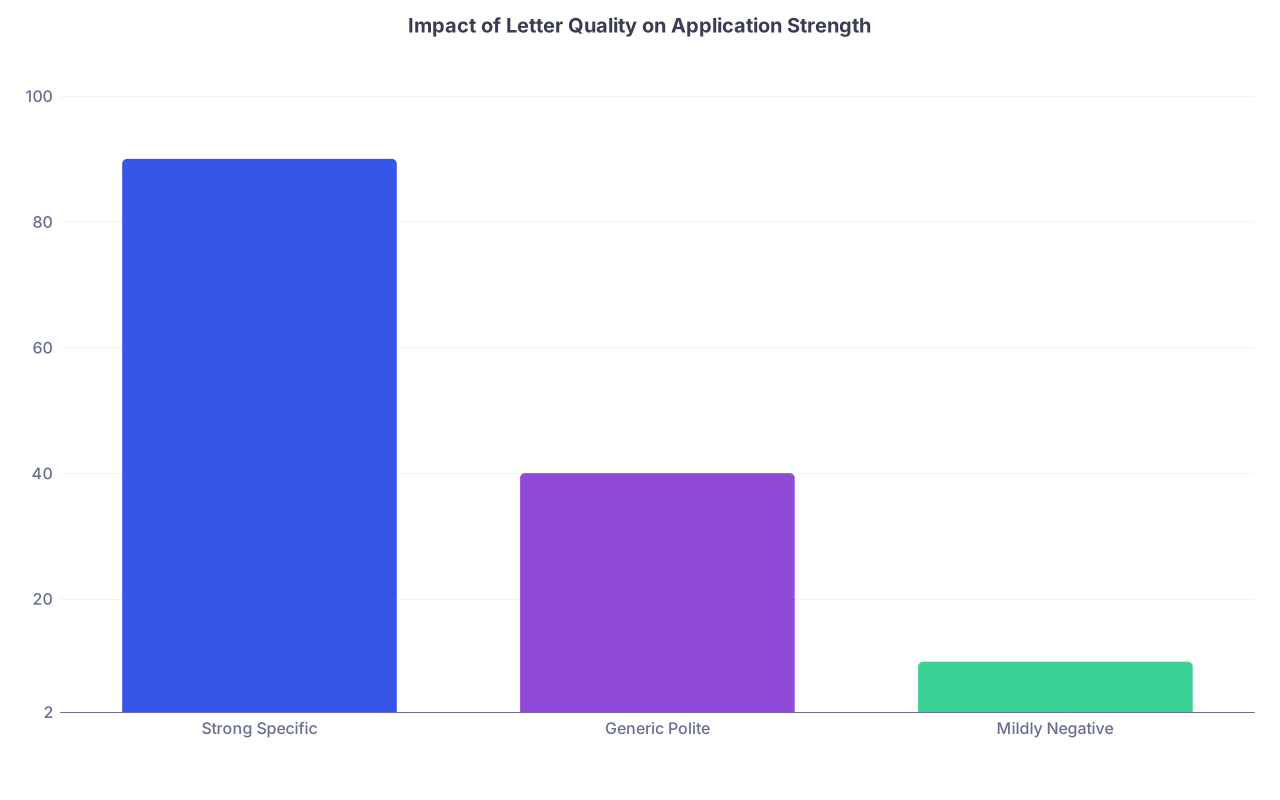
| Category | Value |
|---|---|
| Strong Specific | 90 |
| Generic Polite | 40 |
| Mildly Negative | 10 |
Rough translation of that chart: a strong specific letter can almost carry an application. A polite generic letter does almost nothing. And yes, a truly negative letter can sink you.
The trap? You assume “not negative” means “good.” It doesn’t. In a competitive pool, “generic” is functionally bad.
The Root Problem: You’re Picking Letter Writers for Status, Not Signal
The biggest mistake I see premeds make is this: you chase the fanciest name, not the person who can actually write about you.
You know the move. You angle for:
- The department chair you followed for three half-days in clinic.
- The big-name researcher who barely remembers your poster title.
- The attending everyone talks about as “prestigious,” who worked with you for exactly one week.
Then you’re shocked when you get a generic letter.
Let me be blunt: status without relationship is a letter-writing disaster.
Here’s why those “famous” letters so often come out bland:
They do not know you.
They have no concrete memories to pull from. So they default to generic adjectives. Committees see right through that.They’re busy.
Busy people recycle language. There’s a Word doc on more than one computer titled “LOR template.” Your name gets slotted in; nothing more.They’re cautious.
A senior person who barely knows you won’t stick their neck out saying “top 5%” or “outstanding.” They’ll hedge. Hedging equals weak letter.
The irony: a genuinely strong, specific letter from a mid-level faculty member, a community physician, or a research coordinator can help you more than a generic note from a department chair.
The question you should be asking is not “How important is this person?” It’s “How much real, specific evidence does this person have about me?”
If you pick wrong, you basically engineer your own generic letter.
Red Flags Before You Even Ask: Who Should Not Write Your Letter
Before we talk about doing this correctly, let’s protect you from the obvious landmines.
You should think twice before asking:
Someone who barely remembers your name.
If you have to open with “You might not remember me, but I was the student who…” — that’s already a problem.Someone who supervised you briefly in a crowded setting.
A month on a service where you rounded with 8 other students and barely spoke is not depth.Faculty who say vague things like:
- “I’d be happy to add my name to your file.”
- “I can provide a standard letter.”
- “I don’t know you very well, but I can say you did fine.”
These are coded warnings: you are about to get a generic letter.
Anyone who hesitates when you ask.
If there’s a pause, a sigh, or a careful “I suppose I could,” do not bulldoze through. That hesitation is your early-warning system.

- People who clearly don’t like teaching or mentoring.
If they’ve grumbled about letters in front of you, believe them. Your letter will be rushed, generic, or both.
The hard part: students are so terrified of “bothering” people or being rejected that they ignore these red flags. They think, “Well, at least I got someone,” not realizing they might be better off without that particular “someone.”
Criteria That Actually Predict a Strong, Non-Generic Letter
Here’s how you stack the deck in your favor.
Forget titles for a minute. Focus on mentors who:
Have seen you work over time.
Multiple months, multiple contexts: clinic + project, lab + presentation, volunteering + leadership. Depth beats prestige.Have seen you struggle and improve.
The best letters don’t say “perfect.” They say: “She started here, hit this roadblock, and then did X, Y, Z to get better.” That’s memorable. Committees believe it.Trust your judgment.
If they’ve already trusted you with real responsibilities—independent patient calls, running part of a project, training new volunteers—they’re more likely to go to bat for you.Already talk about you in specific ways.
If you’ve heard phrases like:- “You’re one of the stronger students we’ve had recently.”
- “You really stood out on this team.”
- “I’m impressed with how you handled that situation.”
That’s the language that shows up in strong letters.
Give you honest feedback.
Counterintuitive, but crucial. Someone who only ever tells you “you’re amazing” often writes fluff. Someone who’s pushed you, corrected you, and seen you respond can write substance.
| Potential Writer Type | Likely Letter Quality |
|---|---|
| Knows you 6+ months, mid-level faculty | Strong, specific |
| Famous chair, met you 3 times | Generic, polite |
| [Research PI](https://residencyadvisor.com/resources/letters-of-recommendation/quiet-in-class-strong-in-lab-turning-a-research-pi-into-your-best-recommender), weekly meetings 1 year | Strong, detailed |
| Shadowing-only physician | Generic, shallow |
| Volunteer coordinator, 2 years | Strong for character |
How Your Behavior Pushes Mentors Toward Generic Letters
Let’s be honest about another piece: sometimes the mentor is fine, but your approach makes it almost impossible for them to write anything better than generic.
Here are the big unforced errors.
1. You Ask Too Late
You disappear for months after working with them, then email: “My deadline is next week, can you write me a strong letter?”
What they hear: “Please do unpaid, detailed work for a student who did not care enough to ask with reasonable notice.” The result? A rushed letter. Rushed equals template. Template equals generic.
Give people at least 4–6 weeks whenever possible. More is better.
2. You Provide No Material
You send a one-line email and nothing else. No CV, no personal statement draft, no bullet points reminding them what you did with them.
So they have two options:
- Dig through old notes and emails for details (time-consuming).
- Write from memory and generic impressions (much faster).
Guess which one they choose when they’re on call and 30 notes behind?
Your job is to make it easy for them to remember you specifically.
At minimum, you should provide:
- CV or resume
- Draft of your personal statement or a short “why medicine” summary
- A 1-page highlights document with:
- What you did with them
- 3–5 specific moments/achievements you’re proud of
- Anything you hope they can comment on (work ethic, teaching, leadership, etc.)
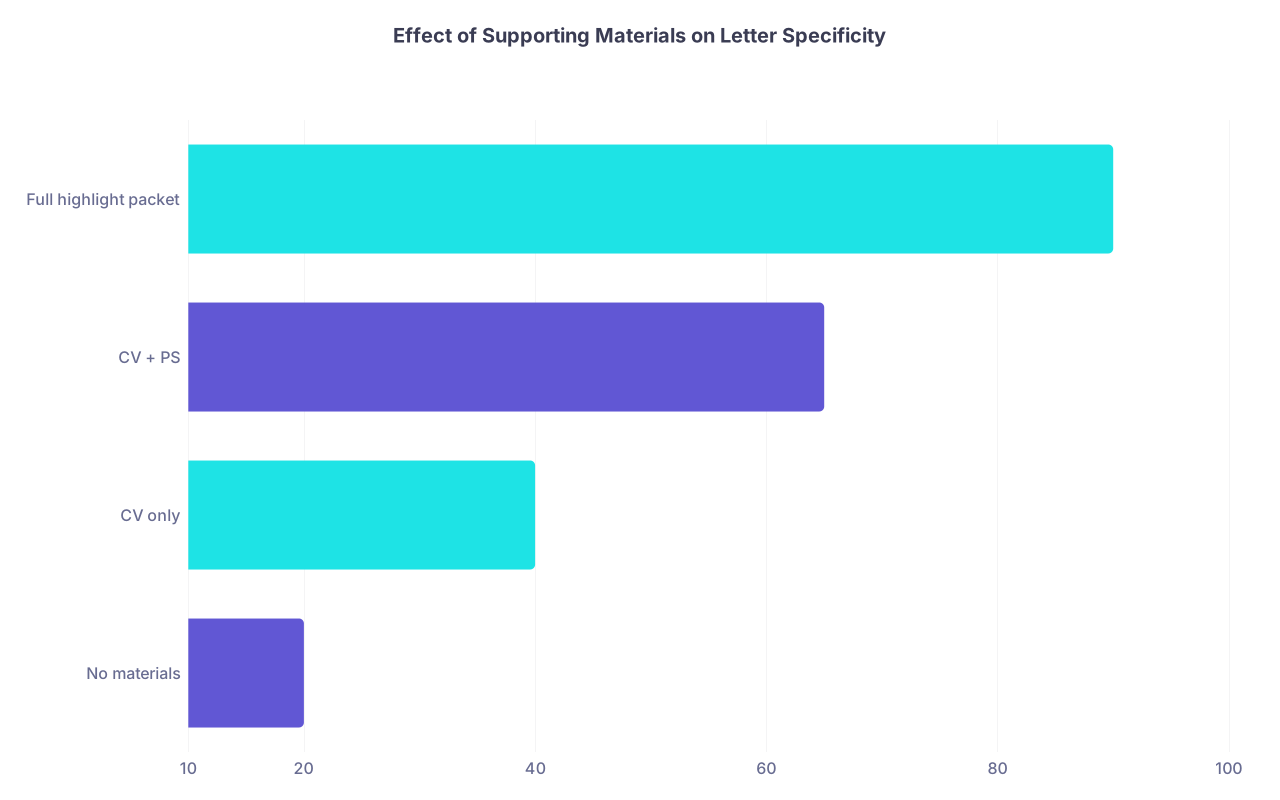
| Category | Value |
|---|---|
| No materials | 20 |
| CV only | 40 |
| CV + PS | 65 |
| Full highlight packet | 90 |
That’s not hypothetical. I’ve watched the same faculty member write drastically better letters for students who handed them a thoughtful packet vs those who sent a terse email.
3. You Don’t Explicitly Ask for a “Strong” Letter
This part makes some students uneasy, but skipping it is a mistake.
You need to ask, in person or by video if possible:
“Would you feel comfortable writing a strong, detailed letter of recommendation for me?”
Not “a letter.” A strong, detailed letter.
Why? Because it gives them a polite exit if they can’t. Anyone honest will respond with some version of:
- “I can write you a letter, but I don’t know you well enough to be very detailed.”
- “I’m not sure I’m the best person for a strong letter; have you considered X or Y?”
That sounds scary. But it’s infinitely better than a surprise generic letter that quietly drags you down.

4. You Treat It as a Transaction, Not a Relationship
If the only time you ever contact this person is to ask for a letter, of course it’s going to be generic. They know nothing about where you’re going, what you care about, or how to frame your story.
Mentors write better letters when:
- You’ve checked in periodically.
- You’ve updated them on your path, even briefly.
- You’ve shown genuine appreciation for their time and teaching.
This is not fake flattery. It’s basic human behavior: people advocate harder for those they feel connected to.
Special Cases: Premed and Early Medical School
You’re at a double disadvantage in the premed / early med phase:
- You don’t have long clinical rotations yet.
- Your roles are often more observational than hands-on.
That makes generic letters dangerously easy to produce.
So you have to be strategic.
For Premeds
Common mistake: getting 3 letters from people who all barely know you in the same way.
For example:
- Shadowing doc for 20 hours
- Another shadowing doc for 15 hours
- PI where you washed glassware for a summer
You’ve basically guaranteed 3 near-identical letters: “Nice student, punctual, interested in medicine.”
Instead, diversify with depth:
- A science faculty member who taught you in 2 courses or supervised your thesis
- A non-science professor who saw you write, think, or lead in depth
- A PI or research mentor who saw you over many months
- A long-term volunteer supervisor (2+ years) who can speak to your reliability and character
And yes, that volunteer coordinator at the free clinic who watched you grow from lost freshman to competent lead volunteer for 3 years? That person can absolutely write a better letter than the cardiologist you followed silently for 12 afternoons.
For Early Medical Students
Typical screw-up: you latch onto the first “big name” attending you meet in M1/M2 and ignore the smaller relationships that actually have substance.
You want:
- Preclinical course directors who know your work ethic from repeated small group sessions.
- Longitudinal mentors (e.g., continuity clinic preceptors) who see you over time.
- Research mentors you met with regularly, not just once a month lab meetings where you sat in the back.
Again, length and depth of contact beat prestige.
What a Strong, Non-Generic Letter Actually Looks Like
You need a mental model for what you’re trying to enable.
A strong letter has:
Context
“I have worked with 200+ undergraduates over 10 years as a course director…”
This lets them place you in a meaningful pool.Comparison
“She is easily in the top 5–10% of students I have taught.”
Committees care a lot about relative ranking.Specific stories
- The time you stayed late to help a struggling classmate.
- The research project you salvaged after data corruption.
- The patient encounter you handled with maturity.
Personality and voice
The letter “sounds” like someone who spent time with you, not like a template. You can feel it.

Your choice of mentor and your preparation either make that kind of writing possible—or force them into filler.
How to Approach the Ask Without Sabotaging Yourself
To avoid the generic trap, here’s a simple but non-negotiable sequence.

| Step | Description |
|---|---|
| Step 1 | Identify potential writers |
| Step 2 | Filter by depth of relationship |
| Step 3 | Schedule conversation |
| Step 4 | Provide materials & deadlines |
| Step 5 | Thank & seek alternative |
| Step 6 | Follow up politely |
| Step 7 | Express gratitude after submission |
| Step 8 | Comfortable writing strong letter? |
The parts students skip are C and D. They fire off a hopeful email and pray. That is how you end up with the polite but empty letter.
Do the uncomfortable thing: talk to them. Ask directly. Give them the chance to say no.
You’ll avoid a lot of silent damage that way.
Two Final Mistakes That Quietly Kill You
Let me hit two last ones I see every cycle.
Depending on One “Hero” Letter to Fix Everything
You imagine one superstar mentor writing a glowing, life-changing letter that erases a mediocre GPA or MCAT. So you chase that one person obsessively and neglect everyone else.
Reality: committees look at patterns.
- Three strong letters? They believe it.
- One strong, two generic? They start wondering what’s going on with the rest of your performance.
Don’t build your application on one person’s shoulders. Build a portfolio of people who know you well enough to say real things.
Not Owning the Outcome
Students love to blame the letter writer: “They said yes, but they gave me a bad letter.”
Sometimes that’s true. Some people overestimate how well they know you and phone it in.
But most of the time, the student:
- Chose someone who barely knew them.
- Gave them almost no notice.
- Provided nothing to work with.
- Never asked if they could write a strong letter.
You cannot control how eloquent someone is. You can control who you ask, when you ask, and how much raw material you hand them. That’s where your power is. Use it.
If You Remember Nothing Else
Keep these tight:
- A generic, polite letter is not “neutral” — in a competitive pool, it’s functionally negative.
- Your mentor choice largely determines letter quality; depth of relationship beats prestige every time.
- Ask early, ask directly for a strong letter, and arm your writers with specific details so they can’t default to vague filler.
Do not be the applicant with the beautiful stats and the forgettable letters. That’s an avoidable failure.