
The weakest letter in your file is often the one that decides how your application is interpreted. Not the strongest. The weakest.
Let me tell you what really happens behind those closed doors.
You’ve been told “get three strong letters” like it’s a checklist item. Premed office says: one science faculty, one non-science, one clinical or research, maybe a committee letter if your school does that. So you hustle for three “good” letters, you think they’re all fine, you submit, and then months later you’re staring at silence from schools that should at least have interviewed you.
And somewhere, in a locked PDF, a single lukewarm, generic, or subtly negative letter is quietly poisoning the well.
I’ve sat in those rooms. I’ve watched adcoms at both med school and residency level read one vague, noncommittal letter and then spend ten minutes trying to decode what the writer is actually telling them. And once they sniff something off in one letter? They go back and reread every glowing one with suspicion.
How Committees Really Read Your Letters
First truth: most reviewers are skimming your file at high speed. The average preclinical faculty on a med school committee is reading dozens, sometimes hundreds of files seasonally. They are tired. They are jaded. And they are pattern-recognition machines.
They do not read all your letters equally.
Here’s the unspoken hierarchy I’ve watched play out:
- The highest risk letter gets the most attention.
- The letters that look “too perfect” get sanity-checked against the outlier.
- A single mediocre or oddly worded letter acts like a red flag on the entire personality section of your file.
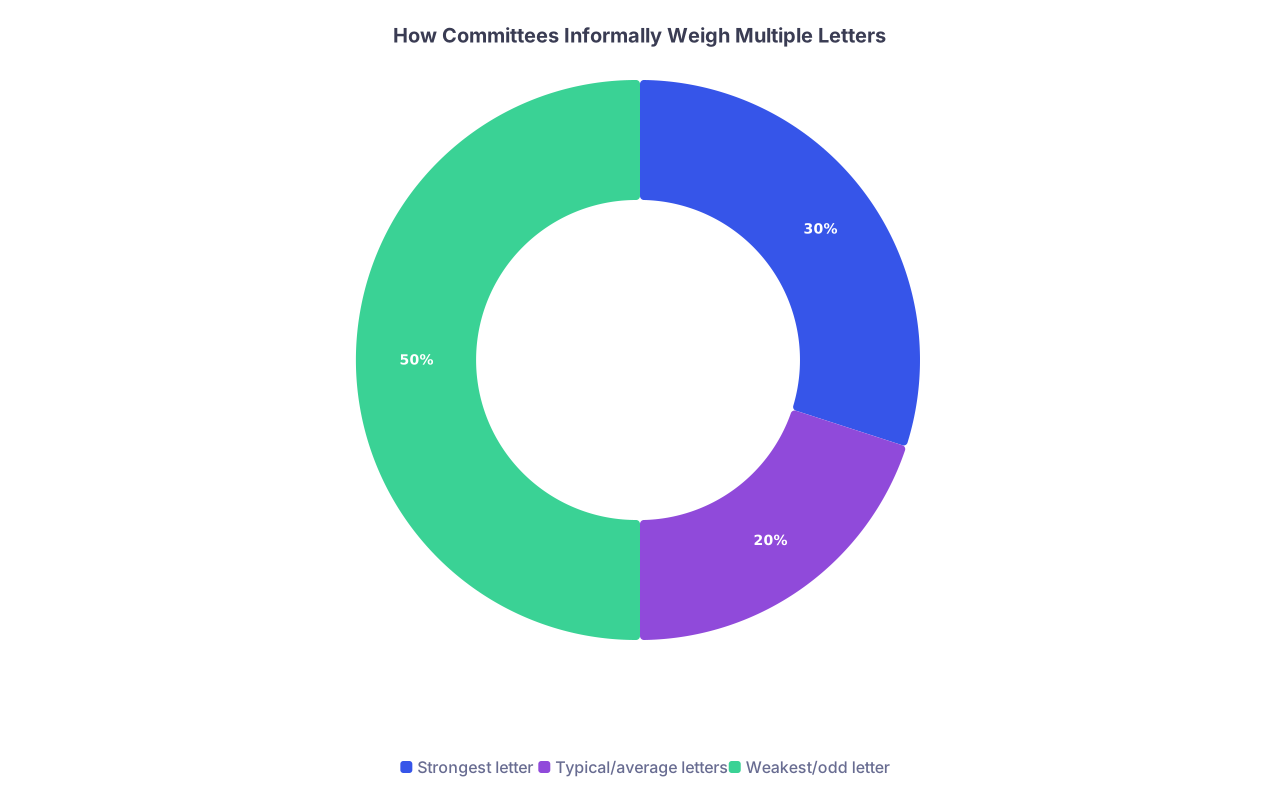
| Category | Value |
|---|---|
| Strongest letter | 30 |
| Typical/average letters | 20 |
| Weakest/odd letter | 50 |
When I say “risk,” I mean:
- Letters from people who should know you well (PI, clinical supervisor, course director)
- Letters from long-term mentors
- Letters attached to important experiences on your CV (major research project, leadership role, longitudinal volunteering)
If those letters are anything less than enthusiastic, that’s where attention goes. The rest of your letters become context, not salvation.
I’ve seen it:
You have three excellent letters. And then the main research mentor writes something like, “She completed all assigned tasks adequately and showed promise. I expect, with further development, she could become a solid contributor to the medical community.”
That sounds… fine, right? To a layperson, sure. To a committee member? That’s code. They will spend the next five minutes trying to decide: “What is this PI not saying?”
And here’s the punchline: they will trust the one bland, senior, understated mentor over your three effusively positive letters from junior faculty or people who barely know you.
The Subtle Language That Kills You
You think a “bad” letter means they slam you overtly. That almost never happens. People are too conflict-avoidant and too liability-aware for that.
What destroys you are the mediocre letters—the quiet assassins.
Here’s the inside language you’re not trained to read:
- “Adequate,” “satisfactory,” “competent” – sounds neutral, reads as “bare minimum / nothing special”
- “Completed tasks as assigned” – translation: did what they were told, no initiative
- “Pleasant to work with” as the main compliment – translation: nice but weak
- “With more maturity, I think he will be successful” – red flag for professionalism issues or immaturity
- “She handled feedback” without “well” attached – often not an accident
- “I have no reservations in recommending…” – this can be okay, but when that’s the most emphatic line and there are no concrete examples, committee members feel the hedging
The worst phrase I see that students misinterpret:
“He will make a fine physician.”
You hear praise. Faculty read it as: “average, not impressive.” If the writer is known to be blunt or stingy and they add “one of the better students I’ve worked with,” that’s different. But most of the time, “fine physician” is a participation trophy.

Now compare that to what actually moves the needle:
- “Among the top 5% of students I’ve worked with in 15 years”
- “I give my strongest recommendation without reservation” with multiple strong concrete anecdotes
- “I would rank her in the very top tier of all applicants I’ve mentored”
When three letters say that, and one senior mentor basically says “nice kid, did the job,” the outlier controls the story.
Why One Mediocre Mentor Overrides Three Great Letters
This part is ugly, but you need to hear it.
Admissions and residency selection run on risk aversion. No one gets fired for not interviewing you. They get in trouble for bringing in someone who later becomes a problem resident or student.
So when they weigh letters, it’s not a democratic vote. It’s a risk assessment.
| Scenario | How It’s Interpreted |
|---|---|
| 3 glowing, 1 mediocre from key mentor | “Something’s off; key mentor saw limits.” |
| 2 glowing, 2 mediocre from minor writers | “Probably okay; minor writers didn’t know them well.” |
| 1 glowing from key mentor, 3 generic | “This person *can* shine; context-dependent.” |
| 4 all-strong, consistent | “Low-risk, likely solid.” |
| 3 strong, 1 clearly negative | “High-risk, usually screened out.” |
Behind doors, I’ve heard comments like:
- “If the PI isn’t excited, I’m not excited.”
- “Three great letters from people who love everyone don’t outweigh one cautious letter from a hard grader.”
- “I want to know what the research mentor really thought. This sounds like they’re being polite.”
Program directors and admissions folks know which writers are “inflaters” and which are “stingy.” There are attendings whose letters we discount because everyone is “outstanding” and “exceptional.” And there are old-guard PIs whose faint praise is treated like a red alert.
So if your three great letters come from:
- A junior attending who likes all her students
- A community physician you shadowed for 30 hours
- A non-science professor who thinks you’re charming
…and your one mediocre letter comes from:
- Your primary research PI of 2 years
- The course director of a major preclinical block
- The physician supervising your main clinical experience
Guess which one shapes the narrative.
The thinking goes: “The person who saw them the longest, in the highest-responsibility setting, was not blown away. Proceed carefully.”
The Common Ways Students Set Themselves Up for a Mediocre Letter
Most students don’t get torpedoed by malice. They get hurt by sloppiness and wishful thinking.
I’ve watched the same preventable mistakes repeat every year:
1. Asking “too early” from a big-name
You spend one semester in Dr. Major Name’s class with 150 other students. You never went to office hours, you got an A–, you were polite, and now you’re convinced their letterhead is gold.
So you send a polite email: “Would you be willing to write a strong letter of recommendation on my behalf?”
They feel cornered. They barely know you. But they’re conflict-avoidant, so they say yes. Then they write a bland, generic, boilerplate letter that basically restates your grade and attendance.
On a committee, we read that as: “Student overstated relationship. Professor not impressed enough to make the effort.”
2. Staying in “good but forgettable” mode with a mentor
You volunteer or research somewhere for a year. You’re punctual. You’re polite. You do your work, but you never really step into the foreground. Never take real ownership. You never ask for honest feedback and improve visibly. You never become indispensable.
So when you ask for a letter, what can they say?
“I worked with X for a year. They were responsible, dependable, and pleasant to have in the lab/clinic. They completed their tasks and were respectful.”
That’s death by faint praise. Not because they dislike you. Because you never gave them a reason to write something else.
3. Asking the wrong person in the right environment
Students overvalue proximity titles:
- “He’s the department chair”
- “She’s the program director”
- “He’s famous in the field”
What matters is who directly supervised your work and saw you in the trenches.
I’ve seen students bypass the fellow or senior resident who actually watched them take ownership, to chase the big-name attending who only saw them on presentation day. The result? The person who barely knows you writes the letter. It reads vague and generic. The person who could have given concrete praise is never asked.
Committees know this pattern. When they see a generic letter from a big title, they wonder who you avoided asking and why.
4. Ignoring early warning signs
Mentors do signal they won’t write you a powerful letter. They just say it politely:
- “I can write you a letter documenting your participation.”
- “I’d be happy to describe your work here.”
- “I can provide a letter, though I don’t know you as well as some of my other students.”
Those are all yellow lights. Sometimes red.
But students hear what they want: “They agreed!”
No. They warned you. And then wrote the lukewarm letter they foreshadowed.

| Step | Description |
|---|---|
| Step 1 | Consider asking for letter |
| Step 2 | Find better evaluator |
| Step 3 | Request meeting |
| Step 4 | Thank them, do NOT proceed |
| Step 5 | Provide materials and confirm strong letter |
| Step 6 | Did mentor see you at your best? |
| Step 7 | Mentor enthusiastic? |
How To Protect Yourself From the “One Mediocre Mentor” Problem
You cannot control every word someone writes about you. But you can control who you ask, when you ask, and how prepared they are to write something meaningful.
Here’s the insider approach I wish more students used.
1. Decide early who you want to be able to ask
In your first serious research position, or major volunteer role, mentally mark the supervisor as a potential letter writer on day one. Then behave accordingly.
Ask yourself:
- “If I keep showing up at this level for 6–12 months, will this person be able to say I was one of their top students?”
- “Have they seen me under stress, making decisions, interacting with others, recovering from mistakes?”
If the answer is no—if you’re just one body in a crowd—either step up or accept they’re not your letter-writer.
2. Force real feedback before you ever ask
The worst letters come from mentors who never had to articulate what you’re actually like before sitting down to write.
Fix that.
Have a conversation months before you plan to ask for a letter. Something like:
“I’m interested in applying to medical school next year, and I’m trying to grow into someone you’d feel excited to recommend. Are there any areas where you think I’m not yet at that level—things I could improve in the next few months?”
If they give you nothing useful, that itself is a signal: they may not be watching you closely enough to write the letter you want.
If they do give feedback, and you act on it, now they have a story to tell: “She asked for constructive criticism, implemented it, and I saw her performance significantly improve.”
Concrete growth stories are catnip to committees.
3. Ask explicitly for a strong letter—and give them an out
I’ve heard mentors complain in the hallway: “They asked me for a letter, but I didn’t feel comfortable saying no. So I just wrote a standard one.”
You prevent that by making it easy for them to decline.
You say:
“I’m putting together letters for medical school and ideally would like to ask people who feel they can write a strong letter on my behalf. Do you feel you’d be able to do that, or would you recommend I ask someone who’s seen me more closely?”
If they hesitate, waffle, or say something like “I can write you a letter” without the word “strong,” you smile and say:
“I really appreciate your honesty—that’s actually very helpful for me. Thank you.”
And you do not press.
The weakest students push. The strongest take the hint and redirect.

4. Choose depth over name recognition
Committees can spot the difference between:
- “Dr. Famous Department Chair” who supervised you once and writes three lines of generic praise
- “Dr. Mid-level Attending” who has three detailed paragraphs about your work, specific patients, and your behavior on real shifts
When we’re reading, the detailed letter wins every time.
If you force me to choose between three detailed, concrete letters from mid-tier names, and one from a big-name who clearly barely knows you, I know which file I’d rather defend in the room.
Because that’s what it comes down to: can someone on that committee defend you to a room full of skeptics? Concrete stories are what they use.
What Happens When Letters Conflict
Let’s say you already have the problem: three strong letters, one clearly mediocre from a core mentor.
How bad is it?
Here’s how it usually plays out in the room.
If your numbers are average and your experiences are typical
The mediocre letter becomes evidence that there’s nothing special here. You fall into the “easy pass” pile. No one fights for you.If your numbers are strong but not stellar and you’re borderline for that school
The mediocre letter often tips you into “probably not.” They might say: “We have other applicants with equally strong metrics and without this question mark.”If everything else is off-the-charts impressive
The letter doesn't automatically kill you, but it forces a more cautious stance. Maybe you still get an interview, but the committee member will walk into your interview looking for the red flag they sensed in that letter.
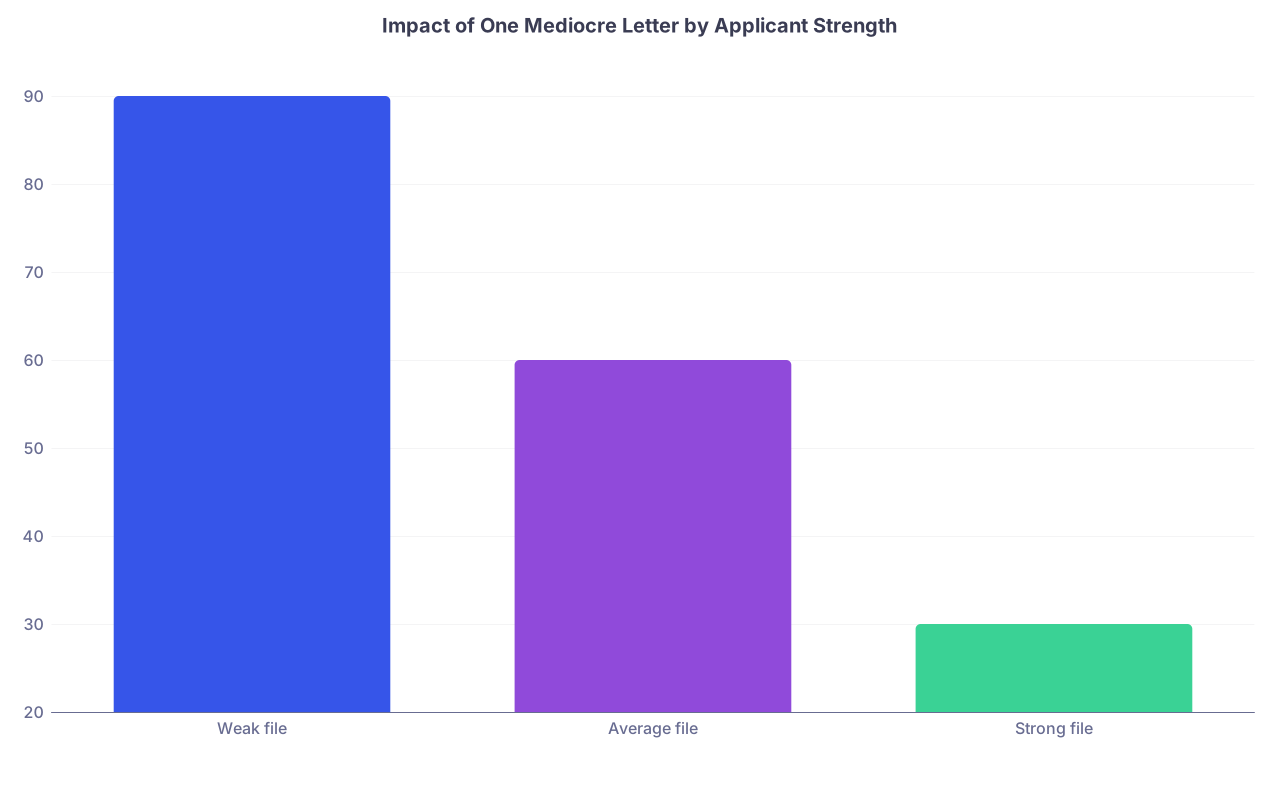
| Category | Value |
|---|---|
| Weak file | 90 |
| Average file | 60 |
| Strong file | 30 |
Those percentages aren’t from a published study. They’re my rough sense sitting in those rooms: with a weak file, a mediocre letter is almost a death sentence; with a strong one, it’s a handicap.
And no—your three great letters don’t “cancel out” the one bad one. Humans don’t average impressions. They anchor to the negative and then discount the positive.
How to Recover if You Suspect a Weak Letter
Sometimes you realize too late that you made a bad choice.
Maybe you got weird vibes when they agreed. Maybe another student told you, “Yeah, that PI writes lukewarm letters for everyone.” Maybe your prehealth advisor looks at your list of letter-writers and raises an eyebrow.
Can you recover? Sometimes.
Here’s what I’ve seen actually help:
- For med school pre-app: you quietly replace them. Pick someone who can speak more specifically about your clinical, academic, or research abilities.
- For schools that allow extra letters: you add a clearly stronger, more recent mentor who can anchor the narrative differently. The risk is letter fatigue, but sometimes it’s worth it.
- For residency: you make sure your most recent and most critical letters (sub-I attendings, chief, program director where applicable) are rock solid, so older mediocre letters feel less relevant.
But the best fix is prevention. Once that PDF is uploaded and transmitted, you have no idea which committee is weighting which letter the heaviest.

The Mindset Shift You Need About Letters
You’ve probably been treating letters like stamps of approval.
You get three or four stamps, present them to the board, and hope they’re shiny enough.
That’s not how insiders look at them.
Letters are risk documents. Each one is an opportunity for someone who knows you to either:
- Strongly reassure the committee you’re worth betting on
- Sound confused, lukewarm, or generic enough that the committee wonders what they’re not saying
Your job is not to “collect LORs.” It’s to curate your evaluators ruthlessly.
If a mentor can’t write you a letter that makes a reviewer sit up a little straighter, they shouldn’t be in your file. I don’t care how big their name is, how prestigious their title, or how guilty you feel.
Years from now, you won’t remember which professor’s ego you gently sidestepped. You’ll remember which doors opened—or never opened—because of what those few people chose to put on paper about you.