
Last cycle, I watched an admissions committee argue for ten minutes over a single applicant. Same GPA, same MCAT bucket as a hundred others. The tie-breaker wasn’t their personal statement. It wasn’t their MCAT subsection scores. It was one line in a letter from a department chair: “I would rank this student in the top 5% of undergraduates I’ve worked with in the last decade.”
You’re told, “Get strong letters.” What nobody really explains is the unwritten hierarchy behind who writes them. Because behind closed doors, not all “strong letters” are treated equally. Not even close.
Let me walk you through how we actually read these—and how your PI, your org advisor, that summer job supervisor all stack up against each other.
The Hidden Power Structure Behind Letters
On paper, a letter is a letter. On the inside, there’s a mental weighting system every experienced committee member uses.
We don’t formalize it. We don’t score it with a rubric labeled “PI vs volunteer coordinator.” But we all know, instinctively, that a glowing letter from the director of a major NIH-funded lab is not the same as a glowing letter from the coordinator of your dorm’s volunteer desk.
Here’s the uncomfortable truth:
We don’t just ask “What do they say about you?”
We also ask, “Who the hell is this person?”
We scan for:
- Name recognition
- Institutional prestige
- Position/title (PI vs adjunct vs volunteer supervisor)
- Perceived selectiveness of the environment (big academic lab vs casual club)
Then we combine that with how specifically they talk about you. Vague praise from a big name? Mildly helpful. Detailed, concrete endorsement from a mid-level PI? We perk up. Over-the-top glowing review from someone with zero academic relevance? We discount it heavily.
To make it clearer, here’s how the hierarchy usually plays out in the premed / early med student world.
| Letter Writer Type | Typical Impact Level |
|---|---|
| [Department Chair / Renowned PI](https://residencyadvisor.com/resources/letters-of-recommendation/how-department-chairs-really-decide-whose-letter-gets-their-signature) | Very High |
| Research PI (mid-level faculty) | High |
| Clinician Faculty (MD/DO) | High |
| Course Professor (science) | Moderate–High |
| Non-faculty Clinician (community) | Moderate |
| Club / Volunteer Supervisor | Low–Moderate |
Now let’s go down the ladder. From top to bottom. And I’ll tell you what really happens in that committee room.
Tier 1: Big Guns – Chairs, Famous PIs, Senior Faculty
These are the letters that make people lean back in their chair and actually read every line.
We’re talking:
- Department Chairs
- Endowed Professors
- High-profile PIs with big grants / lots of publications
- Deans or Associate Deans who genuinely know you (rare, but it happens)
When someone like that writes, the default assumption is:
They’ve seen a lot of students. They don’t waste time. If they’re willing to put their name behind you, we take it seriously.
Here’s the insider twist though: title alone is not enough.
Committee conversation I’ve heard word-for-word:
“Chair of X department wrote this?”
flips pages, skims
“Three paragraphs of boilerplate. They barely know this kid. Next.”
Famous letter writers have two problems:
- They’re busy.
- They write templated letters unless they truly know you.
So you get a kind of paradox: the higher you go on the hierarchy, the more powerful the letter can be—but also the more likely it’s superficial and generic.
What stands out from a high-level writer:
- They give a clear ranking (“top 1–2 students in the last 5 years”)
- They reference specific work: “Her Western blots were reliable enough that we trusted her to run key experiments unsupervised.”
- They cross-compare you to medical students or residents: “He functions at the level of an early medical student in our lab.”
If the letter is just: “She was a pleasure to have in the lab. She was always on time, and I expect she’ll be a great physician,” we mentally downgrade it, chair or not.
When should you chase these people?
When both are true:
- They actually know your work.
- They’re willing to invest time in the letter, not just slap their signature on a template.
If they barely remember your name and you’re just trying to collect prestigious letterheads, you’re playing a game we can see right through.
Tier 2: Your Direct PI – The Real Workhorse Letter
Most strong applicants don’t live on chair letters. They live on direct PI letters—the mid-level or junior faculty who ran the lab where you actually bled for data.
This is the bread-and-butter of serious applicants.
In closed-door discussions, research PIs who supervised you directly carry a lot of weight because:
- They can speak to your intellectual horsepower.
- They see your grit, resilience, and reliability in an environment that’s demanding and somewhat analogous to clinical work.
- They know whether you’re teachable or brittle when things go wrong.
I’ve seen committees go from lukewarm to “we need to interview this person” based almost entirely on a PI letter that clearly shows: you weren’t just washing dishes—you were thinking.
What makes a PI letter land hard:
- They describe how you responded when an experiment kept failing.
- They name specific techniques, projects, or posters you worked on.
- They comment on your maturity and independence relative to your training level.
- They explicitly say they would “recruit this student to our MD/PhD program” or “expect them to be a standout resident.”
The hierarchy inside the PI world:
- NIH-funded, active publishing PI at a medical school or major research institution? Strong.
- Assistant Professor running a growing lab at a decent university? Also strong, sometimes even more personal and detailed.
- Senior Postdoc or Research Scientist as the primary letter writer, with faculty co-sign? A bit weaker, but still meaningful if detailed.
One thing people underestimate: a mid-level PI who really knows you > a big-name PI who barely supervised you. Every time.
We can tell. We’ve written and read enough letters to see who was actually in the trenches with you.
Tier 3: Clinician Faculty – MD/DOs in Academic Settings
Clinician letters occupy a strange middle-high tier. They’re not always as granular as PI letters, but they speak directly to whether you’ll function in a clinical environment.
We look at:
- Whether the writer is an attending physician in an academic hospital
- How long they worked with you (weeks vs months)
- Whether you had meaningful responsibility or were just shadowing quietly
If a clinician says, “This student showed up for three half-days of shadowing and was very polite,” that’s basically a participation trophy. We don’t weigh it much.
But if an academic hospitalist writes:
“For six months, she participated in our outpatient clinic, saw patients with me, presented concise histories, and demonstrated insight into social determinants of health.”
That moves the needle.
The unwritten piece: clinician letters carry more weight if they:
- Are from teaching faculty who are used to evaluating learners
- Directly or indirectly connect you to the medical school or hospital where you’re applying
- Compare you to medical students (“better prepared than many early clerkship students”)
What hurts you is pretending shadowing is the same as real longitudinal involvement. We know the difference.
You want at least one letter where a physician can say, “I’ve seen this person engage with real patients repeatedly,” not just, “They followed me around for a week and didn’t faint.”
Tier 4: Course Professors – Especially Science Faculty
Undergrad science professors are the backbone of the more “traditional” letters, especially for schools that require two science faculty LORs.
Inside committees, here’s how we sort these:
- Big lecture professor who barely knows your face? Lower impact unless they make a point of saying you were exceptional and interacted extensively in office hours or as a TA.
- Smaller seminar / upper-level course professor who worked with you on a paper or project? Higher impact.
- Multiple courses with the same professor, or you served as their TA? Very strong for this tier.
These letters tell us:
- Your academic discipline: do you grind through hard material or just test well once?
- How you handle complex concepts, problem-solving, and group work.
- Whether you took initiative outside of class (office hours, projects, extra reading).
A very strong professor letter often looks a lot like a PI letter in tone: specific, comparative, and personalized. When a professor writes, “Over three courses, I saw his writing, critical thinking, and leadership grow substantially,” we pay attention. It means you weren’t just a name on a grade sheet.
Where students screw this up:
They assume an A in the course automatically means a good letter. It doesn’t. If the professor doesn’t know you, it’s filler. Not harmful, but definitely not the lever you think it is.
Tier 5: Non-Faculty Clinicians & Community Docs
This is your community pediatrician, the private practice surgeon you shadowed, the urgent care doc who let you sit in.
These letters are… fine. Not useless. But they live a rung below academic clinicians in most committee discussions.
Why?
Because:
- Many aren’t used to formally evaluating premeds; they default to generic character comments.
- Their environment isn’t clearly comparable to the academic training setting.
- They usually don’t have sustained interaction with you in a structured way.
A community doc letter can still help if:
- You volunteered or worked in their clinic for months, not a weekend.
- They saw you interact meaningfully with patients and staff.
- They comment on your reliability, empathy, and growth over a substantial timeframe.
Where it falls flat is the classic one-week shadowing letter full of “She asked good questions and seemed very interested in medicine.” That adds almost nothing. We assume baseline interest.
Use these letters as supporting evidence, not your anchor. They can round out the narrative that you understand what medicine looks like “in the wild,” but they won’t carry your file.
Tier 6: Volunteer Supervisors, Club Advisors, Job Managers
Now we’re at the bottom rungs of the hierarchy. Not worthless. But very context-dependent.
These are:
- Volunteer coordinators
- Non-academic supervisors at hospitals (front desk, patient transport, etc.)
- Leaders of health-related nonprofits where you consistently contributed
- Club advisors or student organization mentors
- Managers at non-medical jobs (retail, tutoring centers, etc.)
Here’s the brutal truth:
Alone, these letters will not impress an admissions committee. No matter how glowing. We’ve just seen too many of them that say the same thing:
“Shows up on time. Works well with others. Has a positive attitude.”
We assume that’s you already. You’re applying to a doctoral-level professional degree. Baseline functioning is not a selling point.
So why do these letters exist at all in strong applications?
Because when used correctly, they confirm sustained character and work ethic over long periods and show sides of you that don’t appear in a lab or classroom.
The versions that actually help:
- The volunteer supervisor who watched you move from basic tasks to training other volunteers.
- The community service director who saw you keep showing up for three years, not just one semester.
- The job manager who can talk about you stepping up under stress, covering shifts, handling difficult people.
Inside the room, these letters are used like this:
- You’ve got solid PI/clinical/faculty letters.
- We wonder, “Is this person actually decent to work with?”
- A detailed volunteer letter confirming you’re reliable, kind to staff, and respected by peers makes us more comfortable.
They’re tie-breaker letters. Character reinforcement letters. They’re not the spearhead of your file.
For a premed or early med student, a volunteer supervisor letter is supporting evidence, not primary evidence.
How Committees Quietly Rank Your Letter Set
We don’t formally label letters “Tier 1, Tier 4,” but we instinctively categorize them as we scan your file.
Here’s roughly what’s going on in our heads:
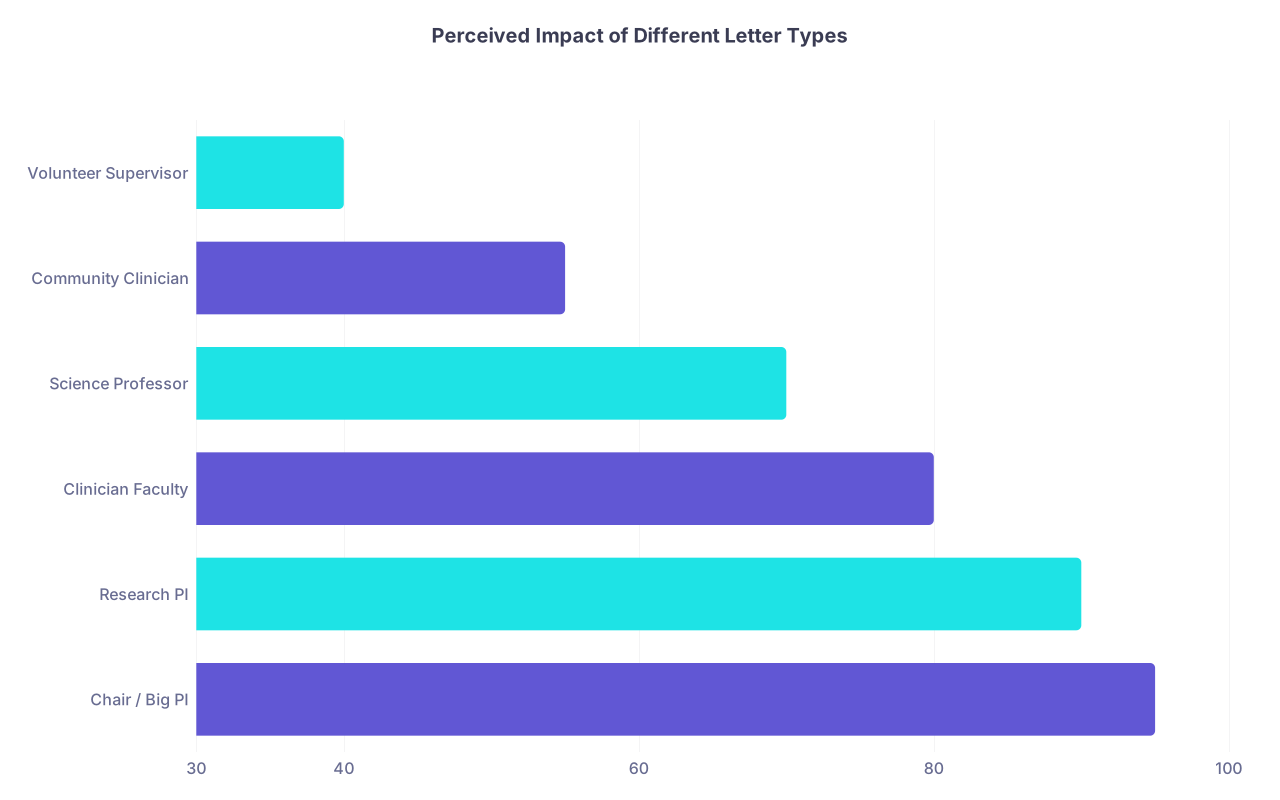
| Category | Value |
|---|---|
| Chair / Big PI | 95 |
| Research PI | 90 |
| Clinician Faculty | 80 |
| Science Professor | 70 |
| Community Clinician | 55 |
| Volunteer Supervisor | 40 |
If your three main letters are:
- Research PI
- Science professor (who really knows you)
- Academic clinician or second PI
We expect a strong, coherent narrative. If those letters are all detailed and enthusiastic, your file rises.
If your letters are:
- Volunteer supervisor
- Community doc who saw you for 3 days
- Large lecture professor who barely remembers you
We immediately think: “Why don’t they have stronger faculty or PI support? Did no one serious want to vouch for them?”
Nobody will say that to you in advising appointments. But that’s exactly the conversation in the back room.
The Optimal Mix: Premed and Early Med
For a premed applicant, the rough ideal structure (when possible) looks something like:
- 1 strong science faculty letter (knows you beyond your grade)
- 1 strong research PI or advanced project mentor letter
- 1 clinician faculty letter (academic setting, substantial contact)
Then, optionally:
- 1–2 supporting letters from volunteer orgs, non-science professors, or long-term supervisors if allowed by schools.
For an early med student applying for research scholarships, special programs, or summer fellowships:
- 1 med school faculty (course or small group instructor)
- 1 research PI
- 1 clinician mentor from early exposure or student-run clinic
Volunteer supervisor letters stay at the margins: good for color, not good as anchors.
How to Climb the Hierarchy Without Faking It
You don’t magically get a department chair as a mentor. You build relationships upward.
Basic sequence I’ve watched work:

| Step | Description |
|---|---|
| Step 1 | Join lab or clinic |
| Step 2 | Show up consistently |
| Step 3 | Take on more responsibility |
| Step 4 | Get feedback & improve |
| Step 5 | Work closely with PI or faculty |
| Step 6 | Present, write, or lead projects |
| Step 7 | Request detailed letter |
You start with whoever will take you. Lab tech, postdoc, small-time PI, community doc. You prove you’re useful. Over time, you move closer to the people whose names and positions carry more weight—and who actually see you doing serious work.
The “secret” part is this: the hierarchy isn’t strictly about title. It’s title plus depth of relationship. A committee can smell fluff. We can tell when you’ve gamed the ladder versus climbed it.
Case Comparisons: Who Actually Wins?
Let me illustrate with two fictional—but very common—profiles.

Applicant A: “Prestige Collector”
Letters from:
- Famous cancer center chair who let them volunteer 2 hours a week for one summer.
- Big-name cardiologist they shadowed for 5 days.
- Large lecture organic chemistry professor where they got an A+ but never spoke.
All letters are positive. All are generic.
Applicant B: “Substance Builder”
Letters from:
- Assistant professor PI at state university where they worked 15 hours/week for 2 years, completed an honors thesis, and presented a poster.
- Upper-level physiology professor who taught them in a 20-student seminar, saw their writing, and mentored their capstone.
- Academic hospitalist who supervised them in a longitudinal premed clinical program for 6 months.
Zero big names. All relatively normal people. But the letters are vivid, specific, and clearly written by people who actually know the applicant.
In committee, Applicant B wins almost every time.
The hierarchy is real. But it bends hard in favor of depth over superficial prestige.
Timeline: When to Secure Each Type of Writer
Most people start thinking about letters way too late. Let me show you the internal “best case” timeline committees assume when they see strong letters.
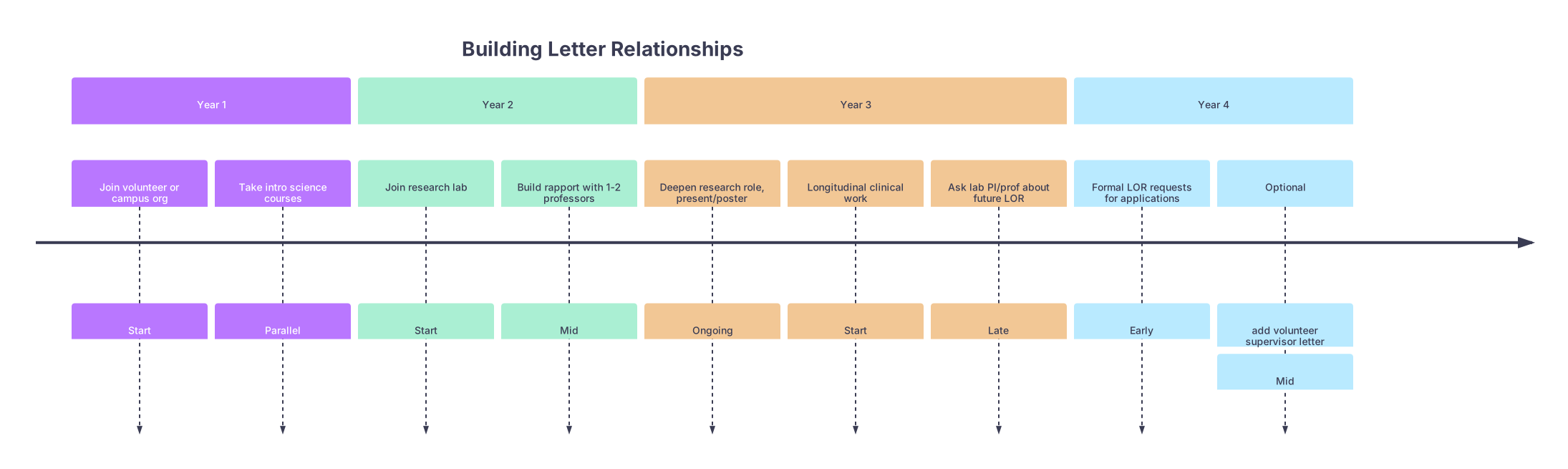
| Period | Event |
|---|---|
| Year 1 - Join volunteer or campus org | Start |
| Year 1 - Take intro science courses | Parallel |
| Year 2 - Join research lab | Start |
| Year 2 - Build rapport with 1-2 professors | Mid |
| Year 3 - Deepen research role, present/poster | Ongoing |
| Year 3 - Longitudinal clinical work | Start |
| Year 3 - Ask lab PI/prof about future LOR | Late |
| Year 4 - Formal LOR requests for applications | Early |
| Year 4 - Optional | add volunteer supervisor letter |
When we see letters that reflect 1–2 years of sustained interaction, we’re more generous with everything else. Because someone has observed your trajectory, not just a snapshot.
Common Misconceptions That Hurt Applicants

Let me shut down a few myths that advisors sometimes soft-pedal.
Myth 1: “Any strong letter is good, doesn’t matter who writes it.”
Wrong. “Strong” is not just adjectives. It’s context, position, and perceived judgment quality. A glowing club advisor letter is not equal to a solid PI letter.
Myth 2: “More letters = better.”
Most committees get irritated by bloated files. If you bury three excellent letters under four mediocre ones, you dilute your impact. Choose strategically.
Myth 3: “Non-science or non-clinical letters show diversity, so they’re just as valuable.”
They show breadth, yes. But they don’t replace core academic/clinical judgments. They supplement them.
Myth 4: “Asking a chair with a template letter is always worth it for the name.”
Sometimes it actually hurts. We read the letter, expect substance, find none, and then quietly wonder why no one who truly knew you stepped up instead.
Myth 5: “It’s rude to ask a writer whether they can write a strong letter.”
The opposite. Serious faculty respect that question. It gives them an out if they barely know you, which protects you in the long run.
How You Use This Hierarchy Without Becoming Cynical
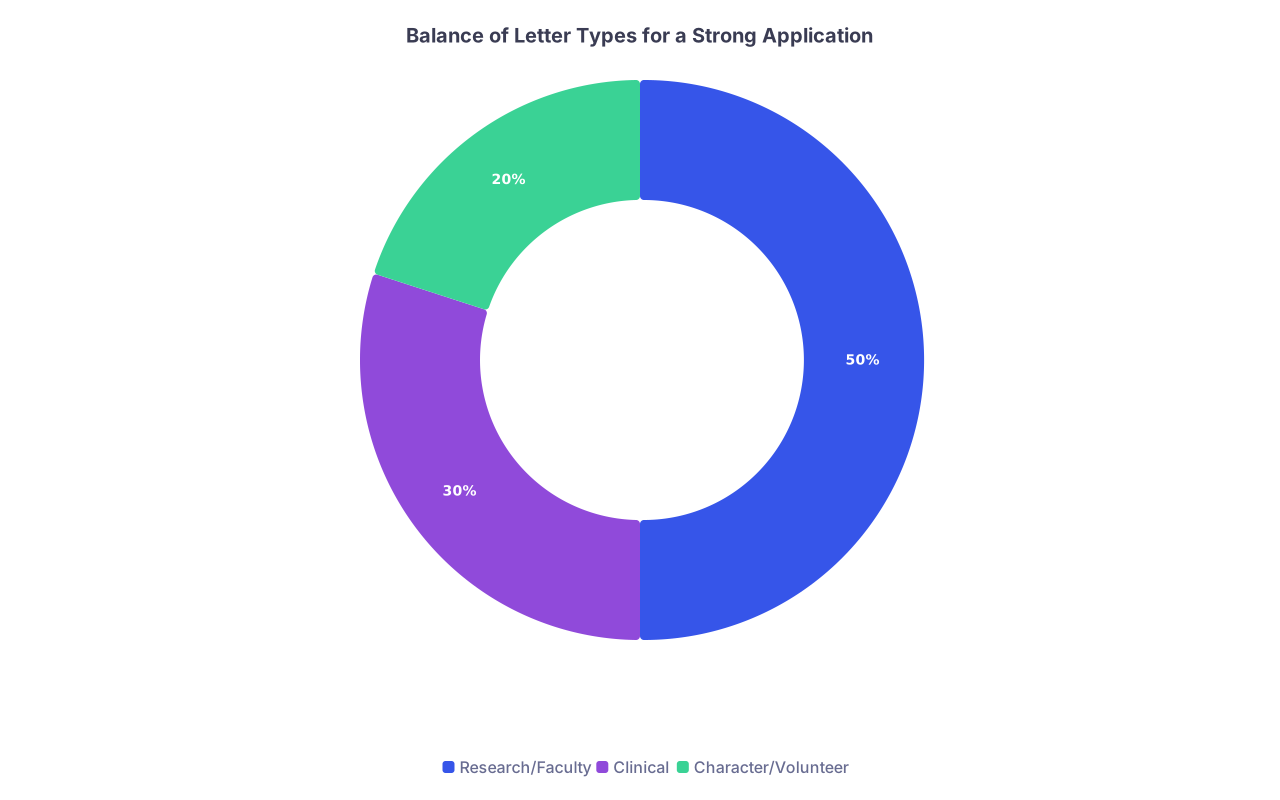
| Category | Value |
|---|---|
| Research/Faculty | 50 |
| Clinical | 30 |
| Character/Volunteer | 20 |
You don’t need to game the system. You need to respect how it actually works.
Align your time with where the strongest letters eventually come from:
- Long-term lab work with real responsibility
- Deep engagement with at least one or two professors
- Substantial clinical immersion with someone who can actually evaluate you
- Consistent volunteer/service where your character is visible over time
Think of volunteer supervisors and club advisors as the chorus backing up your soloists. Important. Supportive. But not the main act.
And remember this: committees are not hunting for perfection. We’re hunting for evidence. Evidence that people who know you well, in demanding environments, trust you with more responsibility.
That’s what this unwritten hierarchy really tracks: who has seen you under pressure, and who is betting their reputation that you’ll rise to the level of the training we’re about to give you.
Years from now, you won’t remember which volunteer coordinator wrote which paragraph. You’ll remember the few mentors who truly knew you—and stuck their necks out in writing to say, “This one is ready.”