
You’re standing outside a faculty office, email drafted on your phone, thumb hovering over “send.”
You need a strong letter—for med school, an SMP, a big scholarship, maybe an early research program. You’ve been told, “Ask for a strong letter,” but nobody has told you what actually flips a faculty member from “yeah, I’ll write something generic” to “I will go to bat for this person.”
Let me tell you what really happens on the other side of that office door.
Most students think faculty say yes or no based on whether they “like” you or whether you got an A. That’s surface-level. The real calculation is quieter, colder, and more predictable. I’ve sat in those meetings where attendings and professors go through letter requests and decide who gets a paragraph and who gets a page and a half of firepower.
There is a pattern. And if you understand it now, you can start setting this up months before you ever ask.
The First Filter: “Can I Honestly Use the Word ‘Strong’?”
Here’s the part almost nobody tells you.
When you write: “Would you be willing to write a strong letter of recommendation on my behalf…”, faculty run a very fast internal diagnostic:
- Do I remember this person clearly?
- Do I have at least one specific story or example about them?
- Would I feel comfortable if another faculty member read this letter and asked me about it at a committee meeting?
If the answer to any of those is “no,” you’re not getting a truly strong letter. You might get something generic, but not the kind that moves a file in your favor.
Most faculty will not tell you this directly. Instead, you’ll get one of three responses:
- “I’d be happy to write you a letter.” (Could be strong. Could be boilerplate. Neutral phrasing.)
- “I can write you a supportive letter.” (Translation: I don’t have much to say, but I won’t hurt you.)
- “I don’t think I’m the best person to write for you.” (Translation: I cannot honestly use the word ‘strong’ and I’m ethical enough not to pretend.)
That first question—“Do I remember this person clearly?”—is why the “I got an A in their class, I’ll ask them” strategy fails so often.
An A in a 200‑student class with no interaction? That’s not a strong letter. That’s a transcript with adjectives.
What Faculty Are Actually Evaluating Before Saying Yes
Let’s walk through the hidden checklist faculty use. They won’t call it that. But it’s there.
1. Depth of Interaction, Not Just Duration
Faculty ask themselves: Have I actually seen you do anything?
That means:
- You spoke in office hours multiple times, and not just to argue for points.
- You worked in their lab, clinic, or project for at least a few months.
- You interacted closely on a small project, case discussion, or longitudinal activity.
- They watched you handle something real: a tough patient, a group project, a challenging concept, a setback.
Time alone doesn’t cut it. You can shadow someone for 40 hours and leave zero imprint. I’ve heard more than one attending say, “They were around a lot, but I couldn’t tell you a single memorable thing they did.”
The students who get yes to a strong letter usually did this: they created repeat, meaningful contact early.
Not in the last two weeks of the semester. In week 3, 4, 5. They came to office hours with real questions. They followed up on topics. They joined a project. They let themselves be seen.
2. Concrete Stories > Vague Impressions
If a faculty member can’t immediately call up a specific story about you, the letter will be weak no matter how much they “like” you.
Committee members can smell fluff. They see phrases like:
- “hard-working”
- “pleasant to work with”
- “attentive in class”
and they know the writer has nothing substantive.
The letters that get quietly flagged in committee rooms contain things like:
- “On our inpatient service, she stayed late on a Friday to help a Spanish-speaking family understand the discharge plan when no interpreter was available. She didn’t just translate; she calmly walked them through each medication, wrote things out, and then checked back the next morning.”
- “In my upper-level physiology course, he was the only student who came to office hours to challenge a core assumption in one of our lectures—and he was right to question it. He had done the extra reading and improved the way I now teach that topic.”
So what are faculty scanning for before they agree to “strong”?
They’re asking themselves:
Can I tell a story that:
- Has a specific setting (clinic, lab, course, project)?
- Shows behavior over time (not just a one-off)?
- Demonstrates judgment, integrity, resilience, or leadership?
If the answer’s no, they may still say yes to your request—but you won’t like that letter if you ever actually read it.
The Unspoken Categories: How Faculty Rate You in Their Heads
Faculty won’t say this publicly, but informally they sort potential letter-writers into types. Here’s how it sounds in hallway conversations when they’re blunt.
| Category Name | What It Really Means |
|---|---|
| Automatic Yes | I will write a truly strong letter |
| Conditional Yes | I’ll write, but strength depends on what you give me |
| Polite Yes | [Generic, safe, likely useless](https://residencyadvisor.com/resources/letters-of-recommendation/the-polite-but-damaging-generic-letter-and-how-your-mentor-choice-causes-it) |
| Quiet No | I hope they ask someone else |
| Hard No | I’d actively advise against them |
Automatic Yes
This is the rare category. These students:
- Show up consistently and do excellent work.
- Make the faculty member look forward to talking about them.
- Already have at least one memorable story attached to their name.
When your email hits, these faculty think: “Finally. I was waiting for them to ask.”
You earn this status by doing real work with them and being reliably good. Not perfect. Just consistently solid and engaged.
Conditional Yes
This is most students who interact a moderate amount. You did well, they know you, but they don’t have a robust narrative yet.
These faculty mentally think: “If they give me a good CV/personal statement and remind me of specific things they did, I can probably produce something decent.”
If you’re in this bucket and you don’t give them material—no CV, no bullet points, no reminder of what you worked on—you slide down into Polite Yes territory by default.
Polite Yes
This is where the danger is.
Faculty agree quickly, sound supportive, but silently know: “I don’t have much to say beyond grades and attendance.” This is the kind of letter that starts with, “I am pleased to recommend [Name] for your program. I have known [Name] for one semester in my [Course] class…”
That’s death in a competitive pool. These letters don’t actively hurt you, but they put you squarely in the undifferentiated middle—where decisions are based on who does have fans in the room.
Quiet No and Hard No
There are students who ask and get soft declines: “I’m not sure I’m the best person,” or “I don’t know you well enough.” That’s a Quiet No. Respect it. Pushing on that is how you end up with a grudge letter.
Hard No is rarer but very real: professionalism problems, poor judgment, ethical red flags. When these students ask, some faculty will refuse outright, others will agree and write a bluntly negative or very tepid letter.
You’ll never see it. But admissions will.
The Hidden Metrics Faculty Care About (Beyond Grades)
Let’s get specific. When faculty debate whether they can write a strong letter, they’re not just thinking “smart vs not smart.” They’re looking at things admissions committees actually talk about.
Here’s what comes up over and over:
1. Reliability and Follow-Through
Faculty remember the students who:
- Answer emails promptly.
- Show up on time—or early—for lab, clinic, or meetings.
- Do what they say they’re going to do, without drama.
I’ve sat in meetings where someone said, “She was fine in clinic, but she no-showed to two follow-up meetings for the project.” That one sentence will kill the enthusiasm for a strong letter.
Admissions readers care more about reliability than they do about charm. So do faculty.
2. How You Handle Being Wrong
This is big. Especially for medicine.
Faculty ask themselves:
- Have I seen this person accept feedback without melting or arguing?
- Did they adjust their behavior next time?
- Do they get defensive when corrected?
The student who says, “You’re right, I missed that. Let me read up on it tonight and try again tomorrow,” gets a much stronger letter than the one who always needs to be right.
Letters that say, “She actively sought feedback and incorporated it rapidly into her work,” get attention. That line doesn’t show up unless you’ve actually demonstrated it.
3. Professionalism Under Stress
Most of the memorable stories faculty use are about how you behaved when things were not easy.
Examples that end up in letters:
- How you dealt with a rude patient’s family.
- How you treated a struggling group member.
- How you reacted when your experiment failed for the third time.
- How you handled a schedule crunch with exams and lab deadlines.
Faculty are silently logging: Do I trust this person not to embarrass me if I put my name behind them?
Because that’s what a strong letter is: a reputational bet.
4. Initiative That Isn’t Performative
They’re looking for real initiative, not resume theater.
Real initiative:
- You identify a problem and quietly fix it without fanfare.
- You propose a small, concrete improvement on a project—then do the work.
- You follow an intellectual thread beyond what’s assigned because you’re actually curious.
Faculty recognize the student who only raises their hand when they know someone’s watching. They rarely write strong letters for them.
What You Should Do Before You Ever Ask
Here’s the part you can control. By the time you send that request, 80–90% of the outcome is already decided by how you’ve behaved for weeks or months.
So, how do you deliberately set yourself up as a “strong letter” candidate?
1. Pick Fewer People, Go Deeper
Spreading yourself across ten labs, five clubs, and seven shadowing experiences is how you end up with ten weak letters and no champions.
You want 2–3 faculty who can say, with a straight face and specific examples, “This is one of the top students I’ve worked with in the last few years.”
That only happens if you:
- Commit to a lab for at least 6–12 months, not 6 weeks.
- Stick with a course instructor for more than a single term (e.g., take their advanced seminar after the intro).
- Show up consistently to the same mentor, not hop around chasing titles.
2. Make Yourself Memorable Early
In the first third of a semester or experience, do the things that separate you from the herd:
- Go to office hours with two types of questions: one clarifying the material, one extending it or applying it.
- Send a short, thoughtful follow-up email after a lecture you genuinely found interesting, referencing a specific slide or point.
- Volunteer for a slightly harder, unglamorous task once. Data cleaning, extra reading, literature search, prepping a session.
You’re building memory hooks. When your name shows up later, something needs to click in their brain besides “sat in row three, left side.”
3. Show Growth Over Time
Faculty love writing about trajectories.
If they can say, “At the beginning of the semester, she struggled with X, but by the end she had done Y,” that reads far more powerfully than “He was excellent from day one.”
So when you hit a challenge, do not hide. Ask for targeted feedback, apply it, then loop back: “I tried what you suggested on the last lab report; did you notice an improvement?” You’re gifting them a narrative arc.
How to Ask in a Way That Signals You’re Serious
By the time you’re ready to ask, you should already know which faculty see you as more than just a name on a roster. But the way you ask still matters. It telegraphs whether you understand what you’re requesting.
Here’s what faculty look for in the ask itself:
1. You Ask Early, Not Last-Minute
Faculty read timing as respect. A two-week notice for a major application says: “You didn’t plan ahead, and now you want me to bail you out.” That is not “strong letter” energy.
You want 4–6 weeks minimum for big things (med school, major programs). For something smaller, 3–4 is okay.
2. You Make It Easy for Them to Say Yes Strongly
The best requests come with a clear, organized package. This is where most students blow it.
A strong request email usually includes:
- A direct question: “Would you feel comfortable writing a strong letter of recommendation in support of my application to [X]?”
- Brief reminder of who you are in their world: “I was in your [Course] in Fall 2023 and have been working in your lab since January.”
- Clear purpose and deadline.
- Offer of supporting materials: CV, draft personal statement, bullet list of projects you did with them, and specific traits/experiences you hope they can address.
Faculty are not offended when you do this. In fact, they breathe a little sigh of relief. It lets them quickly decide if they have enough to work with, and then write faster.
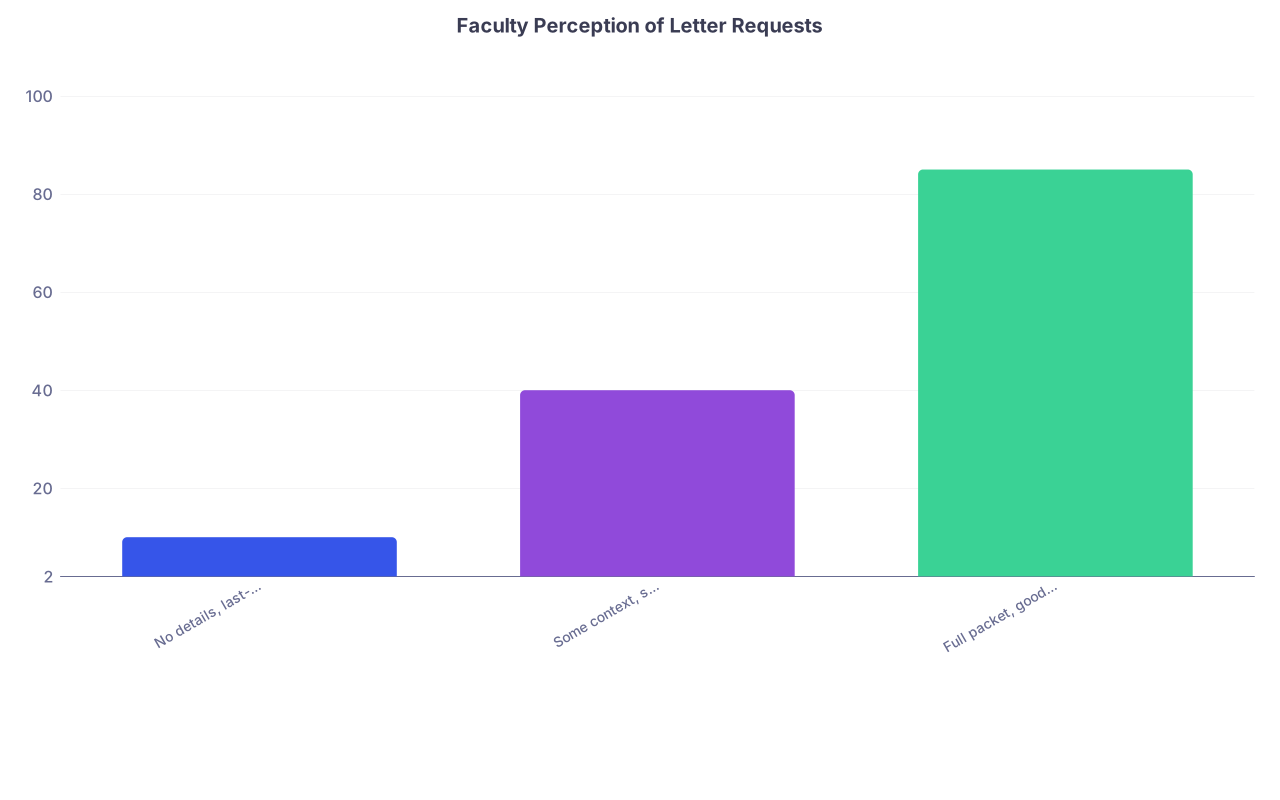
| Category | Value |
|---|---|
| No details, last-minute | 10 |
| Some context, short notice | 40 |
| Full packet, good timing | 85 |
You want to be in that last category.
3. You Give Them an Out
Ethical faculty appreciate this:
“If you do not feel you can write a strong letter, I completely understand and would appreciate your honesty.”
This line does two things:
- It signals that you understand the difference between “a letter” and “a strong letter.”
- It gives them permission to decline instead of writing something lukewarm.
And yes, sometimes they’ll say no. That’s good. A “no” is better than a hidden weak letter.
The Quiet Reality: Faculty Reputation Is Tied to You
Here’s the part students underestimate.
When a faculty member writes a truly strong letter, they’re spending reputation capital. Admissions committees remember names. If Dr. X consistently oversells mediocre students, people start discounting Dr. X’s letters.
So before a faculty member agrees to go all-in, they think:
- If this student ends up in trouble, will my name be attached?
- If another faculty calls me about them, will I stand by what I wrote?
- Am I comfortable putting them in front of my colleagues at that next level?
This is why professionalism, honesty, and basic courtesy matter so much more than you think at the time. Word travels. Faculty talk.
I’ve literally heard: “I wrote him a very strong letter for that summer program, and then he ghosted the PI after a week. I’m not making that mistake again.”
That one story will make that faculty a lot more cautious about the next enthusiastic student who pops into their inbox.
If You’re Early in the Process: How to Start Now
If you’re still premed or early in undergrad, the best thing you can do is stop thinking of letters as a checkbox and start treating them as a natural byproduct of decent long-term behavior with a few key people.
Here’s the stripped-down play:
- Identify 2–3 potential “home bases”: a lab, a course sequence, a clinician you shadow repeatedly, a longitudinal volunteer role with a faculty advisor.
- Show up consistently. Be reliable. Ask good questions. Don’t fake interest—attach yourself where you’re at least mildly curious.
- After a few months, ask for small responsibilities. Deliver on them.
- Maintain light, professional contact over time. Occasional update emails, stopping by office hours once in a while even after the course ends.
Do that, and when the time comes, you won’t be begging strangers for “strong” letters. You’ll be formalizing what everyone already knows.

| Step | Description |
|---|---|
| Step 1 | Start Course or Lab |
| Step 2 | Engage Early: Office Hours & Questions |
| Step 3 | Consistent Performance & Reliability |
| Step 4 | Ask for Feedback & Show Growth |
| Step 5 | Take on Extra Responsibility |
| Step 6 | Maintain Relationship Over Time |
| Step 7 | Request Strong Letter with Full Packet |
FAQ (Exactly 3 Questions)
1. Is it ever okay to ask for a letter from someone who doesn’t know me well if they’re “famous”?
Usually, no. A generic letter from a big-name professor is often less helpful than a detailed, enthusiastic letter from a mid-level faculty member who actually knows you. Committees care far more about content than name recognition. Unless you’ve spent real, substantive time with that famous person, you’re asking for a bland, recycled letter that adds nothing.
2. How many “strong” letters do I really need for med school?
For most med schools, three is the standard: usually two science faculty and one non-science or PI/mentor. Out of those three, you want at least two to be genuinely strong—meaning specific, story-based, and comparative (“among the top X% of students I’ve worked with”). More letters don’t help if they’re all generic. Depth beats volume.
3. What if my school is huge and it’s hard to get to know faculty?
Then you have to be intentional. Smaller upper-level courses, research groups, honors seminars, and long-term volunteer programs tied to faculty are your workaround. If all you do is sit in 300-person lectures and leave, you’re choosing a profile that makes strong letters impossible. Someone on your campus is accessible—you just may have to go slightly out of your way to find them and then stay put long enough to matter.
Key takeaways: Strong letters are not about grades; they’re about stories and trust. Faculty decide long before you ask whether you’re someone they can write about in detail. And you build that decision—slowly—by being the kind of student they’re proud to put their name behind.