The belief that you need a months-long relationship with one attending to get a great clinical letter is outdated. The modern reality—constantly rotating attendings—is not an excuse. It is a constraint you can work with.
If you are on a service where the attending flips every week (or faster), you can still walk away with a strong, detailed clinical Letter of Recommendation. But you cannot be passive. You need a system.
I am going to give you that system.
Step 1: Understand What Makes a Clinical Letter “Strong”
Before you worry about weekly attendings, you need to understand what programs actually want from a letter. Most students get this wrong. They chase big names instead of strong content.
A strong clinical letter has three non-negotiables:
- Specific, concrete behaviors
- Clear comparison to peers
- Evidence that the writer actually knows you
If a letter says:
“Alex was a pleasure to work with. Always punctual, worked well with the team, and patients liked them.”
That is useless. That is the default “I barely remember this student” letter.
Programs want statements like:
- “Top 10% of students I have worked with in the last five years.”
- “On a busy call night, they independently prioritized sick patients, escalated appropriately, and improved our throughput.”
- “I directly observed their patient counseling multiple times; they consistently used understandable language and checked for comprehension.”
So the question you should be asking is not, “How do I get an attending to like me in a week?” but “How do I create enough observable, memorable behavior in one week that they can write this type of letter?”
That is a much better problem. And it is solvable.
Step 2: Map Your Reality – Know Your Rotation Structure
You cannot plan if you do not understand the schedule.
Figure this out on Day 1 (or even before):
- How often does the attending change?
- Do you keep the same residents for the block?
- Are there any “site directors” or “clerkship directors” who see you intermittently but over a longer period?
- Do you switch services entirely every week, or just attendings?
If you are on a rotation where:
- Attendings change weekly
- Residents stay the full block
- Clinic/wards sites have a “site lead”
Then you actually have several potential letter writers:
- One or two attendings who see you for 1–2 very strong weeks
- A senior resident or chief who can co-sign or provide input
- Clerkship or site directors who can write a “summary” letter pulling from multiple attendings’ feedback
The smartest students intentionally create this “composite” evaluation picture. They do not rely on getting lucky with one “amazing attending” for four straight weeks. They engineer redundancy.
Step 3: Pick Your Targets Early and Deliberately
You do not have the luxury of “seeing how it goes” for four weeks. With 1-week attending blocks, your window is small.
By the end of Week 1, you should have a working list in your head:
- Attending A (Week 1): Great teacher, gave you real responsibility, responded well to your initiative
- Attending B (Week 2): Detached, never learned your name, disorganized team. Not your letter writer.
- Attending C (Week 3): Ran tight rounds, you clicked, you got good informal feedback
- Clerkship/site director: Saw you in multiple contexts, reviews all staff evaluations
Your goal is to leave each week with enough impression that:
- The attending remembers you clearly
- They see your growth mindset and reliability
- You have at least one specific case/patient they can mention later
But you do not need every attending to become a letter writer. You need 1–2 very good ones plus strong aggregate evaluations.
Step 4: Design a One-Week “Impression Plan” for Each Attending
This is where students either win or disappear.
You get 5–6 working days with an attending. You cannot be generic. Here is the structure I recommend and have seen work repeatedly.
Day 1: Intentional Introduction and Signal
Most students mumble their name once and vanish into the herd. You will not.
Early on Day 1, when there is a moment:
- Walk up, introduce yourself clearly
- State your level and goals for the week
- Ask one tight, purposeful question
Example script:
“Dr. Smith, I am Jordan, third-year student. This is my first inpatient medicine rotation. My biggest goals this week are to improve my assessment and plan writing and get more comfortable presenting succinctly on rounds. Is there anything specific you like students to focus on or do on your service?”
This does three things:
- Shows maturity and intention
- Gives the attending a mental “hook” for you (M3, inpatient, working on A&P and presentations)
- Opens the door for feedback later
Write down whatever they tell you. Then actually do it.
Days 1–2: Become Predictably Useful
Your job in a short block is not to show you are a genius. It is to show you are a reliable, low-maintenance, quickly improving member of the team.
Focus on:
- Timeliness: Early, not just “on time.” On a 7 am start, you are physically there by 6:40, pre-charting.
- Follow-through: If you say you will do something (check a lab, call a family, update a note), it is done and communicated back.
- Clean, organized notes: Even if the content is still developing, formatting and clarity should never be the problem.
Tell your senior resident on Day 1:
“I know attendings change weekly here. I am hoping to build toward a strong clinical letter. If you notice anything I can fix early, I would rather hear it now than on the last day.”
Residents love this. It makes their life easier and signals you care.
Midweek (Day 3–4): Ask for Focused Feedback
You cannot wait until the last day for “how am I doing?” feedback. It will be vague and useless.
Instead, pick one domain you are working on and ask for very specific feedback.
Example:
“Dr. Smith, could I get brief feedback on my presentations this week? I have been trying to be more concise but still complete. Is there one thing you would recommend I change for tomorrow?”
That “one thing” is gold. Fix it. Then the attending sees rapid improvement over a couple of days. That is what they write about later.
You can do the same with:
- Assessment and plan structure
- Clinical reasoning
- Patient communication (especially in clinic)
- Procedures (if relevant)
The point is: you are creating a feedback loop inside a very short time window.
End of Week: Close the Loop and Plant the Seed
On the last day with that attending, do not just vanish after rounds.
Find a brief time:
“Dr. Smith, I wanted to thank you for the week. Your feedback about tightening my problem list really helped me structure my notes better. I am planning to apply in internal medicine and will likely need strong clinical letters. If, after seeing my performance this week, you feel you could comment specifically on my clinical work, I would be very grateful to ask you for a letter later in the year.”
This wording matters:
- You are not begging
- You are giving them an out (“if you feel you could comment specifically…”)
- You are tying your request to observed behavior
If they say yes, you follow up with an email that weekend (we will get to that). If they hesitate or hedge, they are telling you no. Believe them and move on.
Step 5: Use Residents and Evaluations as Force Multipliers
In weekly attending systems, residents often know you far better than any single attending. Programs know this. Smart attendings ask their residents directly:
“How was this student? Top, middle, bottom?”
So you want residents to be your quiet advocates.
How to do it:
Make their life easier
- Pre-round reliably
- Own 1–3 patients and know them cold
- Help with scut without whining (discharges, med recs, paperwork)
Ask for mid-rotation feedback
On a slow afternoon:“Can I get 2–3 minutes of honest feedback? One thing I’m doing well and one thing I need to fix this week?”
Let them know your goals
Tell a trusted senior:“I am hoping to get a strong IM letter from this rotation, ideally from Dr. X or Y. If you see anything that would help make that possible, or anything I’m missing, please tell me.”
Many residents will then volunteer comments to attendings, like:
“By the way, Jordan has been excellent this week—super reliable, good with patients, improving quickly.”
You cannot force that. But you can earn it.
Step 6: Convert Weekly Impressions into Letter Commitments
Let us say over a 4-week core rotation you have:
- Week 1: Solid, but attending seemed distracted
- Week 2: Strong connection with attending, good direct feedback
- Week 3: Rough first two days, improved a lot by end; resident loved you
- Week 4: Clerkship/site director saw you in clinic twice, gave verbal praise
Your likely letter strategy:
- Primary letter: Week 2 attending
- Backup/second letter: Clerkship or site director who has aggregate impression
- Supporting voice: Residents who will enter evaluations that attendings read before writing
You handle each attending who has seen your “A-game” with the same structure:
- Ask in person, at the end of your week with them, using the script above
- If they say yes, send a follow-up email within 48 hours:
- Thank them again
- Attach your CV and short “brag sheet” (bullet points of patients/tasks you handled that week, plus your future specialty interest)
- Remind them of 1–2 specific cases you worked on together
That email might look like:
Subject: Thank you and letter of recommendation
Dear Dr. Smith,
Thank you again for the opportunity to work with you on the inpatient medicine service last week, and for agreeing to write a clinical letter of recommendation for me. I appreciated your feedback on structuring my problem list and being more efficient on rounds.
To help with your letter, I have attached my CV and a brief summary of my work during our week together, including a few patients we managed (Mr. J with decompensated cirrhosis and Ms. R with new heart failure) and some of the responsibilities I took on.
I plan to apply to internal medicine this coming cycle and I am very grateful for your support. Please let me know if I can provide anything further.
Sincerely,
[Name]
[Contact info]
You are making it as easy as possible for them to remember what you did in that short time.
Step 7: When You Have No Single Long-Term Attending
Some rotations are chaos by design:
- New attending every week
- New sites
- Residents constantly changing
- No one sees you for more than 4–5 days
Here is how you handle that.
A. Identify the “Anchor” Person
Almost every clerkship has:
- Clerkship director
- Site director
- Course coordinator who compiles evaluations
These people often write “summary letters” for residency. They pull in:
- All attending comments
- Numerical ratings
- Resident feedback
Your job is to make sure those components are strong.
How:
- Treat every week as if it might produce written comments that will be seen by your eventual letter writer. Because it will.
- Ask the clerkship director early:
“Given that attendings rotate weekly here, what is your recommendation for building toward a strong clinical letter from this rotation?”
Then follow their playbook aggressively.
B. Create Your Own Performance Log
Do not rely on your memory three months later.
After each week, write down:
- Attending name and contact info
- Residents you worked closely with
- 2–3 specific patients or situations you handled
- Any direct feedback you received
- Any compliments or positive phrases used (“top student this month,” “very independent,” etc.)
This becomes your “letter packet” later. When you ask an attending or director for a letter, you can say:
“Here is a brief summary of what I did during our week together and some patients we managed.”
You are not putting words in their mouth. You are giving them raw material they can verify.
Step 8: Common Mistakes That Kill Letters in Weekly-Attending Systems
You can do 80% of things right and still sabotage yourself with one or two bad habits.
Avoid these:
Being invisible the first 2–3 days “while I get the lay of the land.”
You do not have time for that. Be appropriately assertive from Day 1.Waiting until the last day to ask for feedback.
That guarantees shallow feedback and missed opportunities to improve.Generic “can you write me a letter?” emails months later to attendings who barely remember you.
They either say no or write a bland letter.Over-focusing on one star attending and coasting with others.
Every attending and resident is a potential evaluator. A bad narrative from Week 3 can poison the well.Acting like a “gunner” in a one-week sprint.
Grabbing every task, answering every question, and cutting off other students makes residents hate you. Residents then quietly sink your reputation.
Aim for competent, collaborative, and coachable. Not “dominant.”
Step 9: Special Considerations for Premeds and Early Med Students
If you are still premed or early MS1/MS2, you can start building skills now that make weekly-attending rotations much easier later.
Focus on:
- Presentations: Practice 2–3 minute oral case presentations and get feedback from mentors, preceptors, or standardized patient encounters.
- Email professionalism: Be the person who writes clear, concise, respectful emails now. You will send dozens related to letters later.
- Early mentors: Build 1–2 longitudinal relationships with physicians (shadowing, research mentors, free clinic attendings). These mentors can later “translate” your short clinical experiences for a letter.
For premeds specifically: even if your clinical shadowing has attending turnover, the same rules apply—introduce yourself clearly, ask what you can watch for, follow up, and track who saw you at your best.
Step 10: Concrete Weekly Checklist You Can Start Using Tomorrow
Here is your plug-and-play system for any rotation with weekly attendings.
| Day | Action |
|---|---|
| Day 1 | Clear intro, state goals, ask attending preferences |
| Day 2 | Ask resident for 1 thing to fix, start performance log |
| Day 3 | Request focused feedback from attending on one skill |
| Day 4 | Demonstrate visible improvement on that feedback |
| Day 5 | Thank attending, ask about letter if appropriate, send follow-up email within 48 hours |
Print that. Tape it inside your notebook. Do it every week.
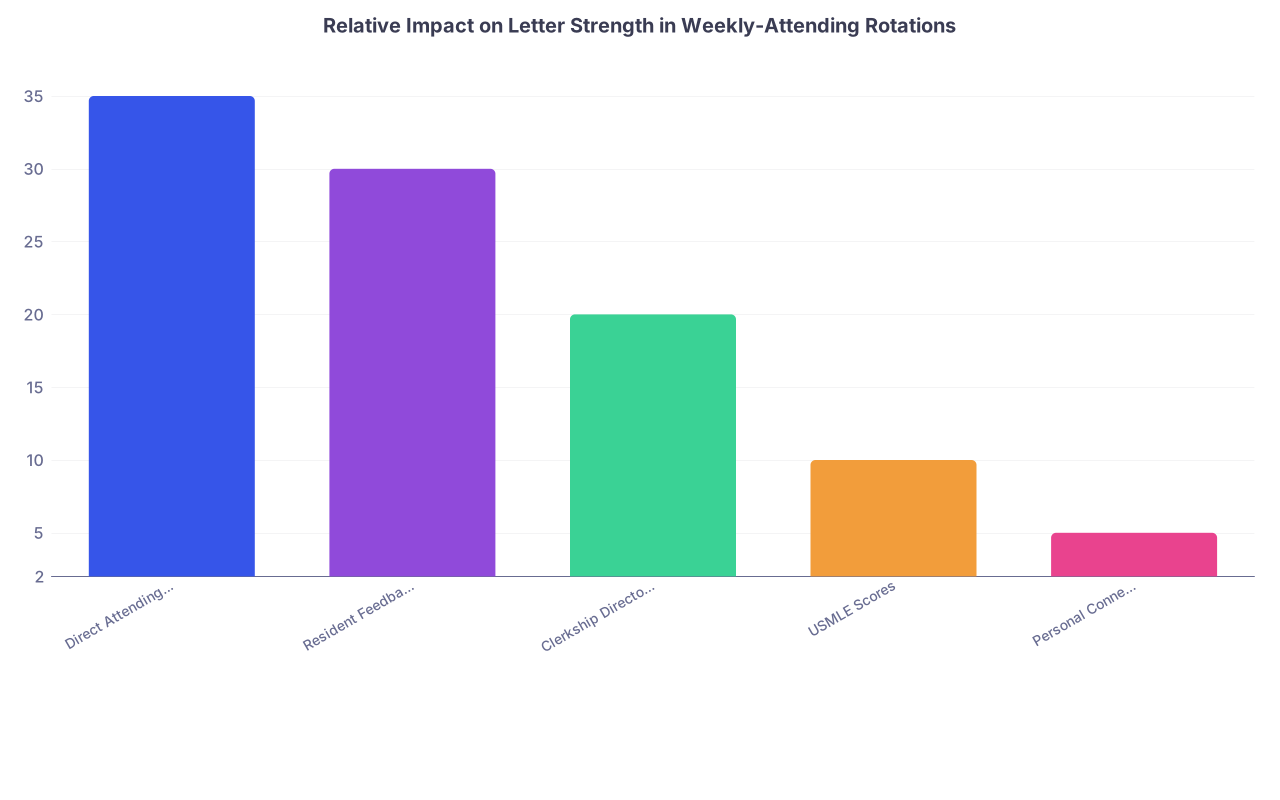
| Category | Value |
|---|---|
| Direct Attending Observation | 35 |
| Resident Feedback | 30 |
| Clerkship Director Summary | 20 |
| USMLE Scores | 10 |
| Personal Connection Only | 5 |
This is the reality: programs care most about what people saw you do clinically. Your job is to manufacture those observations and then make it easy for faculty to convert them into words.

| Step | Description |
|---|---|
| Step 1 | Weekly Attending Rotation |
| Step 2 | Day 1: Intentional Introduction |
| Step 3 | Reliable Work & Feedback Loop |
| Step 4 | Resident Advocacy & Evaluations |
| Step 5 | Targeted Attending Ask |
| Step 6 | Follow-up Email with Cases & CV |
| Step 7 | Strong, Specific Clinical Letter |