
What if your GPA, MCAT, and personal statement are solid—but you still get quietly filtered out because your letters of recommendation came from the wrong people?
That happens more than you think. And not because students cannot find letter writers. Because they choose bad ones.
Everyone obsesses over “strong letter” vs “weak letter” as if that’s just about writing skill or adjectives. The truth is harsher: a lot of letters are DOA the moment the writer’s name hits the page. Wrong person, wrong context, wrong credibility. Commit a few of the mistakes below, and you’ve basically just handed the committee a stack of polite but meaningless noise.
Let me walk you through the nine most common bad mentor choices that quietly sabotage LOR packets for med school and premed programs—and how to never be that applicant.
1. The “Big Name” Who Barely Knows You
This is the classic premed mistake.
You shadowed the department chair for two mornings. Maybe sat in on a tumor board. You exchanged three sentences total. Now you’re thinking: “Chair of Surgery at a big-name academic center! That’ll impress adcoms.”
No. It will not. It will irritate them.
Here’s what happens behind closed doors. Someone reading your file sees:
Letter from: John Smith, MD, FACS, Chair of Surgery, [Well-Known Hospital]
They expect a detailed, personalized letter with concrete evidence of your excellence. Instead, they get:
“I have had the pleasure of very briefly interacting with [First Name]. During their limited time shadowing me, they appeared enthusiastic and interested in surgery…”
That’s it. Vague adjectives. No specific behaviors. No depth.
Adcom thought process: “So you chased a title instead of substance. Got it.”
Why this weakens your packet:
- Shows poor judgment about what matters in medicine: relationships and work ethic, not prestige.
- Signals that no one who actually supervised you closely was willing or able to write.
- Feels like name-dropping. And committees have seen thousands of these.
The better move: Choose the attending who worked with you for 6 weeks on an ongoing research project. Or the course director who saw you grind through a tough exam cycle and lead your lab group. Less fancy name, far more credibility.
2. The Professor From a Class Where You Were Invisible
“I got an A in orgo. I’ll ask that professor.”
Did you ever talk to that professor?
“I mean… no. But I sat in front and got an A.”
That’s not a relationship. That’s a grade.
A letter from a professor who cannot put a personality, voice, or behavior profile behind your name is functionally useless. They’ll just restate your transcript:
“She earned an A in both Organic Chemistry I and II and regularly attended lecture.”
Adcoms can see your transcript. They do not need a letter to repeat it.
You weaken your packet when:
- The professor cannot describe your intellectual style (how you think, not just what you scored).
- They never saw you in office hours, didn’t see you collaborate, and have no examples of resilience or curiosity.
- Their letter could be copy-pasted for any of the 25 students who also got an A.
Better academic letters come from:
- Professors who’ve seen you in small-group or discussion-based classes.
- Course directors you visited multiple times in office hours with real questions.
- Lab instructors or PIs who watched you struggle, troubleshoot, and improve.
If the first time you’re properly introducing yourself to the professor is in your email asking for a letter, that’s already a red flag.
3. The Non-Science “My Favorite Student Ever” Teacher Who Can’t Translate to Medicine
Do non-science letters have value? Yes.
Do they all help? Not remotely.
Good non-science letters:
- Show your communication skills, empathy, leadership, professionalism.
- Come from instructors who can talk about your work in depth.
- Tie traits directly to what would matter in medicine.
Bad non-science letters:
- Sound like a high school yearbook quote with better grammar.
- Lean on generic praise: “best student,” “always prepared,” “a joy to have in class.”
- Never connect your strengths to the realities of patient care or scientific training.
Here’s the trap: You love the teacher. They love you. The letter is glowing. But it’s glowing about the wrong things or in the wrong way, and the adcom reads it as fluff.
If you’re going to use a non-science writer:
- Make sure they understand that this is for medical school, not just “any grad program.”
- Provide a short paragraph about what adcoms care about: reliability, integrity, resilience, teamwork, professionalism, and ability to handle high-stakes information.
- Confirm they can comment on specific projects or behaviors, not just your vibe.
If a non-science professor says something like, “I don’t know anything about medical training, but…”—that opening already softens your letter’s impact.
4. The “Character Letter” From Someone With Zero Academic or Clinical Standing
This one kills packets quietly.
You’re tempted to ask:
- A family friend who is a dentist but never worked with you.
- Your high school coach.
- A pastor, youth leader, or community mentor.
- Your neighbor who “knows your heart.”
Emotionally, that feels right. These people know you deeply. But med schools aren’t selecting for “nice people who try hard in life.” They’re selecting for future physicians who can survive and thrive in rigorous clinical environments.
A pure “character letter” from someone who:
- Never supervised you in a college-level academic setting,
- Never evaluated you in a healthcare, lab, or structured volunteer environment,
…usually lands as extra noise. At best, neutral. At worst, a wasted slot that could have gone to someone with actual evaluative authority.
You should especially avoid:
- Letters from anyone who might raise questions about boundaries (e.g., “I’ve known her as a close family friend since childhood”).
- Anyone whose role is primarily religious or personal unless the letter is tightly framed around structured service work they oversaw.
If the letter writer can’t speak in the language of evaluation—deadlines, performance under stress, responsibility, reliability—their heartfelt praise won’t move the needle.
5. The Physician You Shadowed for 10 Hours (or Less)
Shadowing is not enough by itself to justify a letter.
I’ve seen students proudly attach a letter from a surgeon they followed for two clinic afternoons. The letter usually reads something like:
“[Student] shadowed me for approximately 8 hours across two clinics. During that time, they were respectful and asked appropriate questions. They appear interested in medicine.”
That’s not a recommendation. That’s a verification of presence.
- Observational.
- Low contact.
- Low responsibility.
Letters that matter describe:
- What you did.
- How you handled tasks.
- How you responded to feedback.
- Concrete examples of professionalism and initiative.
If all you did was stand in the corner, wear a white coat, and nod, that physician cannot recommend you beyond the bare minimum. Asking them for a letter just exposes that weakness.
Better strategy:
- Shadow → then transition to volunteering or employment in the same clinic/setting where you can actually work.
- Ask for letters from physicians you scribed for, assisted in research with, or who supervised you in a longitudinal clinic program.
- Minimum: weeks to months of repeated contact, not hours.
If you’re thinking, “But he’s the chief of cardiology,” go back to Mistake #1. The title doesn’t save the letter.
6. The Research PI Who Doesn’t Actually Like or Respect Your Work
This one’s subtle—and dangerous.
Many students assume: “I did research in this lab for a year; the PI has to write me a strong letter.”
No, they don’t. And some will not.
You weaken your packet when you:
- Ask for a letter from a PI who was consistently frustrated with your reliability or effort.
- Ignore the fact that your grad student mentor did all the heavy lifting and the PI barely knows your name.
- Misread polite professionalism as approval.
Here’s what a “polite but lethal” letter from a PI can sound like:
“[Student] has been a member of my lab since May 2023. They assisted with basic data entry and sample preparation. Under supervision, they completed assigned tasks.”
That’s a death sentence for a “research letter.” The subtext: minimal initiative, low impact, maybe even just a warm body.
You must avoid:
- PIs who have never seen you think independently or troubleshoot.
- Labs where you frequently cancelled, showed up late, or ghosted.
- Situations where a PhD/postdoc clearly doesn’t trust you with anything important.
Better options when your PI relationship is weak:
- Ask the postdoc or grad student who directly supervised you to write a primary draft and co-sign with the PI.
- Or skip the lab entirely and get a research letter from another mentor who actually saw you perform (even if the project is smaller or less flashy).
If you get any hesitation when you ask—“I can write a letter, but I’m not sure how strong it would be”—believe them. Do not try to “convince” them. Find someone else.
7. The “Nice” Supervisor From a Fluffy Volunteer Role
Volume of hours is not the same as meaningful evaluation.
Students love to use:
- The volunteer coordinator from a hospital gift shop.
- The staff member from a campus blood drive.
- The organizer from a one-day community service event.
Yes, you logged 200 hours at the hospital information desk. But what did you actually do? Smile. Hand out maps. Call transport. That’s fine as experience. Weak as a primary letter source.
The problem:
- These roles usually don’t test higher-level skills: critical thinking, judgment, handling confidential information, teamwork under pressure.
- Supervisors in these positions sometimes write “sweet” letters that sound like employee-of-the-month blurbs, not professional evaluations.
Committees pick up on this quickly:
- “Very pleasant”
- “Always on time”
- “Patients enjoyed her presence”
Nice, but surface-level. For a secondary letter? Maybe. For a core packet? No.
Stronger clinical/service letters come from:
- Roles where you took care of longitudinal responsibilities (e.g., hospice volunteer over 1–2 years, medical assistant, scribe, EMT).
- Supervisors who can describe how you handled difficult interactions, emotionally charged situations, or complex logistical tasks.
If your biggest accomplishment in that role was “never called out last minute,” it doesn’t warrant a prime letter slot.
8. The LOR From Someone Who Writes Poorly (or Sloppily)
Yes, writing quality matters.
A brilliant mentor with terrible writing skills can still sink you. I’ve seen letters that:
- Use the wrong name or pronouns multiple times.
- Copy-paste sections clearly written about another student.
- Contain spelling and grammar errors on every other line.
- Ramble with no structure, mixing different students and examples.
Adcom signal: this mentor either didn’t care enough to proofread, or they’re generally disorganized. Either way, they do you no favors.
Even worse:
- Super short letters (less than half a page) scream “I have nothing to say” or “I didn’t have time to write this.”
- Over-the-top hyperbole with no evidence feels fake: “the best student I’ve ever met,” “will be the greatest doctor of her generation,” followed by zero concrete detail.
You can’t fully control how a letter is written, but you can reduce your risk:
- Ask mentors who are used to writing LORs for med school or grad programs.
- Pick people who are organized, detail-oriented, and respond to emails reliably. Those traits usually translate into better letters.
- Offer a short bullet-point summary of your work with them and projects you contributed to. Some will use your notes as structure.
If you’ve seen this person’s writing before in emails or evaluations and it’s chaotic or careless, think hard before handing them this responsibility.
9. The “Quantity Over Quality” Mix: Too Many Weak Voices, Not Enough Strong Ones
One last trap: thinking more letters = better packet.
Med schools usually:
- Require certain core letters (e.g., 2 science, 1 non-science, or a committee letter).
- Allow a limited number of additional letters.
Students then:
- Toss in extra shadowing letters, fluff volunteer letters, or random “character” letters.
- Assume volume will show “how many people support me.”
But here’s how it actually lands:
- A few weak or lukewarm letters dilute the impact of your strongest ones.
- Adcoms may wonder why you had access only to superficial recommenders.
- Extra low-value letters increase reading fatigue and annoyance. That’s not what you want associated with your name.
Think of your LOR packet as a curated portfolio, not a scrapbook.
| Packet Type | Number of Letters | Typical Impact on Adcom |
|---|---|---|
| 3–4 strong, specific letters | 3–4 | Clear, compelling signal |
| 2 strong + 3 weak extras | 5 | Mixed, diluted message |
| 1 strong + 4 weak/neutral | 5 | Raises red flags |
Aim for:
- Fewer, stronger letters over many mediocre ones.
- Each writer adding something new: different setting, different competencies, different stories.
If two letters are going to say essentially the same vague thing about you being “nice and hardworking,” one of them can—and should—go.
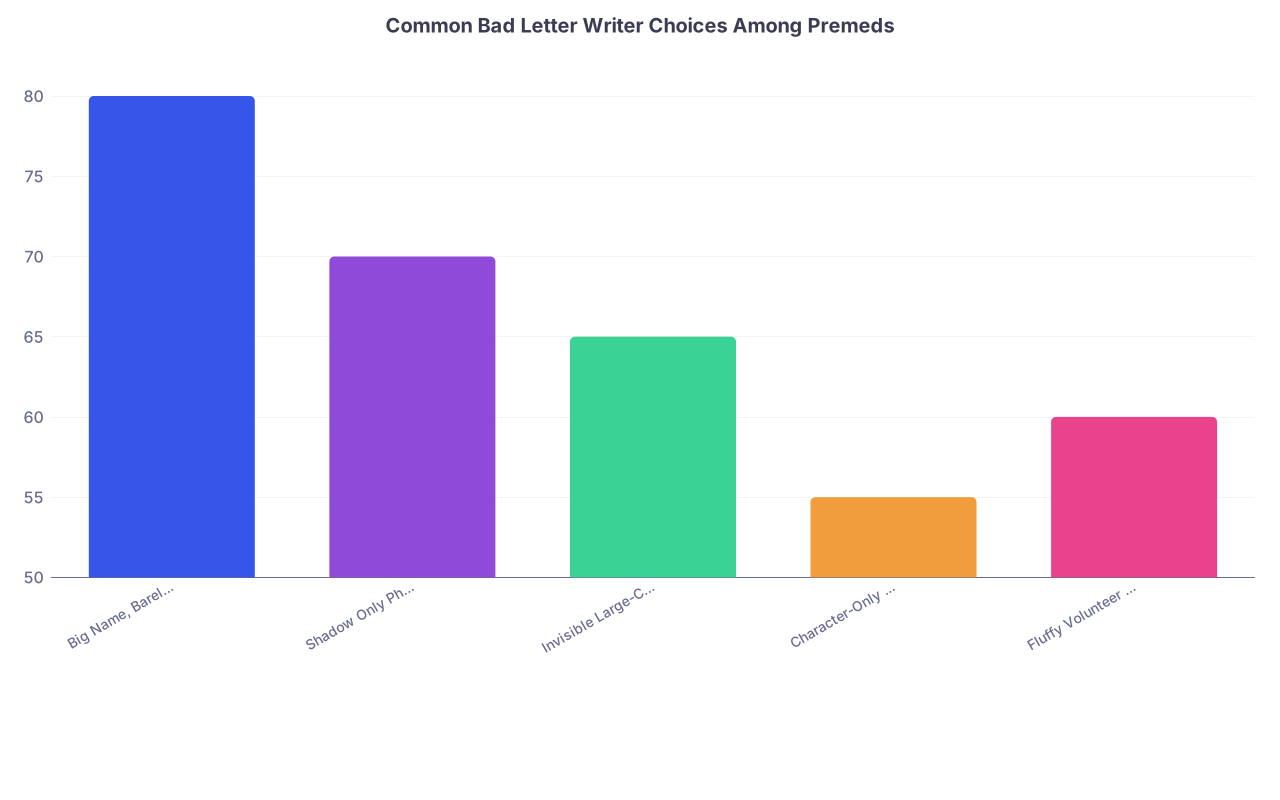
| Category | Value |
|---|---|
| Big Name, Barely Knows You | 80 |
| Shadow Only Physician | 70 |
| Invisible Large-Class Professor | 65 |
| Character-Only Mentor | 55 |
| Fluffy Volunteer Supervisor | 60 |
How to Pressure-Test a Potential Letter Writer (Before You Ask)
Let me give you a quick filter so you stop walking into these traps.
Before you ask anyone, you should be able to answer “yes” to at least most of these:
- Have they seen you work over time, not just in a one-off interaction?
- Can they compare you to peers in a meaningful way?
- Do they understand what medical school or premed programs look for (or are they willing to learn)?
- Could they describe specific examples of your behavior? A project, a crisis, a challenge you handled?
- Do they respect you enough to put their name behind you without hesitation?
If you flinch on any of those, think carefully.
A simple, direct question can also save you:
“Do you feel you could write me a strong, detailed letter of recommendation for medical school?”
If they:
- Hesitate,
- Say “I can write you a letter” without the word “strong,”
- Or sound uncertain about specifics,
Don’t push. Thank them and move on. That awkward moment now is much better than a weak letter later.

| Step | Description |
|---|---|
| Step 1 | Need LOR |
| Step 2 | Do NOT ask |
| Step 3 | Low priority writer |
| Step 4 | Educate them or reconsider |
| Step 5 | Good candidate to ask |
| Step 6 | Has known you 3+ months? |
| Step 7 | Directly supervised you? |
| Step 8 | Can give specific examples? |
| Step 9 | Understands med school expectations? |
Quick Recap: Stop Letting the Wrong People Speak for You
Three things to keep in your head while you pick letter writers:
Prestige doesn’t beat proximity. A mid-level professor or attending who actually knows you will write a stronger, more credible letter than a famous name who barely remembers your face.
Evaluation beats affection. The best letters come from people who have formally or informally evaluated your performance under real responsibility—not people who just think you’re a great human.
Fewer strong letters beat many weak ones. Every extra mediocre letter waters down your story. Protect your packet. Choose selectively. And stop asking the wrong people to define your potential.