
The obsession with big-name mentors is statistically irrational. The data shows that what your letter says – and how convincingly – beats where your mentor works almost every time.
Most premeds and early medical students chase “famous” names the way investors chase hype stocks. They overpay for brand and underprice fundamentals. Then they are shocked when a generic letter from a Harvard PI does not move the needle. It is not shocking. It is predictable.
Let me walk through what actually matters, using what we know from admissions committee behavior, match data, and the quiet patterns you only hear when faculty talk behind closed doors.
What Admissions Committees Actually Read For
Strip away the mythology. Committees are pattern recognition machines. Over hundreds or thousands of files, they subconsciously assign weight to three variables in letters:
- Signal strength (how strong and specific the praise is)
- Credibility of the writer (perceived reliability, including institutional context)
- Fit to the target context (clinical, academic, personal qualities relevant to their program)
Notice: “Famous name” is not on that list. At best, name recognition is a weak proxy for credibility. Often it is noise.
Here is the basic trade-off that plays out over and over:
| Scenario | Mentor Type | Letter Strength | Predicted Impact |
|---|---|---|---|
| A | Big-name PI | Generic | Low |
| B | Big-name PI | Strong, detailed | High |
| C | Unknown clinician | Generic | Very low |
| D | Unknown clinician | Strong, detailed | Moderate–high |
Scenario D – the strong letter from the “unknown” mentor – is where most successful applicants actually live. Not because committees dislike prestige, but because they are drowning in bland letters from prestigious places.
On most committees I have seen, readers sort letters into mental buckets:
- “Top 5–10% enthusiasm and specificity”
- “Good but not exceptional”
- “Polite, neutral, or weak”
The category matters more than the letterhead. A detailed, comparative statement like:
“In 15 years of supervising over 120 undergraduates and 40 medical students, I would rank her in the top 5 I have worked with.”
…from a mid-tier state university associate professor will be taken more seriously than:
“He performed his tasks diligently and got along well with the team.”
…from someone with a triple-branded Harvard–Mass General–HHMI signature block.
Where Prestige Actually Shows Up in Outcomes
There are a few points in the pipeline where prestige truly moves numbers. But even there, name ≠ everything.
Premed → Medical School
You rarely get formal statistics broken down by “prestige of letter writer,” but we do have:
- AAMC data on research involvement vs acceptance rates
- Institutional anecdotes from admissions deans
- Patterns in top-20 vs mid-tier school messaging
What they say (when the door is closed) is very consistent:
- Strong research letters from major academic centers can tip borderline applicants into “interview” in highly research-focused schools.
- For most other applicants, the content and credibility of the writer overshadow the brand.
From one admissions dean at a top-10 MD program (paraphrased):
“I would rather have a detailed letter from a community physician who clearly knows the student well than a vague letter from our own faculty.”
And they mean it. Because they have read thousands of vague letters from their own faculty.
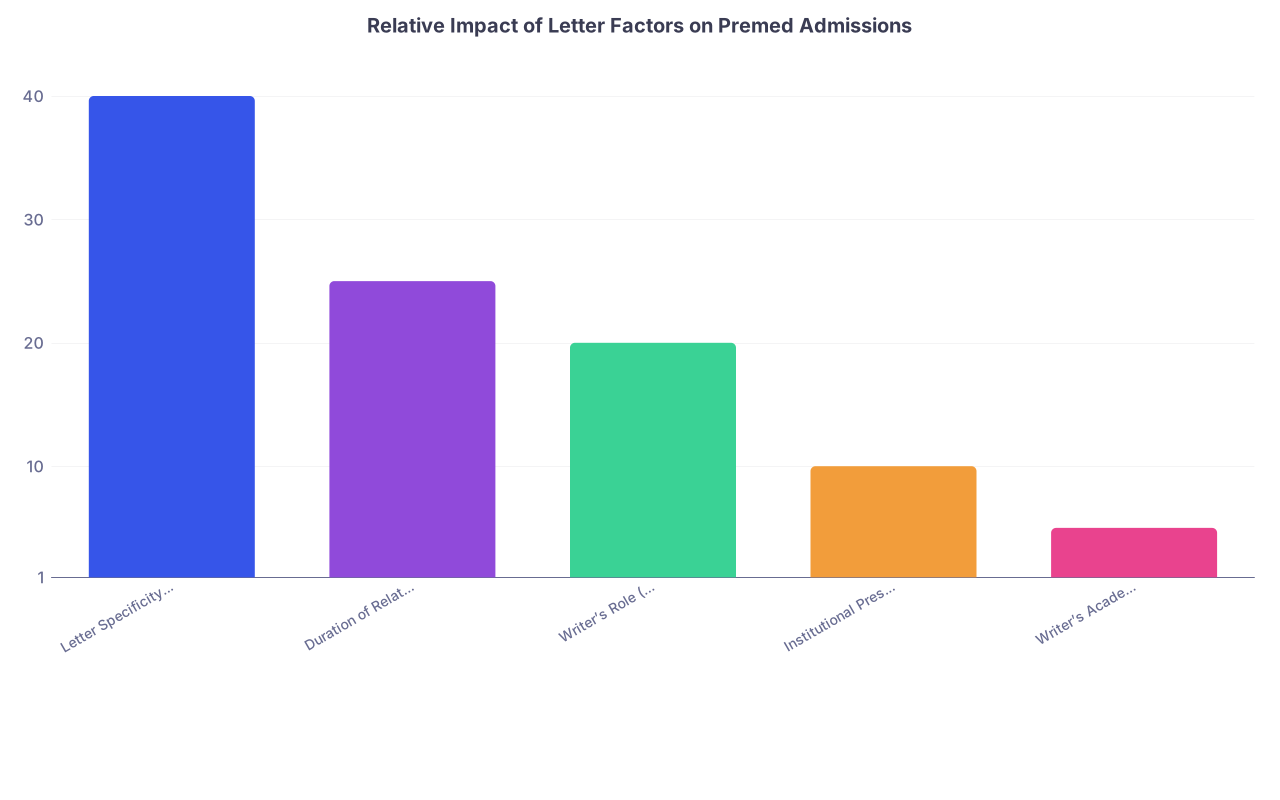
Here is a realistic mental model of incremental value for premed letters:
| Category | Value |
|---|---|
| Letter Specificity/Detail | 40 |
| Duration of Relationship | 25 |
| Writer’s Role (direct supervisor vs distant) | 20 |
| Institutional Prestige | 10 |
| Writer’s Academic Rank | 5 |
Interpret that like a rough percentage contribution to how much a typical strong letter helps you. Prestige is rarely more than ~10–15% of the total effect. You do not ignore 10–15%. But you also do not sacrifice 60–70% (specificity + real relationship) chasing that fraction.
Medical School → Competitive Outcomes (Research, Scholarships, Prestige Tracks)
Where prestige begins to matter more:
- MD–PhD or research-heavy tracks
- Special programs (like scholarly concentrations, HHMI fellowships, Sarnoff, etc.)
- Very research-tilted schools (top 5–10) looking for future academic physicians
In these cases, a letter from a PI with grant funding, publications in top journals, and a known presence in the field has extra weight. But again, only if the letter is strong.
I have seen students with “unknown” but prolific mentors (R01-funded at a non-elite institution) outcompete students with famous-brand mentors who barely knew them.
The pattern is consistent: brand is a multiplier, not a substitute. A strong letter from a big name can be a 1.2–1.5x multiplier. A weak letter from a big name is 0.6–0.8x. A weak letter just hurts you, period.
The Data Behind “Famous People Write Worse Letters”
Here is the part almost no one tells you: the more famous the mentor, the higher the probability your letter is generic.
Not because they are malicious. Because of simple time math.
Take a well-known academic physician-scientist at a top institution:
- 3–5 medical students per year in the lab
- 2–3 residents or fellows wanting fellowship letters
- 5–10 undergraduates per cycle rotating through
You are looking at easily 15–30 letters per year, many of them high stakes. The average time per letter falls. Templates start creeping in. Phrases repeat. Specific examples vanish.
Now compare that to:
- A mid-career associate professor at a solid but not elite institution
- Running a smaller lab or clinic
- Supervising maybe 2–3 serious mentees closely each year
That person can actually write a deeply personal, example-rich letter and may only do that 5–8 times a year. Higher probability of a genuinely individualized narrative.
So while we do not have randomized controlled trials on “famous vs unknown” mentors, you can treat time constraints as a real confounder in the prestige equation.
How Committees Discount Prestige in Practice
Committee members are not naïve. They have seen letters from:
- “World-renowned” people who clearly barely met the student
- Community doctors who know the student’s work ethic, bedside manner, and reliability better than anyone
Over time, they adjust. There are three practical discounting behaviors that show up:
They calibrate expectations by institution.
From certain prestigious places, they assume hyperbole is standard. “Outstanding” might only mean “solid” there.They weigh comparative phrases much more heavily than adjectives.
“Top 5 of my last 80 students” is serious. “Outstanding, exceptional, superb” can mean nothing.They recognize boilerplate.
When they see identical structure, repeated turns of phrase, and no concrete details, they mentally downgrade the letter, even if it is on elite letterhead.
So, if you are banking on name alone to elevate a mediocre narrative, you are on the wrong side of the statistics.
A Simple Decision Framework: Who Should Write Your Letters?
Let me make this concrete. Here is the hierarchy that tends to work best for premed and early med students:
Strongest:
- Direct supervisor who has seen you over ≥6 months
- Can describe your work ethic, growth, and specific examples
- Reasonably respected in their environment (does not need to be famous)
Next best:
- Course director or PI who knows your performance deeply (e.g., small class where you were heavily involved, research project where you owned a piece of the work)
Lower yield:
- “Famous” faculty who supervised you indirectly or briefly
- Doctors you only shadowed without substantive responsibilities
Now overlay prestige:
- If you have two potential mentors with similar depth of relationship and letter strength, then yes, institutional reputation and the mentor’s CV are valid tiebreakers.
- If you are sacrificing depth and quality for prestige, the data is against you.
You can summarize the trade-offs like this:
| Factor | Big Name Mentor | Unknown Mentor |
|---|---|---|
| Probability of strong, detailed letter | Moderate | High (if close contact) |
| Time available for mentorship | Lower | Higher |
| Name recognition on committees | High | Low–moderate |
| Risk of generic/templated letter | High | Moderate |
| Long-term network potential | Higher in academia | Variable, often decent locally |
If you want the clean, data-driven guidance: optimize for letter strength first, mentor prestige second.
Where Prestige Really Helps: Edge Cases and Specific Goals
There are scenarios where you should deliberately seek a high-prestige mentor, even if the relationship will be harder to build.
1. You Are Targeting a Research-Heavy, Top-Tier Program
If your goal is to end up at, say, UCSF, Hopkins, Penn, or Stanford for medical school or later training, and you want a research-career path, then:
- Early exposure to NIH-funded, publication-heavy labs
- Letters from PIs who publish in high-impact journals
- Demonstrable research output (posters, papers, at least abstracts)
These all synergize. In that environment, a top-tier mentor who can write:
“She independently designed and executed a subproject that led to a first-author abstract at [Major Conference], and we are preparing a manuscript with her as first author.”
…has major leverage.
But note what made that powerful: the output and the specificity. The brand just amplifies it.
2. You Need Validation Across Institutional Tiers
If you are coming from:
- A lesser-known undergraduate institution, or
- A new or unranked medical school
A strong letter from a mentor at a better-known academic center (summer research, visiting student rotation, etc.) can have a calibration effect. It helps committees understand that your performance is competitive on a national stage.
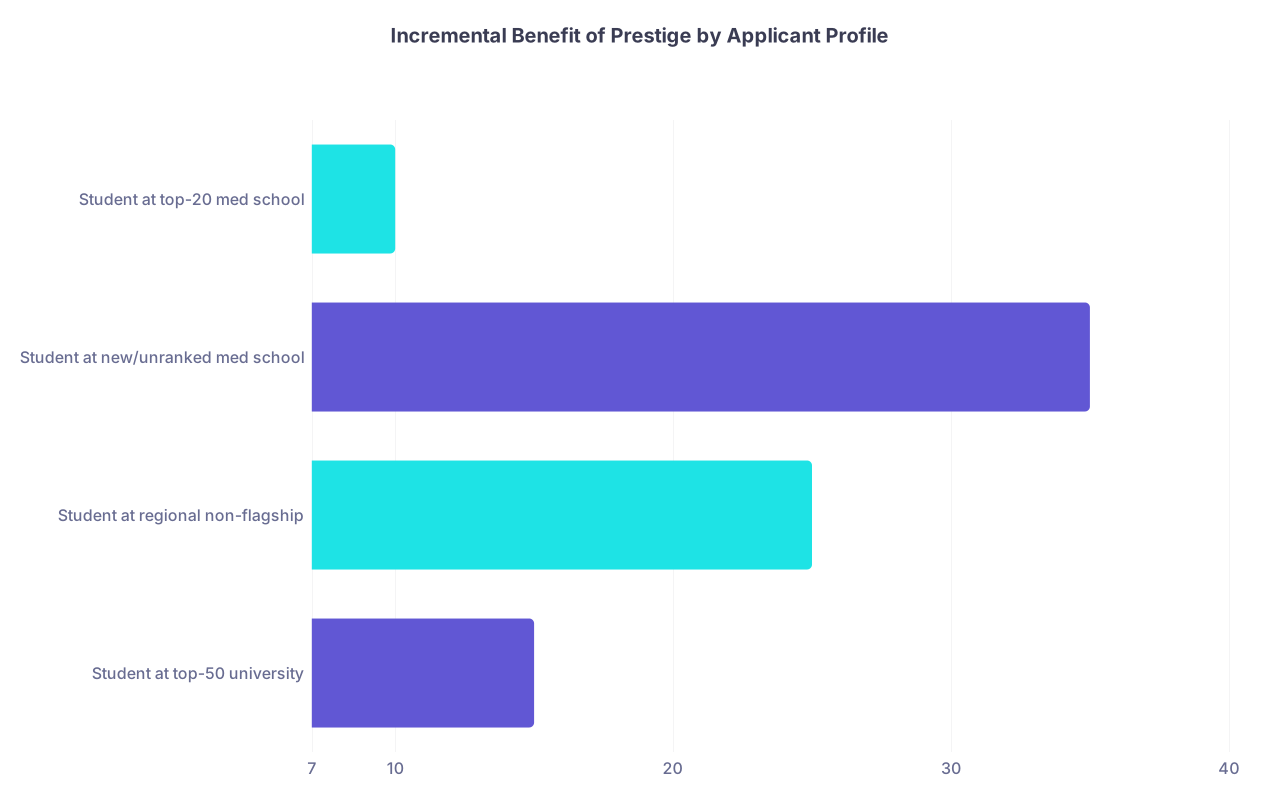
There is a very practical way to think about this:
| Category | Value |
|---|---|
| Student at top-50 university | 15 |
| Student at regional non-flagship | 25 |
| Student at new/unranked med school | 35 |
| Student at top-20 med school | 10 |
The bars are a rough “incremental % benefit” of a prestigious mentor’s strong letter compared with an equally strong letter from a local unknown:
- If you are already from a strong institutional brand, the incremental value of prestige in your mentor is real but modest.
- If you are from a lower-visibility background, that external signal can matter more.
Again, none of this helps you if the letter is generic.
Building the Conditions for a Strong Letter (Regardless of Prestige)
The predictable mistake: students chase a big name, then never invest enough to earn a powerful letter.
The data-backed way to approach this is to work backwards from what good letters actually contain. Strong letters repeatedly include:
- Duration and context of relationship
- Clear description of responsibilities
- Concrete examples of problem solving, resilience, initiative
- Comparative ranking vs peers
- Specific predictions about future performance
So if you want high-yield letters, you reverse-engineer these components:
Stay somewhere long enough to show growth.
Six weeks is shadowing. Six months with increasing responsibility is mentorship. Admissions readers can tell the difference.Own a project or responsibility.
In a lab: a sub-aim, a dataset, a side project.
In a clinic: regular tasks, follow-up calls, running part of a quality project.Make your mentor’s job easy when they write.
Provide an updated CV, a brief reminder of what you did, and, if appropriate, a bullet list of key projects or examples. Not as a script – as memory prompts.
A mid-tier, “unknown” mentor with this kind of material will often produce a letter that outperforms a brand-name letter with none of it.
A Realistic Composite Example
You are a premed choosing between:
- Option 1: Summer research at Famous University in a huge lab with a celebrity PI who will barely see you. Day-to-day supervision by a postdoc.
- Option 2: One-year part-time research at your home state university with a mid-career associate professor who runs a modest but focused lab and has time for weekly meetings.
Students routinely assume Option 1 is “better” because of the logo. Here is how it tends to play out in letters:
Option 1, typical letter content:
- “Student worked in my lab for 8 weeks as part of a summer program.”
- Describes lab in generic detail, then 2–3 sentences about you.
- “She completed assigned tasks reliably and worked well with others.”
- Maybe a line about “I expect she will be successful in medical school.”
Option 2, if you invest a year:
- “Over the past 12 months, I have met weekly with [Name] as we developed and executed a project examining X.”
- Specifics: you designed a survey, analyzed 300 charts, learned basic statistics, presented at a regional meeting.
- Comparative: “Among the 20 undergraduates and 10 medical students I have mentored, I would rank her in the top 3 for initiative and follow-through.”
- Prediction: “I would not hesitate to have her as a medical student on my service or as a resident in our department.”
From the committee’s perspective, Option 2 wins most of the time, even if Option 1 is Harvard or Stanford.
Unknown Mentors Who Are Quietly High-Power
One nuance: “unknown” is often just perception from the applicant side. Many mid-tier or regional faculty are:
- NIH-funded
- On national guideline committees
- Known within specific subspecialty societies
Their names mean nothing to you. They mean a great deal to the specialist on the committee who reads your application.
This is one reason chasing a mentor purely for brand can be naive. A cardiologist at a “no-name” state med school might have more real influence in their niche than a junior faculty at a top-5 department.
Always look at:
- Grants (R01, K awards, etc.)
- Publications (are they first/last author in solid journals?)
- Roles in societies (committee chairs, conference organizers)
You are optimizing for someone whose judgment other physicians trust, even if the general public has never heard of them.
Practical Takeaways: How to Allocate Your Effort
Here is the data-aligned strategy:
- Put 70–80% of your effort into building situations where someone can write a strong, specific letter: longer relationships, clear responsibilities, visible growth.
- Use the remaining 20–30% to, when feasible, align those relationships with mentors who have some academic credibility or institutional strength.
- Do not downgrade a potential A+ letter from a mid-tier mentor in order to chase a hypothetical B letter from a star.
And remember: you usually need a portfolio of letters. One letter from a more prestigious setting plus one or two from “unknown” but deeply invested mentors is often the optimal mix.
Two key points.
First, prestige is a multiplier, not a foundation. The data, the anecdotes from committees, and the actual letters that move decisions all show the same thing: substance first, name second.
Second, most applicants misprice the trade-off. They overvalue the logo on the letterhead and undervalue the only variables that strongly predict outcomes: how well the writer knows them, and how convincingly that writer can describe their performance. If you fix that error, your letters will be better – regardless of whether the world recognizes your mentor’s name.