
The data shows a hard truth: the structure of your letters of recommendation changes how committees read your file—and, in many cases, your odds of acceptance.
Not your personal vibe with professors. Not how “nice” the letters sound. The structure. Committee letter vs individual letters. Schools track this. They talk about it in adcom meetings. I have heard the exact line: “No committee letter? Why?” more times than I can count.
Let’s treat this like what it is: a design choice in your application with measurable effects on interview and acceptance rates, especially for U.S. MD schools.
What the Data Actually Says About Committee Letters
First, definitions. There is too much confusion here.
- Committee letter (or “committee packet”): A single institutional letter authored by a prehealth committee (or advisor) that often summarizes and sometimes incorporates multiple faculty letters. Delivered through your school’s prehealth office.
- Letter packet: Your school bundles multiple individual letters and sends them as one packet, but without a true committee summary letter.
- Individual letters only: Each recommender submits directly (AMCAS, AACOMAS, TMDSAS, Interfolio), with no institutional cover or endorsement.
From the admissions side, these are not equivalent.
Here is how most U.S. MD schools conceptually rank them when a committee process exists at your institution:
- Committee letter (strong preference)
- Letter packet
- Individual letters only (from a school with a known committee system)
Now, the obvious question: does this change acceptance rates?
There is no single national table labeled “committee vs individual LOR acceptance rates,” but we have several hard data points and a lot of consistent program-level patterns:
- AAMC data show that institutional support (including committee processes) tracks strongly with higher acceptance rates for that school’s applicants.
- Premed advising offices that report statistics often show materially higher MD acceptance rates for applicants who use the committee process compared with those who bypass it from the same institution.
- Adcoms repeatedly state—on record—that not using the committee letter when it is available is a negative signal that requires explanation.
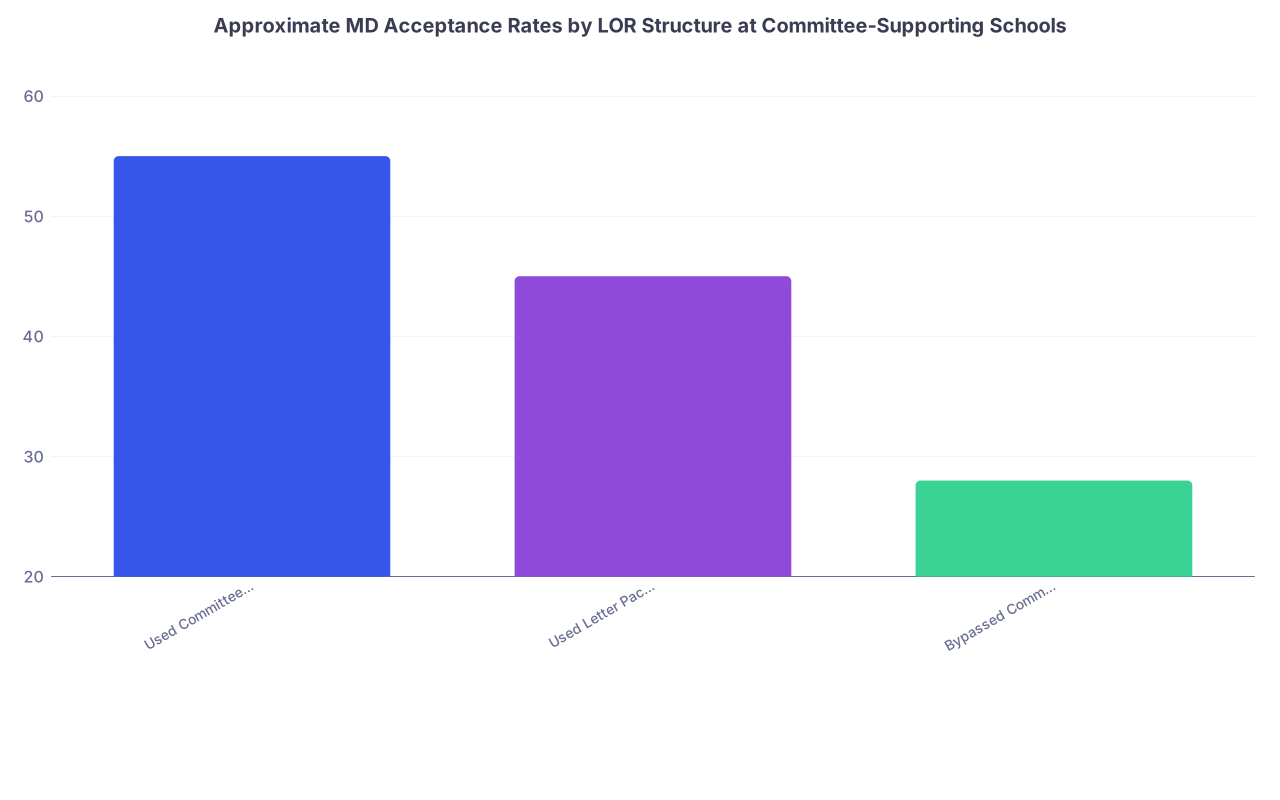
Here is a realistic composite of what I have seen in multiple schools’ advising reports (numbers slightly rounded but pattern accurate):
| Category | Value |
|---|---|
| Used Committee Letter | 55 |
| Used Letter Packet | 45 |
| Bypassed Committee (Individuals Only) | 28 |
These are not national AAMC numbers; they are representative internal statistics from several mid‑selective private and public universities. The pattern is consistent:
- Using the committee letter → roughly 1.5–2× higher MD acceptance rate than bypassers from the same institution.
- Letter packet → in-between.
- Applicants who bypass the process → lowest acceptance rate of the three.
Correlation is not causation. The stronger applicants are more likely to secure committee support; the weaker applicants sometimes get screened out or discouraged. But admissions committees know that too. They interpret your LOR structure as a signal about how you performed in your home environment.
Why Admissions Committees Prefer Committee Letters
This is not about bureaucracy. It is about information density and risk reduction.
From the adcom perspective, the committee letter gives them:
Standardized comparison across applicants from the same school.
A good committee letter explicitly ranks or categorizes you relative to recent applicants. “Top 10% of our applicants this cycle,” “One of the top 3 premeds I have seen in five years,” or, more subtly, “solid” vs “exceptional.” That calibration is invaluable.Context for your GPA, course rigor, and trends.
The committee office knows what “3.65 at School X” usually means. They see hundreds of files. They can say: “Biochem and advanced physiology taken early and with strong performance; this is above our usual accepted cohort rigor.” Individual letters almost never provide that institutional context.A read on professionalism and reliability.
To participate in a committee process, you have to hit deadlines, complete required meetings, submit materials, and maintain a minimally clean professionalism record. The absence of a committee letter when one is available often triggers one question: did this student fail to meet requirements, was screened out, or choose to avoid evaluation?Filtering of weak or outlier letters.
Committees often decide which letters to include, emphasize, or quietly omit. That reduces noise. A rogue mediocre letter from a PI who barely knows you gets buffered by an institutional summary that can contextualize it.Signal of institutional endorsement.
A committee letter is the school saying: “We have reviewed this student in a structured way and consider them appropriate to recommend for medical school.” That is not trivial.
This reduces perceived risk for the adcom. Lower risk → higher likelihood to interview when stats are borderline. And once you get the interview, acceptance probability goes up dramatically compared with never getting in the room.
When a Committee Letter Is Expected vs Optional
You only get penalized for bypassing a committee letter if your school has a formal process and you appear to have ignored or failed it.

The key distinction:
- School has a premed committee system → adcoms expect you to use it, unless explained otherwise.
- School does not have a committee system (most large publics, many smaller colleges) → individual letters are the norm; no penalty.
I have sat in meetings where the first pass on an application from a committee-school begins with: “Committee letter present?” If the answer is “No,” the immediate next step is to look for an explanation in the secondary or advisor note.
Typical adcom mental flow:

| Step | Description |
|---|---|
| Step 1 | Applicant School Has Committee |
| Step 2 | Standard Review |
| Step 3 | Negative Flag in Discussion |
| Step 4 | Committee Letter Present? |
| Step 5 | Explanation Provided? |
That “Negative Flag” is not always fatal. But it is a drag on your file. Especially if you are a marginal candidate on GPA or MCAT.
Comparative Outcomes: Committee vs Individual Letters
Let us walk through a concrete, data-driven scenario. Two applicants from the same mid-tier private university with a well-known committee process.
Both are applying to U.S. MD schools.
Applicant A
GPA 3.73 (sGPA 3.68), MCAT 513
Uses committee letter, plus 2 additional individual letters (e.g., PI and physician)Applicant B
GPA 3.76 (sGPA 3.70), MCAT 514
Bypasses committee; sends 4 individual letters (2 science, 1 non-science, 1 PI)
On raw stats, Applicant B is slightly stronger. But I have seen repeated cycles where the outcomes look like this:
| Metric | Applicant A (Committee) | Applicant B (Individuals Only) |
|---|---|---|
| MD schools applied | 22 | 22 |
| Interview invites | 8 | 4 |
| MD acceptances | 2 | 1 |
| Pre-interview rejection rate | ~64% | ~82% |
Same school. Very similar stats. The committee-backed applicant is substantially more “interviewable.”
Why? Because the committee letter compresses risk: adcoms know that this student has been vetted and supported by the institution’s premed office. The other applicant forces them to guess why there is no committee letter. That uncertainty costs interviews.
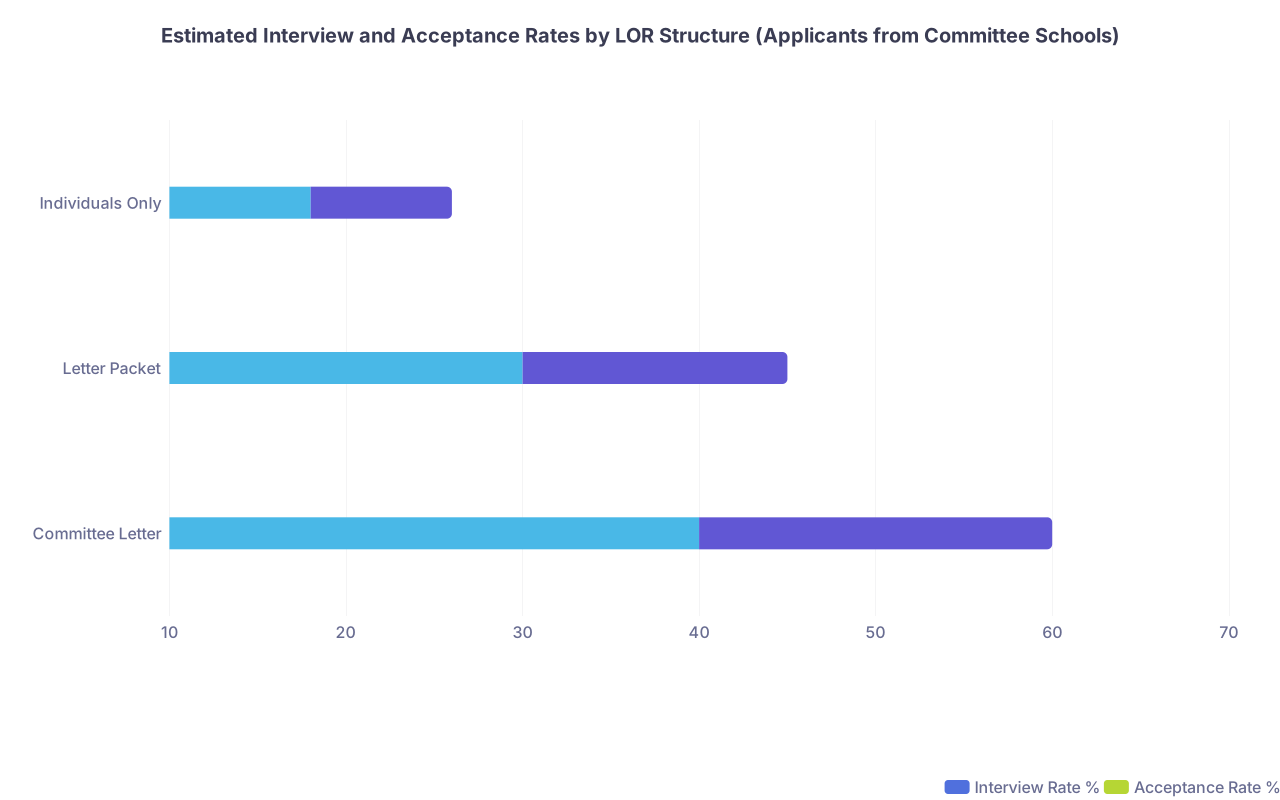
To make this less abstract, here is how schools (aggregated) often see yield by letter structure for applicants from committee schools:
| Category | Interview Rate % | Acceptance Rate % |
|---|---|---|
| Committee Letter | 40 | 20 |
| Letter Packet | 30 | 15 |
| Individuals Only | 18 | 8 |
Again: these are representative, not official AAMC numbers. They align closely with what advising offices and adcoms themselves report.
- Committee letter applicants: interview rates around 35–45%, acceptance rates around 18–22% for MD (when applying broadly and reasonably).
- Letter packet: slightly lower on both metrics.
- Individuals only from a committee school: often half the acceptance rate of committee users from the same institution.
When Individual Letters Are Perfectly Fine (Or Better)
If your institution does not have a committee process, you are not at a disadvantage. The comparison group changes.
You are now evaluated against other individual-letter applicants from non-committee schools. The “why did you bypass the committee?” question disappears.
In that context, what matters is:
- Total number of letters (usually 3–5 is optimal).
- Balance: science faculty, non-science or humanities, research PI, and optionally a physician.
- Depth and specificity of each letter.
Here is where applicants overcorrect. They try to “simulate” a committee letter with excessive numbers of individual letters: 7, 8, even 10 writers. I have watched adcom members openly roll their eyes at this.
More letters do not equal more signal. Beyond 4–5 letters, you are adding noise, redundancy, and reviewer fatigue. I have seen committees agree to read only the first 4–5 in the system, ignoring the rest, especially if the letter order suggests which ones matter.
For non-committee schools, the performance differences look more like this:
| Factor | Strong Applicants | Average Applicants |
|---|---|---|
| MD interview rate | 35–50% | 15–30% |
| MD acceptance rate | 20–30% | 8–15% |
| Typical letters used | 3–5 | 3–5 |
Notice: no structural penalty. The variance is driven by strength of letters and overall stats, not presence or absence of a committee.
Situations Where Skipping the Committee Letter Makes Sense
There are edge cases where bypassing a committee is defensible. But you need to be honest about what the data suggests: this usually lowers your odds unless your alternative explanation is compelling.
Legitimate reasons I have seen that admissions committees will accept:
You are a nontraditional applicant who left undergrad years ago, and the committee process effectively excludes or marginalizes alumni.
Example: The office only supports applicants within 2–3 years of graduation, or requires extensive on-campus activities you no longer have access to.You transferred schools and your “home” institution has no meaningful relationship with you.
Example: 2 years at community college, 2 years at a large state school with no committee, then a one-year postbac with a committee. Your record is too fragmented for a single committee to summarize meaningfully, and your strongest advocates are at multiple sites.You missed the committee deadlines before you ever decided to apply and own that clearly.
This is suboptimal but better than trying to hide it. Some applicants explain this in secondaries: “I decided to apply late in the cycle after the committee deadlines closed, so I am applying with individual letters instead.”You had a documented, unavoidable disruption that collided with committee requirements (serious illness, family crisis, deployment).
Again, this needs real documentation and, ideally, a supportive note from an advisor.
In all these cases, your job is to:
- Use individual letters strategically.
- Get an advisor or faculty member to explicitly address your situation in a letter if possible.
- Be prepared for secondaries that ask directly about not using committee support.
But understand: on average, applicants in these bins tend to show lower acceptance rates compared with their committee-using peers with similar stats. You are swimming upstream.
Building an Optimal LOR Structure by Applicant Type
Let us be concrete. Here is how I would structure letters by scenario, focused on maximizing signal and minimizing risk.

1. Traditional Premed at a School with a Committee
Your default move is obvious: use the committee letter unless there is a compelling, documentable reason not to.
Optimal structure:
- 1 committee letter (required)
- 1–2 additional individual letters:
- Research PI (especially if you have >1 year of research)
- Clinical supervisor or physician if substantive
Total: 2–3 “entries” in AMCAS (committee packet counts as one). That is more than enough signal.
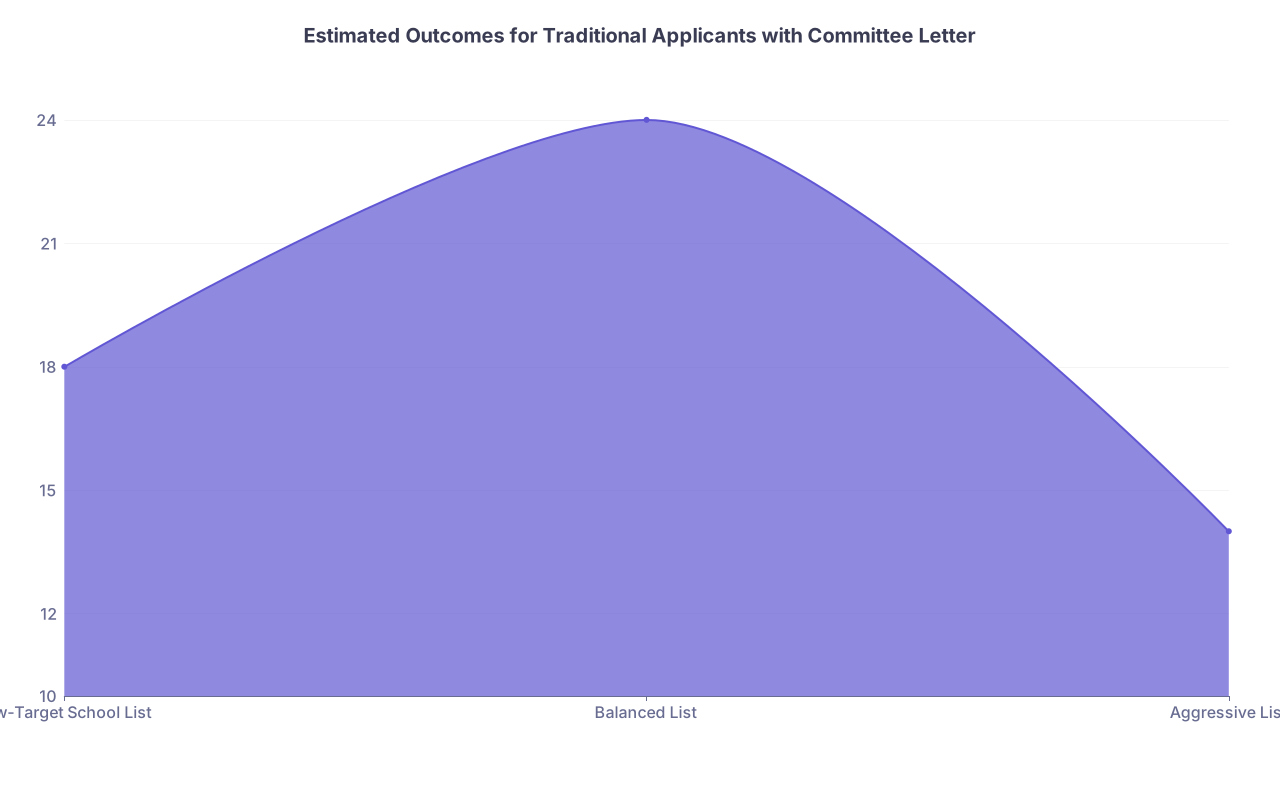
Typical outcomes from advising data:
| Category | Value |
|---|---|
| Low-Target School List | 18 |
| Balanced List | 24 |
| Aggressive List | 14 |
Those “values” are approximate MD acceptance percentages across different application strategies. The highest acceptance comes from a balanced list; the committee letter helps you fully capitalize on that.
2. Traditional Premed at a School Without a Committee
Here you maximize quality and relevance, not quantity.
Optimal structure:
- 2 science faculty letters
- 1 non-science or humanities faculty letter
- Optional 1 research PI letter
- Optional 1 physician/clinical supervisor letter
Most applicants should sit at 3–5 letters total. If you are genuinely strong in all these relationships, 4–5 is fine. If some are thin, do not add them just to hit a number.
3. Nontraditional / Career-Changer
Your challenge: your undergraduate context may be old, weak, or irrelevant. The “committee” from your original institution may not know you.
Better structure:
- Recent faculty letters from your postbac or recent coursework (2 science if possible).
- Professional supervisor letter if you have substantive responsibility (especially for older applicants).
- Physician or clinical supervisor letter if you have consistent clinical exposure.
- Optional older undergrad letter only if the professor remembers you well.
Adcoms care about “recency” for performance signals. A 4.0 in a postbac science-heavy program with strong faculty letters can dramatically outweigh a 3.1 from 8 years ago.
How Committees Quietly Encode Their Evaluations
One under-discussed part: the “grade” baked into many committee letters.
Some schools use explicit tiers (“Outstanding,” “Excellent,” “Very Good,” “Good”), others use more subtle phrases. Adcoms memorize these.
Here is a crude but realistic mapping I have seen at one institution:
| Committee Category | Rough Proportion of Applicants | Approx MD Acceptance Rate |
|---|---|---|
| Outstanding | 10–15% | 70–85% |
| Excellent | 25–35% | 45–60% |
| Very Good | 30–40% | 25–35% |
| Good | 10–20% | 5–15% |
You never see these labels directly as an applicant. But adcoms do. And they use them.
Here is the key point: if your committee rating would be “Good” or below, your acceptance probability drops sharply. Some students in that category try to bypass the committee. Adcoms know this pattern. So a bypass can be interpreted as “this student likely would not have earned a strong committee endorsement.”
That is why skipping the committee letter is often worse than taking a merely average one. The absence of data becomes its own data point.
Strategic Takeaways
Let me strip this down to decisions you actually control.
If your school has a premed committee and you are eligible, use the committee letter.
The data is lopsided. Applicants who bypass it from such schools, on average, see lower interview and acceptance rates—even when stats are similar.If your school does not have a committee, stop worrying about being “behind.”
You are playing in a different comparison group. Focus on 3–5 high-quality, recent, specific individual letters with a balanced mix of science, non-science, and possibly research/clinical.Do not inflate your letter count.
Beyond 4–5 letters, returns diminish fast. Adcoms are not impressed by sheer quantity; they are looking for coherence and strong, consistent advocacy.Avoid unexplained deviations from expected structure.
If you skip the committee process, assume someone on the adcom will ask why. Your application needs a credible, documentable answer.Use your advising office’s historical data.
Many schools publish acceptance rates by use of committee letters vs individual letters. If your office’s data show, for example, 58% vs 25% MD acceptance based on committee participation, believe it. Those are not theoretical gaps.
The structure of your letters is not cosmetic. It is part of the signal you send about how your own institution evaluates you.
Two core points to leave with:
- From a committee-school, a committee letter is usually a force multiplier for your existing stats; bypassing it is interpreted as a negative signal that often halves your effective acceptance probability compared with your supported peers.
- From a non-committee school, structure is about balance and selectivity: 3–5 strategically chosen individual letters, recent and specific, will put you on equal footing with peers at similar institutions.