It is late April. AMCAS opens in a few weeks. You are staring at your email drafts, hovering over “Compose,” trying to decide which professors to ask for your science letters of recommendation. You have a list of names…sort of. The orgo professor who taught 300 students and has no idea who you are. The PI whose lab you joined last semester but barely see. The biostats instructor who likes you but is technically in the School of Public Health.
You feel behind, so you are tempted to just fire off emails and “lock it in.”
This is exactly where pre-meds make preventable, application‑damaging mistakes.
Letters of recommendation are one of the few parts of your file where you are not speaking for yourself. You do not want the wrong person speaking on your behalf. Or the right person saying the wrong things. Or a letter that quietly sinks your otherwise strong application.
Let me walk you through the biggest errors I see pre‑meds make when choosing science LOR writers—and how to avoid them before they cost you interview invites.
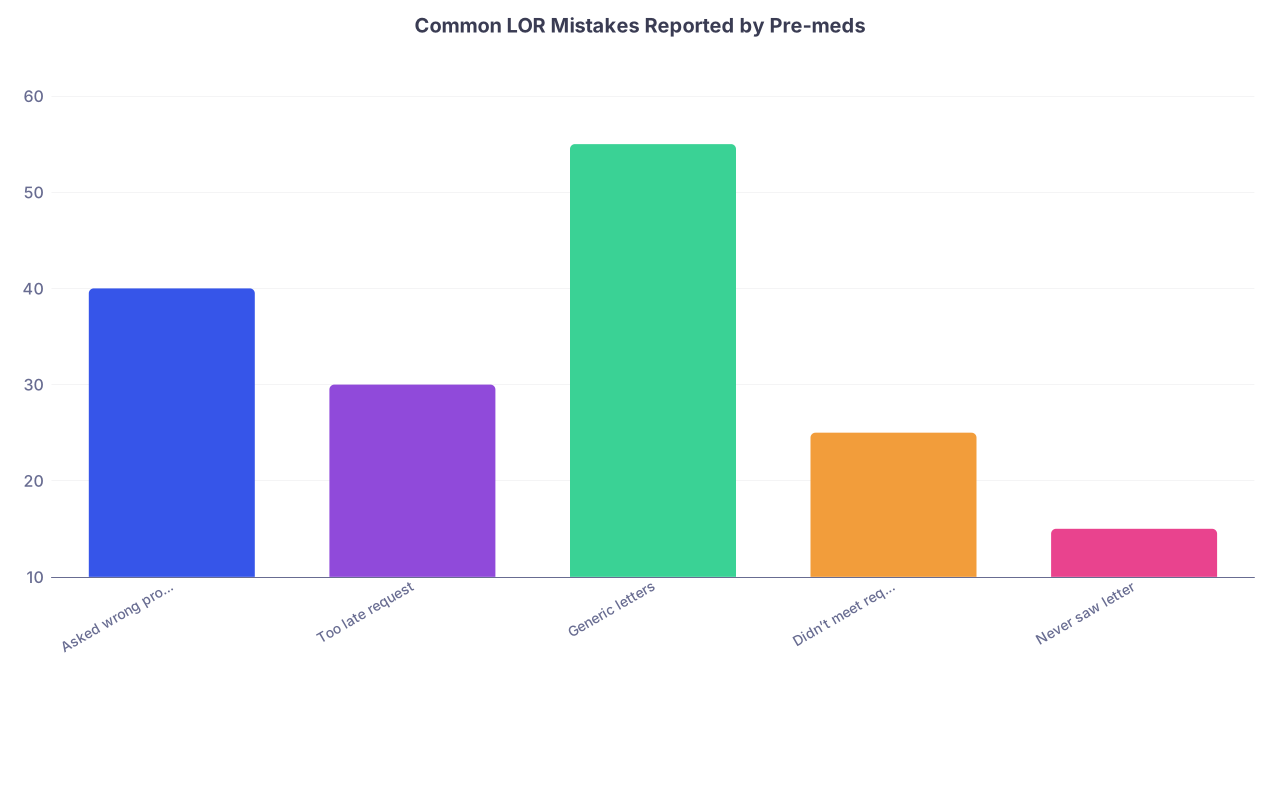
| Category | Value |
|---|---|
| Asked wrong professor | 40 |
| Too late request | 30 |
| Generic letters | 55 |
| Didn’t meet requirements | 25 |
| Never saw letter | 15 |
Mistake #1: Prioritizing “Famous” Over “Knows You Well”
The classic pre‑med move: chasing big names.
You know the type:
- Nobel‑adjacent researcher who gives guest lectures twice a year.
- Department chair you met once at a poster session.
- Physician‑scientist whose papers you cite but who has never graded your work.
You think, “Their title will impress adcoms.” You are wrong.
Admissions committees care far more about:
- How well the writer knows your work and character.
- The specificity and depth of the letter.
- Concrete examples of your performance, reliability, growth, and integrity.
They do not care that your letter writer has 12 R01s if all they write is, “Student X took my course and received an A. She seems motivated.”
A mediocre letter from a big name hurts you more than a strong letter from a mid‑level faculty member who actually knows you.
Common red flags:
- You are not sure they could pick you out of a lineup.
- You never spoke to them outside of lecture.
- You were one of 400 students and never went to office hours.
- You are relying on them “remembering” you from one good interaction.
Do this instead:
- Choose the professor who has seen you struggle, improve, ask questions, and show up.
- Give priority to smaller classes, labs, and discussion sections where you participated.
- Consider a course where you were not perfect but clearly grew over time—and the professor saw it.
If the professor cannot write detailed, story‑based comments about you, it does not matter how famous they are. That is the mistake to avoid.
Mistake #2: Waiting Until You Need the Letter
You would be surprised how often this happens:
It is June. You want to submit early. AMCAS asks for letters. Panic. You scroll through your email and think, “I will just ask now; professors write letters all the time.”
Here is the reality: rushed letters read like rushed letters. And some faculty simply will not do last‑minute requests. Or they will agree and then ghost you until September.
Typical bad timing pattern:
- You finish the course in May.
- You do not say a word for months.
- In late July you send an email: “Hi Professor, I hope you remember me. Could you write a strong letter by next week?”
You are asking them to do professional work on your emergency timeline. That is not how you get their best writing.
Better pattern:
- You identify likely letter writers 6–12 months before you apply.
- You start going to office hours early in the semester.
- You ask for advice on classes, research, maybe pre-med trajectory.
- At the end of the course (or soon after), you ask, “Would you feel comfortable writing me a strong letter of recommendation when I apply to medical school next year?”
Then, as application season approaches, you follow up with:
- A polite reminder.
- An updated CV.
- Draft of your personal statement.
- Clear deadlines (built in with buffer time).
If you are applying this cycle and you already missed the ideal window, you still need to avoid the worst version of this mistake: vague, short‑notice requests without context or materials. Give them at least 4 weeks if at all possible.

Mistake #3: Ignoring Medical School Requirements for Science Letters
I have seen strong applicants get quietly filtered out because they did not meet letter requirements. Not because they were weak students. Because they were sloppy with rules.
Different schools expect different combinations:
- 2 science faculty + 1 non‑science faculty
- 1 science faculty + committee letter
- 3 faculty letters, at least 2 from biology, chemistry, physics, or math
- Or “science” defined differently than you assume
Your mistake: you go by a vague memory of “two science letters” and never verify.
So you choose:
- Biology professor
- Neuroscience research PI who technically has no teaching title
- Public Health statistics instructor
Then you apply to a school that says “letters must be from BCPM course instructors.” Your package does not actually qualify. Some schools will be forgiving. Others will not even flag it; they will just screen you out.
You avoid this by being tedious and precise. That means:
- Making a list of your target schools early (at least 10–15).
- Checking each school’s LOR page for:
- Number of required letters
- How many must be science
- Whether they count math as science
- Whether research mentors are acceptable as “science faculty”
- Committee letter vs individual letters
- Planning your letter strategy around the strictest set of requirements you might face.
If you are at a school that offers a pre‑health committee letter, you can absolutely make the mistake of assuming that replaces all other letters. Some schools want both: a committee letter and individual faculty letters. Do not assume. Confirm.
To keep this straight, create a simple table for yourself.
| School | Science LOR Required | Non‑Science LOR | Committee Letter |
|---|---|---|---|
| School A | 2 BCPM faculty | 1 recommended | Accepted |
| School B | 1 science required | 1 non‑science | Required if avail |
| School C | 3 faculty total | None specified | Optional |
If you do not match the strictest version of these, fix it now while you still have time to build relationships with the right people.
Mistake #4: Confusing “Instructor Who Likes Me” With “Appropriate Science Writer”
A common gray area: who actually counts as a science letter writer?
You might have:
- A fantastic relationship with your physiology TA.
- An MPH‑trained instructor who taught you epidemiology.
- A postdoc who supervised your benchwork and knows your science skills better than anyone.
- A graduate student who basically ran the lab and mentored you for 2 years.
They like you. They can write detailed, glowing things about your abilities. But medical schools might not consider them “faculty science letters” if they:
- Do not hold a faculty appointment.
- Did not instruct a BCPM‑coded course for which you were registered.
- Are not listed as “Professor,” “Lecturer,” or “Instructor of Record” on your transcript.
Your mistake: submitting what is essentially a TA or grad student letter as one of your core science letters, and then learning that some schools do not recognize it.
How to avoid this:
- Always have at least 1–2 letters from official faculty who taught you in a graded biology, chemistry, physics, or math course.
- If a TA or grad student knows you best, ask that person to:
- Draft comments or a letter that the supervising professor can incorporate.
- Co‑sign a letter with the faculty member.
- Provide detailed notes that the professor reviews and turns into the final letter.
- When in doubt, check the writer’s title. “Assistant/Associate/Full Professor,” “Lecturer,” or “Senior Instructor” is usually safe. Pure “Postdoc,” “PhD Candidate,” or “Teaching Assistant” alone is more risky.
I am not saying a TA’s input is useless. It can strengthen the content. But the official signature and letterhead should be from someone that admissions offices will recognize as faculty.
Mistake #5: Asking People Who Are Neutral or Lukewarm About You
The quiet disaster: you ask someone who does not actively dislike you, but also does not think you are impressive. They say “Sure, I can write you a letter,” because they want to be polite. You interpret that as enthusiasm.
Neutral letters kill applications.
They rarely say, “This person is bad.” They just fail to say, “This person is outstanding.” And in a pile of competitive files, a “fine but forgettable” letter is the same as a negative.
Warning signs your potential writer is lukewarm:
- They hesitate when you ask. Or say, “I suppose I can write you a letter,” instead of “I would be happy to.”
- They have never seen your work beyond grades.
- You rarely interacted outside of required class time.
- They do not remember your specific projects, presentations, or exams.
- You feel the need to convince them you were good.
When you ask, use clear language:
“Would you feel comfortable writing me a strong letter of recommendation for medical school?”
If they respond with:
- “I can write you a letter, but I do not usually comment in detail.”
- “I can mostly speak to your grade in the course.”
- “Sure, send me your CV and I will see what I can do.” (with hesitant tone)
That is a no. You thank them and do not use that letter.
You are better off choosing:
- A less “fancy” professor who is genuinely enthusiastic.
- A mid‑level faculty who saw you lead group work, help classmates, and persist.
- Someone who has literally told you things like, “You would make a great physician,” or “I am impressed with your maturity.”
If nobody feels this way about you yet, your problem is not letters. Your problem is how you are engaging in your courses and lab environments. Fix that now.

| Step | Description |
|---|---|
| Step 1 | Potential Professor |
| Step 2 | Keep as Optional Letter Only |
| Step 3 | Confirm Willingness Early |
| Step 4 | Provide Materials and Deadlines |
| Step 5 | Monitor Submission and Thank Them |
| Step 6 | Taught BCPM Course? |
| Step 7 | Knows You Well? |
| Step 8 | Can Write Strong Letter? |
Mistake #6: Choosing the “Easy Yes” Instead of the Strategically Useful Letter
There is an emotional trap here. It is easier to ask the professor where you got an A+ and never struggled. Or the one you chat with casually after class but who has never really pushed you.
The result: letters that say, “This student did well in my class,” and nothing more.
Strong science letters often come from:
- Classes where you initially struggled but sought help, went to office hours consistently, and improved.
- Lab mentors who saw you fail experiments, troubleshoot, learn new techniques, and eventually mentor others.
- Professors who saw you balance a heavy course load with other responsibilities without complaining.
Admissions committees are not hunting for robots who got straight As with zero adversity. They are looking for evidence of:
- Resilience
- Intellectual curiosity
- Work ethic under pressure
- Integrity and professionalism
- Ability to work with others
So do not avoid a potential writer just because you did not get the highest grade, if:
- You consistently engaged.
- You showed growth.
- The professor knows your story.
The “easy yes” from a professor who barely noticed you can be much weaker than the thoughtful yes from someone who saw you earn your progress.
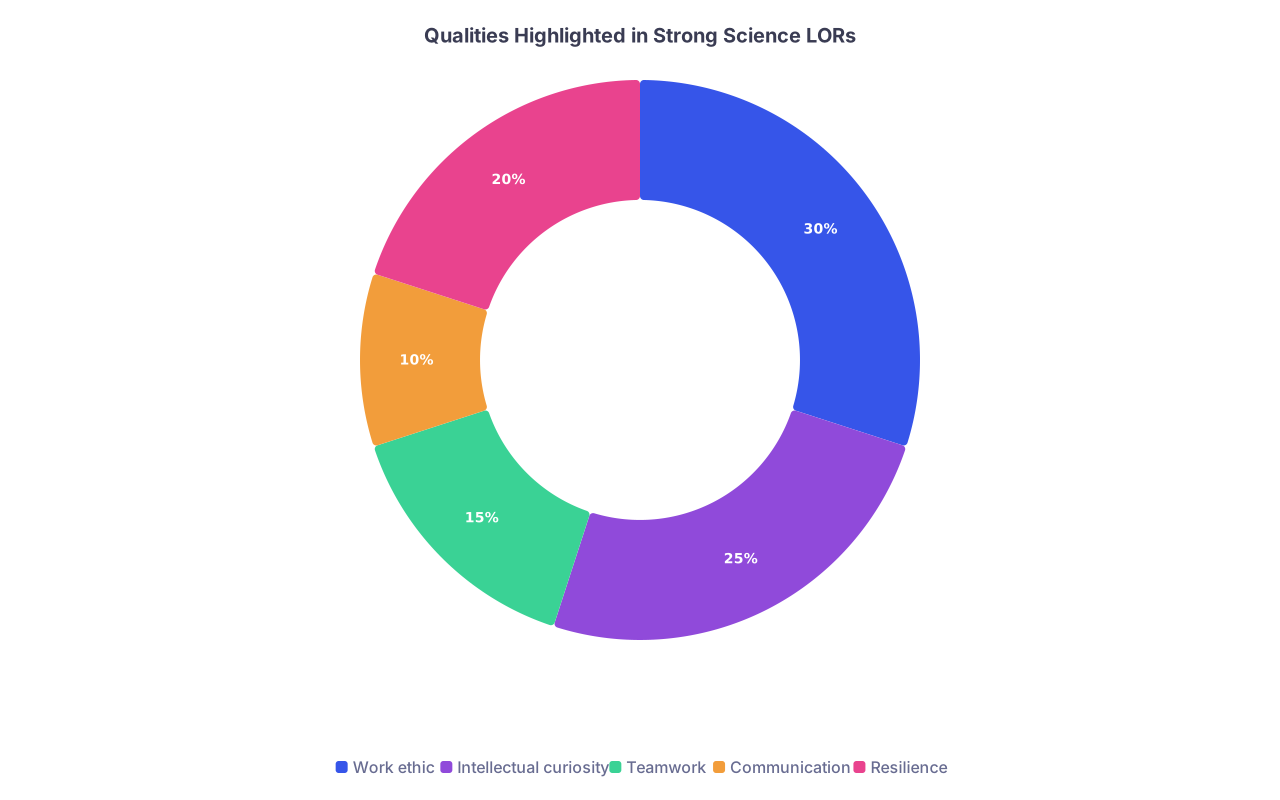
| Category | Value |
|---|---|
| Work ethic | 30 |
| Intellectual curiosity | 25 |
| Teamwork | 15 |
| Communication | 10 |
| Resilience | 20 |
Mistake #7: Failing to Equip Your Writers Properly
You choose your writers correctly. Then you sabotage the letters by making them guess who you are.
I have seen students send a one‑line email:
“Can you write me a letter? It’s due June 1. Thanks.”
No CV. No context. No list of schools. No personal statement. No reminder of what course they taught you. You are forcing them to rely on partial memories and grade spreadsheets.
That produces generic letters like: “X was in my Fall 2023 Organic Chemistry course and received an A. She attended class regularly and participated occasionally. I believe she will do well in medical school.”
Generic. Useless.
When you ask for (or confirm) a letter, you should provide a concise “packet”:
- One‑page summary of:
- What course(s) you took with them and when.
- Your final grade(s).
- Specific projects, labs, or presentations you completed.
- Any meaningful interactions (office hours, emails, discussions).
- Your updated CV or resume.
- Draft of your personal statement or a brief paragraph on:
- Why medicine.
- What you see as your strengths.
- Any major experiences you would like them to highlight.
- List of schools, if you have it, or at least the general level of competitiveness.
- A clear deadline that is at least 2–4 weeks away.
You are not writing the letter for them. You are giving them enough raw material so they can write something detailed and credible. That is how you help them help you.
Mistake #8: Overlooking Diversity in Your Science Letters
Last common error: putting all your LOR eggs in one narrow basket.
For example, you submit:
- Two letters from the same department, same semester, both large lecture courses.
- Or two nearly identical letters from similar research‑heavy faculty who never saw you in a classroom.
- Or two letters that only discuss your exam performance and nothing about who you are as a person.
You want your science letters to complement each other, not duplicate.
Good combinations:
- One letter from a large, rigorous lecture course (e.g., Organic Chemistry) that can speak to your performance among many peers.
- One letter from a smaller, discussion‑based or lab‑based course (e.g., Cell Biology lab) that can speak to your teamwork, communication, and lab skills.
Or:
- One letter from a classroom context.
- One letter from a research context (if the PI is recognized as faculty and the school accepts that as “science”).
Aim for:
- Different vantage points: classroom vs lab vs office hours.
- Different skill sets: analytical thinking, lab competence, collaboration, leadership, resilience.
If all your letters say, “This student got an A in my course,” you are wasting one of the few chances to show admissions who you are in action.
Putting It All Together: A Simple, Non‑Stupid LOR Strategy
You do not need a perfect, magical set of letters. You need non‑damaging, strategically chosen, well‑equipped writers.
Here is a straightforward approach that avoids most disasters:
Map requirements early.
Choose 10–15 target schools and document:- How many science letters they require.
- Whether they count math.
- Committee letter rules.
Identify potential writers during courses, not after.
In each BCPM course you take, ask:- Am I engaging with this professor?
- Do they see my work, not just my grade?
- Could this be one of my 2 core science letters?
Build relationships intentionally.
Use office hours for more than homework questions:- Discuss how you approached difficult topics.
- Ask about their research.
- Mention your interest in medicine (once you actually have something to say).
Ask clearly and early.
Ideally:- 3–12 months before you need the letter.
- In person if possible, or by thoughtful email.
- With the phrase “strong letter of recommendation.”
Support your writers.
Send:- CV
- Personal statement draft or summary
- Reminder of your specific work in their class
- Clear deadlines and submission instructions
Monitor, then thank.
- Track submission in AMCAS/AACOMAS portal.
- Send a reminder a week before the deadline if needed.
- Send a genuine thank‑you note once they submit. They are investing their reputation on your behalf.
Do that, and you will already be ahead of the large chunk of applicants who treat letters as an afterthought.
FAQ (Exactly 5 Questions)
1. Can I use a community college science professor as one of my science LORs?
Yes, but with caution. Some medical schools accept community college letters without issue, especially if you completed prerequisites there. Others are less enthusiastic. You should still have at least one letter from a 4‑year institution if most of your science coursework happened there. If you transferred, a strong letter from a CC professor who knew you extremely well is fine as one of your letters, but do not rely only on community college writers if your final degree is from a university.
2. Is a research PI letter considered a “science letter” for medical school?
Sometimes, but not universally. If your PI holds a formal faculty appointment in a relevant department (Biology, Chemistry, etc.) and is on letterhead that clearly shows that, many schools will count it as a science letter. Some schools, however, specifically require that science letters come from course instructors. This is why you must check each school’s policy. Even if a PI letter is not counted as one of your core science letters, it can still be a powerful additional letter.
3. What if I did well in my science courses but never went to office hours and no one knows me?
Then you need to change your behavior starting now. Pick one current or upcoming science course and commit to consistent engagement: attend office hours, participate meaningfully, ask questions beyond “Will this be on the exam?”, and build some rapport. You can also reach out to past professors and say you enjoyed their course and would like to reconnect for advice about your plans. But do not expect a great letter if they remember you only as “student in row 7 who got an A.”
4. Should I waive my right to see my letters of recommendation?
Yes. Admissions committees expect letters to be confidential. When you waive your right, it signals that the writer can be candid, and it increases the perceived credibility of the letter. If you do not trust someone enough to write a confidential letter, you should not be using them as a recommender. Your leverage point is before you ask them—by choosing writers wisely and asking specifically for a strong letter.
5. How many total letters is too many?
More is not always better. If a school asks for 3–5 letters, sending 8 or 9 does not make you look stronger; it makes you look unfocused and can dilute the impact of your best letters. Aim to meet the required number plus, at most, one or two high‑quality additional letters that clearly add something new (for example, a research PI or a long‑term clinical supervisor). Do not compensate for weak letters by simply adding more; fix the weakness at the source by choosing better writers.
Today’s next step:
Open your transcript and list every BCPM course you have taken in the last two years. For each course, write down the professor’s name and honestly rate (1–5) how well they know you. Circle the top three names. Those are the people you should start building or strengthening relationships with this week.