
You are a year or two from applying. You just switched majors. Your old department knew you. Your new department barely knows your name.
Everyone keeps saying, “Strong letters matter more than ever.”
You look at your current “mentor pool” and feel your stomach drop:
- One lab PI who left for another institution
- A course director who barely remembers you
- Maybe a volunteer supervisor who thinks your name is Alex… or Alice…
And now you are supposed to produce 3–5 powerful letters of recommendation for medical school.
This is fixable. But you cannot wing it and hope it works out. You need a structured rescue plan.
Here is exactly how to rebuild a strong mentor and letter-writer pool after a late major switch.
Step 1: Diagnose Your Real Starting Point (Brutally Honestly)
You cannot fix what you will not name.
Sit down and do a 30-minute audit of your current situation. No wishful thinking. No “maybe they remember me”. You are going to score each potential letter writer.
1. List every possible recommender
Include:
- Old-major professors
- New-major professors
- Lab PIs (current and past)
- TAs who know you well
- Clinical supervisors (MDs, NPs, PAs, RNs)
- Volunteer coordinators
- Work supervisors (especially health-related)
Now next to each name, give objective data:
- How many courses / months you worked with them
- What you did with them (course, research, clinical work, leadership)
- Last time you interacted meaningfully
- How strong you think the letter would realistically be:
- 1 = Generic / weak (“performed adequately, punctual…”)
- 2 = Decent but generic (“hard-working, good student…”)
- 3 = Strong (“top 10%, specific stories…”)
Do not give anyone a 3 unless you know they have concrete stories about you.
2. Map against what med schools want
Most MD and DO schools want some variant of:
- 2 science faculty letters (BCPM – Biology, Chemistry, Physics, Math)
- 1 non-science letter (humanities / social science / other)
- Optional/additional:
- Research PI
- Clinical supervisor (physician or equivalent)
- Long-term community service / leadership supervisor
Use this quick table to see where your holes are.
| Letter Type | Ideal Source | Do You Have 1? | Do You Have 2? |
|---|---|---|---|
| Science Faculty | Bio/Chem/Phys/Math professor | ||
| Non-Science Faculty | Humanities/Social Sciences | ||
| Research PI | Lab PI / thesis mentor | N/A | |
| Clinical Supervisor | MD/NP/PA/RN with oversight | N/A | |
| Service/Leadership | Long-term supervisor | N/A |
Fill this out for yourself. Literally. Pen and paper or a doc.
Wherever you see blanks — those are your priority gaps.
Step 2: Understand Your Time Window and Build a Timeline
You cannot build deep mentorship in four weeks. But in 6–18 months, you can transform your situation.
Figure out your application timing:
- Planning to apply in:
- This upcoming cycle (0–12 months away)
- Next cycle (12–24 months away)
Different starting points require different aggression levels.
If you are 18–24 months away from applying
You have time to:
- Develop 2–3 new strong faculty relationships
- Build a meaningful research or clinical mentorship
- Get to “top 5–10% of students I’ve taught or supervised” territory
If you are 6–12 months away
You must:
- Salvage and deepen existing relationships
- Intentionally perform in 1–2 key courses / roles
- Get at least 1–2 “strong” letters and minimize generic ones
If you are <6 months away
You are in damage control. Still workable, but you will:
- Leverage whoever knows you best right now
- Give them maximum material to work with
- Optimize how your committee packet or letter set looks as a whole
To make this concrete, build a simple timeline for yourself.
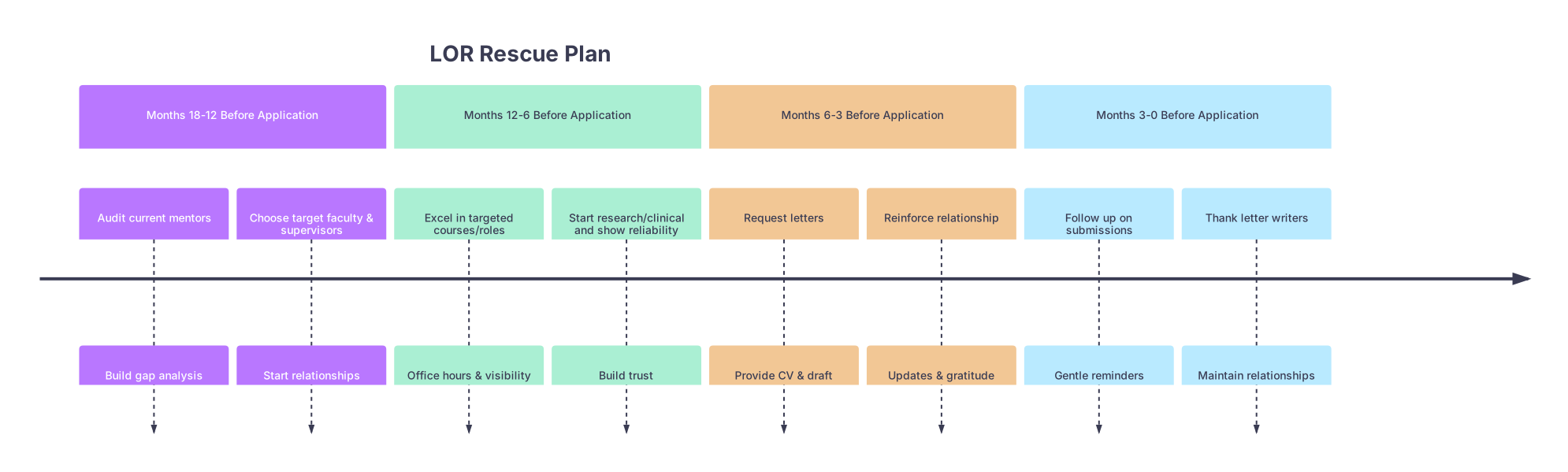
| Period | Event |
|---|---|
| Months 18-12 Before Application - Audit current mentors | Build gap analysis |
| Months 18-12 Before Application - Choose target faculty & supervisors | Start relationships |
| Months 12-6 Before Application - Excel in targeted courses/roles | Office hours & visibility |
| Months 12-6 Before Application - Start research/clinical and show reliability | Build trust |
| Months 6-3 Before Application - Request letters | Provide CV & draft |
| Months 6-3 Before Application - Reinforce relationship | Updates & gratitude |
| Months 3-0 Before Application - Follow up on submissions | Gentle reminders |
| Months 3-0 Before Application - Thank letter writers | Maintain relationships |
Put this timeline into your calendar. You are going to live off it.
Step 3: Extract Every Ounce of Value From Your Old Major
You changed majors, but your old major is not dead weight. You probably have at least 1–2 people there who:
- Taught you more than once
- Know your work ethic
- Saw your progression or struggle and improvement
These can be gold, especially if your new major connections are shallow.
How to salvage old-major mentors
Identify the 2 strongest possibilities
The ones who:- Gave you A or A–
- Saw you in office hours / lab / discussion
- Commented positively on your work at any point
Re-engage them directly
Email template skeleton (you customize it heavily):
Subject: Quick update and request for advice
Dear Dr. [Name],
I took [Course] with you in [Semester/Year] and have been thinking about [specific topic or project] from that course a lot recently. I am now majoring in [New Major], but your class was a big part of what pushed me toward medicine, especially [concrete detail].
I am planning to apply to medical school in [Year] and I wanted to ask if you might be willing to meet briefly so I can update you on what I have been doing since your course and get your advice on next steps.
Thank you for considering this,
[Your Name]Goal of this meeting:
- Re-activate the relationship
- Show how you have grown
- Set up a future letter request
At the meeting, do three things
- Give a 2–3 minute summary of what you have done since: key classes, clinical experience, research, leadership
- Explain your major switch briefly but clearly and without drama
- Signal you value their perspective: “Your course was one of the few that really changed how I thought about X.”
Then, near application season, you come back:
I enjoyed our conversation in [Month]. Since then, I have continued [update briefly]. I am now preparing my application and would be honored if you would consider writing a letter of recommendation on my behalf.
If they hesitate or hedge, that is a red flag. You want people who say yes without waffling.
Step 4: Build New-Major Mentors Quickly and Intentionally
You switched majors. That actually gives you a nice excuse to show up and be visible. But you need to treat this like a campaign.
Choose your “target faculty”
Pick 2–3 new-major professors who:
- Teach upper-level or writing-intensive courses
- Have a reputation for working closely with students
- Have office hours that are not an impossible time for you
Your goal: by the end of 1–2 semesters, at least one of them should know you well enough to write a strong letter.
How to become more than a name on the roster
You do not need to be fake or over-the-top. You do need to be deliberate.
Plan your office hours strategy
- Show up early in the semester (week 1–3).
- Come with 1–2 real questions about course material or how it connects to medicine / your interests.
- Do not start with “Can you write me a letter someday?” Start with “I want to understand this content and your field better.”
Participate consistently, not theatrically
In class or discussion section:
- Ask 1–2 thoughtful questions per week
- Reference readings or prior lectures
- Show you are thinking, not just chasing points
Produce one standout piece of work
Whether it is a paper, project, or presentation:
- Pick a topic that intersects with health, ethics, disparities, or policy if possible. Something you can talk about later in your application.
- Go beyond the minimum. Extra sources. Deeper analysis. A creative angle.
- If you get strong feedback, save it. This becomes evidence for the letter writer.
Schedule a mid-semester check‑in
Around week 6–9:
“I am really enjoying [Course]. I am planning for medical school and also still exploring [field]. Would you have 15 minutes for me to ask you a few questions about the course and your work?”
In that talk:
- Ask about their research and how students can get involved
- Ask what they see in students who go on to do well in medicine or grad school
- Mention you switched majors and are trying to build deeper mentorship in this department
You are planting the seed that you are serious and invested.
Step 5: Engineer a Research or Clinical Mentor That Actually Knows You
Letters from people with “Dr.” in front of their name are overrated if they barely know you. A strong letter from a PhD in psychology who worked with you closely for 2 years beats a one-paragraph note from a famous surgeon who saw you twice.
Your goal is a supervisor who can say:
- “I worked with [Name] for 9–18 months.”
- “They showed up consistently, took feedback, and grew in responsibility.”
- “Here are 2–3 specific examples of their initiative and character.”
Route A: Research mentor (especially if your new major is STEM-ish)
If your new major is anything in the BCPM world or adjacent (bio, chem, neuroscience, psychology, stats, even some engineering):
Identify 3–5 research-active faculty in your new or related department
- Read their lab websites, current projects, and recent publications
- Look for ongoing projects where an undergrad can realistically contribute
Send focused, non-generic emails
No “Dear Sir/Madam, I am passionate about science.” That goes straight in the trash.
Instead:
- One short paragraph on why their specific work is interesting to you
- 1–2 lines connecting that to your experience (course, project, prior research)
- 1 line on your availability (hours/week, length of commitment)
- Brief attachment: 1-page CV, unofficial transcript
Once in the lab, behave like this is a high-stakes job
- Be on time, every time
- Take notes on protocols, do not need instructions repeated 5 times
- After 1–2 months, start asking: “Is there any part of this process I could take more responsibility for?”
That is how you become letter-writer material.
Route B: Clinical or service mentor
If research options are thin or you are already overcommitted, lean on clinical or community supervisors.
Good setups:
- Long-term hospital volunteering (6–12+ months) with the same coordinator
- Free clinic, hospice, or EMS
- Scribing with consistent physician oversight
Your job:
- Be the most reliable person on the schedule
- Ask occasionally for feedback: “Is there anything I could be doing better in this role?”
- Once you have 6+ months, let them know you are planning for medical school and would value their perspective and possibly a letter later on
Step 6: Balance Science vs Non-Science Letters Strategically
A common problem after a major switch:
- You end up with strong non-science connections but weak science letters.
Medical schools still care a lot about your science performance and potential.
You must deliberately engineer at least one strong science faculty letter.
If your new major is non-science (e.g., psychology, sociology, humanities)
You still need BCPM faculty to vouch for you. Here is how to get them, even late:
Target 1–2 upper-level science classes in the next 2–3 semesters:
- Physiology
- Biochemistry
- Microbiology
- Advanced cell biology
- Statistics (sometimes counts as math, check your school’s BCPM rules)
Choose courses with realistic class size
- A 300‑student intro lecture is hard to stand out in. Not impossible, but painful.
- A 30‑person upper-level seminar or lab course is ideal.
Apply the same relationship-building protocol as in Step 4:
- Office hours early
- Strong participation
- Outstanding project or lab performance
- Mid-semester check‑in
Your rule:
At least one BCPM faculty who knows you by name, work, and story by the time you ask for letters.
Step 7: Control What Goes Into Each Letter (Indirectly but Powerfully)
You cannot write your own letter. You absolutely can control the inputs your writers use.
When someone agrees to write for you, here is what you send them, ideally 2–3 months before deadlines:
Targeted letter packet (1–2 pages, not a novel):
- One paragraph: Why you are applying to medicine and your main themes (service, curiosity, resilience, etc.)
- Bullet list: Key experiences with them specifically
- Course(s) and grade
- Specific project / presentation / paper
- Lab accomplishments
- Clinical tasks you handled
- Bullet list: 3–5 traits you hope they can comment on
- Work ethic
- Intellectual curiosity
- Communication
- Leadership
- Compassion / professionalism
Updated CV or resume
- One page if possible
- Highlight clinical, research, and leadership roles
Unofficial transcript (if they ask or if relevant)
Shows them you are not hiding a disaster.
Draft of your personal statement (if at least decent)
This lets them see the story you are telling so their letter can reinforce it.
You make their job easy. People write better letters when you do their memory work for them.
Step 8: Sequence and Mix Your Letters Smartly
You do not just want “a pile of letters.” You want a coherent portfolio that hits different aspects of you.
Aim for a set like this:
- 1 strong science faculty
- 1 additional science or research-oriented mentor
- 1 strong non-science or writing-intensive faculty
- 1–2 additional from: research PI, clinical supervisor, or long-term community/leadership mentor
Where you are short, adjust:
If you cannot get 2 strong science faculty, then:
- Make sure the one good science letter is excellent
- Use research and clinical letters to reinforce your work ethic and analytical ability
If your professors are lukewarm but your clinical and research mentors love you:
- Still include the required faculty letters
- Use the others to carry most of the narrative weight
Think about what each letter “covers”:
- Academic rigor and analysis
- Reliability and professionalism
- Teamwork and communication
- Empathy and service
Try not to have five people all saying, “They are nice and work hard.” That reads flat.
Step 9: Handle the “Letter Request” Conversation Like an Adult
The way you ask for a letter matters. You are not begging; you are evaluating them, too.
How to ask in person or via Zoom (ideal)
You say something like:
“I am planning to apply to medical school this coming cycle, and I wanted to ask if you would feel comfortable writing a strong letter of recommendation for me.”
That word “strong” is doing work. It gives them an exit if they cannot.
If they:
- Say “Of course, happy to” and immediately mention specific things about you → green light.
- Say “I can write you a letter” with no enthusiasm and no detail → yellow/red. Consider not using them if you have alternatives.
If you must ask by email
Keep it precise:
Dear Dr. [Name],
I have really appreciated [course/working with you in X capacity], especially [specific detail]. I am applying to medical school in [Year] and I am writing to ask if you would feel comfortable writing a strong letter of recommendation on my behalf.
If you are able to do so, I would be glad to send an updated CV, a short summary of my work in your [course/lab/clinic], and my personal statement draft for context.
Thank you for considering this,
[Your Name]
You are respectful but not groveling. Professional.
Step 10: Use Your Major Switch to Your Advantage, Not as a Liability
You are nervous that switching majors weakened your mentor pool. That is only true if you let the story sound like:
“I bounced around and never committed.”
You rewrite it to:
“I recalibrated, then went deep.”
How this shows up in your letters and application:
- Old-major professor: “I taught [Name] in [X course]. Even when they later shifted their academic focus, they stayed in touch and showed continued growth.”
- New-major professor: “Although [Name] joined our department later, they quickly became one of the most engaged students, seeking feedback and pursuing advanced work.”
- Research or clinical supervisor: “Over the last 12 months, I have seen [Name] commit deeply to this environment and take on increasing responsibility.”
Your job now is to give your recommenders enough context so they do not guess at the switch. Briefly explain it in your meeting or email:
“I initially majored in [Old Major] but realized I was more drawn to [New Major] because [concise reason]. I still value what I learned in [Old Major], but I have been more engaged and successful in [New Major], especially in [specific courses/projects].”
Own it. Do not apologize for it.
Step 11: Track, Follow Up, and Close the Loop
Letters go missing. People forget. Systems crash. You will not be the one panicking in June because a key letter is missing.
Set up a simple tracking sheet:
| Writer Name | Type (Sci/Non/Clin/Res) | Date Asked | Confirmed? | Materials Sent | Submitted? |
|---|---|---|---|---|---|
| Dr. Smith | Science Faculty | 03/10/2026 | Yes | 03/12/2026 | Pending |
| Prof. Johnson | Non-Science Faculty | 03/15/2026 | Yes | 03/16/2026 | Submitted |
| Dr. Lee (PI) | Research | 03/20/2026 | Yes | 03/21/2026 | Pending |
Then:
- Send a polite reminder ~4 weeks before your deadline if the letter is not in.
- Another reminder 1–2 weeks before, if still missing.
- After it is submitted, send a real thank-you note. Not just “thx!!” by text.
You are building relationships that extend beyond this one application cycle.
Step 12: Reality Check – What Actually Moves the Needle
Let me cut through the noise.
Strong letters of recommendation share three features:
Time-depth
The writer has known you for at least a semester, preferably 1+ years.Specificity
They can name projects, patient encounters, presentations, problems you solved, times you showed maturity or resilience.Comparison
They are willing to place you in a context: “top 10% of students I have taught in 10 years,” or “one of the most reliable volunteers on our team.”
Your late major switch mainly sabotages #1 if you are not careful.
The steps above rebuild that as fast as possible.
To sanity check your progress, ask yourself:
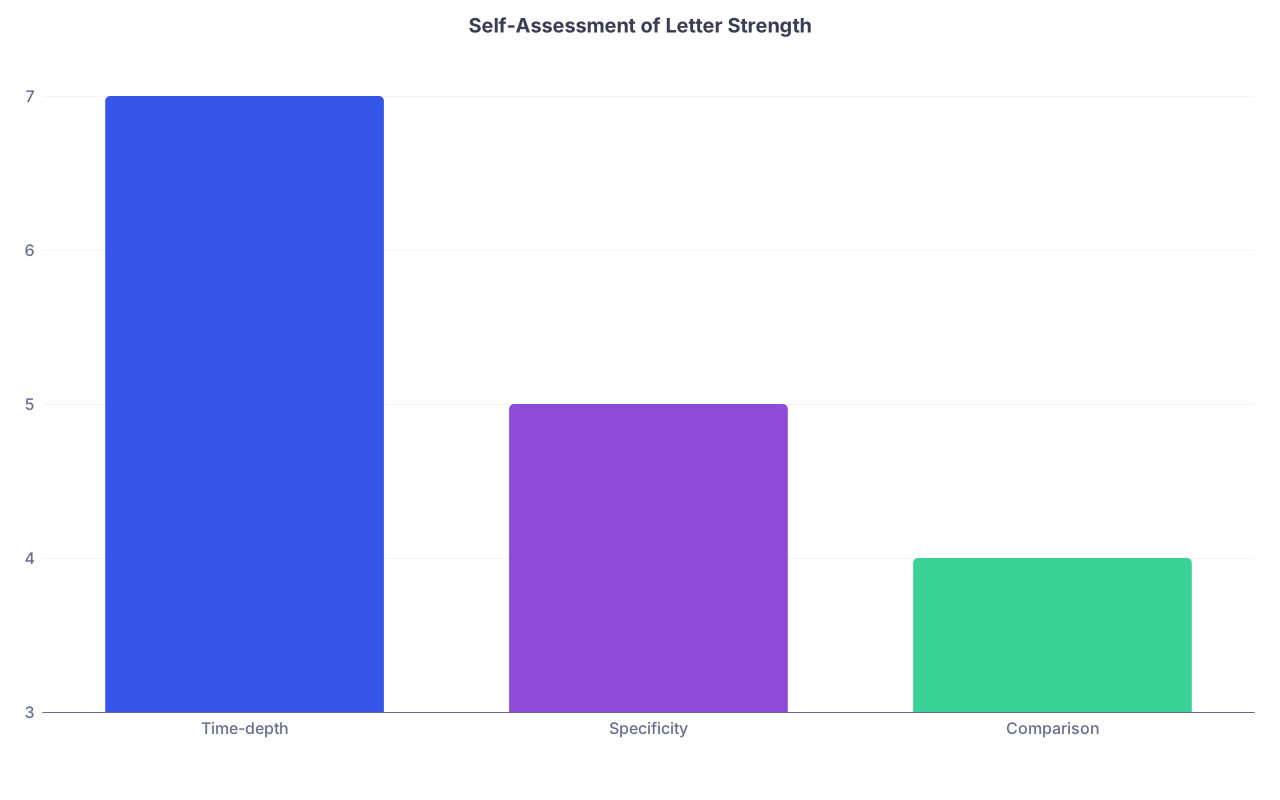
| Category | Value |
|---|---|
| Time-depth | 7 |
| Specificity | 5 |
| Comparison | 4 |
Where 0–10 is your self-judgment of:
- How long and deeply your writers know you (Time-depth)
- How many specific stories they could tell (Specificity)
- How likely they are to compare you favorably to peers (Comparison)
Your goal is to push each of those upward over the next 6–18 months.
One More Thing People Get Wrong
Students in your situation often try to “fix” a weak mentor pool by:
- Chasing “big names” who barely know them
- Collecting too many letters, hoping quantity beats quality
- Avoiding honest conversations because they are scared of a “no”
That approach gives you a folder full of generic, forgettable letters.
Admissions readers have seen thousands of:
“She was punctual and completed all assigned tasks. I am confident she will be successful in medical school.”
This kind of letter does not hurt you dramatically. But it absolutely does not help you in a competitive pool.
A smaller set of vivid, detailed, enthusiastic letters does.
What You Should Do Today
Do not just feel vaguely motivated and move on to something else.
Here is your literal next step for today:
Open a blank document and create two lists:
- “Current Potential Letter Writers” – every name you can think of, scored 1–3 for strength.
- “Target Mentors to Build” – 3–5 faculty/supervisors you will deliberately develop relationships with over the next 6–18 months.
Then, choose one person from List 1 or List 2 and email them before you go to bed:
- Either to re-engage (old major)
- Or to introduce yourself and ask for a brief meeting (new major / potential mentor)
You rescue a weak mentor pool one deliberate relationship at a time. Start that process today, not “after midterms,” not “when things calm down.”