The day your main mentor emails, “I’ll be moving to [Other Institution] next semester,” your LOR strategy just blew up. Unless you fix it fast.
Mentor moves are common, poorly handled, and absolutely salvageable. I have seen students go from “I’m doomed” to “I matched at my first-choice program” with a strong, out-of-institution letter from a mentor who left. The difference was not luck. It was process.
This is about that process.
You are not trying to “stay in touch.” You are trying to:
- Preserve a powerful LOR writer.
- Convert a disrupted relationship into a structured, predictable pipeline for future letters.
- Avoid looking like the student who disappeared and then begged for a letter 18 months later.
Let us fix this systematically.
Step 1: Get Your Head Straight About What Actually Matters
Most students panic about the wrong thing when a mentor leaves.
They worry: “Will programs care that my letter writer is now at another institution?”
They should worry: “Will this person still know me well enough, and be willing and organized enough, to write a strong, specific letter when I need it?”
Residency programs, premed committees, and med school admissions do not care where your letter writer currently sits as long as:
The writer is:
- An MD/DO or PhD or equivalent academic.
- In a relevant field (clinical, research, or teaching).
- Credible in the context of your application.
The letter is:
- Strongly worded and specific.
- Clearly explains how well and how long they have known you.
- On institutional letterhead (even if it is the new institution).
So stop catastrophizing about the move itself. A mentor who moves but stays in your corner is infinitely better than a local faculty member who barely remembers your name.
What kills students is:
- Letting the relationship quietly fade.
- Not updating the mentor with concrete achievements.
- Asking for letters last-minute.
- Never clarifying whether and how they will write for you from the new place.
So your job is simple: lock in clarity and structure before they disappear.
Step 2: Have the Explicit “Letter and Future Plan” Conversation
You need one focused, adult conversation. Not a vague “keep in touch” chat.
If they have already left, fine. Do it by Zoom and email. But do it.
What you want to walk away with
By the end of this conversation you should know:
- Will they write letters for:
- Medical school?
- Scholarships?
- Away rotations?
- Residency?
- Under what conditions and timeline?
- What information they prefer you send each time.
- Their preferred contact email for LOR requests.
- Whether their institution uses a portal (VSLO, ERAS, AMCAS, school portal) or direct upload.
Script you can adapt
You do not need to sound polished. You need to be direct and respectful.
Use something like:
“Dr. Patel, I am very grateful for the mentorship you have given me these last two years. I know you are moving to [New Institution], and I want to be intentional about keeping this relationship going.
I will be applying to [medical school/residency/scholarships] over the next [time frame], and I was hoping you would be willing to continue to support me with letters of recommendation and mentorship from your new institution.
If that is possible, can we talk concretely about:
- The types of applications you would feel comfortable supporting.
- What kind of lead time you need for letters.
- What information you would like me to send you each time so I make this as easy as possible for you.”
Then shut up and let them answer.
If they hedge heavily or seem noncommittal, do not ignore it. That is your cue to diversify mentors. But you still salvage what you can.
Step 3: Build a Simple “LOR Dossier” They Can Reuse
Your goal is to make writing letters for you almost frictionless. Otherwise, you drop to the bottom of their mental priority list.
Create a 1-folder system you can send them every time you need a letter. It should contain:
Updated CV
- Clearly dated at the top.
- Highlighted sections relevant to them (e.g., bold your work in their lab or service).
1–2 Page “Mentor Brief”
- How you know them: roles, dates, projects.
- Specific things you did with them.
- Skills or traits they have previously praised in you.
- Bullet list of “things it would help me if you mention.”
Draft or bullets of your personal statement
- Not to ghostwrite their letter.
- To align the letter’s themes with your narrative.
Target list + deadlines
- Exact programs/schools.
- Exact due dates.
- Method of submission (AMCAS, AACOMAS, ERAS, email link, etc.).
Any institutional instructions
- The wording your premed office or school uses for “strong letter”.
- For ERAS: whether a “department letter” is expected or just an individual one.
Package this as a single email with a clear subject:
Subject: LOR Request – [Your Name], [Cycle Year] – Materials and Deadlines
Do not attach 12 separate files with cryptic names. One organized folder or a short list of clearly named attachments.
Step 4: Timing and Lead Time – Stop Creating Your Own Emergencies
You cannot treat an external mentor like an internal clerk who has to sign whatever you push under their door.
Minimum civilized lead time for an LOR from a busy academic who has moved institutions:
- 4 weeks: Absolute minimum for anything important.
- 6–8 weeks: If it is for residency or medical school and you care about quality.
- 2+ months: If you are asking for multiple letters (e.g., med school plus a scholarship).
Make their life easy:
- Put all deadlines in one place.
- Use calendar language: “Letters needed by July 15” instead of “around mid-July”.
- If you have rolling deadlines (e.g., secondaries), give a single internal deadline for them that covers everything.
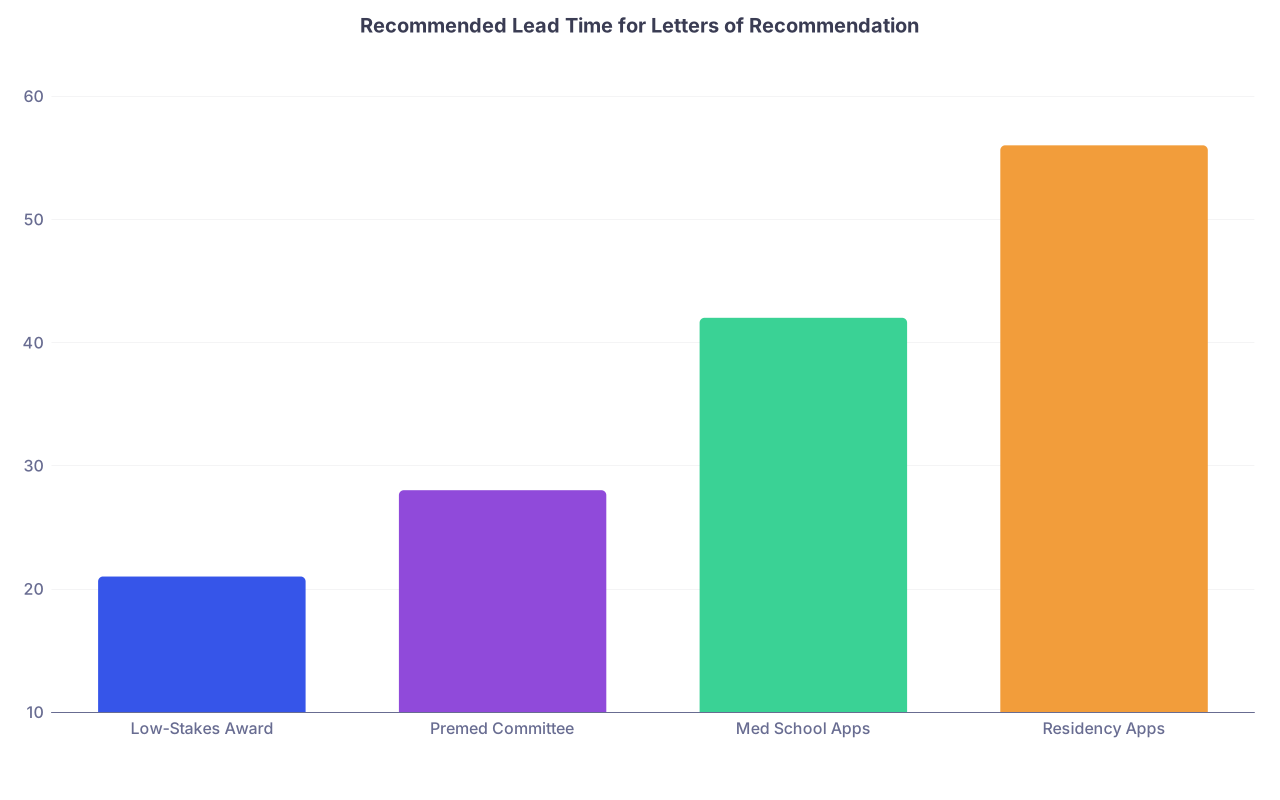
| Category | Value |
|---|---|
| Low-Stakes Award | 21 |
| Premed Committee | 28 |
| Med School Apps | 42 |
| Residency Apps | 56 |
If you are already inside that window because you procrastinated, own it:
“I realize this is a short timeline and I understand if it is not feasible. If possible, I would be extremely grateful for your support by [date].”
Do not pretend four days is “plenty of time.”
Step 5: Get Clear on Logistics – Portals, Letterhead, and Institutional Rules
Mentors who move institutions sometimes get confused themselves about how letters “should” work. You can reduce friction by understanding the mechanics.
Common scenarios
Premed / Medical School Applications (AMCAS/AACOMAS/TMDSAS)
- Letters are uploaded to a centralized service.
- Your mentor’s new institutional affiliation will show in the header and signature.
- Completely fine as long as they clearly state how they knew you at the original institution.
Residency (ERAS)
- Letter writer receives a link to upload directly.
- Letter should be on current institutional letterhead, but explicitly reference your relationship at the old institution.
School-Specific Scholarships / Awards
- Might require letters on your home institution’s letterhead.
- If your mentor is no longer affiliated, you may need clarification from the scholarship office.
- Some will accept “external” letters; some will insist on internal.
Ask clean, direct logistics questions:
“For these med school letters, is it better if I list your current [New Institution] affiliation, or your previous one?
I will be designating you with [New Institution] since that is where you are now, but your letter can state that you supervised me at [Old Institution]. Does that sound right to you?”
“For this internal scholarship, the instructions say ‘preferably from current faculty at [Home Institution].’ Would you still be comfortable writing, or would you recommend I prioritize an on-site faculty member for this particular award?”
You are not being annoying. You are preventing their letter from getting rejected on a silly technicality.
Step 6: Preserve the Relationship with a Simple Follow-Up System
You do not need to “keep up” some fake, constant communication. You need a light, predictable system that keeps you on their radar.
Here is a minimum viable protocol that works:
Twice a year update email (spring and fall):
- 2–3 short paragraphs.
- New roles, major achievements, abstracts, publications, big rotations.
- One sentence explicitly thanking them for past and ongoing support.
- If relevant: where you are in the application timeline.
Every time you use one of their letters:
- Send a brief “thank you + outcome” email once decisions come back.
- Example: “Your letter helped me secure an interview at X, Y, Z and I matched at [Program]. I am very grateful for your support.”
When they change roles again or get promoted:
- Congratulate them. Briefly.
- Do not turn it into a three-page life story.

| Step | Description |
|---|---|
| Step 1 | Mentor Moves Institutions |
| Step 2 | Clarify LOR Agreement |
| Step 3 | Send Initial Dossier |
| Step 4 | Biannual Update Emails |
| Step 5 | Request Letters with 4–8 Weeks Lead Time |
| Step 6 | Send Outcome & Thank You |
If you do just this, you are already in the top 10% of mentees they support. They will remember you when it counts.
Step 7: Fix the “Name and Context” Problem in the Letter Itself
One subtle issue when a mentor moves: the reader at your future school may be confused.
“Why is this [Other Institution] physician talking about their work with a student at [Your Institution]?”
You want to make it easy for the letter reader to understand.
Encourage your mentor (via your “Mentor Brief” and gentle phrasing) to include:
- How and where they supervised you.
- Their role at the time.
- The time frame.
- How your relationship has continued.
Example language you can suggest indirectly by including similar wording in your materials:
“I first met [Student] in 2022 when I was an Assistant Professor of Medicine at [Old Institution], where I supervised them on my inpatient medicine service and as a research assistant in my outcomes lab. Since moving to [New Institution] in 2024 as an Associate Professor, I have continued to mentor [Student] remotely on ongoing projects and career planning.”
You are not scripting their letter. You are seeding the facts they can adapt.
Step 8: Know When You Need a New “Primary Letter Writer” Anyway
Here is the hard truth: sometimes, even a great mentor who moved is no longer your best primary letter writer.
Common red flags:
- They are overloaded at their new institution and slow to answer.
- Their new role is now heavily administrative and far from your field.
- They start declining smaller letter requests.
- They often miss soft deadlines and need multiple reminders.
In those situations, you shift strategy:
- Keep them as a secondary or research letter, not the backbone of your application.
- Deliberately cultivate 1–2 new mentors at your current institution:
- For premeds: course directors, PI at your current lab, longitudinal volunteer supervisor.
- For med students: clerkship directors, sub-I attendings, program leadership in your target specialty.
You do not “break up” with the moving mentor. You downgrade their operational role while preserving respect and gratitude.
Step 9: Special Situations and How to Handle Them
Situation 1: They announce the move right before your application cycle
Example: You are applying to medical school this summer; they leave in June.
Fix:
- Have the conversation immediately.
- Ask if they can write your primary letter before leaving, using current letterhead.
- Upload to AMCAS/committee portal early.
- Then maintain them as an ongoing mentor but focus new letters (scholarships, later programs) on others.
Situation 2: You find out they moved after the fact
You email them at their old institutional address and get a bounce. Panic.
Fix:
- Search their name + new institution on Google.
- Check PubMed for their latest publication and affiliation.
- Reach out via:
- New institution email.
- Professional website contact form.
- Department admin assistant.
Your email might look like:
“Dear Dr. Li,
I hope you are well. I last worked with you in [Lab/Service] at [Old Institution] in 2022. I recently learned you have moved to [New Institution] – congratulations on your new role.I am currently applying to [X], and your mentorship had a major impact on my development. If you still remember our work together and feel comfortable supporting my application, I would be very grateful for a letter of recommendation. I have attached my updated CV and a brief summary of our prior work together.
If your current responsibilities make this difficult, I completely understand and appreciate your consideration either way.”
If they do not respond after 2 attempts spaced 1–2 weeks apart, you move on and build with new mentors. Do not spam.
Situation 3: They tell you candidly they cannot write as strong a letter anymore
Maybe they do not recall details well. Maybe your interaction was brief.
Good. That honesty just saved you a weak, generic letter.
Your move:
- Thank them sincerely for their honesty.
- Ask if they would be open to career advice instead of letters going forward.
- Immediately prioritize other mentors who can speak in detail.
Step 10: Document Everything for Your Own Sanity
Once a mentor is at another institution, losing track of who said what is easy. You do not want to be that person frantically searching old emails during ERAS season.
Minimum tracking system (one page or sheet):
- Mentor name and title.
- Old and new institutions.
- Best contact email.
- What they agreed to write (med school, residency, awards).
- Any constraints (needs 6 weeks; prefers AMCAS upload; will not write for X).
- Dates you requested letters and date they confirmed upload.
| Mentor | Old Inst. | New Inst. | Lead Time (weeks) | Will Write For |
|---|---|---|---|---|
| Dr. Patel | State U | Big Med | 6 | Med School, Residency |
| Dr. Li | City Hosp | Univ A | 4 | Research, Scholarships |
| Dr. Rivera | College X | College X | 3 | Premed Committee Only |
You will reference this constantly once letters start flying.
Step 11: Understand How Admissions Committees Read “Moved Mentor” Letters
Let me be blunt: committees are not sitting around saying, “Hmm, this letter is from a different institution now, suspicious.”
They are asking:
- Does this writer look legitimate and relevant?
- Do they clearly explain how they know the student?
- Do they provide specific behaviors and examples?
- Do they say “top 5%” or “best student I have worked with” or at least something above “fine”?
If your letter from a moved mentor checks those boxes, it can be one of the strongest pieces in your file.
In some cases, a letter from a mentor now at a more “prestigious” institution even helps you:
- Signals that you did serious work with someone who advanced in their career.
- Expands your apparent network beyond your home institution.
The only time a move raises eyebrows is if the letter is vague about your relationship:
- No dates.
- No context which institution.
- No details on what you actually did.
You fix that upstream by giving your mentor the context and reminders they need.
Step 12: A Concrete Communication Template Set You Can Reuse
You do not need to reinvent the wheel every time. Here is a lean set of templates you can adapt.
A. Initial “You are moving; can we talk?” email
Subject: Quick meeting to plan for my upcoming applications
Dear Dr. [Name],
I heard about your upcoming move to [New Institution] – congratulations on this next step. I have really valued your mentorship while you have been at [Old Institution], especially our work on [specific project / rotation].
I will be applying to [medical school / residency / X] in [Month, Year], and I would like to be intentional about planning letters of recommendation and mentorship going forward. Would you be willing to meet for 20–30 minutes in the next couple of weeks to discuss whether and how you would feel comfortable supporting my applications from your new institution?
Thank you again for everything you have already done to support my development.
Best regards,
[Your Name]
B. LOR request email after expectations are set
Subject: LOR Request – [Your Name], [Application Type + Year]
Dear Dr. [Name],
Thank you again for agreeing to support my applications. As we discussed, I am applying to [X] this cycle, with primary deadlines around [date].
Attached are:
- My updated CV
- A 1-page summary of our work together and key points about my application
- A brief personal statement draft / summary of my goals
The letter can be uploaded through [AMCAS/ERAS/school portal]; you should receive an automated email with instructions once I list you as a recommender. My internal deadline for letters is [date], although the official system deadline is [later date].
Please let me know if there is any additional information that would be helpful. I am very grateful for your continued support from [New Institution].
Best,
[Your Name]
C. Outcome + thank you email
Subject: Thank you – [Outcome]
Dear Dr. [Name],
I wanted to share some good news and thank you again for your support. With your letter, I [was accepted to / matched at] [School/Program]. I am thrilled to be starting [M1 / residency in X] this [month/year].
Your mentorship, starting back when you were at [Old Institution] and continuing at [New Institution], has been a major part of getting here. I really appreciate the time and energy you invested in my development.
I will keep you updated as I get started in this next stage.
Warm regards,
[Your Name]
Use these. Tweak them. Just do not wing it with rambling, unstructured emails that bury the actual request.

The Bottom Line
When your top mentor moves institutions, your situation is not ruined. It is just less automatic. You fix that by:
- Making the relationship explicit and structured – discuss letters, timelines, and boundaries directly instead of hoping it “just continues.”
- Reducing friction for your mentor – organized materials, clear deadlines, and respectful lead time keep you at the top of their support list.
- Keeping a light but consistent connection – brief updates and clear outcomes preserve the relationship, even across institutions, while you quietly build additional mentors in parallel.
Do this, and a mentor’s move becomes an inconvenience, not a disaster.