
The most impressive name on your letter of recommendation can also be the one that quietly destroys your application.
If you do not understand how overcommitted “star” faculty operate, you will underestimate the risk they pose to your timeline. And timelines are where otherwise strong applicants bleed out.
This is not about “getting good letters.” It is about getting on-time letters. Commit that distinction to memory.
The Hidden Risk of Star Faculty Letters
You already know this type of faculty member.
They are the big name. Endowed chair. Program director. Department vice chair. National committee this, NIH study section that. Students brag that “Dr. X wrote my letter” like it is a trophy.
Here is the mistake: you assume high status equals high reliability.
It usually does not.
Overcommitted star faculty are:
- Booked solid with meetings from 7:30 a.m. to 6:00 p.m.
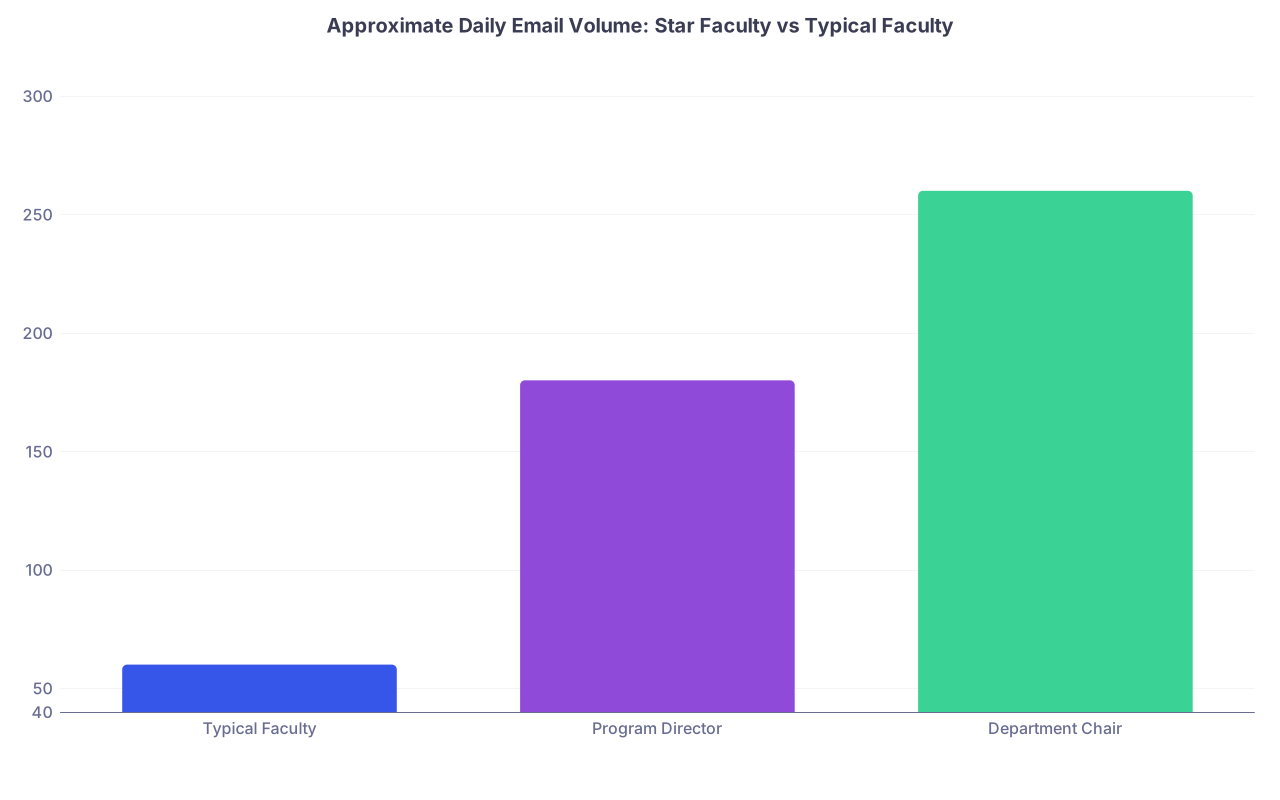
- Getting 200–400 emails a day.
- Traveling for conferences, grant reviews, invited talks.
- Supervising residents, fellows, grad students, postdocs, and undergrads.
Your letter request is one item in a massive queue. And unlike patients, grants, and committee deadlines, your ERAS/AMCAS/secondary deadline is not embedded in their daily survival. It is just another “yes” they said too quickly.
I have watched this exact pattern too many times:
- Student proudly secures a famous recommender in March or April.
- Faculty enthusiastically agrees. “Of course, happy to support you. Just remind me closer to the deadline.”
- Student, intimidated by their status, sends polite, infrequent reminders.
- July–September: deadlines hit; letters are missing; interviews are delayed or never offered.
- The student blames themselves, not the structural problem: they chose someone whose schedule made failure likely.
That is what this article is about—preventable failure.
Why High-Profile Faculty Are Chronically Late (And Do Not See It)
You need to understand their world to protect yourself.
1. They systematically underestimate time
Senior faculty are trained optimists when it comes to bandwidth. That is how they got there—saying yes to too much, then somehow pulling it off more often than not.
When you ask for a letter, they do a mental calculation:
- “I write lots of letters.”
- “I like this student.”
- “The deadline is months away.”
So they say yes. But they do not schedule it. They do not block time. It lives in the vague mental bin of “I will deal with that later.”
You are counting days. They are counting grant cycles.
2. Their email is a black hole
Your request goes into an inbox that functions as a noise machine.
| Category | Value |
|---|---|
| Typical Faculty | 60 |
| Program Director | 180 |
| Department Chair | 260 |
Now imagine your “Just checking in about my letter!” message landing in the middle of 260 messages—most of which are flagged “urgent” by someone.
You think “They must have seen my email and decided to ignore it.”
Reality: they probably never saw it. It got buried in 24 hours.
3. Their priorities are externally enforced. Yours are not.
Grants have hard submission portals that close. Committees have fixed meeting dates. An angry chair will call if a report is late.
Will AMCAS call them if your letter is missing? No.
Will their department punish them? No.
Will anyone besides you suffer a tangible consequence? Also no.
So unless they are extremely conscientious and organized (some are, most are not), your letter sits behind every externally enforced deadline in their life.
4. They overestimate how early they started
Faculty memory is foggy about timing. I have heard versions of this in hallway conversations:
- “I wrote that letter weeks ago.” (It was 48 hours ago.)
- “They asked me very late.” (They asked 6 weeks before the deadline.)
- “I submitted on time, but the system is slow.” (They uploaded it the day after.)
You cannot rely on their internal sense of time. You must protect yourself with external structures.
Classic Ways Students Get Burned (And How To Avoid Each)
Let us walk through the most common patterns where star faculty wreck your timeline, and exactly how to dodge them.
Mistake #1: Mistaking prestige for reliability
You think: “A letter from the Dean or famous PI will impress admissions.”
You do not ask: “Has this person delivered letters on time for students like me?”
Choosing recommenders is risk management, not name collection.
Better options than a risky big name:
- A mid-career faculty member who knows you very well and has written for you before.
- A clinical preceptor who saw you consistently for 8–12 weeks and actually remembers specific examples.
- A course director who can comment on your work ethic, communication, and professionalism.
If you insist on using a high-profile recommender, they should be one letter in a portfolio that is otherwise fully covered by reliable writers, not your cornerstone.
Mistake #2: Asking too late and too softly
You ask in early June and your primary application goes out two weeks later. They say yes. You feel relief. Big mistake.
For heavily committed faculty, “late” often means anything under 6–8 weeks before the true deadline, especially during peak chaos months (May–September).
Here is what a safer approach looks like:
- Ask 10–12 weeks before your first relevant deadline.
- Give them a clear internal deadline that is earlier than your real one (“AMCAS opens June 1; I am aiming to have letters in by May 15”).
- Say out loud: “If your schedule makes this difficult, I completely understand; I have other options and do not want to add stress.”
That last line gives them permission to tell you “No” honestly. You want the “No” now, not in August.
Mistake #3: No redundancy
This is the one that really hurts.
You build your entire application around three letters:
- Famous research PI
- Department chair
- Big-name course director
All three are overloaded. You have no backup writers. No diversity of letter type. No non-faculty clinical recommender.
Then one is two months late, one forgets, and one uploads a generic note after half your secondaries are already submitted. You cannot fix that in September.
Instead, build redundancy intentionally.
| Portfolio Type | Composition |
|---|---|
| Risky | 2+ star faculty, no backups |
| Safer | 1 star + 2–3 reliable mid-level faculty |
| Very safe | 1 star + 2 reliable faculty + 1 clinical + 1 research backup |
| Emergency | 3+ people who know you well, regardless of title |
You do not need to use every letter. You need them in the system before deadlines so that one person’s chaos does not sink you.
Mistake #4: Vague or timid follow-up
Overcommitted faculty are not offended by organized, respectful reminders. They live on reminders. They are offended by last-minute panic.
What students do wrong:
- Send 1–2 very polite emails with no dates: “Just checking in!”
- Do not include the actual deadline in the subject line.
- Do not clarify how critical the letter is in the matrix of their other recommenders.
- Wait until a few days before the deadline to escalate, when it is already unsalvageable.
A better pattern (for someone who has already agreed):
- Initial ask: In person or via Zoom if possible, with clear deadline.
- Follow-up #1: 4–6 weeks before deadline.
- Follow-up #2: 2 weeks before deadline.
- Follow-up #3: 1 week before deadline, with a clear “Plan B” mention.
- Final nudge: 48–72 hours before internal deadline.
You are not being “annoying.” You are compensating for a chaotic environment.
How Late Letters Quietly Damage Your Application
Most premeds and early med students underestimate how timing interacts with competitiveness. “As long as it is in by the deadline, I am fine.” Wrong.
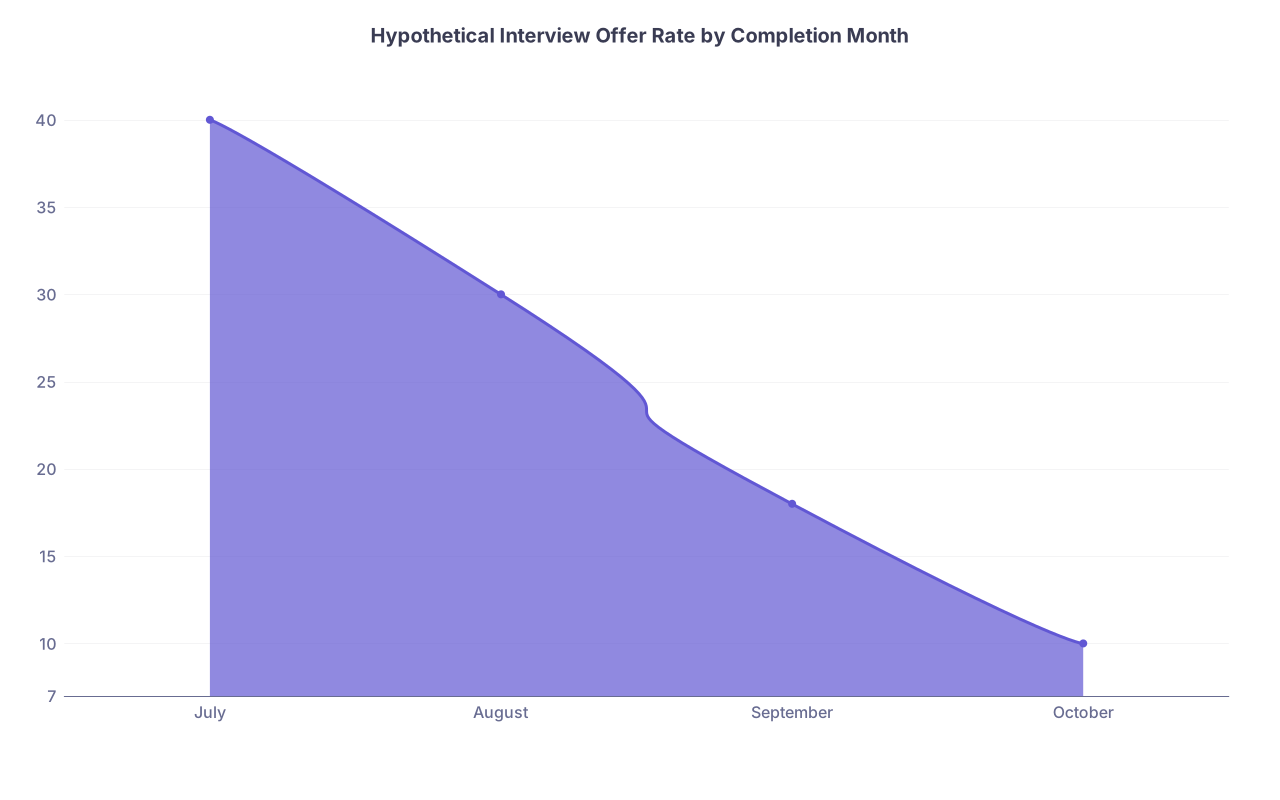
Rolling admissions and lost interview slots
For MD schools and many DO schools, admissions is rolling. Early complete = better odds. Period.
Here is what a missing letter does in practice:
- Your primary is verified.
- Secondaries are submitted.
- But your application sits in the “incomplete” pile because a key letter is missing.
Other students’ files get read. Interview slots fill.
| Category | Value |
|---|---|
| July | 40 |
| August | 30 |
| September | 18 |
| October | 10 |
If your app is not complete until mid-September because of a late letter, you are not competing with the same odds as someone complete in July. Same stats. Different timeline. Different outcome.
ERAS/Residency consequences
In residency applications, delays are even more brutal.
Programs may:
- Filter by “application complete by X date” for interview offers.
- Do their main review push in the first 2–3 weeks after ERAS opens.
- Use letters to decide whom to rank more aggressively.
If your star faculty letter appears in your file on October 20, weeks after program directors did their first major review, that “prestige” has moved near zero in practical value.
Psychological damage and performance hit
There is another cost: what delayed letters do to you.
I have seen students who:
- Spend weeks in anxious limbo checking portals every morning.
- Delay scheduling interviews because they feel their file is incomplete.
- Underperform on late exams or Step/COMLEX because of chronic low-level stress about letters.
This is not minor. Your cognitive bandwidth is finite. You cannot prepare for interviews or exams while worrying that a key recommender has ghosted you.
A Safer System: How To Use Star Faculty Without Letting Them Sink You
You do not have to avoid high-profile faculty completely. You just have to stop treating their letter as a simple checkbox. You design a system around their known failure modes.
Step 1: Triage your recommenders honestly
Make a literal list of people you could ask. Then classify:
- High-risk: Senior leadership, program directors, department chairs, huge PIs who travel constantly.
- Medium-risk: Associate professors, course directors, busy but not running the world.
- Low-risk: Faculty known by students to respond to email, clerkship attendings, advisors, small-group leaders, research mentors who meet with you regularly.
Do not stack your entire letter strategy in the high-risk column. One such person? Fine. Two at most. Three or more is negligence.
Step 2: Set your internal deadlines, not theirs
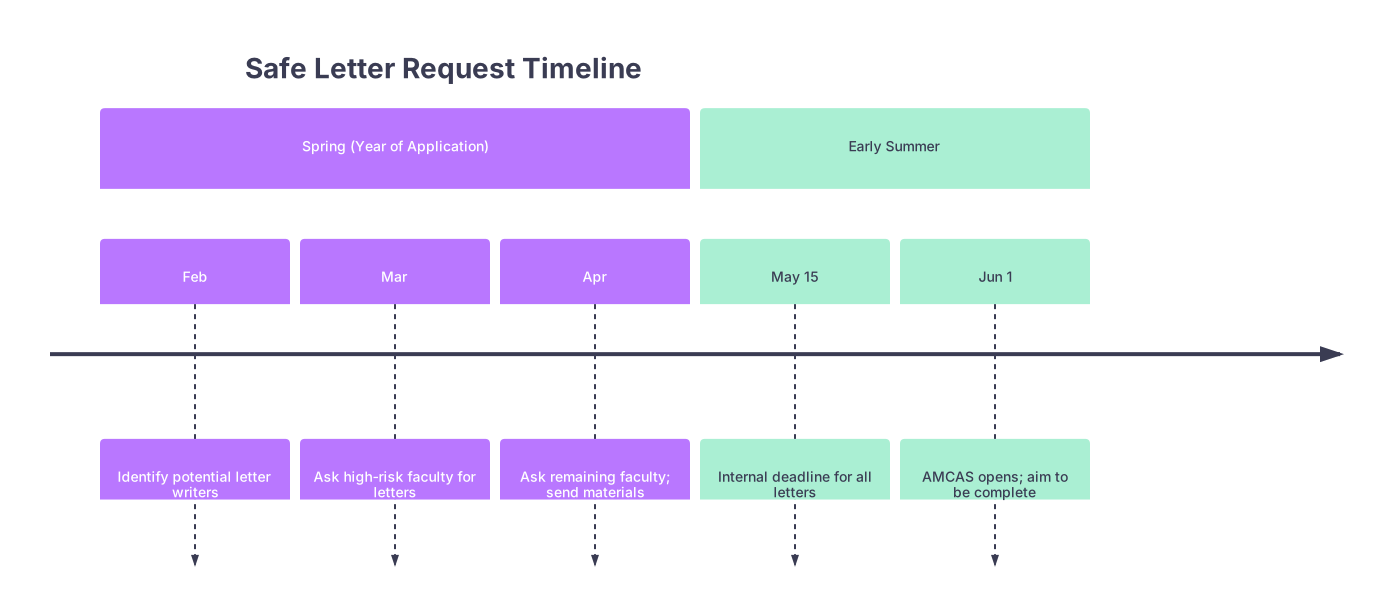
Map out when letters need to be in for you to be “early complete.”
| Period | Event |
|---|---|
| Spring (Year of Application) - Feb | Identify potential letter writers |
| Spring (Year of Application) - Mar | Ask high-risk faculty for letters |
| Spring (Year of Application) - Apr | Ask remaining faculty; send materials |
| Early Summer - May 15 | Internal deadline for all letters |
| Early Summer - Jun 1 | AMCAS opens; aim to be complete |
For residency, shift this earlier relative to ERAS opening.
Then communicate your internal deadline to faculty. Not the last legally possible day. The day that keeps you competitive.
Phrase it like this:
“ERAS opens on September 1, but programs start reviewing applications immediately. To be considered early, I am aiming to have all letters in by August 25. Would that timeline work for you?”
You are not lying. You are aligning your survival with the reality of rolling review.
Step 3: Give them what they need to write efficiently
Overcommitted faculty procrastinate on letters that feel hard or time-consuming.
You reduce that friction:
- One-page summary of your work with them (projects, courses, clinical encounters, specific stories).
- CV or resume.
- Personal statement draft or at least a paragraph on your goals and specialty interests.
- Clear list of what you hope they will highlight (“work ethic, ability to work with a team, research independence”).
The easier you make it, the more likely they will batch-write your letter during a rare free hour.

Step 4: Build and use backups before trouble starts
Do not wait for a disaster signal. Assume that at least one letter will be late.
Have:
- At least one extra faculty member who has already agreed to write.
- A clinical supervisor or community leader who can submit if a faculty letter vanishes.
- For residency: an extra attending from a different rotation or sub-I.
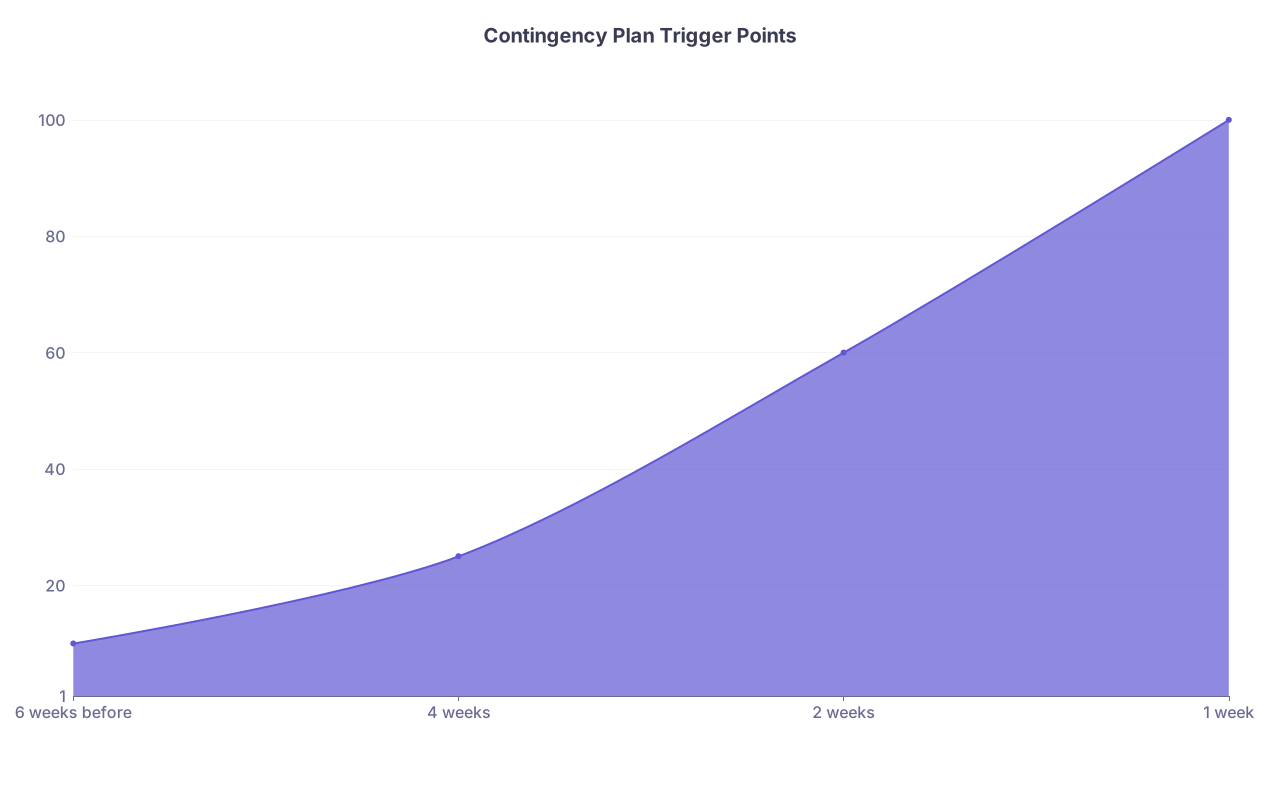
Then watch this carefully:
| Category | Value |
|---|---|
| 6 weeks before | 10 |
| 4 weeks | 25 |
| 2 weeks | 60 |
| 1 week | 100 |
Think of that rising curve as your internal “urgency.” If your high-risk recommender has not even acknowledged your reminder by 2 weeks before your internal deadline, you formally activate Plan B:
- Email them and your backup with clarity.
- Decide in advance: if their letter is not in by X, your backup’s letter becomes primary.
Do not cling emotionally to the star name if it is actively harming your timeline.
Step 5: Escalate like a professional, not a panicked student
If a usually reliable but busy recommender has not submitted close to your internal deadline, escalation is appropriate.
You can:
- Send a polite, very specific email with subject: “Letter for [Your Name] – internal deadline [date].”
- If possible, stop by during office hours to ask in person: “I wanted to quickly check that everything is on track for the letter; if your schedule is too tight, I do have other options.”
- Loop in a coordinator only if the faculty member often uses their staff to manage letters.
What you do not do: passive-aggressively imply they are hurting your career. That backfires.

Red Flags: When You Should Not Rely On That Star Faculty Member
If you hear or see any of the following, treat them as genuine warning signs:
- “Just remind me later; I do not really track these things.”
- “I am traveling most of the summer, but I am sure we can figure it out.”
- They have a reputation among students for writing letters the night before.
- They did not respond to your initial email and only agreed when you caught them in the hallway.
- They say, “I have a standard letter I use; I will just plug your name in.”
In those cases, you can still use their letter, but never as your only or main academic reference. That is playing chicken with your own future.
A Quick Reality Check: When A Star Letter Actually Helps
There is a place for famous names. I am not going to pretend otherwise.
A strong, specific letter from a well-known PI or department leader can:
- Reassure committees that your research is real and you actually did the work.
- Carry weight at institutions where they are personally known.
- Help for very competitive specialties where faculty networks matter.
But only when:
- It is on time.
- It is detailed and personal, not generic.
- It supplements, not replaces, robust letters from people who saw your day-to-day work.
If you have to choose between:
- A potentially late letter from a national name who barely knows you, and
- A timely, concrete letter from a mid-level faculty who supervised you closely for months,
you choose the second. Every time. Prestige does not compensate for absence.

| Step | Description |
|---|---|
| Step 1 | Star faculty available? |
| Step 2 | Do NOT rely on as primary letter |
| Step 3 | Use only as bonus letter with backups |
| Step 4 | Safe to use as one of several key letters |
| Step 5 | Know you well? |
| Step 6 | On-time track record? |

FAQs
1. Is it rude to give a professor an earlier “fake” deadline?
No. It is smart. You are not fabricating the importance of timing; you are aligning your internal deadline with the reality of rolling admissions and review schedules. You are managing risk in a system that punishes lateness. What is rude is silently letting your application be damaged because you were afraid to be clear.
2. What if my only strong letter options are all very busy, high-profile faculty?
Then you compensate in structure, not fantasy. Ask earlier—3 months, not 6 weeks. Provide extremely organized materials. Build at least one backup who is slightly less prestigious but more available. And be transparent in your ask: “I know you are very busy; if your schedule makes this unrealistic, I completely understand and can ask someone else.” You are fishing for an honest “No” from the truly overcommitted.
3. My recommender is late but the portal still shows ‘pending.’ Should I replace their letter?
If your internal deadline has passed and programs are actively reviewing applications, you strongly consider activating a backup. You do not need to “replace” in many systems; you can simply add another letter and reorder which ones are designated. If your star faculty letter arrives later, good—you can still attach it where possible. But never hold your entire application hostage waiting for one person’s schedule to clear.
4. How do I politely stop relying on a star faculty member who keeps missing soft deadlines?
You step back from dependence, not relationship. You might say: “Given how busy your schedule is, I do not want to add stress with additional letter requests. I am grateful for your support, and I will likely use the letter you already wrote, but for future deadlines I have arranged alternative writers who can respond more quickly.” That preserves the connection while freeing your timeline from their chaos.
Key points, so you do not learn this the hard way:
- Prestige does not equal reliability; overcommitted star faculty are high-risk for late letters.
- Your survival depends on early asks, clear internal deadlines, and real backups—not hope.
- A timely, specific letter from a less-famous faculty member beats a late, generic one from a big name every single time.