
One strong mentor won’t magically erase a low GPA – but the right mentor can absolutely change how committees interpret it.
I’m going to be blunt, because that’s probably what you’re craving and dreading at the same time: no letter writer, no matter how famous, can “salvage” a completely non‑competitive application. But a real advocate, who knows you well and is willing to go to bat for you, can be the difference between “auto-screened into the trash” and “let’s actually look at this person.”
That gap is massive.
And yeah, I know the loop you’re stuck in:
- GPA isn’t where it “should” be.
- You don’t have an army of cheering professors lining up to write you glowing letters.
- You’re terrified that the one mentor you do have is your only hope.
- And you’re half-convinced you’re asking them to lie for you.
Let’s untangle this without sugarcoating it.
1. What a Mentor Can (And Cannot) Actually Do
Let me cut through the fantasy first.
Here’s what even the best mentor cannot do for a low‑GPA applicant:
- They can’t override hard cutoffs if schools screen you out at 3.4 and you’re sitting at 3.1.
- They can’t turn a pattern of poor performance with no upward trend into “Oh, it’s fine.”
- They can’t make committees ignore MCAT scores, lack of clinical exposure, or weak essays.
- They can’t “call in a favor” and make Harvard or UCSF take you out of pity.
But that’s not the whole story.
Here’s what a strong mentor can realistically do, especially when your GPA makes people nervous:
- Provide a counter‑narrative: “Yes, the numbers are weaker, but here’s what they completely miss about this student.”
- Explain a credible context for the GPA dip: illness, caregiving, working 30+ hrs/week, learning disability, bad early start with clear improvement, etc.
- Give granular, specific evidence of your ability: “In my lab, they independently designed X,” “In my course, they went from bottom quartile to top 10%,” “They were the only student to do Y.”
- Signal trust: “I would trust this student with my patients, my research, my reputation.”
That last part—reputation—is what admissions committees notice.
They know some letters are “polite fluff.” They also know when someone is truly sticking their neck out. The whole game is whether you can get one or two people willing to do that for you.
2. Low GPA + Few Champions: How Bad Is This Combination Really?
You’re probably catastrophizing it into:
“Low GPA + only one real mentor = I’m done.”
Not necessarily. It depends on how low and what else is going on.
| GPA Range | With Strong Mentor Letters | Without Strong Mentor Letters |
|---|---|---|
| 3.7–3.9 | Great boost, icing on cake | Still competitive |
| 3.4–3.6 | Can offset doubts, very helpful | Mild concern, still viable |
| 3.2–3.3 | Letters become critical context | Risky without context |
| 3.0–3.1 | Needs strong letters **plus** other strengths | Very tough |
| <3.0 | Usually needs post-bacc/SMP + letters | Almost impossible |
If you’re in that 3.0–3.3 bracket, you’re basically asking committees:
“Will you give me the benefit of the doubt and actually read my file?”
That’s where a mentor’s letter matters a lot.
But “few champions” doesn’t mean doomed. I’d rather have:
- 1–2 truly excellent letters from people who know me
than - 4–5 generic letters from people who barely remember my name but say I was “pleasant to work with” and “performed adequately.”
Committees can smell “meh” letters. They’ve read thousands.
3. What Makes a Mentor Letter Actually Powerful for a Struggling Applicant?
Not all “strong” letters are actually useful for someone with a low GPA. There’s a specific kind of letter that moves the needle for borderline numbers.
Powerful letters for low‑GPA applicants usually have these ingredients:
Acknowledges the elephant in the room
Not, “I don’t know anything about their grades,” but something like:
“While their overall GPA is not as high as some applicants, it does not accurately reflect their current capabilities for the following reasons…”Gives concrete evidence of academic ability
Things like:- “They scored in the top 10% on my final exam, which is standardized and historically correlated with success in upper‑level work.”
- “They handled complex, ambiguous experimental design independently.”
- “They consistently taught material to peers who were struggling.”
Describes growth and resilience
Especially if the GPA has an upward trend. Example:
“I first met them when they were struggling significantly in my course. They came to every office hour, implemented feedback, and by the end of the semester, they were performing at the level of my strongest students.”Signals trust with strong, unambiguous language
Admissions committees look for statements like:- “I recommend them without reservation for medical school.”
- “They are in the top 5% of students I have worked with in the last 10 years.”
- “I would gladly have them as a colleague in the future.”
Is clearly written by someone who actually knows you
Specific projects. Specific moments. Not just “hardworking, punctual, team player.”
That’s what your “right mentor” needs to produce if you want them to truly help salvage your chances.
4. How to Turn One Mentor into a Real Advocate (Without Feeling Like You’re Begging)
This is the part that makes your stomach drop: actually asking.
You’re probably thinking:
- “What if they secretly think I’m mediocre?”
- “What if they say yes but then write a lukewarm letter?”
- “What if I’m asking too much because my GPA is bad?”
Here’s the uncomfortable truth: you need to know if they’re willing to go to bat for you, not just submit something.
You can approach it like this:
Ask directly, but with a built‑in exit ramp for them.
Example:
“I’m planning to apply to medical school. Given that my GPA isn’t as strong as I’d like, strong letters of recommendation are especially important for me. Do you feel you know me and my work well enough to write a strong, supportive letter for my application? If not, I completely understand—honestly is really helpful to me right now.”That phrase—“strong, supportive letter”—is key. It gives them a chance to say no if they’re lukewarm.
Give them a clear picture of the story you’re trying to tell.
Share:- Transcript (with a brief explanation of dips or trends).
- CV / activities list (clinical, volunteering, research).
- Personal statement draft, if you have one.
- A short paragraph: “Here’s how I’m hoping committees will understand my academic record—does that feel honest to you?”
Ask them explicitly to address your academic concerns.
Example:
“Because my GPA is on the lower side, it would help me a lot if you’re comfortable commenting specifically on my academic potential and ability to handle rigorous coursework, especially compared to other premeds you’ve taught.”
If the right mentor is really “right,” they’ll understand what you’re asking and either:
- Say, “Yes, I can honestly say those things,” and then actually do it.
- Or, “I don’t think I’m the best person for that,” which stings, but at least you’re not getting a silent torpedo of a weak letter.
5. If You Only Have One True Champion, Now What?
Here’s the rough reality: med schools usually want 3–4 letters. Often:
- 2 science faculty
- 1 non‑science or humanities
- 1 additional (PI, clinician, advisor, etc.)
So if you have:
- 1 amazing mentor
- 1 decent but not close professor
- 1 “I barely remember you but I’ll sign something”
You’re going to worry that the weak links cancel out the strong one.
They don’t fully cancel. But they do water down the impact.
You have three levers here:
Maximize the one champion letter.
Do everything I mentioned above. Meet with them. Give them context. Follow up politely. Remind them of specific stories they might include.Upgrade at least one “meh” letter to “solid.”
This might mean:- Going back to a professor and building more of a relationship (office hours, research, TA’ing).
- Asking if you can assist with something so they see you again in action.
- Or choosing a different letter writer who knows you better, even if they’re not as “fancy” (e.g., community clinic supervisor vs. famous PI).
Let your activities and essays reinforce what that mentor says.
Your mentor says you’re resilient? Your personal statement better show that.
Your mentor says you thrived in their lab? Your activities section better show depth there.
One stellar letter standing alone is suspicious.
One stellar letter echoed by your own story and activities is convincing.
6. Should You Wait to Apply Until You Have More Support?
This is the question you’re probably too scared to ask out loud.
Here’s my honest take:
You should seriously consider delaying if:
- Your GPA is <3.3 and you don’t have:
- Strong upward trend, or
- Post‑bacc/SMP coursework showing A/A- work, or
- A compelling context that’s addressed in your letters and essays.
- Your letters situation is:
- 1 great letter,
- 1 okay letter,
- 1 unknown/weak letter,
- and you’re not in a position to fix that in the next 3–6 months.
That doesn’t mean “never apply.” It just means you’ve got work to do before it’s worth burning an application cycle and thousands of dollars.
If you take a year to:
- Do a post‑bacc or upper‑level science courses and crush them
- Deepen relationships with at least 2 faculty who can actually say, “They turned things around—here’s proof”
- Build stronger clinical experience that backs up your story
Then your “right mentor” doesn’t have to single‑handedly rescue your app. They just become the loudest voice in a choir saying the same thing:
“This person used to struggle, but they figured it out, they’re ready now, and I’d trust them with my patients.”
That story is salvageable. I’ve seen it work.
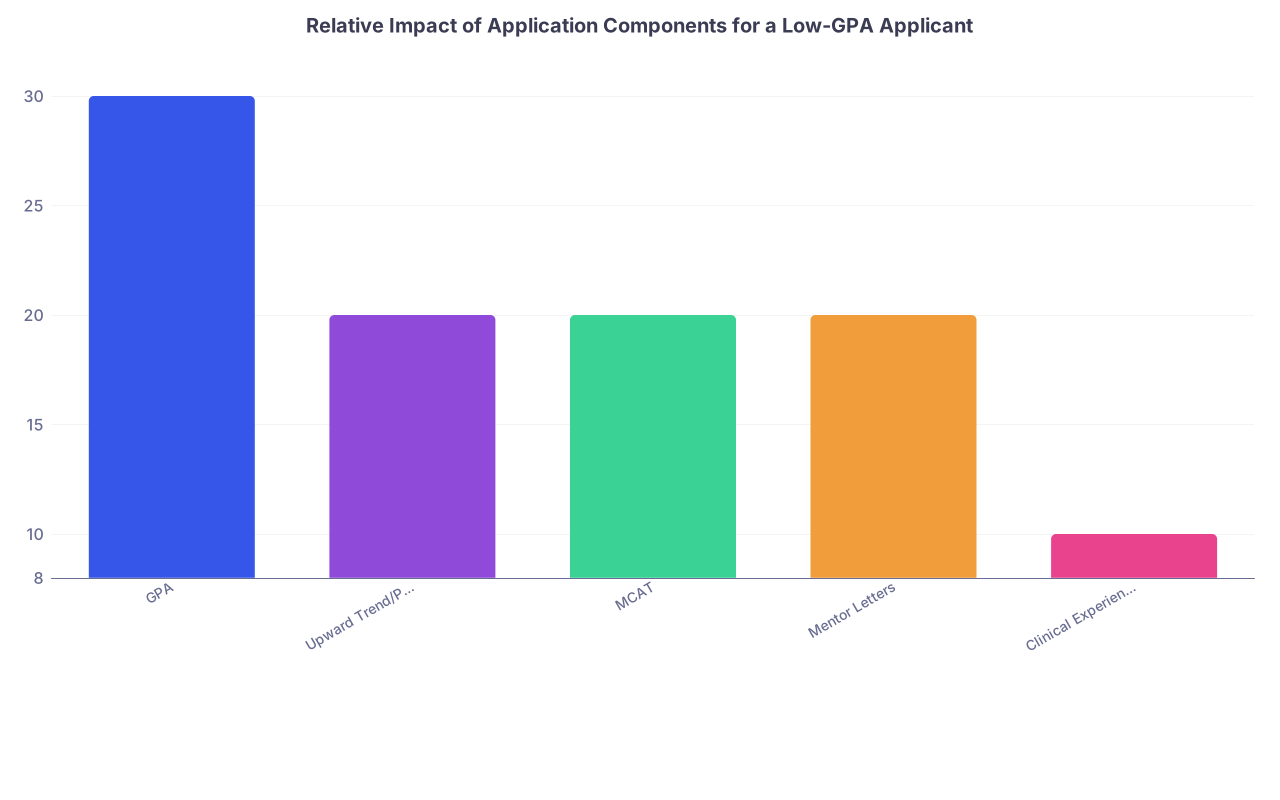
| Category | Value |
|---|---|
| GPA | 30 |
| Upward Trend/Post-bacc | 20 |
| MCAT | 20 |
| Mentor Letters | 20 |
| Clinical Experience | 10 |
7. How to Tell If Your Mentor’s Letter Is Actually Helping (Without Reading It)
You almost never get to see the actual letter. That’s torture, I know.
But you can infer a lot from:
How they respond when you ask.
Enthusiastic: “Absolutely, happy to, you’ve been great.” → good sign.
Hesitant: “I guess I can write one if you need… when is it due?” → red flag.How many clarifying questions they ask.
Do they want your CV, personal statement, list of schools, context on your GPA? That’s what serious advocates do.What they say about you in front of you.
If they introduce you to someone as “one of my strongest students” or “a really impressive member of our lab,” that’s who you want writing for you.
If you walk away from the conversation feeling like they were half‑hearted… trust that feeling. Don’t rely on that person as your “right mentor.” They might still write, but they’re not your foundation.

| Step | Description |
|---|---|
| Step 1 | Low GPA, Few Champions |
| Step 2 | Meet & Explain Context |
| Step 3 | Prioritize Building 1 Key Relationship |
| Step 4 | Ask for Strong, Supportive Letter |
| Step 5 | Increase Contact: Office Hours, Projects |
| Step 6 | Apply Strategically |
| Step 7 | Delay, Do Post-bacc/More Coursework |
| Step 8 | Have 1 strong mentor? |
| Step 9 | Enough solid letters? |
FAQ (Exactly 5 Questions)
1. Can a famous letter writer (big-name PI, dean, etc.) outweigh my low GPA?
Not by themselves. Committees don’t care as much about fame as premeds think. A famous person who barely knows you writing, “They worked in my lab and did fine” is weak. A not‑famous professor who knows you deeply and can say, “Top 5% in 10 years, here’s why” is far more powerful. If the famous person actually knows you well and has seen you overcome academic struggles, great—but the content is what matters, not the title.
2. My GPA is around 3.1 with no strong upward trend. Is it worth applying if I have an amazing mentor letter?
That’s rough. One great letter isn’t enough to fix a 3.1 with no trend, especially at MD schools. You’re usually better off doing a structured post‑bacc or SMP, proving you can handle upper‑level science with As, and then using that same mentor letter to support the new story: “Yes, the early GPA was low, but they’ve clearly turned it around.” If you apply now, you risk becoming a reapplicant without really changing the underlying issue.
3. What if my best mentor is a non-science professor or a non-MD? Does that hurt me?
Not automatically. Schools often want at least 2 science letters, but your strongest advocate doesn’t have to be in science or be a physician. A humanities professor who can speak in detail to your critical thinking, writing, ethical reasoning, and growth can be incredibly valuable—especially if they address your overall potential as a physician. Just make sure you still meet the letter type requirements for each school.
4. Should I tell my mentor exactly what to say about my low GPA?
You shouldn’t script them (that comes off weird and unethical), but you should give them clear context and nudge: “Because my GPA is lower than average, it would really help if you’re comfortable commenting on my academic potential and how I’ve handled challenging material or situations, especially compared to other students.” You can also remind them of specific examples they might have forgotten: projects, exams, growth moments. Then let them put it in their own voice.
5. If one of my letters is weak or generic, will it sink my whole application?
Usually not by itself, but it can drag things down, especially if you’re borderline. A weak letter next to a strong one is like one friend saying “They’re amazing” and another shrugging and saying “They’re fine, I guess.” It creates doubt. That’s why it’s so important to only ask people who know you and to give them an easy out when you ask. One generic letter among two very strong ones is survivable; multiple lukewarm letters on top of a low GPA is where things fall apart.
Key points, so you’re not rereading this at 2 a.m.:
- The right mentor can’t erase a low GPA, but they can make committees actually listen to your story instead of tossing you on numbers alone.
- One truly strong, detailed, honest advocate is more valuable than several hollow, generic letters—but you still need enough solid letters to meet requirements.
- If your GPA is significantly low and you don’t yet have multiple strong supporters, it’s often smarter to pause, rebuild (post‑bacc, relationships, trend), and then apply with a story your mentors can confidently stand behind.