
The obsession with “needing” a physician letter for every med school application is overblown, anxiety-driven, and often flat-out wrong.
Most applicants are not rejected because they lacked a physician letter. They’re rejected because their letters—whoever wrote them—didn’t actually say much, or their academics and experiences weren’t competitive. But fear loves a simple story, and the story right now is: “If I do not have a letter from a doctor for every school, I am screwed.”
You are not.
Let’s pull this apart by looking at what schools actually ask for, what successful applicants actually submit, and when a physician letter is a smart play versus a pointless checkbox.
What Med Schools Really Require vs. What Premeds Think They Require
Here’s the core disconnect: most schools care far more about the quality and credibility of your letters than about whether one of them has “MD” after the name.
If you read actual admissions pages—not Reddit summaries, not your friend’s group chat panic—you see patterns.
Most MD schools (US allopathic) fall into one of these buckets:
- Committee or composite letter from your undergrad (common at large universities).
- A set of individual letters, usually:
- 2 science faculty (biology, chemistry, physics, etc.)
- 1 non-science faculty
- Optional or “up to X” additional letters from research mentors, supervisors, or physicians.
DO schools (osteopathic) sometimes more explicitly recommend or prefer a DO letter, but even there, plenty of accepted students did not have one.
Let me show this visually.
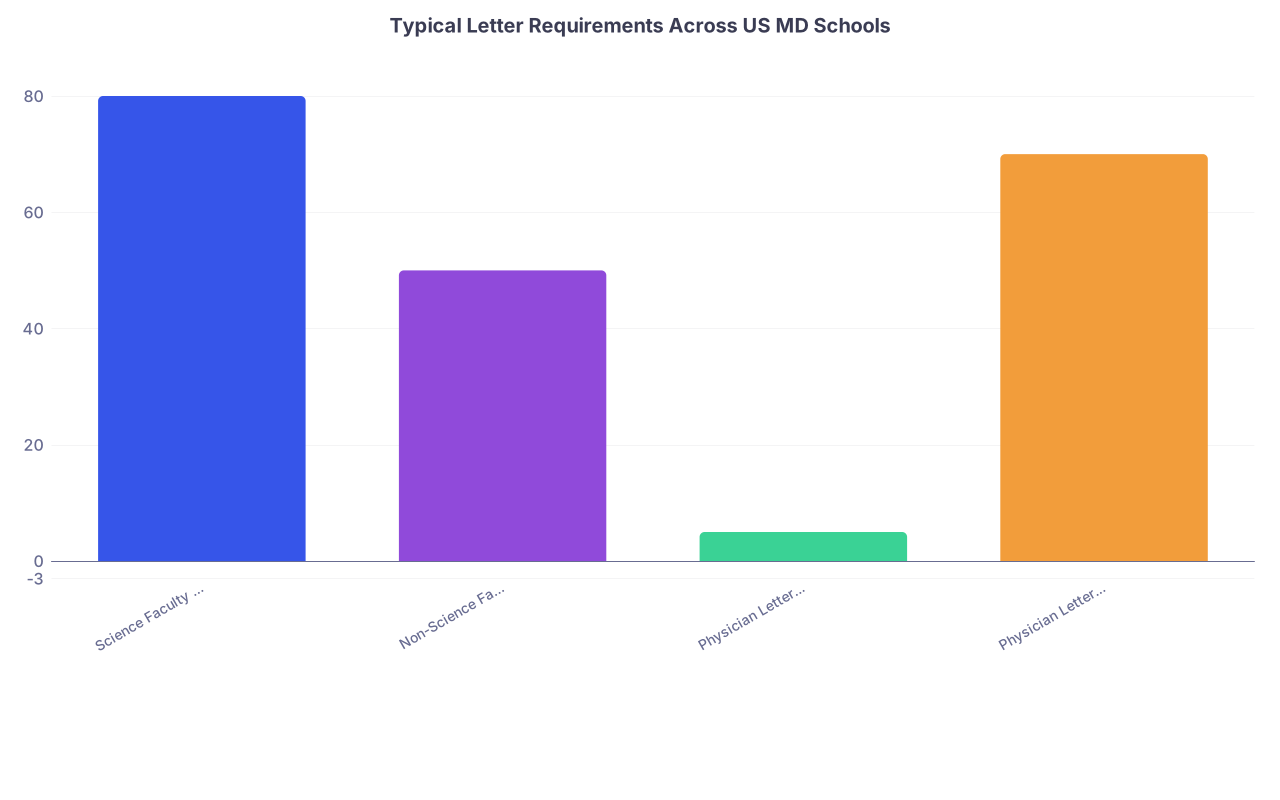
| Category | Value |
|---|---|
| Science Faculty Required | 80 |
| Non-Science Faculty Recommended | 50 |
| Physician Letter Required | 5 |
| Physician Letter Optional | 70 |
Roughly speaking (ballpark, but consistent with published requirements):
- The vast majority want science faculty.
- Many like at least one non-science or “other” recommender.
- Only a small minority explicitly require a physician letter.
- Many allow a physician letter as an additional or optional letter.
Yet the current premed belief system is:
- “If I don’t have a physician letter, I look unserious.”
- “Everyone else has 2–3 doctors writing for them.”
- “Research letters don’t matter as much as clinical letters.”
All three are wrong or at least badly distorted.
Where the Physician Letter Myth Comes From
This myth has two main sources:
Anecdotal survivor bias.
Someone gets into a top program, posts their stats: 518 MCAT, 3.9 GPA, 2 MD letters, 1 PI letter. Everyone fixates on the MD letters like they were the secret sauce. They ignore the GPA, MCAT, and elite research.Lazy advising and vague language.
Advisors and school websites often say things like “Letters from physicians can strengthen an application.” That mutates into “You must have one,” which mutates into “You should have one for every school.”
What admission committees actually say behind closed doors sounds more like this:
- “This doctor barely knows them. It’s just a shadowing summary. Useless.”
- “This PI clearly supervised them for years. Very strong endorsement.”
- “Nice that a physician wrote this, but there’s nothing specific.”
I’ve seen multiple cycles where students with zero physician letters matched at top schools because their other letters were detailed, credible, and enthusiastic.
So let’s correct the myth:
You do not need a physician letter for every application. You need a strong set of letters from people who can talk concretely about how you think, work, and interact with others. If one of those people is a physician and the relationship is real, great. If not, forcing it usually backfires.
Types of Letters: What Actually Carries Weight
Instead of obsessing over titles, you should be asking: Who can write about me in vivid, specific terms that match what med schools care about?
Here’s how different letter types typically stack up in practice.
| Letter Type | Typical Impact When Strong | Typical Impact When Weak |
|---|---|---|
| Science Faculty | High | Noticeably negative |
| Research PI | Very high | Neutral/forgettable |
| Non-Science Faculty | Moderate to high | Neutral |
| Physician (shadowing) | Low to moderate | Often negative |
| Physician (close mentor) | High | Neutral |
| Employer/Supervisor | Moderate | Neutral |
Key reality checks:
- A science faculty letter that says “Top 5% of students I’ve taught in 15 years, consistently led group work, asked sophisticated questions” is gold. I do not care if they are PhD, MD, or MD/PhD. Adcoms don’t either.
- A research PI who supervised you for 2+ years and can talk about your initiative, resilience, and intellectual growth is often more persuasive than a random clinic doctor who saw you twice a week for three months.
- A shadowing-only physician letter is usually weak: “They were punctual, professional, asked good questions.” Translation: “I barely know them but they weren’t a disaster.”
If your only path to a physician letter is shadowing for 20–40 hours and then awkwardly asking for a letter, you’re likely generating a low-yield document and increasing your stress for no real gain.
When a Physician Letter Actually Matters
Now for the nuance. There are times where a physician letter is smart, even strategic. But they’re narrower than people think.
- The school explicitly requires or strongly prefers it.
Some DO schools, and a small number of MD schools, say it flat-out:- “One letter from a physician is required.”
- “A letter from a DO physician is strongly recommended.”
If you’re applying to those schools, you follow directions. That’s not “fear.” That’s reading the fine print.
- You have a genuinely close mentoring relationship with a physician.
Examples:- You worked as a medical assistant for a year and the supervising physician saw you interacting with patients daily.
- You worked in a clinical research role where the PI is an MD who regularly discussed cases, data, and ethics with you.
- You volunteered weekly for a year or more in a free clinic and the medical director (MD/DO) actually supervised and mentored you.
That physician can speak to:
- Your bedside manner
- Your reliability and work ethic
- How you handle tough clinical situations
- Your growth over time
That’s a substantively different letter than “They shadowed me for 30 hours and seem nice.”
- You’re light on clinical depth elsewhere.
If your application’s weakest point is direct clinical engagement, a strong physician letter can partially compensate by vouching for your behavior in clinical spaces. But again, it has to be based on actual observation and time.
If none of these apply, forcing a physician letter is like forcing an extra MCAT practice test the night before the real thing. It feels productive. It’s not.
What Most Accepted Students Actually Submit
Let’s kill another assumption: that “everyone who gets in” has multiple physician letters.
From looking at actual accepted profiles (yes, on SDN/Reddit spreadsheets, but also internal advising data), here’s a rough pattern you see again and again:
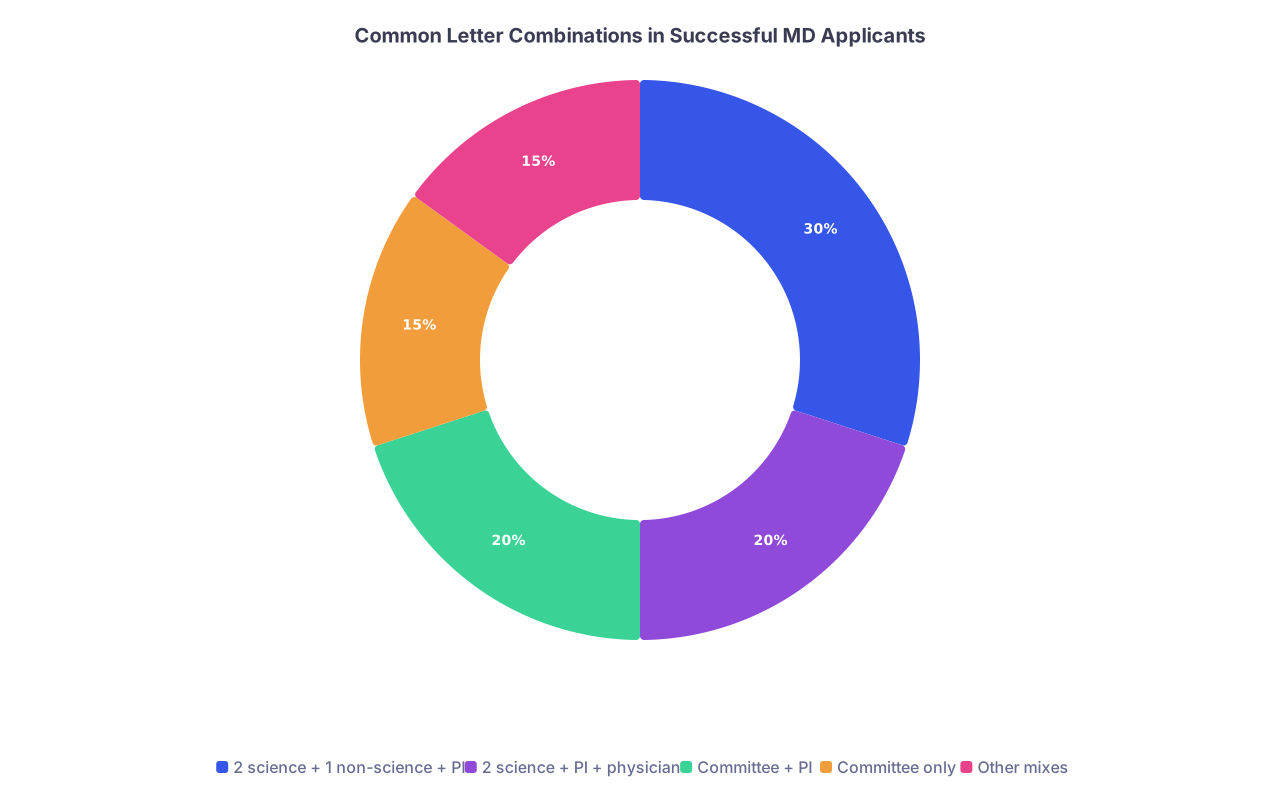
| Category | Value |
|---|---|
| 2 science + 1 non-science + PI | 30 |
| 2 science + PI + physician | 20 |
| Committee + PI | 20 |
| Committee only | 15 |
| Other mixes | 15 |
Notice:
- Only a subset has any physician letter at all.
- Many successful applicants’ “extras” are research PIs, long-term employers, or service supervisors—not clinicians.
- The mode is: meet the faculty requirements, then add one legitimately strong “other” letter.
Meanwhile, weaker applicants often do this:
- 1 mediocre science letter
- 1 decent non-science
- 1 generic physician from shadowing
- 1 lukewarm supervisor from a short-term job
On paper? They “have” a physician letter. In reality? They’ve diluted their application with fluff.
How to Decide If You Need a Physician Letter
Here’s a practical decision framework. No drama. Just logic.

| Step | Description |
|---|---|
| Step 1 | Check school requirements |
| Step 2 | Plan to obtain 1 strong physician letter |
| Step 3 | Assess your current letter set |
| Step 4 | Prioritize faculty relationships |
| Step 5 | Strengthen non-physician mentors |
| Step 6 | Consider adding physician as bonus letter |
| Step 7 | Skip forcing a weak physician letter |
| Step 8 | Any schools require MD/DO letter? |
| Step 9 | Do you have 2 strong science + 1 strong non-science? |
| Step 10 | Do you have strong PI/supervisor letter? |
| Step 11 | Is there a physician who knows you well clinically? |
If you walk through that honestly, most of you will land on:
- Strengthen faculty and mentor letters first.
- Add a physician letter only if (a) required or (b) truly strong.
That’s the rational play.
How to Get a Good Physician Letter (If You’re Going to Get One)
If you decide a physician letter makes sense for you, you need to earn it, not just request it after hovering silently in the corner.
Concrete steps:
Shift from “shadowing” to “working with.”
Shadowing is passive by design. You’re a quiet observer. That makes for a weak letter. Instead:- Volunteer in a clinic where you have a defined role.
- Work as a scribe, MA, EMT, or clinical assistant where allowed.
- Join a long-term clinical research project with an MD/DO PI.
Be visible and dependable.
Physicians are busy. Their default memory of students is “vaguely familiar shadow who wore business casual.” If you want a real letter:- Show up consistently.
- Ask thoughtful, specific questions.
- Take initiative where appropriate.
- Be the person they notice when things get hectic.
Give them time and materials.
When you ask, do it like a professional:- Ask 1–2 months before deadlines.
- Provide your CV, personal statement draft, and a bullet list of experiences they’ve seen you in.
- Explicitly ask: “Would you feel comfortable writing me a strong letter of recommendation for medical school?”
If they hesitate, back off. A lukewarm physician letter is worse than none.
The Fear-Driven Mistakes to Avoid
Let me call out the worst patterns I see over and over from anxious applicants:
Sacrificing quality for a “name.”
Picking a famous cardiologist who barely knows you over the community clinic FP doc who mentored you weekly for a year. Huge mistake.Adding weak letters “just because.”
Some applicants think more letters = better. So they upload 6–7 letters, including:- 2 bland physicians
- 1 okay professor
- 1 decent supervisor
- 1 old high school coach (yes, people do this)
Adcoms are not impressed. If anything, you make their job harder and your signal weaker.
Wasting bandwidth on the wrong target.
Spending months chasing an MD letter while ignoring that your second science professor barely knows your name. If you’re going to hustle, hustle to fix the required letters first.Not checking school-specific rules.
This one is unforgivable. You panic about “needing” physicians in general but never look at the actual websites for your target schools. Some will:- Cap the number of letters considered.
- Specify which categories they want.
- Explicitly say physician letters are optional.
Read. The. Instructions.
A Reality-Based Strategy Moving Forward
If you want a simple, grounded approach for MD/DO letters:
Step 1: Lock in the basics.
Two strong science faculty + one strong non-science (if recommended/required). If you cannot identify potential writers here, that’s your true emergency, not the missing MD.Step 2: Add one high-impact mentor.
Usually a research PI, long-term clinical supervisor, or service director. Someone who can talk about your behavior in complex, real-world settings.Step 3: Physician letter only if it’s clearly additive.
Required school? Do it.
Deep, real relationship with an MD/DO? Great, add it.
Otherwise, move on. Focus on grades, MCAT, and meaningful experiences.
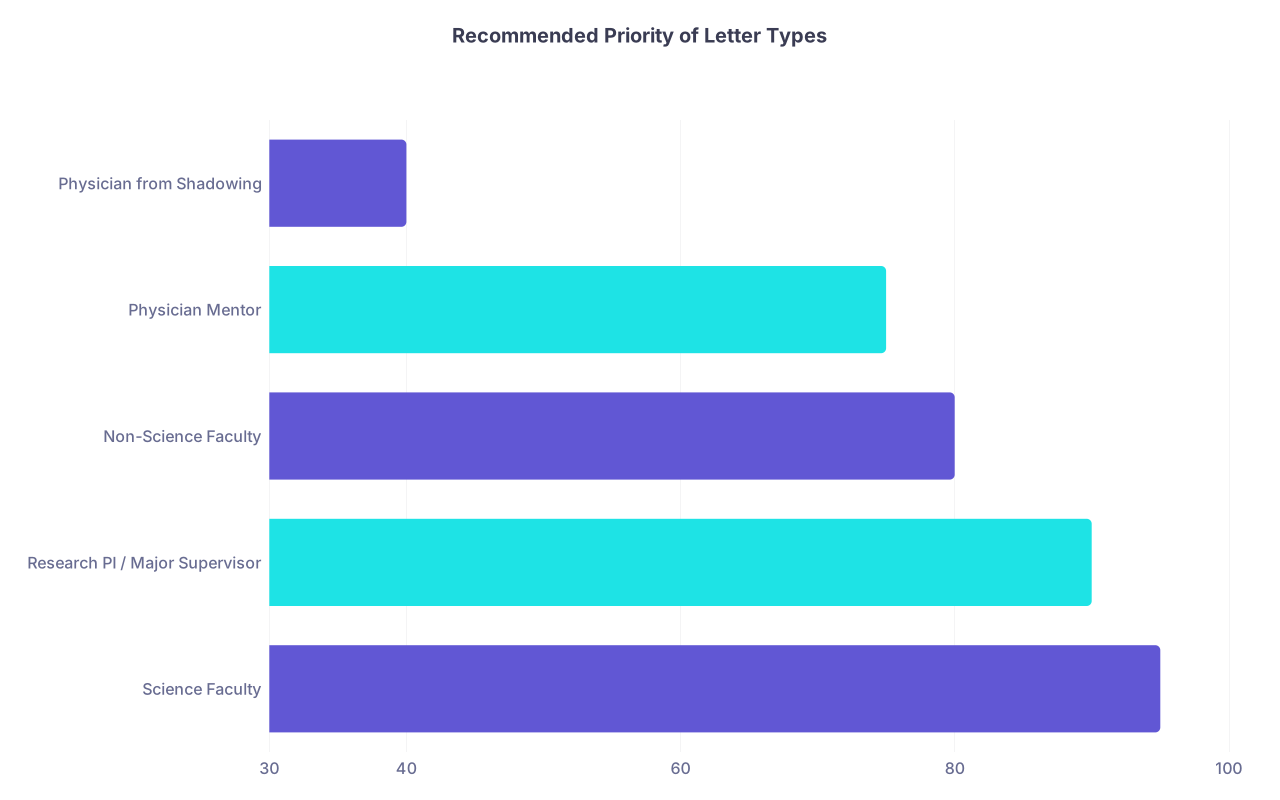
| Category | Value |
|---|---|
| Science Faculty | 95 |
| Research PI / Major Supervisor | 90 |
| Non-Science Faculty | 80 |
| Physician Mentor | 75 |
| Physician from Shadowing | 40 |
That’s how admissions actually behave, not how fear on the internet says they behave.
Bottom Line: Fact vs. Fear
Let me strip this down to the essentials.
You do not need a physician letter for every application.
You only “need” one when specific schools require it, or when you have a genuinely strong physician mentor who can write something substantial.A mediocre physician letter is worse than none.
Shadowing-only letters are usually superficial and often drag your overall letter set down rather than lifting it up.The letters that move the needle are from people who know you well and can describe your character, judgment, and performance in detail—regardless of whether they wear a white coat or a lab coat.
If you stop chasing the MD after the signature and start chasing real, substantive mentorship, your application will get stronger. And you’ll waste a lot less time being scared of the wrong thing.