
Shadowing hours are one of the most overrated metrics in premed culture.
People obsess over them, flex them on forums, and track them in spreadsheets like they’re bench presses or MCAT scores. Then they’re shocked when 200+ hours of shadowing translates into a generic, lukewarm letter of recommendation that might as well have been written for any random applicant.
Let me be blunt: admissions committees are not impressed by your shadowing hour count. They care whether someone who actually knows your work and character is willing—and able—to go to bat for you in a specific, credible way. That’s a completely different game.
You’ve been sold the wrong metric. Let’s fix that.
The Myth: “If I Shadow More, I’ll Get a Better Letter”
You know the script:
- “I need at least 50 shadowing hours with a physician for med school.”
- “If I hit 100+ hours, I’ll stand out.”
- “More specialties, more hours, more impressive.”
This is how anxious premeds talk at 11:30 PM in library corners and Reddit threads. It’s also how people end up with five different physicians who all barely know them and write the exact same useless sentence: “I had the opportunity to have [Applicant] shadow me in clinic.”
Let me translate that for you: this is a weak letter.
Here’s what the data and insider accounts actually show:
- The AAMC, in their surveys of admissions officers, repeatedly ranks quality and specificity of letters as more important than sheer volume of experiences.
- Most schools don’t even have a required minimum number of shadowing hours. When they list a range, it’s usually modest (20–40+), and it’s a check-box, not a ranking system.
- Admissions committee members and deans, in public panels and interviews, consistently say some version of: “I’d rather see one letter from someone who supervised you closely than multiple letters from people you just shadowed.”
To admissions people, “200 shadowing hours” without substance reads exactly like “watched a lot of medicine but never had to do anything hard.”
Shadowing is passive. Letters need active evidence.
That’s the disconnect.
What Committees Actually Look For in Letters
Strong letters aren’t about proximity to a physician. They’re about proof.
Not “I like this student.” Not “they want to be a doctor.” Proof that you’ve demonstrated the kinds of behaviors that predict you won’t flame out when medicine gets ugly: responsibility, follow-through, teachability, judgment, teamwork, resilience.
When I’ve seen admissions committees dissect letters, they don’t linger on titles (MD vs PhD vs DO) for long. They linger on content. Specific sentences. Concrete examples. Phrases that show this writer was paying attention.
The difference is obvious when you put them side by side.
| Aspect | Weak Shadowing Letter | Strong Evaluative Letter |
|---|---|---|
| Relationship | “I had the opportunity to have X shadow me.” | “I have worked closely with X for 10 months in my research lab.” |
| Observation | “X was punctual and professional.” | “X took initiative to redesign how we tracked post-op patients.” |
| Detail | Generic traits, no stories | 1–3 specific scenarios, with context and outcome |
| Evaluation | “X will make a fine physician.” | “X is among the top 5% of students I’ve worked with in 15 years.” |
| Risk | Reads like a template; no skin in the game | Writer clearly stakes their reputation on the applicant |
Notice something? None of this depends on logging 100+ hours of silent shadowing. It depends on meaningfully working with someone who can judge you.
Why Shadowing So Often Produces Terrible Letters
I’ve read too many physician letters that boil down to: “This person followed me around without causing problems.” That’s not a recommendation. That’s a security report.
There are structural reasons shadowing fails to generate strong letters:
You contribute nothing.
HIPAA, liability, time constraints—students shadow, they don’t act. You aren’t writing notes, you aren’t managing patients, you aren’t on call. It’s inherently observational, which is terrible raw material for a detailed evaluative letter.Short-term exposure.
Many shadowing stints are a few half-days or a couple of weeks in the summer. That’s not enough time for a physician to see you struggle, improve, or handle responsibility. Yet you’re asking them to judge your readiness for a lifelong profession.Physicians are busy and default to templates.
A lot of docs crank letters out between clinic sessions, often from the same boilerplate. Unless they know you well and care about you, they’re not inventing rich stories on your behalf.The relationship is often shallow and one-directional.
You’re watching them. They’re not really watching you, beyond “don’t violate HIPAA, don’t faint in the OR, don’t say anything outrageous.”
So what happens? You accumulate hours, not advocates.
The Data Problem: Committees Know Shadowing Is Weak Evidence
Hard numbers on shadowing alone are scarce because most schools don’t track outcomes like “hours vs acceptance rate” in a granular public way. But where we do have data and insider commentary, the pattern is obvious:
- Surveys of admissions officers (AAMC and independent) regularly rank “Clinical Experiences with Direct Patient Interaction” higher than shadowing. Shadowing is often described as useful for you understanding the field, not for them evaluating you.
- Committee members in open Q&As repeatedly say strong letters usually come from research mentors, supervisors in clinical work (scribe, MA, EMT), or long-term community service leads—not the cardiologist you watched for 3 afternoons.
In other words: they treat shadowing as career exploration. Letters should come from performance.
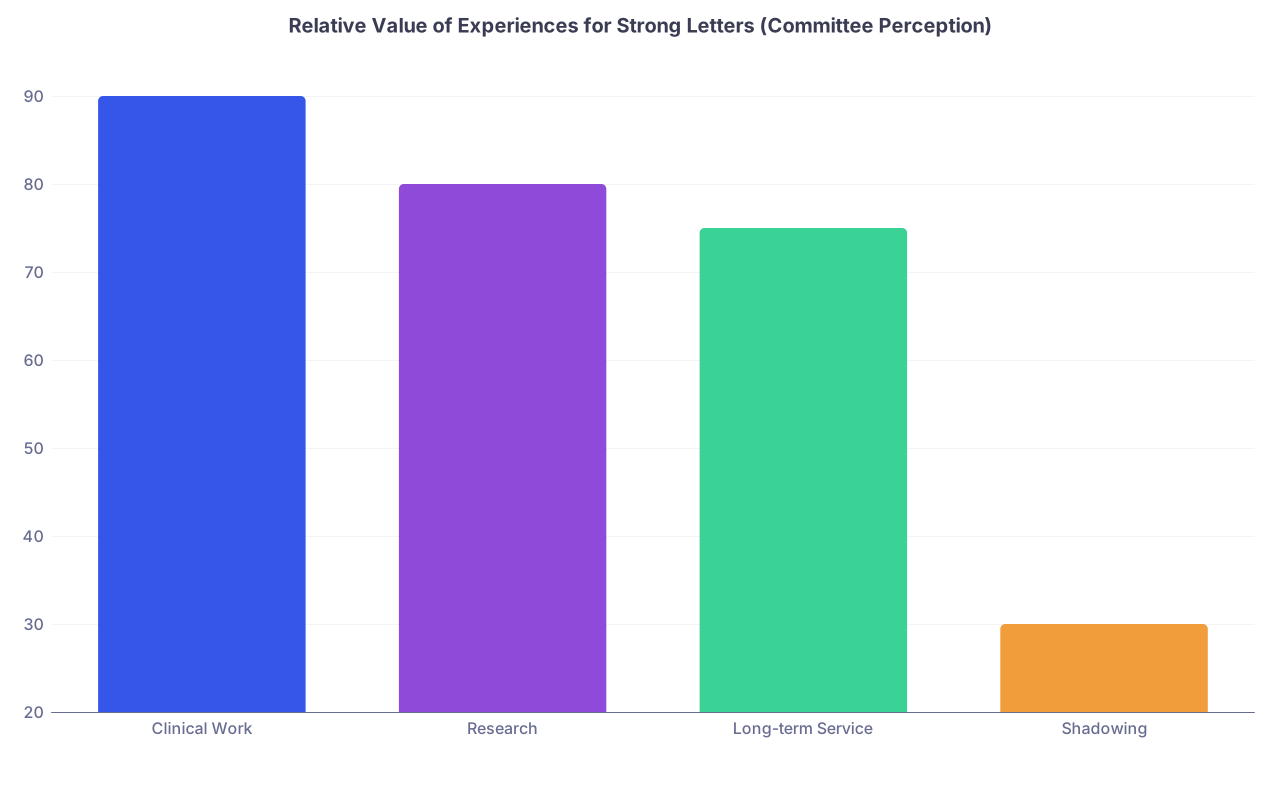
| Category | Value |
|---|---|
| Clinical Work | 90 |
| Research | 80 |
| Long-term Service | 75 |
| Shadowing | 30 |
Not a randomized controlled trial, obviously. But this matches what actual decision-makers say behind closed doors.
They’re not fooled by giant shadowing numbers. They’re bored by them.
What Actually Produces Strong Letters
Let me reframe your goal: you don’t need more shadowing hours; you need more people who’ve seen you do hard, unglamorous work well over time.
Hours are a byproduct. Relationships are the asset.
The strongest letters usually come from at least one of these buckets:
Research mentors who saw you struggle and then deliver.
Think: 1–2 years in a lab where you botched experiments early, learned protocols, maybe earned a middle-author paper, but more importantly showed up, thought critically, and became the person they could trust to train new undergrads.Clinical supervisors who relied on you.
Scribe supervisor, MA lead, clinic manager, charge nurse. The people who watched you handle cranky patients, long shifts, and the reality that healthcare is often chaos wrapped in bureaucracy.Service leaders who watched you lead, not just attend.
Director of the community clinic, volunteer coordinator at a shelter, faculty advisor for your free clinic. Anyone who’s seen you organize people, deal with conflict, and show up when nobody else wants to.Faculty who saw you perform at a high level in demanding courses.
Not your 200-person intro bio class. The upper-level physiology, immunology, or seminar course where you were one of 15 and actually spoke, wrote, and got grilled.
Shadowing can play a supporting role. Sometimes a physician wears two hats: you start by shadowing, then you transition into a more involved role (scribe, volunteer, assistant on a project). Then they actually have something to say about you.
That’s the key: Letters are about evaluation, not eyewitness testimony that you were physically present in a clinic.
How Committees Read Letters (And Where You Lose Them)
Picture an admissions committee meeting. There’s a stack of files. Everyone’s tired. They’ve seen “excellent” and “hard-working” 800 times this month.
They hit your letters. Here’s what happens:
- They skim the first paragraph for relationship: “How long? In what context? Do you actually know this person?”
- They look for comparative language: “Top 10% of students I’ve taught” or “above-average” or “typical.” Yes, some writers are too nice, but after you’ve read enough, you can still tell.
- They hunt for stories. Specific vignettes. Situations. Anything that proves the adjectives.
- They check for risk. Does this writer stick their neck out, or are they carefully neutral? Any faint-praise landmines? Words like “adequate,” “good,” “solid,” “pleasant” can sink you more than an outright criticism.
Where do most pure-shadowing letters fail? Paragraph one and three. The writer barely knows you, so there are no stories and no meaningful evaluation. Just vibes.
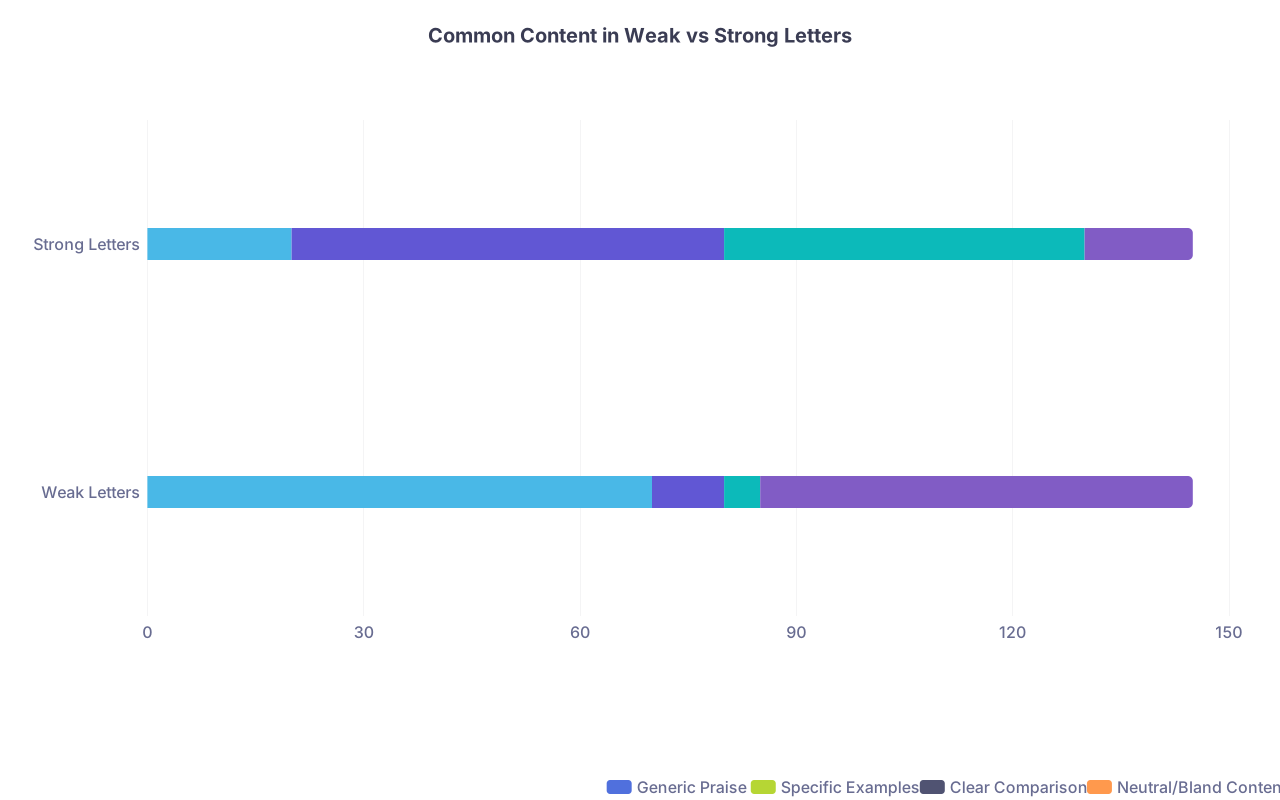
| Category | Generic Praise | Specific Examples | Clear Comparison | Neutral/Bland Content |
|---|---|---|---|---|
| Weak Letters | 70 | 10 | 5 | 60 |
| Strong Letters | 20 | 60 | 50 | 15 |
That’s why someone with “only” 20 hours of shadowing but 2 years of research and a year as a clinic scribe often crushes someone with 150+ passive shadowing hours and no real supervisors.
Stop Chasing Shadowing Hours. Do This Instead.
If you’re still early (premed or early med school), you can course-correct. Shadow enough to confirm you actually want this life. Then shift your energy.
Here’s the approach that actually moves the needle:
1. Treat Shadowing as a Doorway, Not a Destination
Shadow to learn what physicians do and to build rapport. Then, if there’s a natural opening, pivot:
- “I’ve really enjoyed learning from you these past few weeks. Is there a way I can get more involved in a role where I can contribute something to the team?”
- “Do you know of any opportunities—scribing, research, clinic volunteering—where students can do more than observe?”
Some physicians will say no. Fine. Others will say, “Actually, we need help with…” That’s when a future strong letter becomes possible.
2. Commit Long-Term to Fewer Things
Rotating through 10 different shadowing experiences for 10 hours each looks unfocused. And it deprives you of the chance to let anyone actually get to know you.
One year as a scribe in an ED, logging 8–12 hours a week, will teach people who you are. The charge nurse, the attending, the scribe lead—they’ll see you on good days and bad days. They’ll trust their read on you.
Those are the people whose letters committees respect.
3. Make Yourself Easy to Write About
You want your letter writer to have material. Give them some.
That means:
- Taking initiative instead of doing the bare minimum.
- Asking for feedback, then actually correcting course.
- Being the person who shows up consistently, on time, and prepared, week after week, when nobody is watching.
If you’re doing research, offer to take ownership of a piece of the project. If you’re volunteering at a free clinic, become the one who trains new volunteers. If you’re in a small seminar, speak up, go to office hours, write something worth commenting on.
You’re building a portfolio of specific stories for someone else to tell about you.
How to Ask for Letters Without Sounding Desperate
Strong letters start with strong relationships, but you still need to actually ask. Do it like a professional, not like a panicked undergrad hoping shadowing hours magically turned into a glowing endorsement.
You want a question that gives them an honest out:
“Dr. Smith, I’ve really valued working with you in the clinic these last 9 months. I’m applying to medical school this upcoming cycle, and I’d like to ask if you’d feel comfortable writing me a strong letter of recommendation based on what you’ve seen of my work.”
If they hesitate, or say something like “I can write you a letter,” without the word strong, take the hint and move on. Better a smaller set of powerful letters than a pile of generic ones.
And no, mentioning “I shadowed you for 80 hours” does not make the ask stronger. It just reminds them you mostly stood there.
Where Shadowing Does Matter
Shadowing isn’t useless. It serves two real purposes:
- For you: sanity check. You need to see the reality of medicine before you commit a decade of your life to it. The emotional tone, the pace, the bureaucracy, the patient mix.
- For schools: evidence that you’ve actually looked at the job up close. They want to know you aren’t walking in with only Grey’s Anatomy and TikTok medicine as your reference points.
But that bar is low. Once you’ve shadowed enough that you can talk intelligently about what physicians actually do, more hours add very little. Especially for letters.
If you’re north of ~40–60 hours and still dumping time into shadowing instead of real work with supervision, you’re optimizing for the wrong metric.
The Bottom Line
Three things to leave with:
- Shadowing hours do not equal strong letters. Committees care about what someone can credibly say about you, not how long you stood in a clinic hallway.
- Strong letters come from supervisors, not spectators. Long-term, responsibility-heavy roles—clinical, research, or service—generate the specific, comparison-rich letters that move files from “maybe” to “interview.”
- Use shadowing as a starting point, then graduate out of it. Confirm your interest, build rapport, then pivot into roles where you actually contribute. That’s where real advocacy—and real letters—come from.
Stop collecting hours. Start collecting people who can honestly say, “I’ve seen this person do the work, and I’d bet my name on them.”