
Most premeds are asking the wrong LOR question.
The issue is not “Do I have enough letters?”
The issue is “Do my letters collectively cover the competencies schools actually care about?”
Let me break this down specifically.
Medical schools are not counting how many “science” and “non‑science” letters you upload like some bureaucratic checkbox game. They are using those categories as proxies to make sure someone has directly observed specific core competencies: intellectual, interpersonal, ethical, and professional. If you understand which competencies go where, you will stop wasting letters on redundancy and start building a portfolio that actually moves your file.
1. The Real Landscape: What Schools Explicitly Ask For
Before we talk competencies, you need the structural reality.
Most MD schools in the U.S. fall into one of a few common patterns:
| School Type | Common Requirement | Science Letters | Non‑Science / Other |
|---|---|---|---|
| Mid‑tier MD | 3 individual LORs | 2 science | 1 non‑science |
| Research‑heavy MD | 3–5 LORs | 2 science | 1 non‑science + research recommended |
| DO schools | 2–3 LORs | 1–2 science | Often 1 physician letter |
| Canadian schools | 3–4 LORs | Flexible | Focus on roles/competencies |
| BS/MD programs | 2–4 LORs | At least 1 science | Often 1 counselor/teacher |
Typical wordings you will actually see:
- “Two letters from science faculty who have taught you.”
- “One letter from non‑science faculty.”
- “At least one letter must come from a professor in biology, chemistry, physics, or math.”
- “We highly recommend one letter from a faculty member in the humanities or social sciences.”
- “Committee letter or packet satisfies all requirements.”
So the “science vs non‑science” split is not philosophical. It is logistical. Schools are forcing your letters to be written from different vantage points of your behavior and performance.
Now let me map those vantage points to competencies.
2. The AAMC Core Competencies: What LORs Are Supposed to Prove
Medical schools lean on a set of AAMC “Core Competencies.” Most students can sort of name them. Very few actually weaponize them when choosing letter writers.
Simplified and grouped, here are the buckets that matter for LORs:
Academic / Cognitive
- Critical thinking
- Quantitative reasoning
- Scientific inquiry
- Written communication (sometimes evident from class performance / writing-intensive courses)
- Capacity for improvement (trajectory over time)
Interpersonal
- Service orientation
- Social skills
- Cultural competence
- Teamwork
- Oral communication
Intrapersonal / Professional
- Ethical responsibility
- Reliability and dependability
- Resilience and adaptability
- Capacity for improvement (also here)
- Professionalism
Your personal statement and activities can claim these. Your LORs have to verify them with concrete behavior.
Here is the key:
- Science faculty are positioned to certify cognitive/academic and professional competencies in rigorous, high‑stakes environments.
- Non‑science faculty are positioned to certify communication, interpersonal, and perspective‑taking competencies in contexts where argument, reflection, and nuance actually matter.
- Research mentors bridge scientific inquiry and professionalism under real‑world pressure.
- Clinical mentors (physicians, NPs, PAs) certify applied interpersonal and ethical behavior with patients.
If your letter portfolio is all one flavor—three science profs from lecture courses, for instance—you are letting half the competencies float unverified.
Let’s get painfully specific about who should cover what.
3. Science LORs: Exactly What They Should Be Proving
“Science letter” usually means a professor (sometimes lecturer, occasionally adjunct) who taught you in:
- Biology (any subfield)
- Chemistry (general, organic, biochem)
- Physics
- Math / statistics
- Sometimes engineering, depending on the school’s definition
Core competencies a strong science LOR should cover
If your science letter just says “Student got an A and came to office hours,” you wasted a slot. A serious science letter should explicitly—or implicitly through examples—address:
Intellectual rigor under pressure
Can you handle dense, conceptually difficult material and high workload? This includes:- Handling multi‑step problems
- Integrating new data / concepts quickly
- Not collapsing when an exam goes badly
Scientific reasoning and problem‑solving
Not just memorization. Things like:- Applying principles to new scenarios
- Designing or critiquing experiments (especially in lab courses)
- Asking “why” rather than “what will be on the exam”
Professional behavior in academic settings
- Attendance, punctuality, respecting deadlines
- Responsiveness to feedback
- Academic integrity (no drama, no suspicion of cheating)
Trajectory / capacity for improvement
The gold standard: a letter describing how you improved over the semester or across multiple courses.
Concrete scenarios that lead to powerful science letters
These are the situations where I see genuinely strong letters come out:
- You bomb the first midterm in organic chemistry, meet with the professor weekly, show them reworked problems, and end with an A–. The letter: “She refused to accept mediocrity and turned a 62 into consistent 90s through methodical re‑learning.”
- You are one of two students who regularly ask concept‑level questions in upper‑division physiology. The letter: “He was one of the few students who asked questions that connected our lecture to current literature and clinical applications.”
- In an inquiry‑based physics lab, you design a creative solution for a flawed experimental setup and calmly re‑organize your team. The letter: “She showed leadership in troubleshooting and did not panic when the initial design failed.”
What a science LOR should not be doing
Science letters are not ideal as your primary evidence for:
- Deep interpersonal skills
- Narrative writing ability
- Longitudinal service commitment
They might mention them, but they see you mostly in a structured, time‑limited, graded environment. Their primary function is academic and professional verification.
If you have three potential science writers, you do not pick all three just because they are “available.” You pick:
- The one who saw you struggle and improve,
- The one who saw you perform at the top of a truly hard class, or
- The one who supervised you in a lab with actual responsibility.
You then let non‑science, research, or clinical letters cover the rest of the competency space.
4. Non‑Science LORs: What They Can Cover That Science Letters Usually Cannot
The “non‑science letter” is not a throwaway requirement. Done right, it fills crucial gaps in your narrative.
Non‑science faculty = humanities, social sciences, arts, some interdisciplinary courses:
- English, comp lit, philosophy, history, religion
- Sociology, psychology, anthropology, political science
- Communication, languages, media studies
- Music, fine arts, theater (if it involves serious work and evaluation)
Competencies that non‑science faculty are uniquely good at certifying
Written and oral communication
- Clarity and structure of your writing
- Ability to handle feedback on drafts
- Speaking in class, leading discussion sections
Critical analysis of complex issues
- Grappling with ambiguous topics (ethics, policy, history)
- Interpreting texts, data, arguments from multiple angles
- Building coherent, evidence‑based arguments
Perspective‑taking and cultural competence
- Responding thoughtfully to ideas you disagree with
- Respecting peers from different backgrounds
- Integrating social context into your thinking (health disparities, structural issues, etc.)
Engagement beyond grades
- Volunteering for extra projects
- Mentoring other students informally
- Showing actual curiosity rather than doing the minimum
Concrete non‑science letter scenarios that impress admissions
Here are scenarios that reliably produce exceptional non‑science letters:
- You take a small (≤20 students) seminar in medical ethics, go to office hours repeatedly, refine a term paper through 3–4 drafts, then present it to the class. The professor can write: “He produced one of the strongest papers I have read in five years, integrating bioethics with lived patient narratives.”
- You are a discussion leader in a sociology of health course, consistently tying abstract concepts to your clinical volunteering. The letter: “Her contributions frequently grounded theoretical material in real patient interactions, demonstrating empathy and analytic maturity.”
- You complete a year‑long honors thesis in history or political science related to health policy. The letter: “His thesis on Medicaid expansion and rural hospital closures reads at the level of a beginning graduate student.”
Non‑science letters can also hit professionalism from a different angle: do you respond to emails promptly, own your mistakes in group projects, and meet long, open‑ended deadlines (e.g., term papers)?
What non‑science letters should avoid trying to cover
They should not pretend to be:
- Your “scientific ability” validators (unless the course is methods‑heavy, like econometrics or social stats).
- Clinical character references (they do not see you with patients).
Their value is in showing you can think, argue, and communicate like a mature adult in contexts where there is no single right answer. Medical schools love that when it is specific and earned.
5. Research Mentors, PIs, and Clinical Supervisors: Where They Fit Into the Grid
Now the nuance most premeds miss: “science vs non‑science” is only one axis. The other is setting (classroom vs lab vs clinic vs community). Different settings showcase different behaviors.
You should think of your letter portfolio as a coverage map along both axes:
- Science vs non‑science
- Academic vs research vs clinical vs service
Research mentors / PIs
A research mentor (PI, postdoc, senior PhD student who actually knows you) is often the single most powerful letter in your file if:
- They have seen you at least 6–12 months
- You owned a piece of the project (not just washed dishes or shadowed)
- They trust you enough to let you fail, fix, and present
Competencies research mentors cover well:
- Scientific inquiry (obviously)
- Critical thinking and problem‑solving
- Resilience and adaptability (experiments fail constantly)
- Teamwork within a lab
- Professionalism over time (punctuality, honesty with data, ownership of errors)
This is the letter that can say, “I would take this student into my MD/PhD program” or “I entrusted her with independent experiments which contributed to a submitted manuscript.”
Where does this sit on the “science vs non‑science” requirement? It depends:
- If your PI has an academic appointment in a science department and taught you, some schools will accept them as a science letter if they mention that role.
- Many schools, however, treat “research only” mentors as supplemental letters, not a replacement for a pure “course instructor” science letter requirement.
So you do not gamble here. You still secure at least one classic classroom science letter, then add the PI as an additional or specifically labeled “research” letter.
Clinical supervisors (physicians, NPs, PAs, nurses)
Clinical letters are mostly about your behavior around patients and teams, not your MCAT‑style intelligence.
Competencies they can certify:
- Service orientation
- Empathy and bedside manner
- Oral communication with patients and staff
- Reliability in a real‑world setting (showing up at 5:30 am for rounds, following HIPAA, not vanishing mid‑shift)
These letters carry more weight when:
- The writer is not just a shadowing host, but actually saw you repeatedly over weeks to months.
- You took on defined responsibilities (scribe, MA, volunteer with specific tasks, etc.).
- They describe concrete cases—“I watched her sit with a non‑English‑speaking patient and patiently use interpreter services to explain discharge instructions.”
Most schools do not count these as “science” or “non‑science” faculty letters unless the clinician also holds a formal teaching faculty role and taught you in a course. Treat them as additional letters that deepen the professional/clinical side of your competency map.
6. Matching Mentors to Competencies: A Precise Coverage Strategy
Now to the question you actually need answered: Which mentors should cover which competencies, and how do you prevent overlap and gaps?
Think in terms of building a portfolio that, taken together, checks off the whole grid.
The core grid
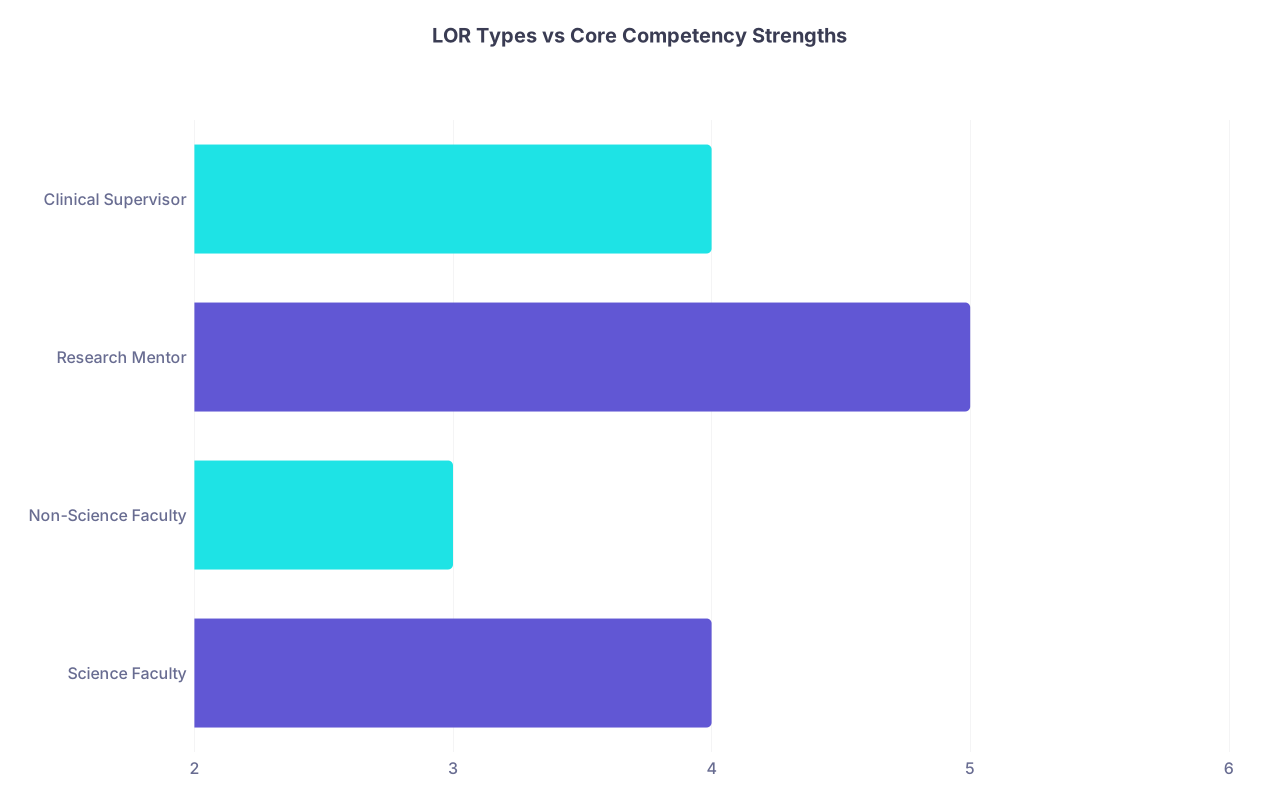
| Category | Value |
|---|---|
| Science Faculty | 4 |
| Non-Science Faculty | 3 |
| Research Mentor | 5 |
| Clinical Supervisor | 4 |
Let me translate the idea behind that sketchy bar chart:
- Science faculty: strongest for academic rigor, scientific thinking, and reliability as a student.
- Non‑science faculty: strongest for communication, critical interpretation, and interpersonal maturity in discussion‑based settings.
- Research mentors: strongest for applied scientific reasoning, independence, long‑term professionalism.
- Clinical supervisors: strongest for service orientation, ethics in practice, bedside interpersonal skills.
A realistic 4–5 letter setup for a typical MD applicant
Let’s say a school allows a committee letter or up to 4–5 individual letters. A high‑yield configuration:
Science letter #1 (required)
- From: Upper‑division biology, biochemistry, physiology, or hard physics.
- Competencies: academic rigor, problem‑solving, reliability, improvement.
Science letter #2 (strongly recommended at many schools)
- From: Another rigorous science or math course, ideally different style (e.g., lecture vs lab).
- Competencies: adds confirmation of scientific strength and work ethic from a second vantage point.
Non‑science letter (required at many schools)
- From: Small seminar or writing‑intensive course where you engaged deeply.
- Competencies: communication, critical analysis, cultural/perspective‑taking, professionalism with long deadlines.
Research mentor letter (if you did meaningful research)
- From: PI or direct supervisor who knows your work and character.
- Competencies: scientific inquiry, resilience, teamwork, independence, long‑term reliability.
Clinical supervisor letter (optional but very powerful if strong)
- From: Physician or advanced practitioner who actually supervised your clinical work.
- Competencies: service orientation, interpersonal skills with patients, ethics, real‑world professionalism.
You will not send all 5 to every school if they cap letters, but you will choose combinations that preserve science/non‑science requirements and maximize competency coverage.
How to decide between marginal options
You have:
- A B+ in General Chemistry with a professor who barely knows you
- An A in Cell Biology where you met with the professor 6–7 times and did a small independent extension
- An A in Music History where you wrote a capstone paper and the professor loves you
Which to choose?
For “science letter,” Cell Biology wins easily. Because the letter can say something real:
- “I met with her weekly as she planned an original project extending one of our labs.”
- “He actively sought feedback and responded with substantially revised work.”
The Music History professor is then your non‑science letter, not a competitor to Cell Bio.
Another scenario:
- You have a PI who is an MD in the Department of Medicine but never taught you in a formal course.
- You have a physics professor who taught you twice and knows your exam performance inside out.
You do not gamble that the PI will be counted as “science faculty.” You list physics as your science letter, PI as research. If some schools want “2 science” and you only have one classroom science, then yes, you chase another.
7. How To Actually Talk To Mentors About Competencies (So They Write The Right Letter)
Most students just say, “Can you write me a strong letter?” and walk away. That is lazy and wastes potential.
You need to guide them—subtly—toward the competencies you want them to highlight.
The packet you give each type of writer
Every writer gets:
- Updated CV or resume
- Draft of your personal statement (even if not final)
- List of schools or at least the type of programs you are applying to
- A brief, customized one‑pager that says, in effect:
- Here is how I engaged in your class / lab / clinic
- Here are a few concrete moments I remember
- Here are some specific strengths schools look for that you have seen from me
For a science faculty member, your one‑pager might say:
- “You saw me go from 68% on Exam 1 to consistent 90s by the final after weekly office hours.”
- “You commented that my lab reports were among the most detailed in the course.”
- “Medical schools value evidence of critical thinking, scientific reasoning, and reliability under academic pressure. You have seen me in all three contexts.”
For a non‑science faculty member:
- “In your seminar, I led the discussion on [topic] and revised my final paper 3 times based on your notes.”
- “You once mentioned in office hours that my ability to disagree respectfully with peers was unusual in the class.”
- “Admissions committees care a great deal about written/oral communication, critical analysis, and cultural/perspective‑taking; you have seen me demonstrate these.”
You are not scripting their letter. You are reminding them of real events that map to real competencies. Good writers appreciate this. Weak writers ignore it, which itself is useful information (maybe they were the wrong choice).
Detecting a bad or generic letter risk
Red flags when asking:
- They hesitate or say, “I can write you a letter, but I do not know you very well.” Translation: lukewarm or generic. Pass if you have alternatives.
- They agree instantly but never ask for your CV, PS, or transcript. Translation: they are firing off the same template letter for everyone.
- They seem annoyed, rushed, or say, “Just send me the link,” and that is it. Possible they will do the bare minimum.
In those situations, you might still use them as a backup if you are desperate for a second science letter, but you do not build your application around them.
8. Special Situations: Community College, Post‑Bacc, Non‑Traditional, and Committees
Life is messy. Your path might not fit the “traditional” undergrad narrative, so let’s be precise.
Community college science courses
If you took prerequisite sciences at community college and then more advanced sciences at a 4‑year institution:
- Prioritize science letters from the 4‑year institution when possible.
- One science letter from a CC prof who knows you very well is fine, especially if they supervised you in a lab or multiple courses.
What you do not want: only community college science letters and zero evidence of performance at a 4‑year level, if you have already transferred.
Post‑bacc or SMP (special master’s program) students
If your undergraduate grades are weak and you did a DIY post‑bacc or SMP:
- Your most important science letters are from the post‑bacc/SMP faculty, because they speak directly to your academic “redemption arc.”
- You should very explicitly ask them to comment on your maturity, responsibilities (maybe you worked while studying), and upward trajectory.
The competency here is “capacity for improvement” plus pure academic horsepower. A strong SMP letter wipes out years of doubt more effectively than any personal statement.
Committee letters and letter packets
If your school offers a premed committee letter:
- Many schools treat the committee letter as the primary document, with attached individual letters as supporting evidence.
- You still want diversity inside the packet: at least one science, one non‑science, and ideally one research or clinical if allowed.
Smart move: meet with your premed advisor and make sure they understand your competency coverage plan. Hand them the same one‑page competency mapping you thought through, so their committee letter actually integrates those themes: “Across his science and non‑science courses, mentors consistently highlight…”
9. Putting It All Together: A Clean, Competency‑Driven Plan
To recap this in a more operational way, here is how a thoughtful student actually executes this.

| Step | Description |
|---|---|
| Step 1 | List potential letter writers |
| Step 2 | Rank by strength of relationship and rigor |
| Step 3 | Non-science faculty |
| Step 4 | Research mentor |
| Step 5 | Clinical supervisor |
| Step 6 | Select top 1-2 for required science LORs |
| Step 7 | Select best for communication & analysis |
| Step 8 | Select if research is meaningful |
| Step 9 | Select if clinical exposure is strong |
| Step 10 | Map competencies covered |
| Step 11 | Identify additional mentors |
| Step 12 | Request letters & provide packets |
| Step 13 | Science faculty? |
| Step 14 | Non-science, research, or clinical? |
| Step 15 | Any competency gaps? |
Then you sanity‑check yourself with a simple grid: who is covering what?
| Writer Type | Name / Role | Primary Competencies Covered |
|---|---|---|
| Science Faculty 1 | Dr. Lee – Biochemistry Prof | Academic rigor, scientific reasoning, improvement |
| Science Faculty 2 | Dr. Patel – Physics Prof | Problem-solving, quantitative reasoning, reliability |
| Non-Science | Dr. Alvarez – Ethics Seminar | Writing, critical analysis, cultural competence |
| Research Mentor | Dr. Chen – PI, Neuroscience Lab | Scientific inquiry, resilience, teamwork, independence |
| Clinical Supervisor | Dr. Green – Hospitalist | Service orientation, interpersonal skills, professionalism |
If you can fill in that table for yourself—real names, real roles, real competencies—you are ahead of 90% of applicants who are just hoping their letters are “good.”
10. Final Takeaways
Three things you should not forget:
“Science vs non‑science” is just the surface. What actually matters is that, across all letters, you cover the full competency spectrum: academic rigor, scientific reasoning, communication, interpersonal skills, ethics, and professional reliability.
Pick writers strategically, not based on convenience. A B+ with a professor who truly knows your work and growth is usually more powerful than an A with someone who barely remembers you.
Guide your writers. Give each mentor a tailored snapshot of how you engaged with them and which competencies you hope they will highlight—anchored in real examples. Do that, and your LORs stop being generic endorsements and start functioning as hard evidence that you belong in medicine.