The loudest faculty voices in your application are not always the most famous ones. They are the ones who can credibly answer, “Can this person handle medical school right now?”
Let me break that down specifically for the SMP/post‑bacc crowd, because this group gets more bad advice about letters of recommendation than almost anyone else.
You are not a traditional junior in college asking for the standard “two science, one non‑science” letters from random undergrad professors. You are actively trying to rewrite your academic story. Which means adcoms read your letters through a different lens—and they rank the sources differently than premed forums would have you believe.
The real question adcoms are asking about your letters
Adcoms do not sit there counting how many letters are from “Professor” versus “Dr.” versus “Dean.” They are asking two much more focused questions:
- Who has seen you most recently in a rigorous, medical‑school‑adjacent environment?
- Who can explain, with receipts, that either:
- your poor past performance is no longer who you are, or
- your strong performance is consistent, reliable, and predictive?
For SMP and post‑bacc students, that usually means:
- SMP or post‑bacc science faculty
- Program directors or course directors in your special program
- Physicians or clinical supervisors who’ve watched you work like a professional
Traditional undergrad letters, especially from years ago, slide way down the priority list unless they are exceptional and clearly still relevant.
To make this very concrete, here is how the typical med school faculty member on an admissions committee subconsciously ranks common letter writers for someone with an SMP or post‑bacc background.
| Letter Writer Type | Typical Impact Level |
|---|---|
| SMP/post‑bacc science course director | Very High |
| [SMP/post‑bacc program director](https://residencyadvisor.com/resources/letters-of-recommendation/premed-committee-letters-choosing-sideletter-mentors-that-add-real-value) | Very High |
| Recent hard science professor (upper‑div) | High |
| Physician supervisor (direct, longitudinal) | High |
| Research PI (recent, high involvement) | Moderate–High |
| [Old undergrad science professor](https://residencyadvisor.com/resources/letters-of-recommendation/dont-do-this-common-premed-errors-when-choosing-science-lor-writers) | Moderate–Low |
| Shadow‑only physician | Low |
| Generic “character” letter (volunteering) | Very Low |
Are there exceptions? Always. But if your actual letter strategy is fighting this hierarchy, you are making your life harder than it needs to be.
Now let’s get precise about whose voices carry what kind of weight—and how you should prioritize them.
SMP vs post‑bacc: what adcoms expect from each
Before sorting letter writers, you need to be clear about how adcoms view these two buckets.
SMP (Special Master’s Program) letters
In a good SMP, you are deliberately being compared—formally or informally—to M1s. Either you share courses, share exams, or your courses are explicitly “med‑school style” in volume and assessment. Admissions committees know this. They use SMP performance and SMP letters as a proxy for med school readiness.
That means SMP letters are not “extra”. They are central. If you did an SMP and do not have strong SMP letters, adcoms will assume one of three ugly things:
- You did not do well academically.
- You did “fine” but did not stand out enough for anyone to vouch for you.
- You did well on paper but were unprofessional, unengaged, or forgettable.
None of these helps you.
So from an SMP, the letters that really matter:
- A science course director in a core class (e.g., Physiology, Biochemistry, Anatomy)
- The SMP program director or academic advisor who can see your full record
- Any faculty who taught you in courses shared with med students (if applicable)
Post‑bacc letters
Post‑baccs are more variable. You might be:
- Doing a formal career‑changer post‑bacc at a name‑brand institution
- Doing an informal DIY post‑bacc at your local state university
- Retaking prerequisites scattered across several schools
Adcoms see post‑bacc work as either:
- Fixing a past academic problem, or
- Filling in missing prerequisites for a career‑changer
So they want letter writers who can say:
- “In hard sciences, at full speed, this student now performs at or near the top of the class.”
- “Their habits, professionalism, and engagement are what you want in a future resident, not just a student chasing grades.”
Post‑bacc letters matter because they are your current version academically. They will usually outweigh letters from your original undergrad era, especially if you were mediocre back then.
Whose letters carry the most weight (ranked, with nuance)
Let’s go source by source and get specific.
1. SMP/Post‑Bacc Science Course Directors – the gold standard
If you are in an SMP or a rigorous post‑bacc and you do not get at least one letter from a science course director, you are missing the point of doing that program.
Who counts here?
- Faculty teaching: Biochemistry, Physiology, Anatomy, Pathophysiology, Microbiology, advanced Cell Biology, etc.
- Course directors for “med school style” courses (block exams, heavy volume, NBME‑style questions)
- People who have seen your exam performance, your consistency across the term, and your behavior in and out of class (office hours, small groups, labs)
Why their voices matter so much:
- They can compare you directly to other strong premeds or to med students.
- They know your current capacity. Not what you did 5 years ago when you were immature or distracted.
- They can speak to skills that look suspiciously like M1/M2 skills: note‑taking, pattern recognition, handling dense material, professionalism under stress.
A strong letter from a course director in your SMP or post‑bacc that says:
“In a class designed to mirror our M1 physiology block, this student performed in the top 10–15% and was one of a small subset I would be comfortable teaching in our medical school tomorrow.”
…carries more real weight than a glowing letter from a Nobel‑prize‑adjacent PI who saw you twice and thinks you have “tremendous potential.”
2. SMP/Post‑Bacc Program Director – the “meta” letter
The program director sits at a different altitude. They see:
- Your full transcript in the program
- Trends across semesters
- Remediation, professionalism issues, leaves of absence
- Your prior academic history and how this program fits into your overall arc
Their letter is where narrative and data meet. They can say:
- “Yes, the undergrad GPA was a 3.0 with a bad upward trajectory, but in our program, which is known to be demanding, this student performed at [specific level] consistently.”
- “They came in with clear weaknesses in X; they actively sought help, used tutoring, and turned that into a strength.”
This is especially powerful for:
- Reinventors who had a rough early undergrad
- Students with a prior academic dismissal or serious stumble
- Anyone with a significant time gap between undergrad and SMP/post‑bacc
If your SMP or post‑bacc has an official committee or “sponsorship” letter from the program director, that usually ranks at or near the top of importance for that chunk of your application.
3. Recent, rigorous science faculty (post‑bacc or late undergrad)
Not everyone is in a formal SMP. Maybe you are doing upper‑division physiology at your state university plus some advanced biochem and immunology. Those professors can still carry serious weight if:
- The course rigor is real (not intro level fluff)
- You were top tier in that class, not borderline
- The professor actually knows your face, your work ethic, and your trajectory
The further away you get from your actual application year, the more this decays. A high‑level biochem class from 5 years ago is less compelling than one from 6–12 months ago.
If you are a classic reinvention candidate—say, 2.8 science GPA in undergrad, now 3.8 across 40+ recent post‑bacc credits—these recent science faculty voices are what make that reinvention believable.
4. Physicians who supervised you closely – but not just “shadowing”
Here is where a lot of people get it wrong.
A letter from “Dr. Smith, Cardiologist at Big‑Name Hospital” where you shadowed for 40 hours and made pleasant small talk? Low value. It reads like:
“This student shadowed me. They were punctual, polite, and asked good questions. I believe they will make a fine physician.”
That letter does almost nothing for you.
Now compare that to:
- A physician who supervised you as a medical assistant for 18 months
- An attending who worked with you weekly as a scribe in a busy ED
- A clinic director who watched you take vitals, manage patient flow, and deal with angry, scared, or confused patients
That person can say:
- How you handle stress and multitasking
- How quickly you pick up clinical workflows
- Whether you behave professionally when nobody is watching
Their voice carries weight because they are commenting on behaviors you will need starting Day 1 of residency, not just vague “future potential.”
For SMP/post‑bacc applicants, the most compelling letter sets I see often look like:
- 1–2 letters from SMP/post‑bacc science faculty or program director
- 1 letter from a physician or clinical supervisor who saw you in a real working role
- Optional: 1 from a research PI or long‑term community service leader
Notice I did not say your primary clinical letter must be from an MD. A long‑term nurse manager or clinic manager who watched you actually work will often write a sharper, more believable letter than an MD who barely remembers your name.
Whose letters are overvalued (and often weak)
Let me be blunt about a few categories that students keep chasing for no good reason.
The Famous‑Name Letter
Everyone has a version of this story: “But this professor is a department chair at Harvard / big‑name hospital / prestigious place. Surely that carries weight?”
Not if:
- They barely know you
- They cannot speak to your day‑to‑day behavior
- They repeat your CV back to the committee in prose form
Adcoms understand exactly how many people cycle through those labs and clinics. A generic letter with a famous letterhead is obviously generic. If you can combine “famous” with “actually knows you and supervised you closely,” then yes, that is valuable. But the name alone is not the point.
The Old Undergrad Professor Who Loved You
If you are 3–5+ years out from undergrad, in an SMP or heavy post‑bacc, and you are still leaning primarily on a letter from your sophomore organic chemistry professor, that looks off.
It signals:
- You have not built recent academic relationships.
- Your strongest academic era is the distant past.
- You may be coasting on old connections rather than proving yourself now.
Use those old undergrad letters as optional support if they are truly excellent. But do not let them crowd out your current academic voices.
Shadow‑Only Physicians
Covered this already, but it bears repeating: shadow‑only letters are low yield unless the shadowing was extremely longitudinal and the physician took an unusual level of interest in your development. That is rare.
How medical schools actually read your letters
Let’s step briefly into the committee room.
Imagine an SMP/post‑bacc applicant with a messy undergrad and strong recent grades. The committee member pulls up their letters. What they want answered:
- Is this turnaround real or cosmetic?
- Did they brute‑force memorize their way through, or do they actually think like a future physician?
- Are they reliable? Or are there hints of flakiness, unprofessional emails, missing deadlines?
What jumps out:
- Specific comparisons (“top 5% of 80 students in a course modeled after M1 biochemistry”)
- Concrete anecdotes (“They organized peer‑teaching sessions when half the class was struggling with renal physiology”)
- Longitudinal observation (“I have worked with this student over 3 courses and watched them mature academically and personally”)
What makes letters sink:
- Generic phrases that could apply to anyone
- Obvious red flags: “with appropriate support, they may succeed,” “they have learned from past missteps” with no detail
- Vague praise with zero data (“hard‑working,” “passionate about medicine”)
Your job is to choose letter writers who have the raw material to write the specific kind of letter adcoms trust.
Strategy: how to prioritize and assemble your letter set
Here is the ordering I would use for most SMP/post‑bacc applicants when choosing who gets a guaranteed slot in your application.
Think of this as a priority ladder.
Required institutional/committee/SMP letter
- If your SMP or post‑bacc offers a composite or committee letter, get it. These are usually expected and often required.
One core science faculty from your SMP/post‑bacc
- Choose someone from a demanding class where you performed clearly well and actually interacted with the professor.
Second academic letter (science or research PI)
- Another SMP/post‑bacc course director, or
- A research PI who knows your thinking and work habits in depth
Clinical supervisor / physician (longitudinal)
- Someone who saw you in a working role; can speak to professionalism, reliability, and interpersonal skills
Optional: Long‑term service / non‑science mentor
- Only if they can speak to multi‑year commitment, leadership, and character without sounding like a generic “nice person” letter.
If your SMP/post‑bacc has a reputation or publishes outcomes (e.g., percentage of grads who get into medical school), a strong letter from that environment is doubly valuable: adcoms know the baseline and can calibrate your performance.
To illustrate the mix visually:
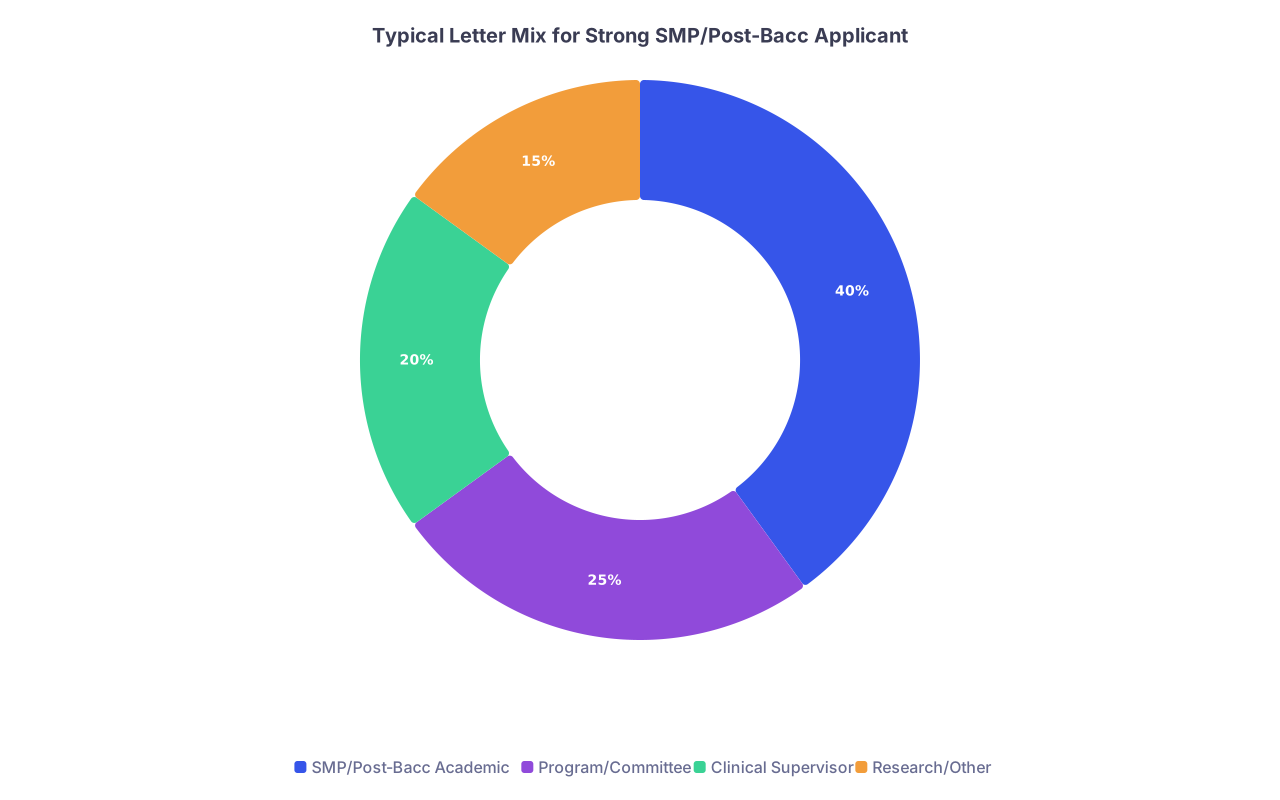
| Category | Value |
|---|---|
| SMP/Post‑Bacc Academic | 40 |
| Program/Committee | 25 |
| Clinical Supervisor | 20 |
| Research/Other | 15 |
This is not rigid, but you get the idea: most of the weight should be anchored in your recent academic reinvention, supported—not replaced—by clinical and research letters.
How to cultivate the right kind of letter from the right person
You do not just “request” strong letters. You earn them, then you direct them.
Three concrete moves:
Make yourself visible early in your SMP/post‑bacc
- Sit near the front, ask intelligent questions, use office hours to clarify understanding (not to argue for points).
- Volunteer for problem‑solving roles in small groups. Faculty remember the people who make their job easier by lifting others.
Explicitly frame your story when you ask
- When you request a letter, say some version of:
“My undergrad record is weaker than my current performance. This SMP is the central evidence that I can handle medical school. I am hoping you can comment on my performance relative to my peers and on how I’ve approached the course.” - Provide a short, focused “letter packet”: CV, unofficial transcript, personal statement draft, and a 1‑page “things you might not know about me” with bullet points.
- When you request a letter, say some version of:
Aim for comparative language and specifics
- You cannot write the letter for them, but you can say:
“If you feel comfortable, it would be very helpful to the committee if you could include how I performed relative to other students you have taught, and any specific examples of my work or growth this term.”
- You cannot write the letter for them, but you can say:
The best SMP/post‑bacc letters read as if the writer is advocating for you, not just passively describing you.
When old undergrad letters are still worth including
There are a few scenarios where earlier letters retain real value:
- You were strong throughout undergrad, then added an SMP/post‑bacc for acceleration or linkage, not repair.
- You did a rigorous thesis or multi‑year research project with significant intellectual ownership.
- A long‑term mentor (PI, major advisor) has watched your trajectory into SMP/post‑bacc and can speak to growth over 4–6+ years.
In these cases, undergrad letters function as longitudinal evidence: “this is not a one‑off good semester; this is who they have been for a long time.”
But if you struggled in undergrad, then crushed an SMP, the center of gravity for your letters should be squarely in the SMP years.
Building a timeline that actually works
SMP and post‑bacc programs are compressed. You do not have three leisurely years to build relationships. You have one or two.
A basic structure that works:
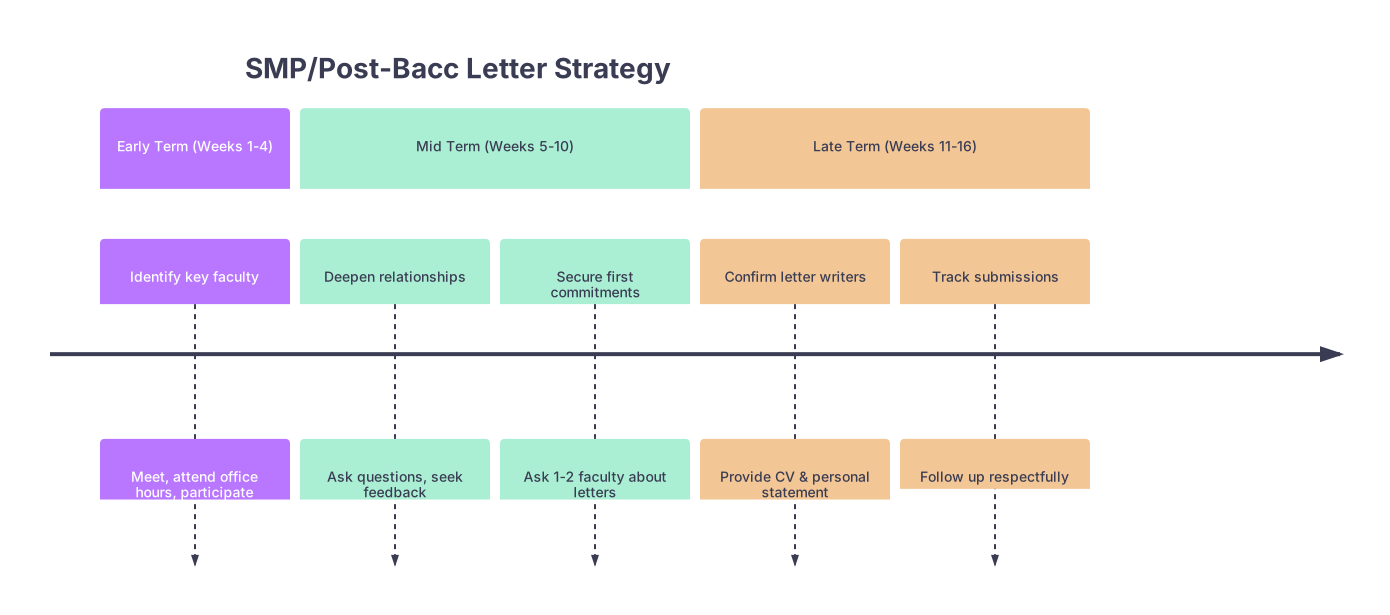
| Period | Event |
|---|---|
| Early Term (Weeks 1-4) - Identify key faculty | Meet, attend office hours, participate |
| Mid Term (Weeks 5-10) - Deepen relationships | Ask questions, seek feedback |
| Mid Term (Weeks 5-10) - Secure first commitments | Ask 1-2 faculty about letters |
| Late Term (Weeks 11-16) - Confirm letter writers | Provide CV & personal statement |
| Late Term (Weeks 11-16) - Track submissions | Follow up respectfully |
The students who end up scrambling for letters in June are almost always the ones who treated their SMP/post‑bacc like a second anonymous undergrad. Invisible in lecture. Never in office hours. Never acknowledging that they are rebuilding a narrative.
You cannot afford that.
Quick reality checks: common scenarios
Let me run through a few real‑world patterns I see all the time and how the letter hierarchy plays out.
Scenario 1: 2.7 undergrad science GPA → 3.8 SMP
You should anchor your letters in:
- SMP program/committee letter
- Two SMP science course directors (especially those where you excelled)
- One clinical or research supervisor if strong; but do NOT downgrade SMP letters for the sake of variety
Here, your SMP voices carry more weight than any undergrad letter you could produce, unless some undergrad scenario was truly exceptional.
Scenario 2: Non‑traditional career‑changer, strong old GPA, no science background, now doing a 1‑year career‑changer post‑bacc
You need:
- 1–2 post‑bacc science faculty
- 1 clinical supervisor (if you have been working clinically)
- Optional: old undergrad mentor or employer who can show that you have consistently been excellent in demanding environments
Here, the post‑bacc letters prove you can do hard science now; the older letters prove your general academic and professional caliber.
Scenario 3: DIY post‑bacc scattered across 2–3 institutions, mostly online
This is trickier. Some online instructors barely know who you are. You have to be deliberate:
- Identify at least one in‑person or high‑engagement course where the instructor actually saw your work up close.
- Combine that with a strong clinical supervisor letter.
- If possible, add a research PI or long‑term community service leader.
Adcoms will worry more about rigor and isolation here, so your best letters become the few people who genuinely know how you operate.
Red flags that quietly kill the value of your letters
A letter can look “fine” on the surface and still hurt you. Watch for these patterns:
- The writer hesitates or seems lukewarm when you ask.
- They say, “Sure, I can write you a letter,” but they do not use the word “strong.”
- They have not seen you in more than one context (e.g., only one group project, one term, one shadowing day).
- Your main letters are all from years ago while your SMP/post‑bacc faculty are absent.
If your SMP or post‑bacc director tells you, “You should really get a letter from Dr. X, they know your work well,” listen to that. They know who carries weight in their own ecosystem.
The bottom line: whose voices actually move the needle
If you strip away the myths, the faculty voices that carry the most weight after an SMP or post‑bacc are:
- Those who have seen you recently in demanding academic settings
- Those who can compare you to real med‑school‑caliber peers
- Those who can describe specific behaviors that match what residency programs want in interns
Prestige helps only if it rides on top of that foundation.
So when you are choosing between:
- A world‑famous researcher who barely supervised you, and
- The SMP physiology course director who watched you grind, improve, and finish near the top…
You already know which voice the admissions committee trusts more.
Your SMP or post‑bacc exists to change the story your transcript tells. Your letters exist to prove that story is real. Get those aligned, and the numbers on your screen start to mean something very different in a committee room.
With that sorted, your next move is obvious: start acting like someone whose professors will fight to write them a letter. Then, when application season hits, you are not begging for voices. You are deciding which of several strong advocates to put on the front line for you.