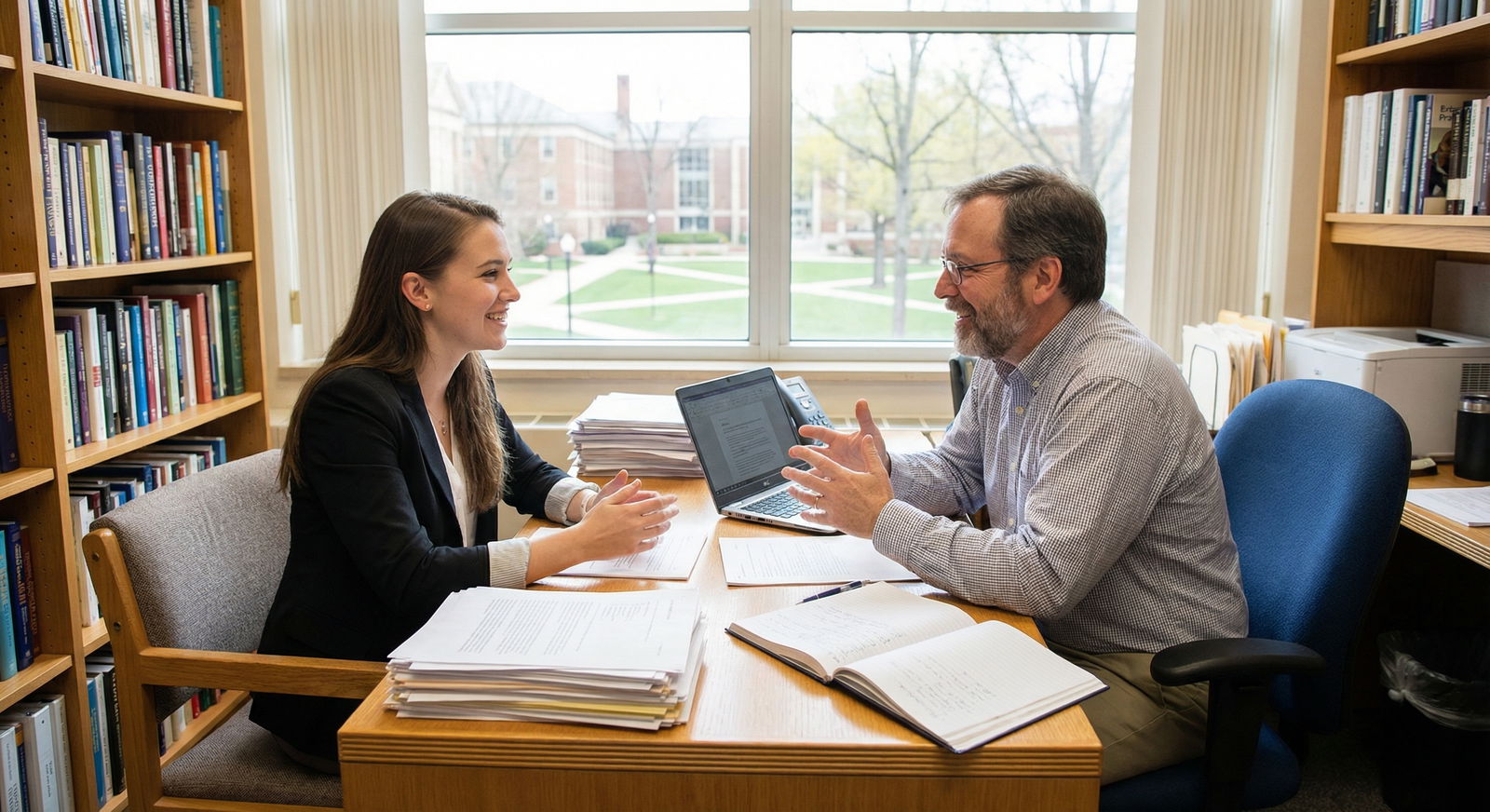
Virtual research mentorship is not the problem. Shallow, checkbox relationships are.
If you want a strong letter from an online or remote research mentor, you are fighting two separate battles:
- Building real scholarly depth without ever sharing a physical lab bench.
- Convincing admissions committees that this person actually knows you, and is not just blessing yet another Zoom acquaintance with a generic letter.
Let me break down exactly how to engineer a virtual research relationship that produces letters which sound like:
“I would recruit this student to my lab tomorrow,”
not: “We met a few times on Zoom and they seemed nice.”
1. How Committees Actually Read Research Letters
First, understand the target. Letters from research mentors are not evaluated the same way as letters from classroom faculty.
Admissions readers are scanning for four specific things:
- Proximity – How closely did this person work with you?
- Duration – For how long and in what intensity?
- Cognitive ability – Can you think independently, handle complex ideas, troubleshoot?
- Professionalism & trajectory – Are you reliable, coachable, and likely to succeed in academic medicine or research-heavy environments?
With virtual mentors, there is an extra, often unspoken, fifth question:
- Is this relationship real, or is this a pay-to-play / transactional online thing?
That credibility test is brutally simple. If the letter is full of vague adjectives and empty praise with no concrete examples, it is dead on arrival. If, on the other hand, the writer describes specific meetings, turning points, drafts, analyses, and your unique quirks, readers stop worrying about “virtual vs in-person” and start thinking “this is a serious student.”
Strong virtual letters usually have phrases like:
- “Over our weekly Zoom meetings over the course of 10 months…”
- “I shared my screen as we reviewed her code line-by-line…”
- “He independently drafted the first version of our methods section…”
- “On three separate occasions, she identified errors in my own preliminary analysis…”
Notice the pattern. Concrete moments. Frequency. Time. Tasks.
Your entire strategy with a virtual mentor is to give them this kind of ammunition.
2. The Minimum “Depth” Required For A Credible Letter
You want numbers? Good. Because committees and experienced mentors think in numbers, not vibes.
There are three axes that matter for virtual research relationships:
- Time (months)
- Intensity (hours/week)
- Responsibility (what level of work you actually own)
Let’s be blunt: a 4-week, 3-hour-per-week online “research internship” where you mostly watched PowerPoints will not produce a letter you should use.
Here is a rough threshold for something that can produce a credible, detailed letter from a virtual mentor:
| Dimension | Weak / Questionable | Credible Baseline | Strong / Standout |
|---|---|---|---|
| Duration | < 2 months | 3–6 months | 9–18+ months |
| Hours / week | 1–2 hrs sporadic | 4–6 hrs consistently | 8–12+ hrs, project-critical role |
| Meetings | Monthly or irregular | Weekly or every other week | Weekly with ad-hoc check-ins |
| Role | Simple data entry / lit | Clear sub-aim or analysis segment | Lead on defined subproject / draft |
| Output | None | Poster / abstract / internal work | Manuscript, first-author abstract |
Does every letter need to hit the “Strong/Standout” column? No. But if your situation is sitting mostly in the “Weak / Questionable” column, do not rely on that mentor for a primary LOR. At least not yet.
3. Choosing Virtual Mentors That Can Actually Help You
Most students choose virtual mentors with the wrong criteria:
- “They’re famous.”
- “They’re at a big-name institution.”
- “This program guaranteed a letter after 8 weeks.”
(That should worry you, by the way.)
The right criteria for letter potential are much less glamorous:
Access and Responsiveness
Can you realistically meet one-on-one at least every 1–2 weeks?
Do they answer emails or Slack messages?Control Over Projects
Are they the PI or at least someone with intellectual ownership of the project? A senior postdoc who actually directs the research is often better than a “celebrity” PI you never see.Track Record of Mentorship
Have they had undergrads or premeds before who went on to MD/PhD/DO/MPH programs? Will they speak bluntly about expectations?Project Type Compatible With Remote Work
Remote letter strength is easier when the project itself is amenable to virtual execution:- Clinical database work
- Chart review
- Biostats / coding / modeling
- Systematic reviews and meta-analyses
- Survey studies
Wet lab bench work done by proxy (you on Zoom watching someone else pipette) is nearly useless for letter depth. If your only involvement is reading PDFs and “attending lab meeting,” you are not giving your mentor anything to write about.
4. Designing A Virtual Research Relationship That Feels “Real”
You cannot passively wander into a strong virtual letter. You engineer it.
A. Start With A Concrete Role, Not Just “Join The Lab”
From the very beginning, you want something like:
- “I will be responsible for the initial literature review and ongoing reference management for the project.”
- “I will clean, code, and analyze the subset of data on X.”
- “I will draft the introduction and methods sections for our manuscript based on group feedback.”
That role should be written down somewhere. Email recap after your first or second meeting. It anchors expectations and gives your future letter-writer language: “We initially brought her on to handle X, but she quickly expanded her role to Y.”
B. Build A Structured Meeting Rhythm
Virtual relationships decay fast without structure.
You need:
- A standing weekly or biweekly meeting with the mentor or direct supervisor.
- Clear agenda items: progress, obstacles, next steps, conceptual discussion (not just task lists).
- A consistent medium: Zoom, Teams, Google Meet. Camera on. Notes open.
If all you have are occasional emails and maybe two or three Zoom sessions across months, the mentor will not remember you clearly enough to write more than boilerplate.

| Step | Description |
|---|---|
| Step 1 | Initial Contact |
| Step 2 | Define Role & Expectations |
| Step 3 | Set Weekly/Biweekly Meeting |
| Step 4 | Regular Progress Updates |
| Step 5 | Take Ownership of Subproject |
| Step 6 | Produce Tangible Outputs |
| Step 7 | Request Detailed Letter |
That is the spine of a credible letter-producing relationship.
C. Document Everything (For Their Future Letter)
This is the part students skip, then regret.
Create a single, living document (Google Doc or Notion page) that includes:
- Dates and brief summaries of each meeting.
- Specific tasks you accomplished between meetings.
- Technical skills you used or learned.
- Any metrics: number of charts reviewed, patients abstracted, scripts written, papers summarized.
Why? Because when you request a letter later, you will send this document as a memory jog. Good mentors are busy. Great mentors will be relieved you did their recall work for them.
5. What “Depth” Looks Like In Practice (Virtual vs In-Person)
Let me show you the difference in “depth” as it would look on a letter.
Shallow Virtual Mentorship (Weak Letter Ingredients)
- You attended group Zoom meetings 1–2x/month.
- You read articles and summarized them in shared docs.
- You helped with “data entry” into RedCap for a few weeks.
- Total time: 15–25 hours across 3 months.
What the mentor can honestly say:
“X participated in our virtual research group during the summer. She attended lab meetings and contributed by helping with data collection and literature review. She was punctual and enthusiastic.”
That letter will be politely ignored. It is wallpaper.
Deep Virtual Mentorship (Strong Letter Ingredients)
- You met one-on-one weekly for 9 months.
- You were given a distinct question to answer, dataset to manage, or section of a paper to own.
- You submitted drafts, got robust feedback, then improved.
- You learned and applied at least one technical / analytic skill.
- You presented your work (even internally, at lab meeting or a virtual poster session).
- Total time: 100+ hours.
What the mentor can write:
“Over the past 10 months, I have met with X virtually almost every week as we worked together on an outcomes study involving 1,200 patients. He independently cleaned and recoded the dataset using R, created the first set of descriptive tables, and identified a critical issue with missing values that even our biostatistician had not noticed. I watched his evolution from a student who needed line-by-line guidance on code, to someone who would send me a well-annotated script before our meetings, anticipating questions. He drafted the initial version of the results section, and I expect him to be second author on our upcoming manuscript.”
Nobody on an admissions committee is dismissing that because “it was virtual.”
6. Weekly Mechanics: How To Behave So Your Mentor Actually Knows You
You want your mentor to see three things: your mind, your work ethic, and your trajectory. That requires intentional behavior during virtual interactions.
Here is what I tell my own remote mentees to do.
Show Your Work, Not Just Your Results
Bring in-process material to meetings:
- Draft figures, even if ugly.
- Snippets of code with comments where you got stuck.
- Early outlines of sections with bullet points.
This gives the mentor material to comment on and, later, to reference in a letter: “She arrived at meetings with detailed drafts and specific questions.”
Make Your Thinking Visible
Do not just say, “I checked the assumptions.” Say:
“I tested normality using Shapiro-Wilk; p < 0.001, so I shifted to non-parametric tests. Here is the output.”
Or:
“In reviewing the last 20 charts, I noticed that postoperative complications were inconsistently documented between residents and attendings, so I created a standard abstraction rule and updated our codebook.”
That sort of language sticks in a mentor’s mind. Committees crave evidence that you think this way.
Communicate Like A Professional Colleague
Email structure matters. Subject lines like:
- “Update on X project – questions re: logistic regression”
- “Draft of introduction and methods for your review”
Short, clear, with attached or linked work.
You want your mentor to have the experience of: “This student already communicates like a junior colleague.” That sentence, if they use it in a letter, is gold.
7. Turning Virtual Projects Into Tangible Scholarship
Another credibility test: Did anything come out of this relationship beyond private Zoom talks?
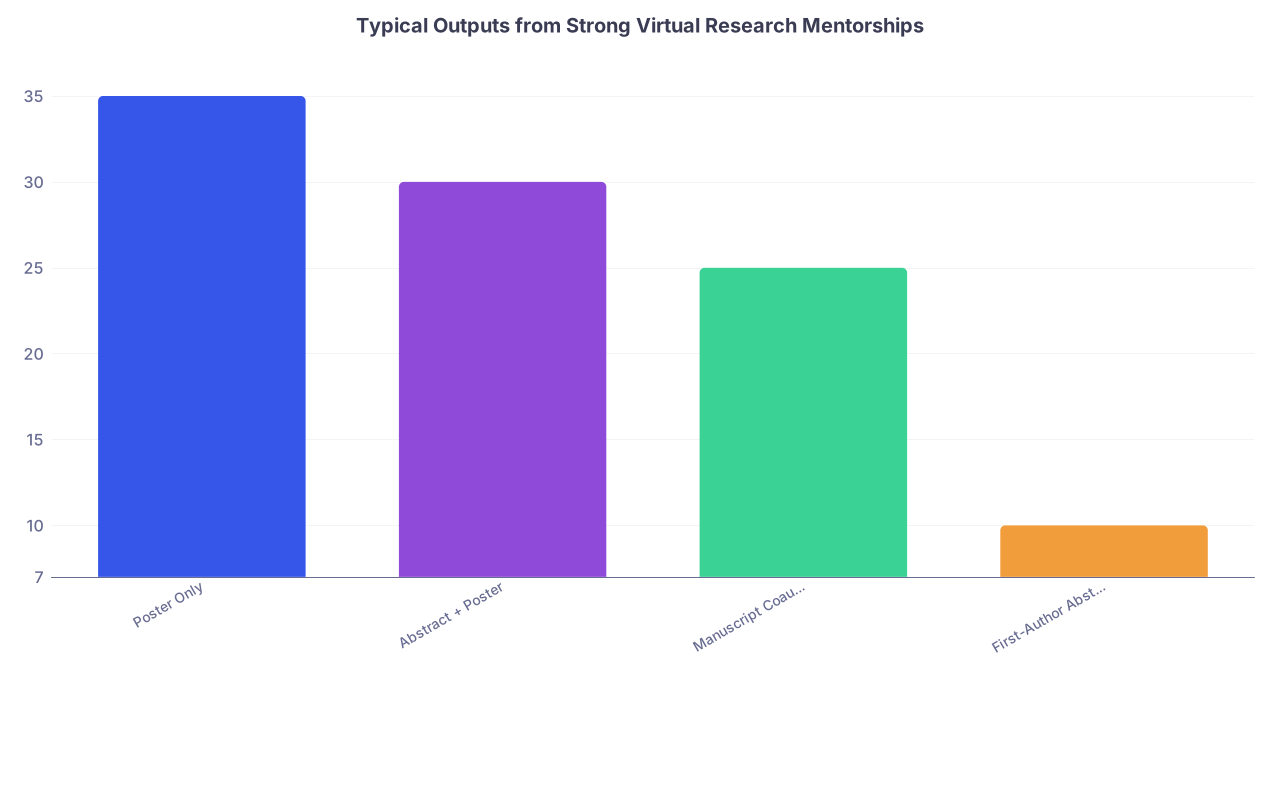
You want at least one of the following from a long-term virtual mentorship:
- Abstract submission (regional, national, or institutional).
- Poster presentation (even a virtual conference or school research day).
- Co-authorship on a paper (preprint, submitted, in press, or published).
- Internal lab presentation with slides you actually built and delivered.
| Category | Value |
|---|---|
| Poster Only | 35 |
| Abstract + Poster | 30 |
| Manuscript Coauthor | 25 |
| First-Author Abstract | 10 |
Do not obsess over “published in high-impact journal.” A carefully written letter saying “she will be presenting our work at the state ACP meeting this fall” is entirely sufficient for medical school-level research credibility.
Your job is to push for at least one concrete output. You do that by:
- Asking early: “Is this project on track for an abstract or manuscript?”
- Volunteering: “I would be happy to take the first stab at the abstract / poster layout.”
- Following through: sending drafts without being chased.
Mentors are far more willing to write detailed letters for students who pushed a project over the finish line.
8. How To Ask A Virtual Mentor For A Strong Letter (And Help Them Write It)
You do not just say, “Can you write me a letter?” Not with virtual mentors. There is too much risk of a bland, purely polite letter.
You ask this way:
“Would you feel comfortable writing me a strong, detailed letter of recommendation for medical school that speaks to my research abilities, reliability, and potential for a career in medicine?”
If they hesitate, you pivot. You want an enthusiastic yes, not a pity letter.
When they agree, you send a clean package:
CV or resume (with research section clearly highlighted).
Draft of your personal statement or statement of purpose.
One-page “research summary” for this specific project:
- Dates involved.
- Your role as you see it.
- Skills used (stats packages, coding languages, methods).
- Outputs (posters, abstracts, manuscripts).
- 2–3 specific stories or moments you recall as turning points.
A timeline and instructions (AMCAS/primary portal, due dates, links).
This does two things:
- It refreshes their memory of what you actually did.
- It subtly suggests the content of a strong letter without being obnoxious.
Most experienced mentors appreciate this. You are doing the cognitive heavy lifting they wish all students would do.
9. Red Flags: When A Virtual Research Letter Will Hurt You
Here are situations where I tell students not to use a virtual mentor’s letter unless they have no alternatives.
- Total involvement under 30–40 hours, spread thinly over months.
- Never had one-on-one meetings; only saw the mentor in large group calls.
- You never produced any independent work product with your name on it.
- The mentor seems distracted, late to meetings, or forgetful about who you are.
- They say “I am happy to write you a letter,” but hesitate when you say “strong, detailed.”
Also, be wary of structured “virtual research programs” that:
- Guarantee letters for any participant after a set number of weeks.
- Are mostly lecture-based with little actual research.
- Do not assign you to a clear project where the mentor has skin in the game.
Admissions committees are increasingly savvy about these. They can smell mass-produced letters full of generic praise.
10. Comparing Virtual vs In-Person: How Committees Really See It
You might think virtual mentorships are inherently second-class. They are not, as long as depth is present.
Here is the mental comparison an experienced reader makes:
| Feature | In-Person Weak | Virtual Strong |
|---|---|---|
| Duration | 2 months | 10 months |
| Meetings | Ad-hoc, rare | Weekly on Zoom |
| Project Ownership | Minimal | Clear, defined subproject |
| Output | None | Abstract + manuscript |
| Letter Detail | Vague | Specific, example-rich |
| Overall Competitiveness | Mediocre | Clearly stronger |
Committees do not care about the medium. They care about signal. A deep, specific, virtual letter beats a superficial in-person one every time.
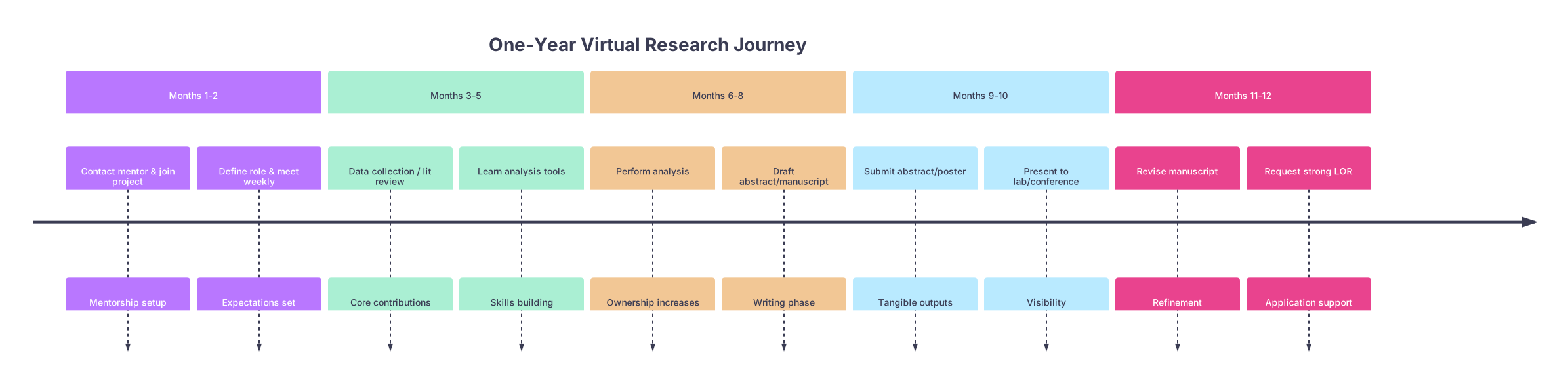
11. A Sample Timeline: From First Email To Strong Virtual Letter
To make this less abstract, here is what an ideal 12-month timeline might look like.
| Period | Event |
|---|---|
| Months 1-2 - Contact mentor & join project | Mentorship setup |
| Months 1-2 - Define role & meet weekly | Expectations set |
| Months 3-5 - Data collection / lit review | Core contributions |
| Months 3-5 - Learn analysis tools | Skills building |
| Months 6-8 - Perform analysis | Ownership increases |
| Months 6-8 - Draft abstract/manuscript | Writing phase |
| Months 9-10 - Submit abstract/poster | Tangible outputs |
| Months 9-10 - Present to lab/conference | Visibility |
| Months 11-12 - Revise manuscript | Refinement |
| Months 11-12 - Request strong LOR | Application support |
You do not need perfection. You need enough consistent activity, ownership, and output for your mentor to write about.
12. How To Recover If Your Virtual Mentorship Started Shallow
Many students wake up late: “I have been in this ‘virtual lab’ for 4 months and all I do is read papers.” Fine. Then you pivot, hard.
Here is exactly what you do:
Schedule a focused one-on-one.
Say: “I would like to discuss how I can contribute at a deeper level to the project.”Propose a specific subproject.
Examples:- “Could I take ownership of cleaning and analyzing the data for Aim 2?”
- “Could I draft a mini-review on [narrow topic] that could become part of our introduction?”
- “Could I build the initial figures/tables for our results section?”
Increase your contact frequency.
Move from sporadic meetings to weekly or at least biweekly check-ins. Show up with progress.Ask explicitly about outputs.
“Is there a potential conference where we might submit an abstract once we have preliminary results?”
If the mentor responds positively and gives you more responsibility, you can salvage depth. If they stonewall or keep you on trivial tasks, accept that this will not be a strong-letter relationship and reallocate your effort elsewhere.
FAQ (Exactly 6 Questions)
1. Do virtual research letters “count” less than in-person letters for medical school?
No, not if they are detailed and example-rich. Committees care about how closely the mentor worked with you, for how long, and what you actually did. A specific, narrative-driven virtual letter is valued more than a vague, generic in-person letter. The medium is secondary to the substance.
2. What is the minimum duration I should aim for before asking a virtual mentor for a letter?
Aim for at least 3–6 months with consistent engagement (4–6 hours/week and regular meetings). Under that, most mentors simply will not have enough lived experience with you to write anything beyond basic praise. If your timeline is shorter, you should heavily prioritize responsibilities and outputs, but recognize the ceiling on letter strength.
3. If my virtual mentor is a postdoc or fellow, is their letter still valuable?
Yes—if they supervised you closely and can describe your day-to-day work. A detailed letter from a postdoc who met you weekly and oversaw your project is often stronger than a one-paragraph letter from a famous PI who barely knows your name. You can still list the PI as senior author on your CV; the primary letter should come from whoever truly mentored you.
4. How many virtual research letters should I include in my application?
Most applicants need only one research-focused letter, whether virtual or in-person. If research is central to your story (MD/PhD, heavy academic focus), two can make sense, but only if both are deep and non-redundant. Do not stack three similar-sounding virtual letters; it adds volume, not value.
5. Can I ask for a letter if the project has not yet produced an abstract or publication?
Yes, but then the letter must lean heavily on process: your initiative, independence, problem-solving, and reliability. You should still try to create at least a small internal output—lab presentations, draft figures, or a near-ready abstract. Your mentor can reference these as evidence that the project is real and progressing.
6. What if my virtual mentor offers to show me the letter—should I read it?
If institutional policy permits and they explicitly invite you to read it, you can. But for most applications, you should waive your right to view letters when submitting through AMCAS or similar systems; committees expect confidential letters. The more important step is upfront: ask if they can write a “strong, detailed” letter, and provide them with a thorough summary of your work so they have material to write from.
Key takeaways:
- Virtual mentorship is not a handicap; shallow involvement is. Depth comes from months of consistent work, clear ownership, and tangible outputs.
- Structure the relationship—defined role, regular meetings, documented progress—so your mentor has real material for a specific, example-rich letter.
- Be ruthless about where you invest your time: pursue virtual mentors and projects that will actually know you well enough to write the kind of letter that makes committees pause and say, “We want this one.”