
You are standing outside your PI’s office holding a draft of your CV. Down the hall, the chief of medicine who let you shadow last month just told you to “swing by any time” to talk about the field. You need letters. You do not want generic fluff. And you keep hearing contradictory advice:
“Only research letters matter if you want academic medicine.”
“You need clinical letters; admissions does not care that you pipetted well.”
Both are overstated. And both miss the actual point: clinical and research mentors do very different jobs for your application, and which one helps you most depends on the profile you are building.
Let me break that down specifically.
The Core Difference: What Each Mentor Can Honestly Say
Strip away the fluff and you have a simple distinction.
Clinical mentors can say:
“I watched this person interact with patients, staff, and real clinical problems. Here is how they will function on a team, on the wards, in residency.”
Research mentors can say:
“I watched this person think, persist, and handle complex, ambiguous work over months. Here is how they will function in scientific environments and long-term intellectual projects.”
Everything else is details and strategy.
What Admissions Actually Reads For in Letters
Before we split clinical vs research, you need to understand what selection committees scan letters for. No, they do not read every sentence slowly. They hunt for signals.
Here is what most MD and MD‑PhD committees quietly prioritize when reading letters:
Credibility of the writer
Named person? Known institution? Known output? “Professor of Medicine, long-time clerkship director”? That gets weight. A vague “clinical instructor” who barely knows you? Less weight, no matter how nice the words.Depth and specificity
They want concrete examples: “She independently managed the pre-rounding data on 12 patients and presented succinctly at 6:30 am” is real. “He is hardworking and caring” is white noise.Basis for comparison
Phrases like “top 5% of students I have worked with in 15 years of teaching” are gold. That is what moves the needle.Fit with your story
If your application screams “I am a future physician-scientist” and there is zero serious research letter, it looks incoherent. If your narrative is “non-traditional, heavy clinical experience, late to research” and you force a weak research letter, it can actually hurt.
So the real question is not “clinical vs research?” but “Which mentor can produce a credible, specific, comparative letter that fits the version of you I am presenting?”
Clinical Mentors: The “Can They Actually Doctor?” Letter
Clinical letters ask and answer: “Can I trust this person with patients and a team at 3 a.m.?”
They are powerful when used correctly, but often underused or misused.
What Strong Clinical Mentors Actually See
A good clinical mentor is not just a name on your shadowing log. They have watched you in:
- Patient interviews or histories (even as a premed scribe or MA)
- Pre-rounds, handoffs, sign-outs (for med students)
- High-stress situations: a rapid response, a difficult family conversation, a consultant who is annoyed, a workflow meltdown
They can speak to:
- Reliability: Do you show up early? Stay late when things get busy? Or do you vanish at 4:59?
- Communication: Can you talk to a non-English speaking patient with an interpreter effectively?
- Team function: Are you useful or just decorative? Do nurses actually like working with you?
If all you did was follow three steps behind them in clinic for five afternoons and say very little—this is not a clinical mentor. That is a shadowing contact. Stop trying to squeeze letters out of that.
What Committees Expect From Clinical Letters at Each Stage
Let me split by training level.
Premed (MD/DO applicants)
Clinical letters are often your main proof that you are not just a GPA/MCAT robot.
Best use cases:
- You have substantial direct patient contact (MA, EMT, CNA, scribe, hospice volunteer) with a supervising clinician who knows you well.
- You are coming from a non-traditional background with years of clinical work; that letter can show maturity and professionalism.
- You lack extensive research; clinical letters can balance your file and reassure schools you will function well clinically.
Weak use cases:
- A 3-day shadowing experience where the physician barely remembers your name.
- A letter that only says “He is interested in medicine and asked good questions.” That sentence appears in 10,000 weak letters per cycle.
For most MD applicants, one substantive clinical letter is valuable. Two can be good if both are strong and from different contexts (e.g., ED scribe + inpatient volunteer coordinator). More than that usually adds redundancy, not strength.
Med school applicants to summer programs, research fellowships, etc.
Here a clinical mentor letter is often secondary. But it helps when:
- You are applying for a clinically heavy summer program rather than pure bench research.
- You need someone to testify to your bedside manner and professionalism, which matters for certain clinical scholarships or service-oriented awards.
Med students applying to residency
For residency, clinical letters are almost mandatory. Program directors want:
- Departmental or chair-level letters from your home institution in the specialty.
- Clinical attendings who supervised you on sub-Is and core rotations.
- Sometimes an off-service attending who can speak to your team function (e.g., medicine letter for neurology applicant).
At the residency level, if I have a stack of glowing research letters and no one willing to say you were safe, competent, and reliable on the wards? Red flag.
Research Mentors: The “Do They Have a Brain for This?” Letter
Research letters answer: “Does this person have the intellectual horsepower and grit to handle complex problems over time?”
MD schools care. MD‑PhD programs care even more. Academic residencies notice.
What Strong Research Mentors Actually Evaluate
Forget “they ran Western blots.” A serious research mentor observes:
- How you handle failure: 90% of experiments do not give clean results.
- How quickly you learn: Do you internalize feedback or repeat the same errors?
- Cognitive style: Do you ask good questions? See patterns? Connect literature?
- Independence: Do you start seeing what needs to be done and doing it without being spoon-fed?
A PI who has met you twice and lets their postdoc hand them a template letter? That letter reads exactly how you think it reads: generic, inflated, and useless.
A PI who has argued with you in lab meeting about your data interpretation for six months? That letter can be lethal (in a good way).
What Committees Expect From Research Letters by Applicant Type
Premed for MD
For a typical MD applicant, one solid research letter is enough to show you can think beyond memorization. That letter especially matters if:
- You claim research as a “most meaningful experience” on AMCAS.
- You are applying to research-heavy schools (e.g., UCSF, Penn, Hopkins, WashU).
- You want to signal potential interest in academic medicine.
You do not need three PI letters if you did one summer project in each lab without deep involvement. One strong long-term mentor beats multiple shallow ones.
Premed for MD‑PhD
Different universe.
For MD‑PhD, research letters are non-negotiable and must be:
- From PIs (or equivalent senior scientists), not just grad students or postdocs.
- Very specific about your projects, your contributions, and your level of independence.
- Comparative: “top 1–2 undergrads I have mentored in my career” type language.
If you apply MD‑PhD with only one lukewarm research letter and two generic clinical letters, you are effectively applying as a weak MD applicant with confused expectations.
Med student for research year, fellowships, or academic residency
At this level, research letters tell a future program:
- Can you produce something—abstracts, manuscripts, presentations—in 1–2 years?
- Are you the kind of resident who will drive the scholarly profile of the program?
- Are you a future faculty member they might want to recruit?
For academic internal medicine, radiation oncology, neurosurgery, dermatology, and similar specialties, high-quality research letters absolutely move you up in rank lists.
How Each Mentor Type Strengthens Different Profiles
Now the part most applicants mess up: matching letter type to your trajectory and current weaknesses.
1. The “Pure Stats” Applicant (High GPA/MCAT, Light Experience)
Common profile: 3.9 GPA, 520 MCAT, one short summer research position, some shadowing, minimal real clinical work.
What you need: humanity and work behavior.
Who helps more: a true clinical mentor, if you actually have one.
You are a textbook case where the committee wonders: “Are they just good at school, or will they show up for people?” A strong clinical letter from a physician or nurse manager who has seen you consistently with patients (scribe supervisor, MA supervisor, hospice coordinator) can rehabilitate an otherwise sterile file.
Research letter is nice, but if your work was 8 weeks of dishwashing and semi-supervised data entry, that PI cannot say much that matters.
2. The “Research-Forward” Applicant (Academic Trajectory, MD or MD‑PhD)
Profile: multiple years of lab work, posters, maybe a publication, comfortable in scientific conversations.
What you need: validation of your potential as a physician-scientist.
Who helps more: research mentors, obviously—but only if the letters are deep and comparative.
For MD‑PhD:
- You want 2 strong PI-level letters and maybe 1 additional from a collaborator or course director.
- Clinical letters are supporting cast—fine to have one, but if your best letter is clinical and your research letters are bland, you have a problem.
For MD with heavy research interest:
- At least one PI letter that clearly states you are among the strongest undergrads / students they have mentored.
- Then a clinical letter or two to show that your people skills exist.
Here is where applicants screw up: they chase a “big name” lab head who barely knows them instead of the slightly less famous PI who has actually mentored them. The famous but generic letter loses to the specific one almost every time.
3. The “Non‑Traditional, Heavy Clinical, Light Research” Applicant
Profile: EMT for 4 years, or RN transitioning to MD, or military corpsman; minimal formal research. GPA maybe less traditional.
What you need: proof of professionalism, maturity, resilience.
Who helps more: clinical supervisors and educators.
Letters from:
- ED attending physician who has worked with you on shift for years.
- Charge nurse or nurse manager who can speak to your ability to handle stress and patient load.
- Physician assistant or NP who can describe your teamwork and initiative.
If you do have one small research experience, a letter is fine but not mandatory for MD. For MD‑PhD, you need substantially more research depth before you should apply seriously.
4. The “Borderline Academic Metrics, Strong Experiences” Applicant
Profile: GPA a bit low, MCAT borderline, but rich clinical and/or research experience.
You are trying to convince committees to overlook numbers because you clearly function at a high level in real settings.
Here, mentor choice is strategic:
If your weakness is academic credibility: a research mentor or academic course director who can say “Despite a 3.3 GPA, this student performed at the level of our top students in rigorous, upper-division work” can mitigate risk.
If your weakness is questionably low clinical exposure: a clinical mentor who has witnessed you in demanding roles can argue you are the kind of person they want in their class despite numbers.
You probably want one of each, chosen purely based on who can write the strongest, most detailed advocacy letter.
Concrete Examples: When Each Letter Carries More Weight
Let me spell it out with scenarios.
| Scenario | Strongest Primary Letter | Key Supporting Letter |
|---|---|---|
| MD‑PhD applicant, 3+ years research | Research PI | Second research PI |
| MD applicant, heavy clinical work | Clinical supervisor | Research or science prof |
| Non-trad EMT, minimal research | ED physician or EMS director | Science/clinical faculty |
| Med student, applying derm | Research mentor in derm | Specialty clinical attendings |
| Med student, applying family med | Clinical clerkship director | Community preceptor |
How to Decide: A Simple Flow for Choosing Mentors
Use this as your internal decision tree.

| Step | Description |
|---|---|
| Step 1 | Start: Need LORs |
| Step 2 | Prioritize 2+ research PIs |
| Step 3 | Get 1 strong research PI letter |
| Step 4 | Focus on clinical and academic letters |
| Step 5 | Add 1-2 clinical letters |
| Step 6 | Use course directors/academic mentors |
| Step 7 | Applying MD-PhD? |
| Step 8 | Have long-term research? |
| Step 9 | Have strong clinical supervisor? |
The principle: lead with the mentor who best supports your main narrative, then backfill with letters that cover gaps (clinical ability, academic rigor, research potential).
What Actually Goes In a Top‑Tier Clinical vs Research Letter
You cannot fully control content, but you can choose the right writers and give them the right material.
Top‑Tier Clinical Letter: What It Looks Like
Features I see in truly strong clinical letters:
- Clear context: “I am an attending in internal medicine and have supervised ~500 students over 12 years.”
- Duration and intensity: “I worked with Ms. X for 8 weeks on an inpatient medicine service, observing her daily patient care.”
- Specific episodes: a difficult patient, a busy call day, a time you handled uncertainty maturely.
- Comparison language: “Top 10% of students at her level,” “exceptional professionalism,” “would be thrilled to recruit her to our residency.”
The best clinical letters are not glorified character references. They are performance reviews in real clinical environments.
Top‑Tier Research Letter: What It Looks Like
The strong research letter will include:
- Specific projects: “He designed experiments testing X, implemented Y protocol, and interpreted Z dataset.”
- Intellectual contributions: “She identified a confounding variable we had missed,” “He proposed a novel analysis that strengthened the paper.”
- End products: posters, abstracts, manuscript authorship, presentation to the group.
- Comparisons: “Among the 40 undergraduates I have mentored, she is easily in the top two.”
Vague “worked hard, came in on weekends” language is entry-level. Real value comes from statements of originality, independence, and sophistication.
How Many of Each? Balancing Your Letter Portfolio
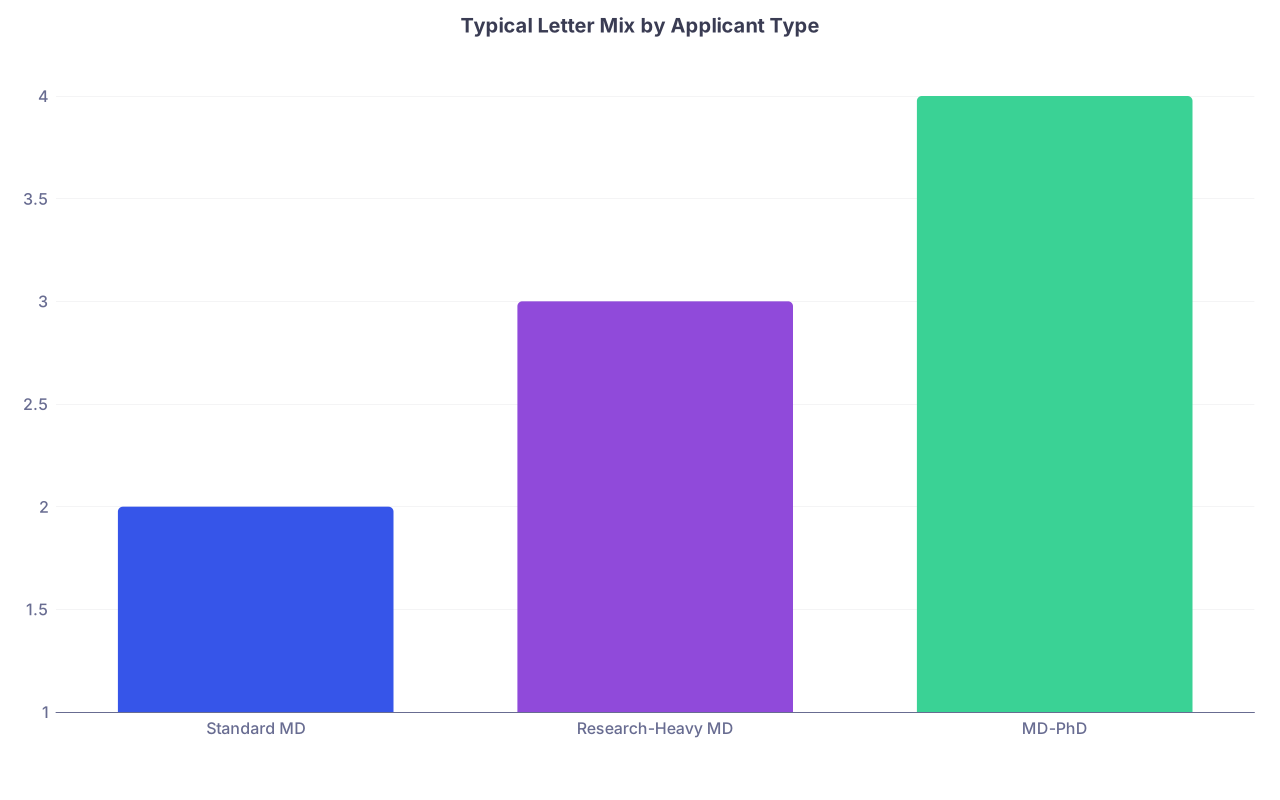
Most U.S. MD applicants end up with 3–4 letters total. You want a balanced but strategic mix.
Here is a rough structural guide:
| Category | Value |
|---|---|
| Standard MD | 2 |
| Research-Heavy MD | 3 |
| MD-PhD | 4 |
That bar chart is just total letter count; distribution is what matters:
Standard MD applicant with some research
- 1 science faculty letter (could also be PI if they taught you)
- 1 research mentor letter (if research is significant)
- 1 strong clinical or service supervisor letter
Optional: 1 more from another domain (humanities prof, additional clinical supervisor) if allowed.
Research-heavy MD applicant
- 1–2 research PI letters
- 1 clinical letter
- 1 science course director or academic letter
MD‑PhD applicant
- 2 PIs (minimum)
- 1 additional science or engineering faculty letter
- 0–1 clinical letter (nice but not primary if space is limited and research letters are strong)
Timing and Relationship Building: You Cannot Rush This
This is where premeds get it wrong: asking for letters after barely getting to know someone.
Whether clinical or research, a mentor needs:
- Time watching you work
- Context: your goals, your path, your struggles
- Evidence: specific episodes they can describe
You cannot brute-force this two weeks before AMCAS opens.
For Research Mentors
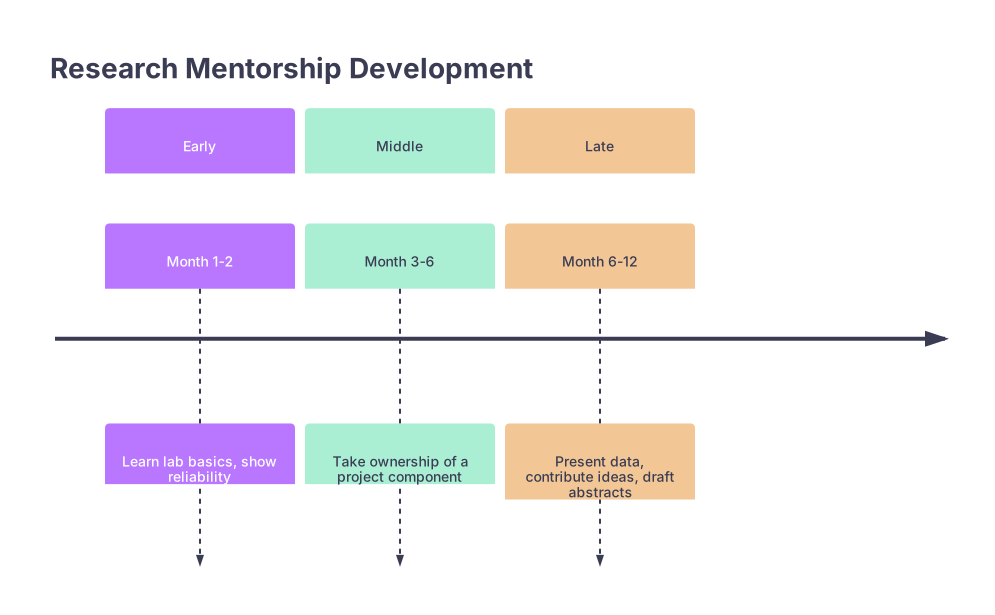
Ideal timeline:
| Period | Event |
|---|---|
| Early - Month 1-2 | Learn lab basics, show reliability |
| Middle - Month 3-6 | Take ownership of a project component |
| Late - Month 6-12 | Present data, contribute ideas, draft abstracts |
By the time you ask for a letter, they should have seen you think, fail, adapt, and contribute.
For Clinical Mentors
You build these through:
- Longitudinal scribe / MA roles
- Long rotations or sub-Is (for med students)
- Regular volunteer schedules where the supervisor is on-site and engaged
If your contact with them is scattered or brief, they are not a good letter writer no matter how senior they are.
Avoiding the Two Biggest Mistakes
I see the same two mistakes repeatedly.
Mistake 1: Chasing Title Over Relationship
Students get starry-eyed about big names: “Department chair at a prestigious hospital!” Then the letter they get is 3 paragraphs of generic praise with no details.
A detailed letter from an assistant professor who has mentored you closely beats a perfunctory letter from a world-famous PI 9 times out of 10.
Mistake 2: Forcing a Weak Letter to “Cover a Box”
You do not “need” a research letter if you did three weeks of low-level work and the PI barely remembers you. That letter will be weak and may undermine your otherwise solid clinical or academic profile.
Similarly, you do not “need” a clinical letter from a random shadowing physician just to say you “saw patients.” If they cannot talk about your performance, skip it.
Ask yourself:
- Who has seen me at my best, consistently, over time?
- Who can compare me to a meaningful peer group?
- Who actually likes and respects me enough to advocate strongly?
That is your mentor. Clinical or research.
Quick Visual: How Each Letter Type Speaks To Different Competencies
| Competency | Clinical Mentor Strong? | Research Mentor Strong? |
|---|---|---|
| Patient interaction | Yes | Rarely |
| Teamwork & communication | Yes | Sometimes (lab teams) |
| Reliability & work ethic | Yes | Yes |
| Intellectual curiosity | Sometimes | Yes |
| Scientific thinking | No | Yes |
| Resilience to failure | Yes (clinical stress) | Yes (experimental failure) |
| Fit for academic career | Sometimes | Yes |
You want letters that collectively hit as many of these boxes as possible in a way that matches your story.
How to Ask Each Type for a Letter (Without Being Awkward or Vague)
You will ask differently depending on whether they are clinical or research.
Asking a Research Mentor
Do not say: “Can you write me a letter?”
Say something closer to:
“I am applying to MD programs with a strong interest in physician-scientist work. You have seen my work on the X project over the last year. Would you feel comfortable writing a strong, detailed letter commenting on my research skills and potential for an academic career?”
This phrasing does two things:
- Gives them an out if they cannot be strong.
- Signals you understand what their letter should cover.
Provide:
- CV
- Draft of your personal statement or research statement
- List of programs / deadlines
- Summary of your work in their lab (bulleted is fine)
Asking a Clinical Mentor
For a clinician who supervised you closely:
“I am applying to medical school and would value a letter that speaks to my clinical performance, teamwork, and professionalism as you observed during [X role or rotation]. Do you feel you know my work well enough to write a strong letter?”
Again, offer your materials and remind them of specific patient encounters or situations they witnessed if they seem receptive.
Visual: Balancing Your Profile Over Time
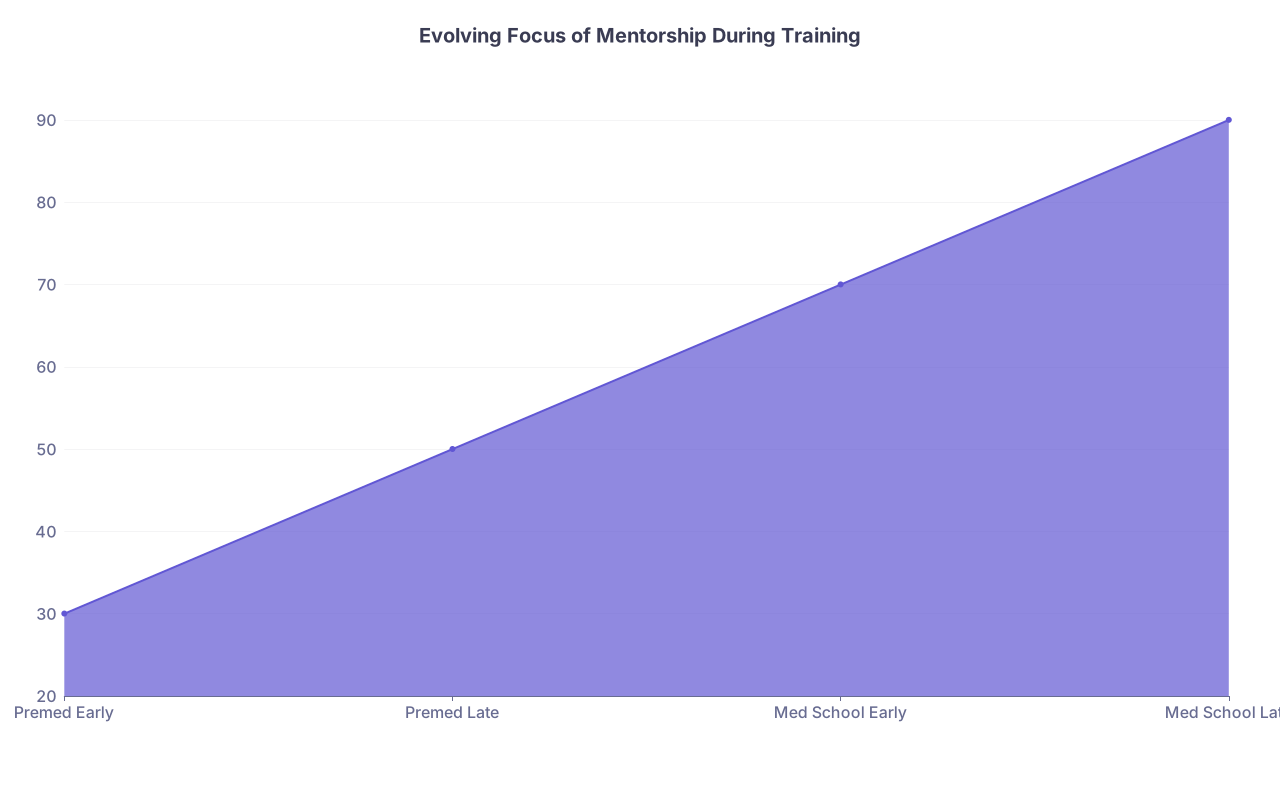
If you are early (college freshman/sophomore), think ahead.
| Category | Value |
|---|---|
| Premed Early | 30 |
| Premed Late | 50 |
| Med School Early | 70 |
| Med School Late | 90 |
Interpretation: As you move along, the depth of mentorship you need (clinical and research) should grow. If you hit “Med School Late” with superficial connections, your letters will show it.
Final Calibration: What Should You Do Next?
If you are reading this, you are likely overthinking this in the abstract and under-investing in the concrete.
Here is what I would do in your place this month:
- Make a short list (3–6 names) of potential mentors: both clinical and research.
- For each, write down: duration of contact, depth of interaction, specific episodes they saw, and whether they can compare you to peers.
- Identify 2–3 who clearly rise above the rest in depth and quality of relationship, regardless of type. Those are your anchor letter writers.
- Then check: does your overall mix cover academic ability, research potential (if relevant), and clinical functioning? If there is a gap, deliberately cultivate that relationship over the next 3–12 months.
Do this intentionally and you stop asking “clinical vs research?” as if one is globally better. You start asking the only question that matters: “Who can best prove, on paper, that I am the kind of future physician or physician‑scientist this program would be stupid not to train?”
Key Takeaways
- Clinical and research mentors serve different functions: clinical letters prove you can function with patients and teams; research letters prove you can think deeply and persist with complex problems.
- The “right” mix depends entirely on your profile and trajectory: MD‑PhD and academic-heavy MD applicants must prioritize PI letters; clinically rich or non-traditional applicants should lean on strong clinical supervisors.
- Relationship depth beats title: a less famous mentor who knows you well and can be specific is far more valuable than a big name who barely remembers you.