
Course directors do not automatically write better letters of recommendation than your small‑group leaders. The “big name = better letter” logic is lazy and often wrong.
Let me break this down specifically.
Most premeds and early medical students chase titles: course director, clerkship director, department chair. They assume prestige on the letterhead will magically compensate for a weak, generic narrative. Meanwhile, the quiet small‑group facilitator who actually watched you think, struggle, and improve ends up being overlooked.
That is backwards.
The best academic LOR is the one that proves, with receipts, how you think, work, and grow in an academic setting. Sometimes that is the course director. Very often, it is the person who sat three feet from you in small group for twelve weeks.
We will walk through:
- What program directors and admissions committees actually look for in academic LORs
- The real strengths and weaknesses of course directors vs small‑group leaders
- How this plays out differently for premeds, M1–M2, and clinical‑year med students
- Concrete decision rules: who you should ask, and how to set them up to write a strong letter
What an Academic LOR Actually Needs to Do
Before judging “who is better,” you need to know what “better” means from the committee side.
An effective academic letter of recommendation usually answers five questions, more or less:
- How did this writer know you, and for how long?
- How did you perform compared with peers?
- How do you think? Do you handle complexity, ambiguity, and feedback?
- What are you like to teach and work with?
- Would this writer stick their neck out and rank you near the top of students they have taught?
The problem: many applicants optimize for “famous signature” instead of “detailed answer to these five questions.”
Admissions readers are not impressed by a course director who clearly does not know you. They see hundreds of those letters. The dead giveaways:
- “I had limited direct interaction with the student…”
- “I did not personally observe the student’s clinical work…”
- “Based on their grades and feedback from other faculty…”
That kind of language screams: generic compilation, not genuine endorsement.
On the other side, a small‑group leader who can write:
- “I supervised Alex every week in our 8‑student physiology case‑based group from August to December 2024…”
- “Alex routinely led the discussion, synthesized complex pathophysiology, and diplomatically redirected peers when the group went off track…”
- “Among the ~120 preclinical students I have taught in the last 5 years, Alex is in the top 10 for analytical reasoning and professionalism…”
will carry far more weight, even if their official title is less fancy.
Course Directors: What They Do Well, What They Miss
Course directors are not useless. They just are not automatic home runs.
Strengths of Course Director Letters
When they actually know you, course directors bring some specific advantages.
- Macro‑level comparison across a big cohort
A solid course director letter can say:
“Out of 180 first‑year students, Maya ranked in the top 5% on cumulative exams and consistently performed at the Honors level.”
Committees like that kind of calibration. It gives context. A “strong” student in one school’s system might be average in another; percentiles and explicit ranking language clarify that.
- Perceived institutional authority
Right or wrong, a letter signed by “Director, Foundations of Medicine Course” sounds like it represents the school’s academic leadership. That does carry some psychological weight.
Some residency PDs have told me outright: “A thoughtful letter from a clerkship or course director helps me trust the transcript.” Not because the name is magic, but because:
- They assume the director has access to grade distributions
- They assume the director knows how prior strong residents from that school looked on paper
- Access to multisource data
Course directors often have:
- Exam scores and distributions
- OSCE / practical performance data
- Faculty and small‑group facilitator comments
- Professionalism/attendance flags
So a well‑done course director letter can synthesize all of that: “She scored in the top 10% on written exams, performed above average on practical assessments, and consistently received ‘outstanding’ professionalism marks from small‑group facilitators.”
That kind of integrated summary is useful, particularly for med school → residency transitions.
Weaknesses of Course Director Letters
Here is where they fall apart.
- Limited direct observation
Most course directors:
- Give a handful of large‑group lectures
- Maybe run one or two review sessions
- Spend most of their time in meetings and email, not actively teaching individuals
So unless you:
- Went to office hours frequently
- Served on a course committee
- Had academic difficulty and worked closely with them to improve
- Worked with them on a project (curriculum, research, etc.)
they may not have any meaningful “stories” about you.
What you get instead is the dreaded “database letter”:
- Paragraph one: boilerplate about the course
- Paragraph two: your grade and maybe your rank
- Paragraph three: “professional and pleasant,” pulled from generic comments
- Paragraph four: “I recommend without reservation”
No teeth. No specifics. Committees smell that from a mile away.
- Over‑reliance on numbers
Because course directors sit on score spreadsheets all day, their letters can flatten humans into metrics. You end up with:
- “Top 10% in MCQ exams”
- “Performed adequately on OSCEs”
without concrete behavior, reasoning, or interpersonal examples. That might be fine as one letter in your packet, but it is not what you want as your primary narrative academic letter.
- Name without substance problem
I have watched students brag: “The course director agreed to write my letter!” Then the letter appears and reads like:
“I did not work closely with Jordan but based on their excellent performance and feedback from other faculty, I can say Jordan is a strong student.”
That line alone can downgrade the entire LOR in a reader’s mind. It advertises that the writer barely knows you.
If your only real asset is “Director of X” under the signature, you are gambling.
Small‑Group Leaders: Where They Quietly Win
Small‑group leaders (PBL, TBL, case discussion, labs, anatomy tutors) often produce surprisingly powerful letters. Why? Because proximity beats prestige.
Strengths of Small‑Group Leaders
- Direct, repeated observation
A facilitator who has watched you:
- Every week for an entire block
- In groups of 6–10 students
- Solving cases, arguing mechanisms, admitting confusion, teaching peers
has data that no course director can match. They can describe how you think in messy, real time.
Examples that show up in these letters:
- “On three separate occasions, when the group stalled, Aisha stepped in, summarized the case, and proposed a structured plan to investigate the differential. This was not assigned to her—she simply saw the need.”
- “When one student repeatedly dominated discussion, Daniel found a way to redirect the conversation and invite quieter members in, without embarrassing anyone. That is not taught; it reflects innate collegiality.”
This is gold to admissions committees. They are choosing future colleagues, not just test takers.
- Concrete behavior and growth
I have seen some of the best letters start with weakness. Example pattern:
“Early in the semester, Natalia tended to withdraw when the group disagreed with her interpretation. After mid‑block feedback, she came to office hours to strategize. Over the following weeks, she deliberately practiced articulating her reasoning and inviting critique. By the end of the course, she was comfortable leading the group through complex cardiovascular physiology cases and adjusting her view publicly when new data emerged.”
That is exactly the kind of growth mindset, coachability, and reflection PDs want. Small‑group leaders see it. Course directors rarely do.
- Authentic voice and credibility
A good small‑group letter often sounds like this:
- Less templated, more specific
- Filled with short, telling anecdotes
- Clear sense that the writer actually liked working with you
Even if their title is “Clinical Instructor” or “Adjunct Faculty,” committees know that the person who ran PBL three hours a week with you probably has a better sense of you than the dean.
Weaknesses of Small‑Group Leaders
They are not perfect either.
- Limited comparison scale
A small‑group leader might only work with 8–16 students a year. Their strongest claim:
- “Among the 16 students in this year’s groups, Leslie was the most prepared and consistently the best at articulating complex concepts.”
Not bad. But “16 students” is a small denominator. Program directors tend to give more weight when the writer clearly has seen hundreds of learners.
The workaround: some small‑group leaders are long‑standing faculty who can say “in my 10 years of facilitating >200 students…” That suddenly becomes quite powerful.
- Variable academic seniority
There is a spectrum:
- Senior PhD or MD faculty who facilitates small group
- Junior faculty in their first teaching role
- Fellow or senior resident serving as “small‑group instructor”
Letters from residents or fellows can be excellent character references but are often discounted as primary academic letters. Committees assume:
- Less experience comparing across multiple classes
- Less positional authority
- Potential friendship bias if ages are close
So you need to know who your small‑group leader actually is in the academic hierarchy.
- Occasional writing inexperience
Some facilitators do not write many formal LORs. Their letters can be:
- Too short
- Overly informal
- Vague on ranking language
You can mitigate this by providing them with:
- Your CV
- A short “summary of things you saw me do”
- A gentle note that explicit comparative language (“top X%,” “one of the strongest students I have taught”) is helpful if accurate
Premed vs Med School: Context Changes the Answer
The question “who writes better academic LORs” has a slightly different answer depending on where you are in the pipeline.
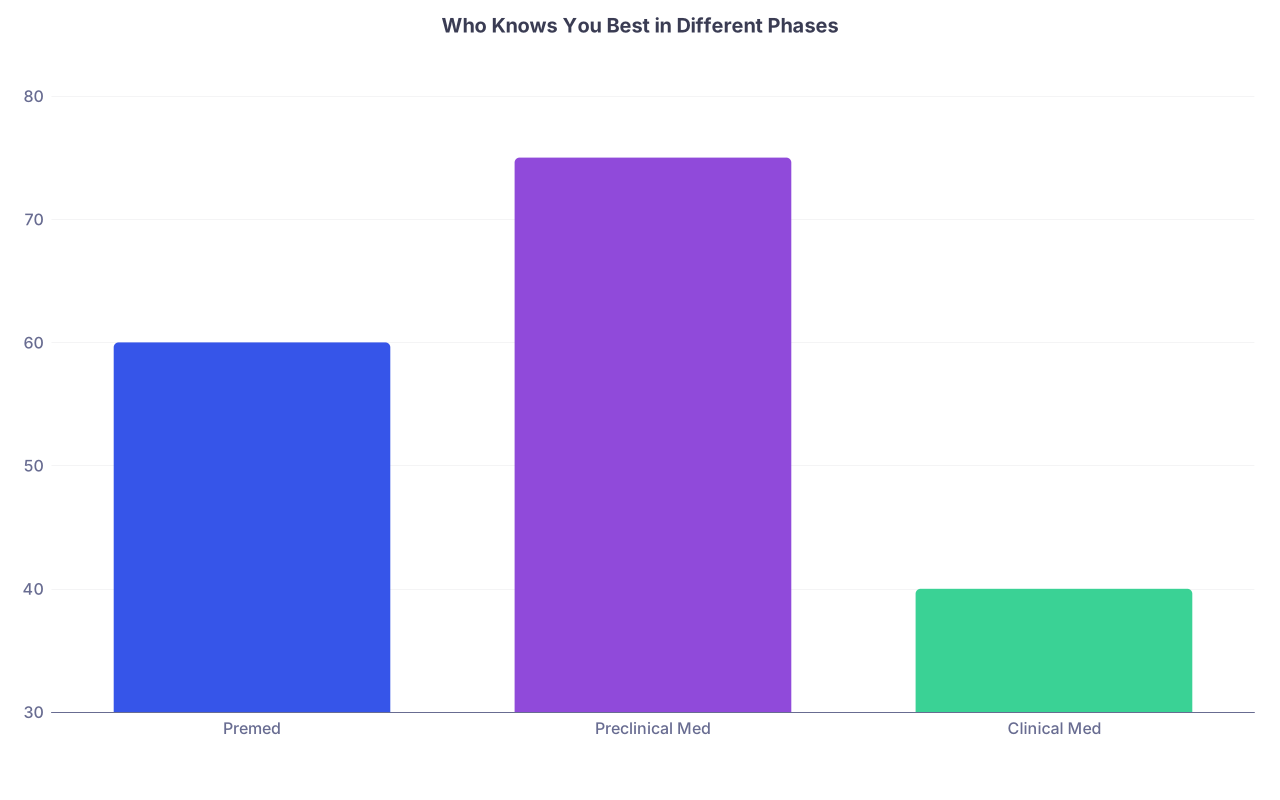
| Category | Value |
|---|---|
| Premed | 60 |
| Preclinical Med | 75 |
| Clinical Med | 40 |
(Values here loosely represent how often small‑group / discussion‑based teachers know you better than course/clerkship directors, from what I have seen.)
Premed (Undergrad or Post‑Bacc)
Translate “course director vs small‑group leader” into undergrad reality:
- Large lecture professor or course coordinator
- Lab instructor, discussion‑section TA, honors seminar professor, small‑enrollment course faculty
Here, the pattern is similar:
- The 400‑person organic chemistry lecturer usually does not know you
- The 20‑person honors biochem instructor who has heard you present twice and graded your projects does
For premeds, these are the very strong letter writers:
- Honors / upper‑division science course professors who taught you in a small setting
- Research mentors (if allowed as “science faculty” at your schools)
- Lab or discussion‑section instructors who are faculty (TAs can be helpful, but MD/PhD faculty carry more weight)
The “course director” equivalent only wins if you built an actual relationship: went to office hours, did a project, or were repeatedly and visibly engaged.
Preclinical Medical School (M1–M2)
Here the question is almost literal: systems course director vs PBL/TBL/anatomy lab faculty.
Patterns I have seen:
- The best academic preclinical letters often come from small‑group faculty in longitudinal roles (e.g., someone who facilitated both fall and spring case‑based learning).
- A course director letter becomes powerful if you (a) clearly crushed the course and (b) interacted with them meaningfully outside the exam hall.
This is where a hybrid strategy shines:
- One letter from someone who observed you closely in small‑group setting
- One academic letter from a course/clerkship director who can anchor you in the class distribution
You do not need every letter to be from a director. You need at least one to speak to comparative performance across the cohort.
Clinical Medical School (M3–M4)
Now the analog is:
- Clerkship director vs attending who directly supervised you on the wards
The same principles apply:
- The attending or faculty who watched you admit patients at 2 a.m., gave you feedback, and saw you respond to stress—often writes a more compelling narrative than the clerkship director who reads evaluations and never rounded with you.
- That said, many schools require a “departmental” or “clerkship director” letter; those letters matter, but they function more like an institutional attestation than a personal testimonial.
If your school has formal “SLOE‑style” templates (like EM), the director letter may be structurally strong even if they did not personally work with you every day. But in most fields, narrative detail from a supervising attending reads stronger.
How Committees Actually Read These Letters
Let me pull back the curtain a bit.
Admissions or residency committees read academic letters fast. They are looking for specific signs.
| Feature | Strong Signal |
|---|---|
| Relationship clarity | Weekly contact, specific time frame |
| Comparative language | Top X%, “one of the best in X years” |
| Concrete examples | Specific cases, behaviors, improvements |
| Direct observation | “I observed…”, “I worked with…” |
| Writer seniority | Faculty > fellow > resident > TA |
The name under the signature is one piece of this. But not the most important.
Patterns that make them roll their eyes:
- “I did not know the student well, but…”
- One long paragraph that could apply to any competent student
- Letter full of course description and almost no student description
Patterns that make them lean forward:
- “I worked with Sara every Tuesday afternoon in our longitudinal small‑group over two academic years…”
- “In the top 5 of the ~150 students I have taught at this institution…”
- “A memorable example of his intellectual curiosity occurred when…”
That “memorable example” line almost never comes from someone who did not work with you regularly.
So Who Should YOU Ask? A Concrete Decision Framework
You do not need a philosophical answer. You need a practical one. Here is how I would decide, case by case.
Step 1: Rank your potential writers by how well they know you
Forget titles for a moment. Ask:
- Who has seen me think out loud?
- Who has seen me struggle, receive feedback, and improve?
- Who could tell a specific story about me without re‑reading my CV?
If the answer is a small‑group leader, they move to the top.
Step 2: Check their role and seniority
Now reality intrudes. Among the people who know you well:
- Prioritize full‑time faculty over residents/fellows/TAs for “core” academic letters
- A fellow or senior resident letter can be a nice supplement but typically should not replace a required faculty academic letter
So:
- Small‑group leader who is associate professor of medicine and has facilitated for 8 years? Excellent academic letter writer.
- Small‑group leader who is a PGY‑2 resident? Great character witness, but you still need at least one faculty letter.
Step 3: Add at least one letter with broad comparison
You want at least one writer who can credibly say:
- “Top 10% of X”
- “One of the strongest in the last Y years”
That can be:
- A course director who actually knows you
- A small‑group faculty who has taught hundreds of students over a decade
- A research PI overseeing many trainees
Do not assume only course directors can provide that context. Many small‑group faculty have been teaching for years and can compare across large numbers.
Step 4: Ask directly about strength
When you approach someone (course director or small‑group leader), ask:
“Would you feel comfortable writing a strong letter of recommendation for me for [medical school / residency in X]?”
If they hesitate or downgrade (“I can write you a letter, but I did not work with you very closely”), walk away politely and choose someone else.
Weak letters from big titles hurt.
Step 5: Equip them properly
Regardless of their title, you make their letter better by giving them:
- Your CV
- A short paragraph about what you are applying for and what you hope they can comment on
- A bullet list of concrete interactions you had with them (cases, presentations, improvements, feedback you implemented)
For a course director, this can turn a “database letter” into a more personalized one.
For a small‑group leader, it triggers their memory and helps them anchor your strengths with specifics.
Smart Combinations for Different Scenarios
Let me give you concrete setups that tend to work well.
Strong premed applying to medical school
Ideal academic trio (adjust for individual school requirements):
- Small, upper‑level science course professor who knew you well (seminar, lab, or honors course)
- Another science faculty (could be a course coordinator who interacted with you frequently, or a PI if allowed)
- Non‑science professor or additional science professor who saw you lead, write, or present
Between those three, you want at least:
- One who can say “top X% among Y students”
- One who can tell a detailed story about your work/participation
The massive 400‑student “course director” only makes the list if they truly know you.
M1–M2 applying for a research year, MD‑PhD, or early scholarship
You might aim for:
- Small‑group preclinical faculty who facilitated PBL or TBL with you for a full semester or year
- Course director or system director who actually interacted with you and can place you in cohort context
- Research PI or scholarly project mentor
This gives you both narrative depth and institutional comparison.
M3–M4 applying to residency
Typical strong academic package (varies by specialty):
- Departmental / clerkship director letter (required in many places; institutional voice)
- Attending from a rotation where you worked closely for several weeks, who can describe clinical reasoning and work ethic
- Optional: Sub‑I attending or small‑group leader from case‑based/clinical reasoning course who saw you frequently
Again, the best “academic” letter often comes from the person who watched you admit, present, and follow patients—not just the person with “Director” in their title.
The Real Answer: Relationship > Role
Course directors vs small‑group leaders is the wrong battle. The correct hierarchy is:
- Depth of authentic relationship and direct observation
- Writer’s experience with many learners (so they can compare)
- Writer’s academic rank / role
- Name recognition and title
Order matters. Most applicants reverse it.
So who writes better academic LORs?
- If the course director actually knows you—has met with you, seen you engage over time, supervised a project—then a course director letter can be outstanding.
- If the course director barely knows you and the small‑group leader has watched you think every week for months, the small‑group leader will almost always write the better letter.
Pick accordingly.
FAQs
1. Should I ever ask a course director who barely knows me, just for the title?
No. That is a common but bad strategy. A generic letter from a high‑status person often reads weak and can actively hurt you. Only ask a course director if you have had meaningful interaction: frequent office hours, small‑group participation they directly supervised, a project you did together, or clear recognition of your performance.
2. My best small‑group leader is a fellow, not faculty. Is their letter worth using?
Yes, but usually as a supplemental letter, not your main academic LOR. A fellow who knows you well can provide rich narrative detail about your reasoning, teamwork, and growth. However, many medical schools and residencies explicitly prefer or require letters from faculty (assistant professor or higher). Pair the fellow’s letter with one or two from faculty who can meet formal requirements.
3. How many academic LORs should come from preclinical vs clinical faculty for residency?
For residency, weight should tilt toward clinical. Most programs care far more about how you function on the wards than your preclinical exam scores. One strong departmental/clerkship director letter plus 1–2 letters from attendings who directly supervised you clinically is ideal. A preclinical small‑group faculty letter is rarely necessary unless they know you exceptionally well or you are applying to a very academic program that specifically values it.
4. How can I help a small‑group leader write a “comparative” letter if they only saw a small group of students?
You cannot inflate their experience, but you can help them frame it. Provide them with your CV and remind them how many groups or years they have taught (“As you know, you mentioned having facilitated PBL for 6 years”). Many faculty understate their total teaching exposure. A facilitator who has taught 8 students per semester for 10 semesters has actually taught ~80 students and can honestly say, “Among the ~80 preclinical students I have taught in small‑group format, Jordan stands out in the top 5–10.” That is a credible and powerful comparative statement.