
It is late April. You are staring at your AMCAS “Letters of Evaluation” section, cursor blinking over “Add Letter Writer.”
On one side: the nurse manager from your paid medical assistant job who has watched you handle real, messy medicine at 2 a.m.
On the other: the longtime physician you have volunteered with for two years in the hospital clinic, who always says, “You’re one of my best volunteers.”
You can only send so many letters. You need signal, not noise. And now you are stuck on a deceptively simple-sounding question:
Who is the stronger clinical mentor and letter writer — your volunteer supervisor or your employment supervisor?
Let me break this down specifically, because a lot of premeds get this completely wrong and end up with beautifully written letters that say absolutely nothing admissions committees care about.
What Medical Schools Actually Want From Clinical Letters
Forget the job title for a moment. Admissions committees are looking for content, not a fancy role name. When they say they want “at least one clinical letter,” what they want is:
- Proof you have seen real patients in real clinical settings.
- An adult clinician or supervisor who can say:
- “I saw this person show up repeatedly over time.”
- “I trusted them with responsibilities that mattered.”
- “Here is how they handled stress, ambiguity, and sick people.”
- Specific examples that show:
- Work ethic
- Reliability
- Interpersonal skills with patients and staff
- Integrity and professionalism
- Capacity to grow and learn
Where do they get this? From letters that:
- Are detailed and concrete, not generic.
- Are clearly written by someone who actually supervised you.
- Reflect longitudinal contact (months to years, not two shifts and a handshake).
- Are in a real clinical setting (hospital, clinic, hospice, etc.), not just “health adjacent.”
So your core question here is not “volunteer vs job.” It is:
Who can write the highest-yield, most specific, most credible letter about me in a clinical context?
Let us dissect the usual differences.
Volunteer Supervisors vs Employment Supervisors: Core Differences
| Factor | Volunteer Supervisor | Employment Supervisor |
|---|---|---|
| Time with you | Often intermittent | Often frequent and sustained |
| Stakes of responsibility | Lower to moderate | Moderate to high |
| Ability to evaluate work ethic | Variable | Typically strong |
| Documentation of performance | Rare | Common (evaluations, write-ups) |
| Clinical proximity | Can be close or distant | Usually closer to daily workflow |
Typical Volunteer Supervisor Profile
Common examples:
- Physician overseeing a student-run free clinic.
- Volunteer coordinator or charge nurse for hospital volunteers.
- Clinic manager supervising front-desk or patient liaison volunteers.
What they usually see:
- You greeting patients, rooming them (in some places), restocking, transporting.
- You interacting at the edges of care rather than at the core of decision-making.
- Your reliability for scheduled shifts.
- Your interpersonal style with patients and staff.
Strengths of volunteer supervisors:
- Often see you over very long time frames (1–3 years).
- See how you behave when you are unpaid — which screams intrinsic motivation.
- Can comment powerfully on compassion, commitment, and consistency.
Common weaknesses:
- Sometimes do not see you in high-stakes or high-responsibility roles.
- Letters can become generic (“great volunteer, always on time, pleasant”).
- Volunteer coordinators who barely know you but “will happily write a letter.”
Typical Employment Supervisor Profile
Common examples:
- Nurse manager or charge nurse for your CNA / MA / ER tech job.
- Practice manager or physician at a private clinic where you are a scribe.
- Lead medical assistant or senior staff in outpatient settings.
What they usually see:
- You on busy days when the waiting room is full and tempers are short.
- You making mistakes, fixing them, and learning.
- How you handle direct orders, feedback, multitasking.
- Whether you are actually dependable when it matters.
Strengths of employment supervisors:
- Can speak to reliability under pressure: sick patients, short staffing, weekends, nights.
- Have objective leverage: they hired you, trained you, evaluated you.
- Often can compare you to many other employees.
Common weaknesses:
- May not be physicians, which makes some students nervous (unnecessarily, most of the time).
- May not write long, polished letters; content can be blunt.
- If you only work part-time or very recently, they may not know you deeply yet.
Now the key point: Admissions readers do not automatically prioritize “volunteer” or “job.” They prioritize substance and credibility.
The Signal Hierarchy: What Actually Matters Most
If I were to rank what matters for a clinical mentor letter, it is roughly this:
, Duration and frequency of contact, Level of trust/responsibility, Writer’s enthusiasm & advocacy, Writer’s title (physician vs other)](https://cdn.residencyadvisor.com/images/articles_svg/chart-relative-importance-of-clinical-letter-factors-5320.svg "Relative Importance of Clinical Letter Factors")
| Category | Value |
|---|---|
| [Specific behavioral examples](https://residencyadvisor.com/resources/letters-of-recommendation/the-polite-but-damaging-generic-letter-and-how-your-mentor-choice-causes-it) | 95 |
| Duration and frequency of contact | 90 |
| Level of trust/responsibility | 85 |
| Writer’s enthusiasm & advocacy | 80 |
| Writer’s title (physician vs other) | 60 |
Let us walk through those.
1. Specific behavioral examples (top priority)
“I watched her de-escalate an anxious parent in the pediatric ER at 3 a.m., then calmly help restrain the child so we could suture safely, all while reassuring both the child and mother.”
That sentence is worth fifty generic “hardworking and compassionate” lines.
Letters that win:
- Use concrete patient encounters.
- Show you acting, not just being “nice.”
- Mention times you struggled or grew and how you responded.
This can come from either a volunteer or job setting. But jobs tend to force you into more real responsibility.
2. Duration and frequency of contact
Someone who has known you:
- 18 months, weekly shifts,
- through both calm and chaos,
is vastly more valuable than a big-name attending who supervised you twice in a shadowing capacity.
Both a volunteer and employment supervisor can have this. You need to ask:
- Who has seen me consistently?
- Who saw me often enough to notice growth over time?
3. Level of trust and responsibility
Admissions committees care about whether:
- You were trusted with tasks that matter.
- Your absence hurt the team.
- You handled confidential or sensitive tasks appropriately.
Paid positions typically give more of this by default. But do not underestimate high-responsibility volunteer roles (ED volunteers who run complex workflows, hospice volunteers doing full shifts, student-run free clinic coordinators).
4. Enthusiasm and advocacy in the letter
There is a difference between:
“I recommend her for medical school.”
and
“I recommend her for medical school without any reservations and believe she will be an outstanding physician.”
You want the second (or stronger).
Choose the person more likely to write that kind of endorsement, not the person with the fancier job title.
5. Writer’s title and credentials
This matters, but it is not first-tier. Roughly:
- Physician (MD/DO) in clinical setting: strong.
- Advanced practice provider (PA/NP), PhD in a clinical research setting: also strong.
- RN, NP, PA, or manager directly supervising your clinical duties as employee: strong.
- Volunteer coordinator / non-clinical administrator with limited exposure: weaker.
So yes, a non-physician employment supervisor who knows you well and has seen you perform under pressure can absolutely outrank a physician volunteer supervisor who barely knows your last name.
When a Volunteer Supervisor Is the Better Choice
Let us be concrete. These are scenarios where the volunteer supervisor is usually the correct signal.
Scenario 1: Longitudinal, high-touch mentorship
You have:
- Volunteered in the same free clinic for 2.5 years.
- The attending physician on-site has watched you:
- Move from basic escorting to full rooming, basic vitals, chart prep.
- Lead new volunteer orientations.
- Take initiative on quality-improvement tasks.
They can say things like:
“In my decade overseeing premed volunteers, she is in the top 5% for reliability and patient rapport. I have trusted her with tasks I typically reserve for more senior volunteers.”
That is a great volunteer letter. It is effectively functioning as both clinical and character evidence.
Scenario 2: Volunteer role more clinically substantive than job
Your job: front-desk receptionist at an imaging clinic. You check people in, verify insurance. You rarely see any clinical decision-making or patient course.
Your volunteer role: ED volunteer functioning as a tech aide. You transport patients, help with chaperoned exams, assist during codes with logistical tasks, and are present for real emergencies.
If the volunteer physician or nurse has seen you repeatedly in that ED role — and your front-desk boss has only watched you manage spreadsheets — the volunteer letter is the higher-yield clinical signal.
Scenario 3: Employment supervisor knows you minimally
Some students cling to “employment supervisor” just because it is technically a job, even when:
- They started the job two months before applying.
- They work only weekends.
- The supervisor manages 50+ staff and barely interacts with them.
If your paid supervisor could not pick you out of a lineup, do not force that letter just because “paid > volunteer.” It does not.
When an Employment Supervisor Is the Better Choice
Now the flip side. These scenarios are where an employment supervisor usually should be your first pick.
Scenario 1: Real clinical responsibilities, intense environment
You work as:
- CNA on a med-surg floor.
- ER tech in a busy urban ED.
- MA in a high-volume primary care or urgent care clinic.
- Scribe directly with an attending physician.
Your boss has:
- Reviewed formal evaluations of your performance.
- Heard feedback from nurses, physicians, patients.
- Observed you in high-stress and high-emotion situations.
And they can say things like:
“We routinely staffed him on our busiest nights because he remained calm under pressure and consistently anticipated staff needs in the trauma bay.”
That type of letter is gold. It shows:
- Trust with real patient care.
- Functionality within a healthcare team.
- Professional behavior under stress.
Scenario 2: Job is your main clinical experience
If your most meaningful clinical exposure — in hours, depth, and responsibility — came from employment, then it is logical your primary clinical letter comes from that environment.
Example:
- 1,500 hours as an MA in a family medicine clinic (0.8 FTE for two years).
- 50 hours of hospital volunteering.
You would be shooting yourself in the foot to have a hospital volunteer coordinator (who saw you twice a month for light tasks) carry more weight than the physician or manager who saw you function daily at the clinic.
Scenario 3: Employment boss is a strong advocate
There is an obvious but overlooked point: do not chase letters from people who are lukewarm on you.
If your nurse manager has explicitly told you:
“If you ever need a recommendation, please let me know — I’d be happy to support you. You’re one of the most dependable techs we’ve had in years,”
that is the person you prioritize over a somewhat aloof attending who will produce two paragraphs of formal fluff.
Mixed Strategy: Using Both Without Redundancy
You do not have to pick only one category forever. Many schools allow 3–5 letters; some allow more.
For clinical letters, a strong strategy often looks like this:
- 1 letter from your most intensive clinical employment or volunteer role.
- 1 additional letter from a different clinical context that shows a different side of you (e.g., employment + free clinic volunteering).
What you do not want is:
- Two letters saying the same general thing from similar roles.
- Two weak letters from people who barely know you simply because they are “official supervisors.”
Make Their Lanes Clear
When you ask both a volunteer and an employment supervisor, do this:
- Give each of them:
- Your CV.
- A short paragraph of what you learned in their setting.
- A sentence about what you hope their letter might emphasize.
Example note to your ED tech supervisor:
“I’m hoping your letter can highlight how I functioned on the ED team, my reliability with shifts, and how I worked with patients and families on high-acuity days.”
Example note to your free clinic volunteer physician:
“I’m hoping you might emphasize my long-term involvement, how my responsibilities grew over time, and how I interacted with our underserved patients.”
You are not scripting them. You are giving them a frame so the letters complement each other instead of duplicating.
The One Group You Should Avoid as Primary Clinical Mentors
This will sound harsh, but someone has to say it clearly.
Volunteer coordinators who barely know you are generally weak clinical letter writers.
If all of the following are true:
- They never watched you directly with patients.
- They manage scheduling and checklists rather than clinical work.
- Their primary knowledge of you is attendance and “no complaints.”
Then they can be a supporting letter at best, not one of your primary clinical mentors.
Admissions committees can smell those letters a mile away: all adjectives, no substance.
How to Decide Between Two Real Options (Step-by-Step)
If you are down to “this volunteer doc vs that job supervisor,” use a simple scoring approach. Be honest.
Rate each potential writer 1–5 on:
- How well they know you.
- How long and how often they have worked with you.
- How clearly they have seen you with patients.
- How strong you think their enthusiasm will be.
- How likely they are to write specific, example-filled narratives.

| Step | Description |
|---|---|
| Step 1 | List both supervisors |
| Step 2 | Score each on 5 factors |
| Step 3 | Choose volunteer as primary clinical letter |
| Step 4 | Choose employment as primary clinical letter |
| Step 5 | Add the other as secondary clinical letter |
| Step 6 | Keep the higher-scoring writer only |
| Step 7 | Total score higher? |
| Step 8 | Room for more letters? |
Whichever one has the higher total is probably your primary clinical letter. The other can be an additional letter if you have space and they add a different dimension.
Timeline: When to Cultivate Volunteer vs Employment Mentors
You cannot fix a weak relationship two weeks before letters are due. This is the part almost everyone ignores until it is almost too late.
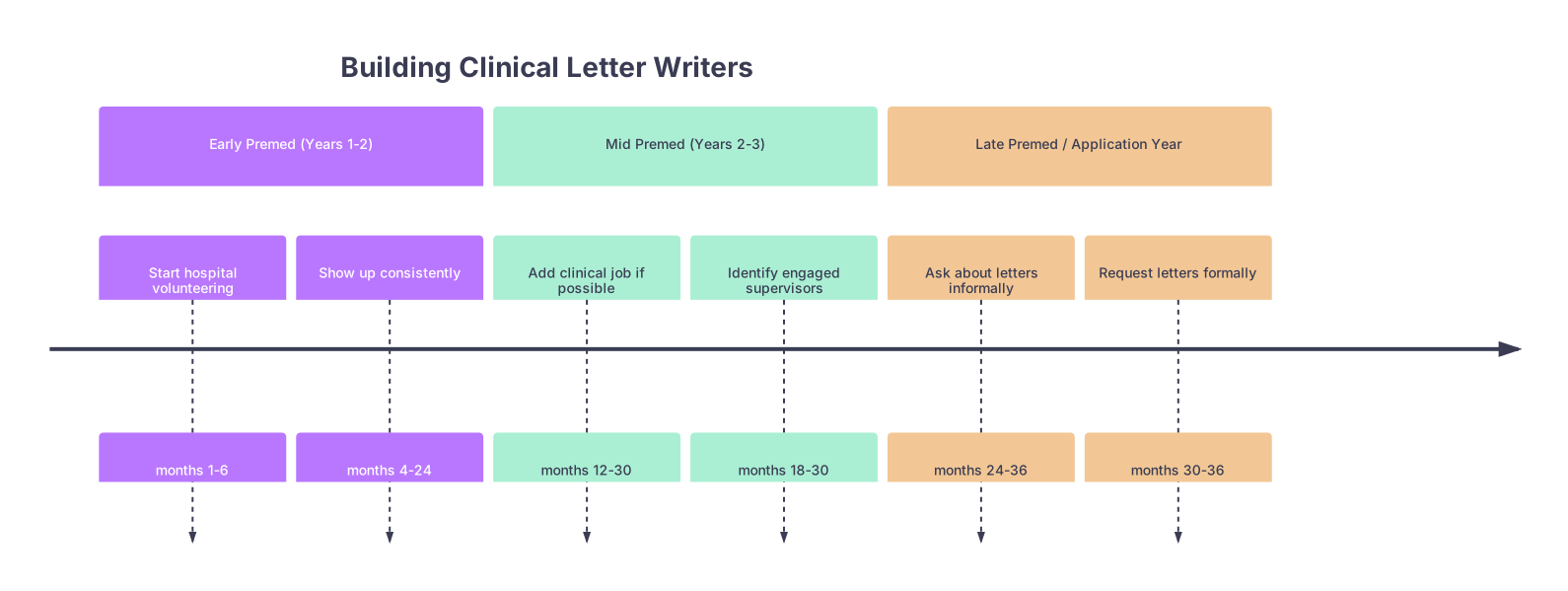
| Period | Event |
|---|---|
| Early Premed (Years 1-2) - Start hospital volunteering | months 1-6 |
| Early Premed (Years 1-2) - Show up consistently | months 4-24 |
| Mid Premed (Years 2-3) - Add clinical job if possible | months 12-30 |
| Mid Premed (Years 2-3) - Identify engaged supervisors | months 18-30 |
| Late Premed / Application Year - Ask about letters informally | months 24-36 |
| Late Premed / Application Year - Request letters formally | months 30-36 |
If you are:
- A first- or second-year student: focus on showing up reliably for volunteering and start building relationships early.
- A late premed starting a clinical job: be proactive. Ask for feedback. Let supervisors see you as more than just “the new MA.”
Letters are written off cumulative impressions. Not one heroic shift.
Common Mistakes Premeds Make With Clinical Letters
Let me just call out the repeat offenders I keep seeing.
Choosing prestige over knowledge.
Big-name attending who barely knows you vs mid-level supervisor who worked with you weekly. The latter wins.Assuming “paid” is automatically better.
It is not. It is just often more substantive. If your paid job is weakly clinical and short-term, do not force it.Requesting from whoever says yes first.
You should be selective and strategic, not desperate.Not giving writers any context.
You are not annoying them by giving your CV and personal statement. You are helping them write a better letter.Using clinical letters to replace required science letters.
No. Clinical letters typically supplement science faculty letters, not substitute them (unless a specific school says otherwise).
Example: Comparing Two Realistic Options
You: 3rd-year premed, applying this cycle.
Experience A – Volunteer
- 18 months as a hospital volunteer, 4 hours/week.
- Role: transport, stocking, occasional patient interactions.
- Supervisor: volunteer coordinator who sees you check in, occasionally on the floor. No direct patient observation.
Experience B – Employment
- 10 months as MA in a family medicine clinic, 20 hours/week.
- Role: rooming patients, vitals, handling messages, basic procedures assists.
- Supervisor: lead MA and clinic physician, both directly observe patient interactions and workflow.
Which is better as your primary clinical mentor?
Answer: Employment supervisor — specifically the physician or lead MA who supervises your direct patient work.
What about including the volunteer setting at all?
Maybe, if:
- You have a specific physician or nurse in that setting who has seen you repeatedly with patients.
- You are not short-changing more substantive academic or research letters to make room.
But if the only person who “knows” you there is the volunteer coordinator, that letter slides to the bottom of the priority list.
Quick Visual: Typical Weight of Different Clinical Letter Sources
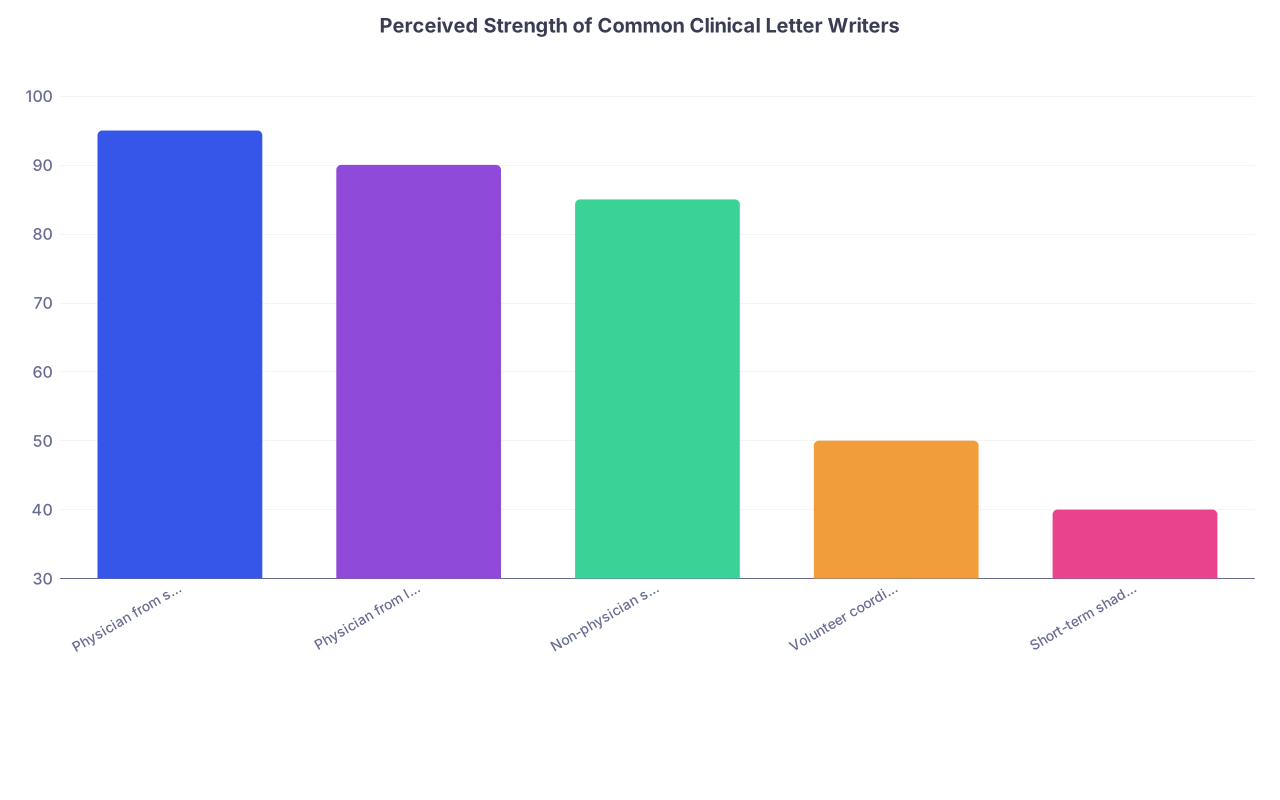
| Category | Value |
|---|---|
| Physician from substantial job | 95 |
| Physician from long-term clinic volunteering | 90 |
| Non-physician supervisor from substantial job | 85 |
| Volunteer coordinator with minimal contact | 50 |
| Short-term shadowing physician | 40 |
You want to live in the 85–95 range as much as possible.
FAQs
1. Does my main clinical letter have to be from a physician?
No. A non-physician supervisor (RN, PA, NP, clinic manager) who has deeply supervised your clinical work is absolutely acceptable and often excellent. The content and depth of knowledge about you beat the degree after their name. That said, you should still make sure you have enough physician letters overall if schools on your list explicitly recommend or require them.
2. Can I use both a volunteer and employment supervisor as clinical letter writers?
Yes, and often you should, if both know you well and each sees you in a different clinical context. The key is avoiding redundancy. If both will say essentially the same thing — “shows up, is pleasant, works hard” — choose the one who can provide more detailed examples, stronger advocacy, and more credibility about your actual clinical responsibilities.
3. What if my employment job is mostly administrative and not very clinical?
Then it may not qualify as a strong clinical letter source. In that case, a volunteer supervisor who has watched you interact directly with patients and staff in a clinical setting is probably the better signal. You can still mention the administrative job in your activities section, but do not pretend it is your main clinical exposure if it is not.
4. How far in advance should I ask a clinical supervisor for a letter?
Ideally 2–3 months before you need it submitted. Before that, ask informally: “Do you feel you know me well enough to write a strong letter for medical school?” Pay attention to the word “strong.” If they hesitate or sound neutral, that is a red flag. Once they agree, give them your CV, draft personal statement, and a short reminder of specific situations you think might help them write a detailed letter.
Key points: Pick the supervisor who knows you best in a clinically meaningful way, not the one with the flashiest title. Employment often gives deeper responsibility, but a long-term, high-responsibility volunteer role can absolutely produce a top-tier clinical letter. And if you remember nothing else: specific examples plus strong advocacy beat generic praise every single time.