
You are a junior in college, sitting in a tiny campus coffee shop with a spreadsheet open. One column says “MD programs,” another says “MD‑PhD (MSTP).” A third sheet is labeled “LORs – who can I ask?” and that is the one giving you a headache.
You have a PI who likes you, a primary care doc you shadowed, a physics professor who thinks you walk on water, and a volunteer supervisor who has literally seen you mop bodily fluids off the floor at 11 pm. But you keep hearing two conflicting things:
“MD schools want strong clinical and character letters.”
“MD‑PhD wants research, research, research.”
So which mentors should you actually prioritize? And how should your letter portfolio differ depending on whether you are aiming MD, MD‑PhD, or realistically, both?
Let me break it down very specifically.
1. MD vs MD‑PhD: What The Committees Are Actually Looking For
Before you pick mentors, you need to understand what the readers are trying to prove to themselves when they open your letters.
For MD admissions, they are fundamentally asking:
- Will this person be a good, reliable, ethical clinician?
- Can they handle the academic load?
- Are they decent to work with, or a walking HR problem?
For MD‑PhD admissions, they are asking all of that, plus:
- Is this person a future independent investigator?
- Can they think like a scientist, not just follow instructions?
- Will they survive (and actually finish) a PhD in our environment?
So the bar is different. Not “higher vs lower” in some absolute moral sense. Just different emphasis.
In practice, that means:
MD programs care a lot about:
- Clinical exposure and bedside potential
- Professionalism, empathy, teamwork
- Steady work ethic and academic reliability
MD‑PhD programs care intensely about:
- Depth and duration of research
- Scientific thinking and independence
- Evidence that you understand what a research career really is
(not just “I liked pipetting for a summer”)
Your letters need to be built to answer those questions.
2. Core Letter Types: MD vs MD‑PhD Side‑by‑Side
Let us get concrete. Assume a typical US applicant using AMCAS.
Most MD and MD‑PhD programs will see:
- Committee / composite letter (if your school offers it)
or - 3–5 individual letters
The categories are similar, but the emphasis is not.
| Track | [Science Faculty](https://residencyadvisor.com/resources/letters-of-recommendation/science-vs-nonscience-lors-precisely-which-mentors-cover-which-competencies) | Non-Science/Character | Research Mentor | Clinical/Service |
|---|---|---|---|---|
| MD | 1–2 | 1 | Optional/Helpful | 1 |
| MD-PhD | 1–2 | 0–1 | 1–2 (strong) | Optional |
Notice the pattern:
MD: at minimum, one strong science faculty letter + one character/clinical/service letter. Research letter is helpful but not mandatory for many programs.
MD‑PhD: a research mentor letter is absolutely mandatory, and a second research‑heavy letter is often the difference between “interesting” and “interview invite.”
If you are applying to both MD and MD‑PhD at the same time, you are trying to build a portfolio that can be re‑weighted by track. You do not need two entirely different sets, but you need enough material so the MD‑PhD side can highlight science, while MD can still see clinical and personal depth.
3. Choosing Mentors for the MD Track: Who Carries the Most Weight
For MD only, the hierarchy of letter impact usually looks something like this (assuming similar letter strength):
- Science professor who taught you in a challenging course and knows you well
- Research mentor (if they can speak to your academic skills and character, not just lab technique)
- Clinical supervisor / physician you have shadowed substantially or worked under
- Long‑term service / community supervisor
- Random famous person who barely knows you (this is almost always overrated and often useless)
Let’s dissect the ideal MD‑focused letter mix.
A. Science Faculty Letter(s): The Academic Backbone
You want at least one, preferably two, from:
- Biology, chemistry, physics, biochem, or other hard sciences
- Professors who taught you in real courses, not just a guest lecturer
Stronger if:
- Class was upper‑level or known to be difficult (e.g., “Molecular Cell Biology,” “Physical Chemistry”)
- You spoke to the professor outside class, TA’d for them, or did a project
What this letter should hit hard:
- Comparison to peers (“top 5% of 200 students over the last 5 years”)
- Intellectual curiosity and resilience
- How you handle setbacks/challenging material
- Reliability and professionalism in an academic setting
Weak version I have seen:
“Got an A, attended class, turned in work on time.” That is a transcript with adjectives.
Strong version:
“Led group discussions in a 300‑level molecular biology course, asked sophisticated questions about experimental design, came to office hours to push beyond the syllabus, helped struggling classmates without being performative.”
Choose the professor who can write the second, not the first.
B. Clinical or Service Supervisor: Your “Will You Be Safe With Patients?” Letter
For MD admissions, someone must answer the unspoken question:
“If I put this person in a hospital, are they going to be a net asset or a problem?”
Good sources:
- Physician you shadowed consistently (not 8 hours spread over four Saturdays)
- Clinical volunteering supervisor (ED volunteer coordinator, hospice nurse manager)
- Scribe supervisor or MA supervisor if you have a paid clinical role
This letter should emphasize:
- Reliability under boring, repetitive, and sometimes gross circumstances
- Empathy, boundaries, handling of emotional situations
- Ability to communicate with patients and staff
- Teammate behavior – are you the person others want on their shift?
Red flag letters are often subtle:
“Shows up on time, is polite, eager to learn” with nothing else concrete. Translation: “Fine, but I barely know them.”
If your clinical contact is shallow, move them into your activities descriptions instead of forcing a weak letter.
C. Research Mentor for MD‑Only Applicants: Helpful, But Framed Correctly
If you have meaningful research, a research letter can still help an MD‑only application, but it should not read like a grant review.
For MD:
- The mentor should connect your research to traits that predict success in medicine:
- Persistence
- Handling ambiguity
- Collaborative work with lab members
- Communication skills (presentations, posters)
You are not trying to prove you are an R01‑funded future PI, just that you can handle rigorous thinking and long‑term projects.
4. Choosing Mentors for MD‑PhD: This Is Where People Get It Wrong
For MD‑PhD, the research side is not optional fluff. It is the center of gravity.
A. Your Primary PI Letter: The Non‑Negotiable Anchor
If you are applying MD‑PhD without a substantial PI letter, committees will assume one of three things:
- Your research experience was superficial.
- Your PI does not think you are ready.
- You do not understand what they are selecting for.
Your main PI should:
- Know you for at least 1 year, ideally longer
- Have seen you on a real project, not just washing glassware
- Be able to comment on your intellectual contribution, not just task execution
What this letter must cover, in explicit detail:
- Specific project(s) you worked on: question, methods, what you personally did
- How you approach troubleshooting and failed experiments
- Any signs of independent thinking:
- Proposed controls
- Suggested new approach
- Interpreted messy data effectively
- Evidence you understand the research process beyond “results were cool”
This letter is often the single most important one for MD‑PhD committees. If your PI cannot write this kind of letter, you have a structural problem you need to address before application season.
B. Secondary Research‑Heavy Letter: Reinforcement, Not Redundancy
You generally want a second letter that still leans research, but from a slightly different angle. Examples:
- Co‑mentor or senior postdoc who directly supervised you and will spend more time on your day‑to‑day performance
- Another PI from a previous long‑term research experience (e.g., HHMI summer, off‑cycle lab, or post‑bacc position)
- A course‑based research professor who ran a serious, authentic research experience
This second research‑heavy letter can:
- Confirm the primary PI’s claims about your research potential
- Show that across different environments, you consistently behave like a budding scientist
- Fill in aspects your PI might underplay (e.g., communication, teamwork, coding skills)
C. Where Clinical and Service Letters Fit for MD‑PhD
MD‑PhD committees do not ignore clinical potential, but they assume:
- The MD screen already filters out people with zero clinical exposure.
- They will see your clinical activities and personal statement anyway.
So:
- A purely clinical letter that has nothing to say about your intellectual side is lower yield.
- A clinical or service supervisor who can ALSO talk about your analytical thinking, leadership, or how you process complex situations is more valuable.
If you have limited slots, do not sacrifice a strong second research letter for a generic clinical one for MD‑PhD programs. For MD‑only, that calculus can flip.
5. Building a Dual‑Track Portfolio (MD + MD‑PhD in the Same Cycle)
Most high‑achieving applicants apply to both MD and MD‑PhD programs. The smartest thing you can do is plan a flexible portfolio that can satisfy both.
Think in categories, not individual schools:
You want a pool of:
- 2 solid science faculty letters
- 1 powerhouse PI letter
- 1 second research‑heavy letter (if available)
- 1 clinical/service/character letter
Then the MD vs MD‑PhD tailoring happens at the program list level (which letters you assign where), not at the “I need 10 completely different mentors” level.
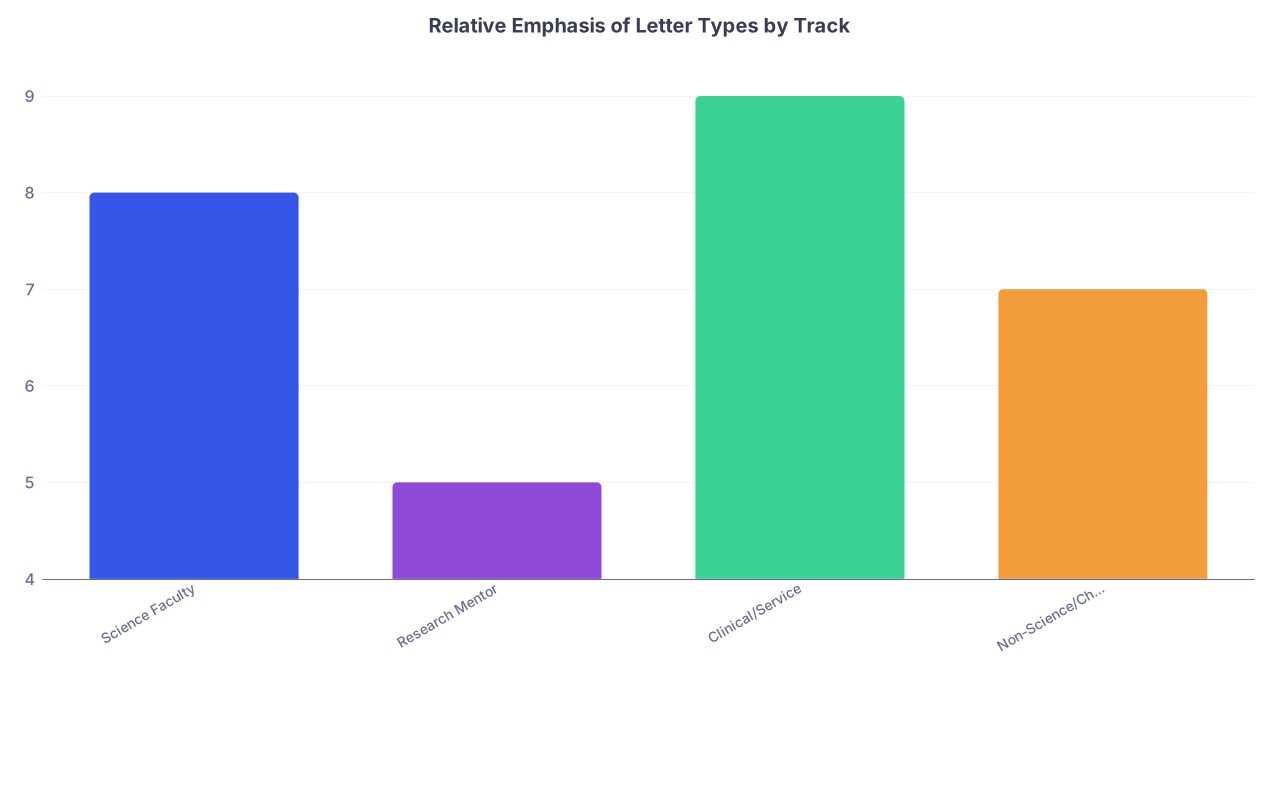
| Category | Value |
|---|---|
| Science Faculty | 8 |
| Research Mentor | 5 |
| Clinical/Service | 9 |
| Non-Science/Character | 7 |
For MD‑only programs:
- Prioritize at least:
- 1–2 science faculty
- 1 clinical/service
- Optionally, PI or research letter as academic reinforcement
For MD‑PhD programs:
- Prioritize:
- 1 PI letter (mandatory)
- 1 second research‑heavy or science faculty who can vouch for research potential
- 1 general academic/character letter (science faculty or committee letter)
Practical Example Portfolio
Let’s say you have:
- Dr. K (PI) – 2.5 years of bench research, poster, maybe a manuscript in prep
- Dr. C (course professor, cell biology) – knows you well from class and office hours
- Dr. P (physics professor) – very strong advocate, but only class‑based
- Ms. L (clinical volunteer coordinator in free clinic) – has seen you for 2 years
- Dr. R (summer research PI, 10 weeks, you did some coding/analysis)
Optimal grouping:
For MD‑PhD:
- Dr. K (PI) – non‑negotiable
- Dr. R (summer PI) – reinforces research, different environment
or - Dr. C (cell biology) – if she can speak to scientific reasoning, not just grades
For MD‑only:
- Dr. C (cell biology)
- Dr. P (physics)
- Ms. L (clinical/service)
- Optionally Dr. K if his letter also emphasizes your maturity and teamwork, not just lab output
You do not send all five to every school; you pick the 3–5 that best match what that program is actually screening for.
6. How Early You Need to Cultivate These Relationships
You cannot wake up in May of your application year and suddenly “get to know” a professor enough for a serious letter. That is how you get vague, padded letters that read like LinkedIn endorsements.
You need to work backwards.
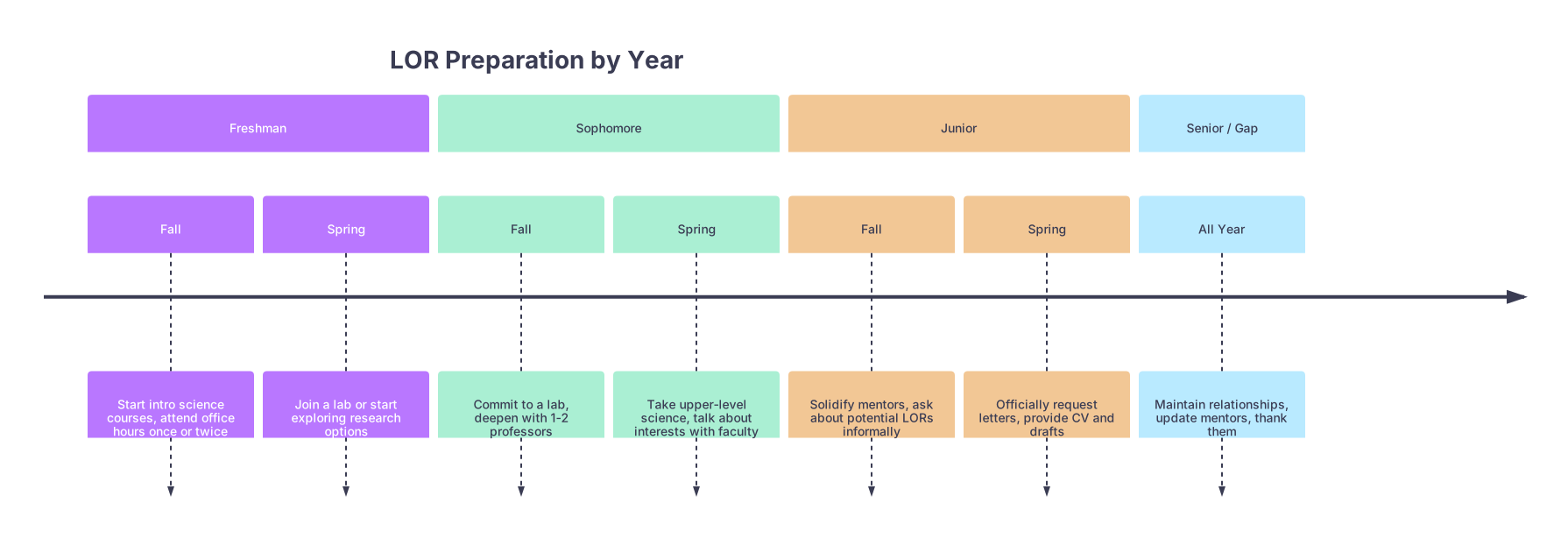
| Period | Event |
|---|---|
| Freshman - Fall | Start intro science courses, attend office hours once or twice |
| Freshman - Spring | Join a lab or start exploring research options |
| Sophomore - Fall | Commit to a lab, deepen with 1-2 professors |
| Sophomore - Spring | Take upper-level science, talk about interests with faculty |
| Junior - Fall | Solidify mentors, ask about potential LORs informally |
| Junior - Spring | Officially request letters, provide CV and drafts |
| Senior / Gap - All Year | Maintain relationships, update mentors, thank them |
Basic rules:
- At least 1 year in a lab before a strong PI letter.
- At least one full semester of real interaction with a professor before you ask; two is better.
- For clinical/service supervisors, 6–12 months of consistent presence.
The MD‑PhD route especially punishes “summer‑only” relationships as your primary research narrative. As a supplement, fine. As the core, not strong.
7. What Makes a Letter Strong vs. Useless: Content Details
Forget the template fluff (“To Whom It May Concern,” “I am pleased to recommend…”). Committees skim.
They are hunting for:
- Specific behaviors
- Comparative language
- Concrete outcomes
A strong letter for either track will contain:
- Clear context: how long, in what capacity they have known you
- Specific anecdotes:
- “When experiment X failed three times, they redesigned the protocol, checked literature, and rescued the project.”
- “Handled a difficult, non‑English speaking patient with calm and respectful communication, then debriefed insightfully afterwards.”
- Explicit comparisons:
- “Top 5% of undergraduates I have mentored in 15 years.”
- “Among the best two or three students in a class of 180.”
- Forward‑looking statements:
- “I expect them to thrive in an MD‑PhD program and eventually run an independent lab.”
Useless or actively harmful signals:
- Overemphasis on personality alone: “Nice, enthusiastic, polite.”
- Faint praise: “With more experience, may become an independent thinker.”
- Backhanded comments: “Sometimes needs direction but improves with feedback” – this reads very differently to committees than it does to you.
You cannot control every word, but you can choose mentors who have seen you in enough depth to write more than generic fluff.
8. How Much To “Coach” Your Letter Writers (Without Being Annoying)
You should not write your own letter. That is an ethical line and most serious mentors will refuse.
You should give your letter writers:
- Your CV / resume
- Draft of your personal statement
- A 1‑page “brag sheet” with:
- Projects you worked on with them
- Specific stories they might remember
- Your target programs and whether you are going MD, MD‑PhD, or both
For MD‑PhD letters in particular, explicitly tell your PI:
- “Programs care about whether you see me as a future independent investigator.”
- “If you feel comfortable, can you comment on my potential to succeed in a PhD program and handle independent work?”
Most faculty appreciate this clarity. They do not have time to mind‑read.
For MD letters:
- Ask clinical supervisors to comment on reliability, communication, professionalism.
- Ask science faculty to include comparisons to peers and evidence of resilience and curiosity.
If a potential writer seems hesitant or says something like, “I could write you a standard letter,” that is your cue to back away politely and choose someone else. A lukewarm letter is worse than no letter.
9. Special Situations and How To Handle Them
A. No Long‑Term PI yet, but You Want MD‑PhD
Risky, but not impossible if:
- You have substantial research through multiple structured programs (e.g., 2 full‑time summers, one during gap year) with strong supervisors who can each attest to your abilities.
- At least one of those mentors can honestly say: “I would take this person into my own PhD program.”
However, if all you have is:
- One 8‑week summer, no real ownership
- A course‑based lab with canned experiments
Then MD‑PhD this cycle is likely premature. Apply MD only, keep doing research, and reconsider MD‑PhD later (either as internal transfer or PhD later).
B. Committee Letter Systems
Many undergrad institutions produce a “committee letter” that packages individual letters together.
For MD‑PhD, two checks:
- Ensure your PI’s narrative is fully included, not lost in a summary.
- Make sure the committee letter itself emphasizes your research trajectory, not just GPA and service.
Ask your prehealth office directly:
- “For MD‑PhD programs, do you include full PI letters, or only excerpt them?”
- “Can my PI submit a standalone letter in addition to the committee packet?”
Often, MD‑PhD programs will accept both.
C. Non‑Traditional Applicants
If you have been out of school for several years:
- Prioritize recent supervisors:
- Research PIs (if you are in a lab now)
- Clinical job supervisors (scribing, MA work, nursing, etc.)
- You still want one academic letter if possible, but it can be older if it is strong.
For MD‑PhD, the recency of research letters matters more than the recency of classroom letters. A 3‑year‑old but detailed PI letter from your current lab beats a 1‑year‑old but generic letter from a random online course professor.
10. Quick Reality Check: What To Stop Worrying About
People stress about the wrong things:
Overrated:
- Prestige of the letter writer’s institution if they barely know you
- “Title inflation” – a dean who saw you twice is not better than a PI who knows you cold
- Perfect distribution of letters across categories for every single school
Crucial:
- Depth and specificity of each letter
- Having a true PI letter for MD‑PhD
- At least one person speaking credibly to your potential as a clinician (for MD and MD‑PhD) and one to your potential as a scientist (for MD‑PhD)
If a Nobel laureate writes: “I have only known the student for 8 weeks and they performed adequately,” that is worse than your mid‑career PI saying, “In 15 years, this is one of the three most promising undergraduates I have mentored.”
FAQs
1. If I am applying to both MD and MD‑PhD, do I need separate letters for each?
Usually no. You need a pool of strong letters that can serve both. The key is:
- At least one true PI/research mentor letter that clearly supports MD‑PhD potential.
- At least one science faculty academic letter.
- At least one clinical/service/character letter.
Then you assign letters strategically per school. You do not need “MD‑only” and “MD‑PhD‑only” letters in most cases, though some PIs explicitly mention MD‑PhD suitability, which is ideal.
2. Can a postdoc or graduate student write one of my main research letters?
Yes, but carefully. For MD‑PhD:
- Best: Letter is co‑signed or strongly endorsed by the PI.
- Acceptable: A senior postdoc who directly supervised you and has significant independence.
If your primary mentor is a postdoc, ask if they are comfortable writing the narrative and having the PI either co‑sign or submit a short supporting letter stating they fully endorse the assessment.
3. Is it a problem if my PI is not well‑known or from a small institution?
Not if the letter is strong and specific. Committees care far more about:
- Detailed description of your contributions
- Clear comparative statements
than about name recognition. A small‑school PI who has mentored many undergrads and can rank you very highly is often more persuasive than a big‑name PI who barely remembers you.
4. How many total letters is “too many”?
If a school allows 3–5 letters, sending 8 is not “thorough,” it is noise. Aim to:
- Hit the core categories (science, research, clinical/character)
- Use 3–5 of your strongest letters per school
You can keep a larger total pool in AMCAS, then assign selectively.
5. I only did one summer of research. Should I still apply MD‑PhD?
Usually not, unless:
- That summer was extremely intensive, you stayed on remotely, and your mentor genuinely sees you as PhD‑level material.
- You have additional research‑like experiences (e.g., substantive independent thesis work) with strong letters.
Most successful MD‑PhD applicants have at least 1–2 years of sustained research (including summers, academic year, or post‑bacc). Without that, your PI letter will almost always read thin.
6. Should I ever not use my PI letter if I worry it is lukewarm?
If you suspect your PI cannot or will not write a strong MD‑PhD‑level letter, you have two options:
- Have an honest conversation: “Do you feel you can strongly support my MD‑PhD application?” If there is hesitation, thank them and do not push.
- Consider delaying MD‑PhD applications and building a stronger research relationship elsewhere.
For MD‑only, a PI letter that is merely decent is not fatal. For MD‑PhD, a lukewarm PI letter can quietly kill your application.
Key points to walk away with:
- MD and MD‑PhD tracks use similar letter categories, but MD‑PhD absolutely requires a deep, specific PI letter that frames you as a future investigator.
- For dual applicants, build a flexible pool: science faculty, PI + second research letter, and a strong clinical/character letter, then assign strategically per program.
- Choose mentors who know you well and can be concrete. A detailed letter from a mid‑tier professor who has watched you struggle, adapt, and think is worth more than a brand name with nothing real to say.