
Most pre‑meds completely waste their side letters by picking the wrong people and asking for the wrong things.
Let me be blunt: if you are at a school that uses a pre‑med committee letter, your “side‑letter” strategy can quietly make or break your file at selective medical schools. The committee letter sets the baseline; your individual letters are what prove that baseline is real.
You are not picking “people who like you.” You are constructing corroborating evidence. Very different mindset.
I will walk you through how committee letters actually work on the back end, how med schools read them, and then exactly how to choose, deploy, and coordinate side‑letter writers so they add real, measurable value instead of just more noise.
1. How Committee Letters Really Work (And How Side Letters Fit In)
At most schools with a pre‑med committee, the committee letter is a synthetic document. It is not just “another LOR.” It is:
- A summary of your academic record and pre‑med trajectory
- An integration of comments from multiple faculty and advisors
- Often a quasi‑ranking of your strength as a candidate
Many committees do one of the following:
- Assign tiers (e.g., “recommend with highest enthusiasm,” “strongly recommend,” “recommend”)
- Embed coded language that programs at your school have learned to interpret
- Pull in quotes from your individual letters or internal evaluations
Then, med schools see:
- The committee letter
- Individual uploaded letters (your “side letters”)
- Sometimes an internal rating grid that your school sends along
Your side letters are not independent essays floating out in space. They are supporting exhibits. Think: your committee letter says “this student is a top 10% biology major leader with exceptional clinical maturity.” Your side letters should each prove one part of that.
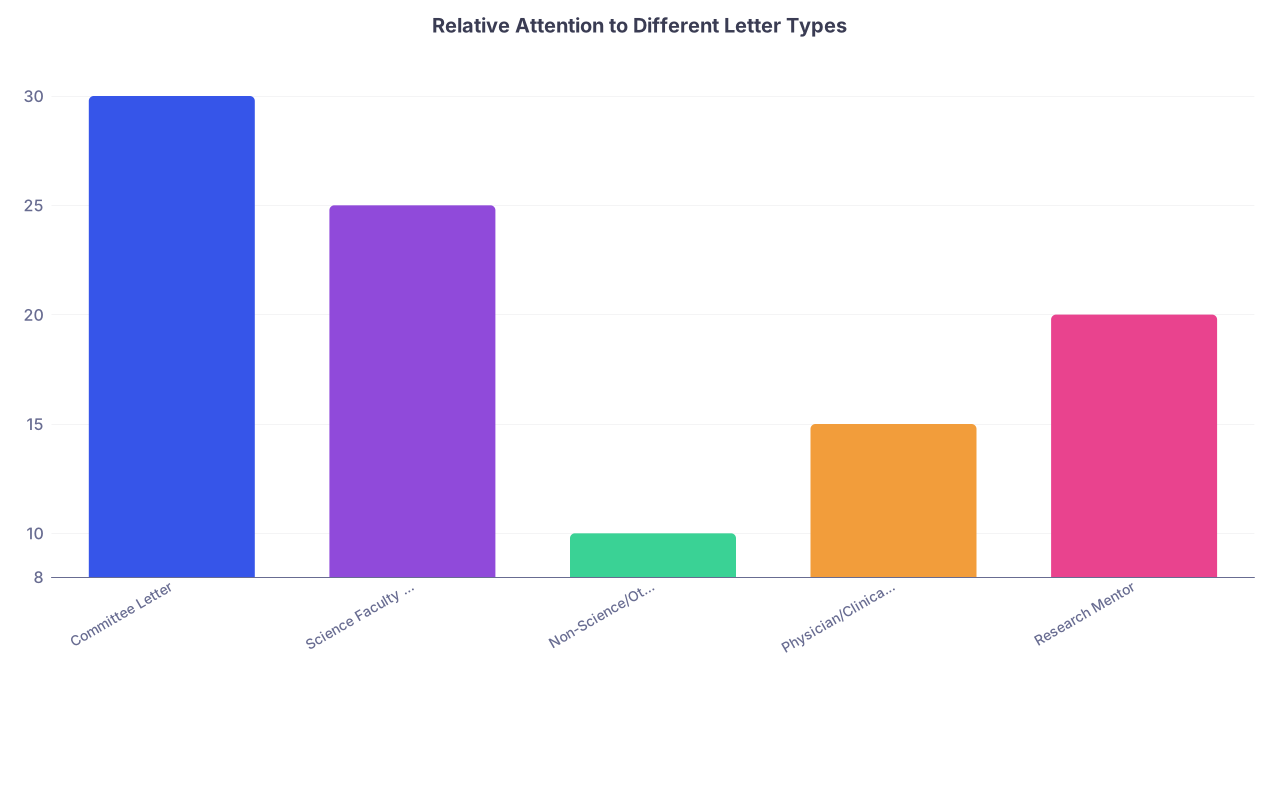
| Category | Value |
|---|---|
| Committee Letter | 30 |
| Science Faculty Letters | 25 |
| Non-Science/Other Faculty | 10 |
| Physician/Clinical Letters | 15 |
| Research Mentor | 20 |
Roughly how adcoms weight things (this varies, but the pattern is consistent):
- Committee letter: framing document
- Science faculty: academic rigor, comparability
- Research mentor: intellectual depth, reliability in serious settings
- Clinical/physician: bedside manner, professionalism, how you are with patients and teams
- Others (PI from non-science, employer, coach): character, work ethic, leadership
You want your committee letter plus side letters to:
- Cover all critical domains (academic, research, clinical, character)
- Avoid redundancy (“hard‑working, caring, bright” repeated 5 times is useless)
- Resolve potential concerns (slump, withdrawal, bad semester, later start to clinical work)
2. The Core Strategy: Decide What Each Letter Must Prove
Before you chase letter writers, you need a map. Not a wish list.
Forget the “I need X science, Y non‑science, Z physician” checkboxes for a moment. Start by writing down, very concretely, what you want your overall letter packet to demonstrate that the committee letter alone cannot fully prove.
Use categories like this:
- Pure academic firepower in hard science
- Intellectual maturity / curiosity / research ability
- Clinical readiness: reliability, composure, actual patient‑facing behavior
- Character: integrity, resilience, how you treat others, follow‑through
- Leadership / initiative beyond just padding the CV
Now, next to each category, list 1–2 people who have actually seen you do those things, in specific contexts.
Not “people who know my name.” People who:
- Have seen you handle difficulty
- Can compare you to serious peers
- Can tell at least one detailed, concrete story about you
If you cannot imagine what story they would tell, they are not an A‑tier letter writer for that domain.
3. Committee Letter First, Side Letters Second
Your committee will usually “collect” information from:
- An interview with you
- A questionnaire you complete
- Your transcript, CV, personal statement draft
- Sometimes confidential input from faculty at your institution
Then they generate the composite letter. Some offices:
- Ask you to pre‑select individual LORs that they then weave into the committee letter
- Allow “extra” letters to be sent directly to AMCAS/other services as side‑letters
- Mandate that all letters go through them (they then bundle them and send to AMCAS as a letter packet)
You need to understand your own office’s mechanics. The misunderstandings here are painful.
| School Model | How Letters Are Handled | Implication for Side Letters |
|---|---|---|
| Classic Composite | Committee drafts narrative and includes quotes from faculty | Choose faculty who know you deeply; their comments may be summarized rather than sent separately |
| Committee + Packet | Committee letter plus full individual letters sent as one packet | Strong opportunity: side letters can be highly targeted and still all get read |
| Committee Only | Only committee letter sent, no extras | You must feed the committee robust input and faculty contacts |
| Open Extras | Committee letter plus unlimited external letters | Self-control needed; more letters is not better; curate ruthlessly |
Call or email your pre‑health office and ask very specifically:
- “How many individual letters are typically sent along with the committee letter?”
- “Do you cap the number?”
- “Do you send them as a packet, or do they show up separately on AMCAS?”
- “If I add a letter later in the cycle (e.g., from a gap year PI), how is that handled?”
You design your side‑letter strategy based on those answers, not on Reddit rumors.
4. Who Should Write Side Letters: The Priority List
Let me break this down concretely.
4.1 The ideal core side‑letter mix
At most committee‑letter schools, a strong side‑letter set looks like:
- 1 strong upper‑division science faculty letter
- 1 research mentor / PI letter (if you have real research)
- 1 clinical supervisor / physician letter who actually saw you work
- Optional: 1 “other” mentor (non‑science faculty, long‑term employer, coach, service supervisor) if they know you extremely well
If your committee letter already incorporates quotes from some of these people, you may not need all four as separate uploads. But conceptually, these are the roles you want filled.
4.2 Ranking potential letter writers by impact
When you evaluate potential mentors, stop asking “Do they have a big title?” Wrong question.
Ask:
- How long and how closely has this person seen me work?
- In how many different contexts? (class, lab, clinic, leadership, crisis)
- Can they compare me to a meaningful peer group? (“top 5% of the 200 students I have taught in the past five years”)
- Will they remember me clearly when they sit down to write in June?
- Are they reasonably organized and responsive?
A superstar PI who barely interacted with you and cannot remember your project is worse than a mid‑career associate professor who supervised you week in, week out and saw you deal with failed experiments and revisions.
5. Building Mentor Relationships Before You Ask
Letters are not one‑off transactions. The best ones are the last step of a 6–18 month relationship.
I have seen this pattern so many times it is almost boring:
- Student drifts through a class, earns an A, rarely goes to office hours
- In April of junior year, they send a 5‑line email: “Can you write me a strong letter?”
- Faculty says yes, writes vaguely positive, generic, forgettable letter
- Student wonders why “strong” faculty letters did not help at top‑tier schools
Contrast that with the student who:
- Starts visiting office hours in the first 3–4 weeks
- Asks concrete questions, sends occasional follow‑up emails about course topics or related articles
- Offers to TA, help with problem sets, or support course projects next semester
- Keeps the professor updated on milestones (MCAT, major research milestones, major leadership roles)
By the time that student asks for a letter, the faculty member can see a narrative arc, not just a grade.
Same logic for research mentors and clinical supervisors.
6. Matching Letter Writer to Gap: Precision, Not Volume
Now we get practical.
6.1 Start from your perceived weaknesses
Look at your profile honestly:
- GPA strong but almost no research?
- Excellent research but a C+ in orgo and only one solid upper‑level science course?
- Tons of clinical hours but all as a volunteer with minimal responsibility?
- Later clinical start because of COVID, family illness, or athletics?
Your side‑letter choices should be guided by these gaps.
Examples:
- Weak sophomore grades in science, but strong junior/senior science: get an upper‑div science professor who will explicitly say you mastered challenging material later and are now functioning at a high level.
- Nontraditional student with heavy work responsibilities: get an employer who can speak to your reliability, stamina, and performance under stress.
- Research‑heavy applicant targeting MD/PhD or research‑intensive MD programs: get a PI who can talk about your capacity to operate at near‑graduate level in the lab.
6.2 Avoid redundant letter clusters
One of the most common mistakes: three nearly identical science letters.
- All of them: “Top student in my class, very engaged, excellent exam scores, always prepared.”
- None of them: “Here is a specific instance where they helped a struggling peer understand a concept. Here is the advanced reading they did beyond the syllabus. Here is the independent project they designed.”
If your committee office already insists on two science faculty letters, think hard before adding a third purely academic science letter. That third slot is often better used by:
- A clinical supervisor demonstrating patient‑facing behavior
- A PI giving depth on research
- A community service supervisor showing long‑term commitment with vulnerable populations
Your packet should feel like a 3D profile, not a photocopy set.
7. How to Approach Mentors for Side Letters (Scripts That Work)
Your ask must be direct and give them a graceful exit. And you need to frame the letter’s purpose in the context of the committee letter.
7.1 Email template you can adapt
Subject: Request for medical school recommendation letter
Professor [Name],
I hope you are well. I am applying to medical school in the upcoming 2025–2026 cycle and will be using our pre‑health committee letter.
Because the committee letter will provide a general overview, they’ve encouraged us to request individual “side letters” that can speak in more depth to specific aspects of our preparation. I immediately thought of you given [our work together in X / the past year in your lab / your supervision of me at Y clinic].
Would you feel comfortable writing a strong, detailed letter on my behalf focusing on [specific domain: my work in your advanced physiology course and how I grew as a student / my development as a researcher on the [project] / my reliability and patient interactions in clinic]?
If you are able to do this, I am happy to provide:
- A short bullet‑point summary of my work with you
- My CV and draft personal statement
- The committee’s guidance on letters and any forms they require
Letters would be due to the pre‑health office by [date]. I completely understand if your schedule will not allow it or if you feel someone else could comment in more depth. Either way, I appreciate your time and everything I’ve learned from working with you.
Best regards,
[Your Name]
[Major, Year]
Notice what this does:
- Links the request to the committee letter structure
- Specifies what you want them to highlight
- Gives an out (important; you want anyone unsure to decline)
- Signals that you will make their life easier with materials
8. What To Give Your Letter Writers (And What Not To)
Good mentors are busy. The difference between a tepid letter and a truly excellent one is often the quality of the packet you give them.
You should prepare:
- 1–2 page “brag sheet” tailored to that writer
- Updated CV
- Personal statement draft (or at least a 1‑page narrative if PS is not ready)
- Specific bullet points they might mention, including concrete anecdotes
8.1 The brag sheet should be specific, not generic
For a research mentor:
- Dates, hours/week, position title
- Projects you worked on, with concrete tasks you handled
- Any data you personally collected or analyses you ran
- Abstracts, posters, manuscripts (with your role)
- Specific challenges you faced and how you handled them
For a clinical supervisor:
- Roles and responsibilities you had (rooms patients, took vitals, pre‑charting, etc.)
- Examples of challenging patients or days, and what you did
- Any time you took initiative beyond the basic job description
For a professor:
- Which assignments you went beyond the minimum on
- Office hours discussions that stood out to you
- Any improvements over the term (from first to second exam, etc.)
What not to do: 5‑page life story with every club you ever joined. Most of that will get ignored. You want to make it easy for them to see you clearly in the context they knew you.
9. Coordinating With the Committee: Make the Packet Cohesive
You are not just managing up to letter writers; you are also managing sideways with the committee.
Schedule a real meeting (video or in‑person) with your pre‑health advisor and walk them through:
- Who you are asking for letters
- What each letter is intended to highlight
- Any red flags in your record that letters could help contextualize (poor semester, withdrawal, light clinical hours pre‑junior year, etc.)
Then ask directly:
- “Given my profile and your experience with our applicants, are there any gaps in my letter strategy?”
- “Are there any letter types that carry particular weight for our school’s applicants?”
Sometimes they will tell you things like:
- “Top programs really value long‑term PI letters from this institute.”
- “Admissions deans have said they put a lot of stock in letters from upper‑division lab instructors here.”
You want the committee and your side‑letter mentors rowing in the same direction.
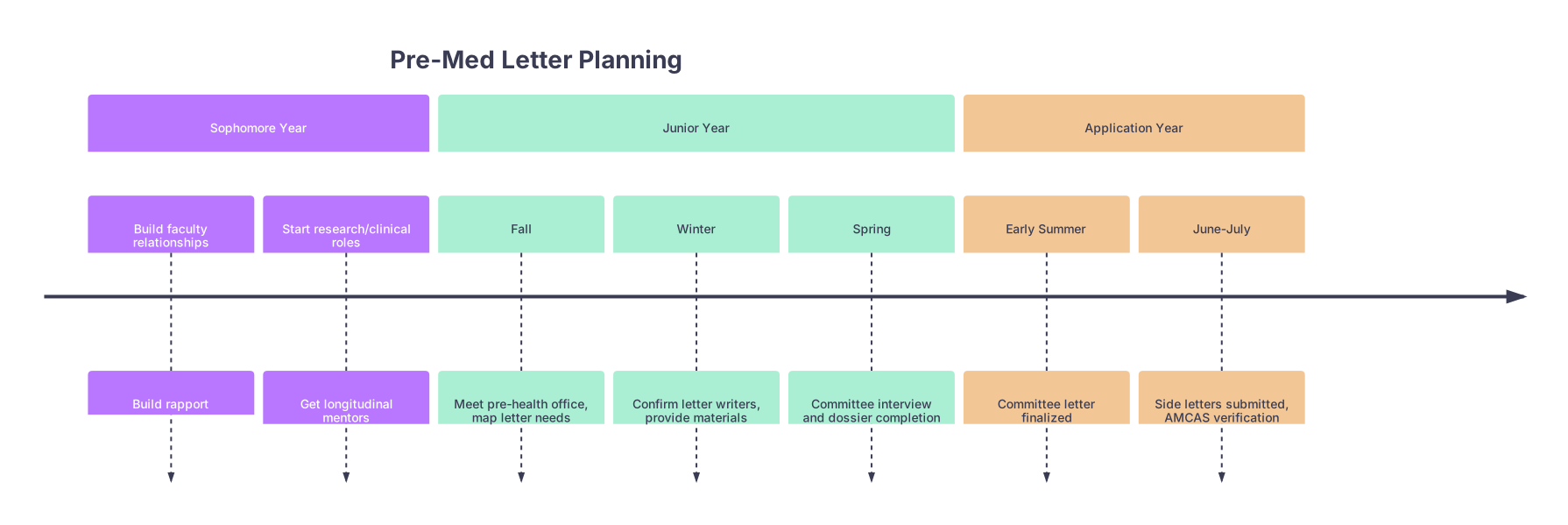
| Period | Event |
|---|---|
| Sophomore Year - Build faculty relationships | Build rapport |
| Sophomore Year - Start research/clinical roles | Get longitudinal mentors |
| Junior Year - Fall | Meet pre-health office, map letter needs |
| Junior Year - Winter | Confirm letter writers, provide materials |
| Junior Year - Spring | Committee interview and dossier completion |
| Application Year - Early Summer | Committee letter finalized |
| Application Year - June-July | Side letters submitted, AMCAS verification |
10. Special Situations: Nontraditional, Post‑bac, and Weak Committee Offices
Not everyone has a robust, well‑respected committee. Some of you have…let’s call them “minimalist operations.” Or you are post‑bac, DIY post‑bac, or several years out.
10.1 If your committee is weak or poorly regarded
You cannot fix the committee’s reputation. You can absolutely ensure your side letters are stellar.
Emphasize:
- Long‑term mentors who can vouch for you over 1–3 years
- Concrete, measurable progress (academic and professional)
- Clear explanation of any nonstandard paths
In your secondaries, you can sometimes use “academic difficulties” or “challenging circumstances” prompts to explain institutional limitations without trashing your school.
10.2 If you are post‑bac or nontraditional without a new committee
Then your “committee letter” is replaced by a well‑constructed set of individual letters. Your side‑letter logic is exactly the same; you just do not have a composite.
You want:
- 1–2 recent science faculty from your post‑bac or last 2 years of coursework
- 1 long‑term clinical supervisor or physician
- 1 recent research mentor (if research is a significant part of your story)
- 1 long‑term professional supervisor if you have been in the workforce for several years
Adcoms know how to read nontraditional files. They look harder at recency, context, and trend.
11. Common Pitfalls That Quietly Hurt You
Let me call out the stuff that actually causes problems in committee‑letter+side‑letter setups.
- Asking for letters from “famous” faculty who barely know you. The letter ends up 2 paragraphs long and 90 percent generic.
- Using physicians who only saw you shadow for a few afternoons. They cannot comment on anything that matters.
- Collecting 7–8 letters “just in case.” More letters often dilute impact and bore the reader. Four excellent letters beat eight mediocre ones every time.
- Never updating your letter writers. They end up writing as if you are still a junior, no mention of your senior thesis, MCAT, or leadership roles.
- Not waiving your right to see letters. Med schools notice. It signals distrust and makes readers question candor.
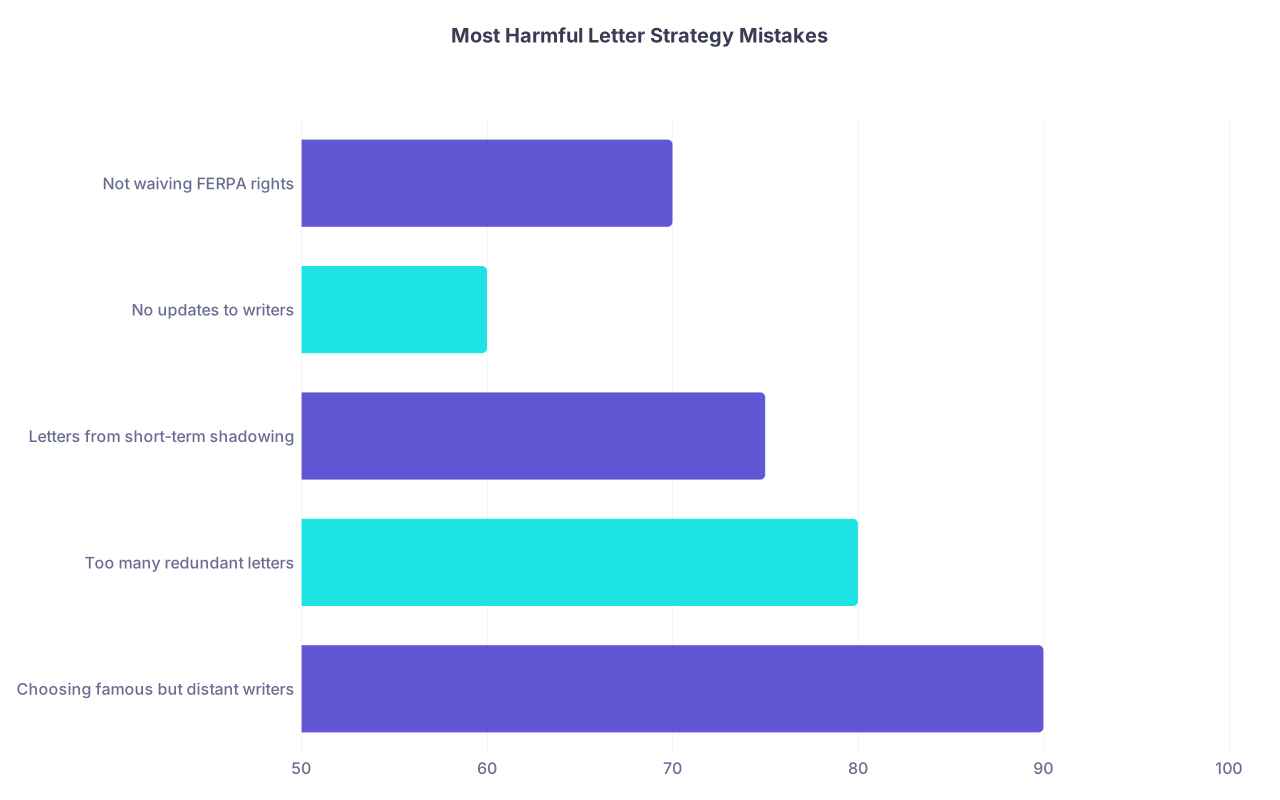
| Category | Value |
|---|---|
| Choosing famous but distant writers | 90 |
| Too many redundant letters | 80 |
| Letters from short-term shadowing | 75 |
| No updates to writers | 60 |
| Not waiving FERPA rights | 70 |
Those percentages are not real data, but they reflect how often I see each mistake blow up an otherwise strong file.
12. Final Checklist: Are Your Side Letters Adding Real Value?
Run through this quickly:
- Does each letter have a clear “job” (academic, research, clinical, character), or are you just collecting names?
- Can each writer tell at least one detailed story about you that no one else can tell?
- Have you given each of them a tailored brag sheet and enough lead time?
- Does your pre‑health office understand how these letters fit together so they can frame you correctly in the committee letter?
- Is there any major concern in your file that no one is addressing? If so, you need a letter that directly or indirectly addresses it.
If you cannot answer “yes” to almost all of those, you still have work to do.
FAQs
1. Should I ever turn down or avoid a committee letter and just use individual letters?
If your school offers a committee letter and med schools expect it from your institution, skipping it is usually a red flag. Programs will ask why. The only semi‑reasonable exceptions are very unusual circumstances with your office (hostile advisor, serious conflict, you graduated many years ago and the office no longer works with alumni). Even then, you should explain the situation clearly in secondaries or in an advisor letter. For 95 percent of students: use the committee letter and then optimize your side letters.
2. How many side letters is “ideal” with a committee letter?
For most applicants, 3–4 total individual letters alongside the committee letter is the sweet spot. That usually means: 1 science, 1 research or clinical, 1 “other” mentor, sometimes an extra if you have a genuinely distinct domain (varsity coach for a D1 athlete, long‑term employer, or major community service mentor). Once you get past 5, you are probably adding redundancy instead of value.
3. Is a letter from a non‑MD (PA, NP, RN, PhD psychologist) worth it?
If they supervised you closely in a clinical or research setting and can speak in detail about your work, yes, absolutely. Titles matter less than depth of observation. A PA who watched you care for patients every week for a year is far more valuable than a surgeon who saw you twice and barely remembers your name. You just need at least some letters (overall packet) that clearly show physicians and scientists vouching for you in contexts relevant to medicine.
4. Can I reuse the same letter for multiple cycles if I reapply?
You can, but you should not rely on an entirely stale letter set. At minimum, ask key mentors to update their letters with new observations, roles, and growth since your last cycle. Many committees will also update your composite letter. A file that looks frozen in time screams stagnation. The reapplicant who shows new responsibilities, deeper clinical work, or upgraded research roles—and has letters that back that up—is the one who gets a different result the second time.
Key points to remember:
- Your side letters exist to prove and deepen what the committee letter claims, not to duplicate it.
- Choose mentors based on depth of observation and specific stories they can tell, not fame or convenience.
- Coordinate deliberately with both writers and the committee so your overall packet feels like a cohesive, 3D portrait rather than a random pile of praise.