
Most reapplicants ask the wrong people to write the right letters. You need the right people to write the targeted letters.
You are not just “collecting” more letters this cycle. You are engineering a set of recommendations that directly attacks the weaknesses that got you screened out or waitlisted last time.
If you treated letters of recommendation like a checkbox on your first attempt, you cannot afford to repeat that mistake. Programs absolutely do read them. And for reapplicants, some committees go straight to the letters and the school’s previous summary of your file to see one thing:
Did this person understand what went wrong, and did they fix it with credible external validation?
Let me break this down specifically.
Step 1: Diagnose Your Prior File Like an Adcom Would
Before you chase new mentors, you need a precise diagnosis. “My app was probably weak overall” is useless. You want a problem list.
Here is how to do that like a grown-up applicant, not a confused second‑timer.
Collect everything:
- Prior AMCAS/AACOMAS application PDFs
- Secondary essays (especially “Why our school?” and adversity questions)
- School-specific feedback, if any (post-rejection or waitlist emails, advisor summaries)
- Interview notes, if you got that far (including questions that seemed to target concerns)
Label your weaknesses into buckets. Most reapplicants fall into some combination of:
- Academic performance concerns
- MCAT inconsistency or low subscore profile
- Limited or shallow clinical exposure
- Weak or performative service commitment
- Thin or unfocused research
- Questionable professionalism / maturity / judgment
- Lack of sustained leadership or initiative
- Letters that were generic or misaligned with your narrative
Then sharpen it one more level. For example:
Not: “My GPA was low”
But: “Upward trend only in last 30 credits; science rigor questioned; needed evidence of performance in upper‑division biology with lab.”
Not: “I did not have enough clinical hours”
But: “Had 80 shadowing hours, but no longitudinal, patient-facing volunteer or employment; unclear if I can handle emotionally difficult patient interactions.”
This framing matters, because your new mentors must be chosen to contradict the exact doubts that committees had last cycle.
You are not just looking for “strong supporters”. You are looking for targeted validators.
Step 2: Map Weaknesses to the Type of Mentor You Need
You do not fix an academic reputation problem with another non-science volunteer letter. You fix it with someone who teaches or supervises you in the exact domain of concern and has credibility there.
Here is the matching logic most applicants never explicitly think through:
| Prior Weakness | Ideal New Mentor Type |
|---|---|
| Low or inconsistent science GPA | Upper‑division science course professor |
| [Postbac/SMP performance needs validation](https://residencyadvisor.com/resources/letters-of-recommendation/letters-after-smp-or-postbacc-which-faculty-voices-carry-the-most-weight) | Program director or core science instructor |
| Thin clinical exposure | Physician supervisor or clinical coordinator |
| Weak service/commitment to underserved | Nonprofit director or long-term volunteer lead |
| Disorganized during internship/EC | Direct supervisor in structured role |
| Questioned professionalism/maturity | Supervisor who saw you handle conflict/stress |
Now I will walk through how the mapping actually plays out in real scenarios I have seen.
1. Academic / Science Performance Concerns
If schools doubted your ability to handle medical school coursework, you need:
A letter from someone who:
- Taught you a rigorous science course (upper-level bio, biochem, physiology, heavy lab, or hard quantitative course like physical chemistry)
- Has objective evidence: your exam scores, major assignment performance, and comparison to peers
- Is known (at least internally) as a tough but fair evaluator
And that letter must explicitly:
- Reference your past academic struggles (briefly, not an essay on your trauma)
- Describe your specific improvement: study habits, consistency, exam performance
- Compare you favorably to peers who have succeeded in professional programs
If you did a postbac or SMP because of prior GPA issues, your primary target mentor is:
- The program director or a core faculty member who:
- Saw you in multiple courses, or
- Oversaw the program and knows relative ranking of students
A generic: “X worked very hard and was a pleasure to have in class” letter from an easy A humanities seminar will not fix a 3.1 BCPM.
2. MCAT / Cognitive Doubts
You cannot fix an MCAT score with a letter. But you can soften the cognitive doubt with:
- A professor in a content-heavy or test-heavy course who can say:
- You consistently performed at a high level on challenging exams
- You improved meaningfully over time with feedback
- You handle dense material under time pressure
This does not magically turn a 506 into a 520. It does, however, change the narrative from “ceiling issue” to “test-day underperformance despite strong coursework performance.”
3. Clinical Exposure and Patient Care
If your last cycle screamed: “Observational but not immersed,” you need mentors who have:
- Directly watched you interact with patients or families
- Trusted you with graduated responsibility over time
- Seen you on good and bad days, not just curated hours
That usually means:
- Charge nurse who oversees volunteers or scribes
- Lead MA or clinic manager who supervises your workflow
- Physician who:
- Actually worked with you (scribe, MA, research assistant with clinical interface)
- Can credibly describe your bedside manner, reliability, and response to difficult scenarios
A cold email to a shadowing doc you followed for 8 hours three years ago is not a solution. That is desperation.
4. Service / Commitment to Underserved Populations
If your original file looked like “hours in random one-off events,” especially if your personal statement screamed “service,” you need:
- A letter from someone embedded in the service context:
- Director or coordinator of a free clinic
- Nonprofit supervisor
- Shelter manager
- Long-term tutoring or mentoring program coordinator
And they must be able to say:
- You showed up consistently for months to years, not weeks
- You handled uncomfortable, messy tasks without complaining
- You interacted with people that most premeds avoid and did not treat the work like a photo-op
5. Professionalism, Maturity, and Reliability
If you had any of the following:
- Inconsistent employment history
- Reported professionalism incident
- Strange interview feedback (e.g., evasive, vaguely entitled, overly defensive)
Then your best new mentors are:
Supervisors in structured environments:
- Clinical job supervisors
- Lab managers
- Work supervisors outside medicine (restaurant, retail, logistics) if they genuinely evaluated your reliability under pressure
People who can say:
- You show up on time. Every time.
- You receive critical feedback without collapsing or arguing
- You own mistakes and correct them
Programs care much more about this for reapplicants. They assume academic data is already known; they are trying to figure out if you fixed the “grown-up” side of things.
Step 3: Decide Who Needs to Be Replaced vs Augmented
Reapplicants often cling to old letter writers out of loyalty. Sometimes that is fine. Sometimes it hurts you.
You classify old letter writers as:
- Keep as-is
- Keep but demote (optional / extra letter)
- Replace entirely
Use this test:
Did the letter writer actually know you well?
- If you were one of 300 students in Gen Chem and never visited office hours, that letter was generic at best. Replace.
Did their domain match your story?
- If your entire application screamed “future physician-scientist,” and your strongest letter was from a philosophy TA, you need to rebalance.
Are they still the best representative of your current self?
- If you have since done an SMP, heavy clinical work, or serious research, old letters from 3+ years ago usually should be background, not the main show.
For many reapplicants, the correct move is:
- Keep one legacy letter that was strong and domain-appropriate
- Add 2–3 new letters directly tied to what you fixed since last cycle
You are demonstrating change over time. A new cast of evaluators who have seen your evolution is incredibly persuasive.
Step 4: Selecting New Mentors with Surgical Precision
Now we get tactical. You know the domains you must rehabilitate. Who exactly should you target, and how do you evaluate whether they are capable of writing the right kind of letter?
Non-negotiable qualities in new mentors
The mentor you pick to patch a weakness must:
Have observed you enough to comment on:
- Specific behaviors
- Growth over time
- Comparative performance vs peers
Understand what a medical school letter requires:
- Some non-academic supervisors write job references, not admissions letters. You want people who can comment on judgment, ethics, emotional resilience, not just “good worker.”
Be willing to go beyond generic praise:
- “Hardworking, punctual, team player” is baseline. You want narrative, not cliché.
Have some clout in their setting:
- Department chairs, course directors, principal investigators, program coordinators, and long-term supervisors carry more weight than someone who met you twice.
Where to find these mentors (strategically)
If your weaknesses are predominantly:
Academic → Prioritize:
- Postbac/SMP faculty
- Upper-division science faculty with small class sizes
- Lab PIs who directly supervised your work and saw your analytic ability
Clinical → Prioritize:
- Paid roles (scribe, MA, CNA, EMT) where someone supervised your reliability
- Clinic coordinators who see volunteer consistency
- Physicians in small clinics who truly observe your patient interactions
Service / leadership → Prioritize:
- Programs where you held a defined role or leadership position
- Long-term (≥ 6–12 months) involvements
You should be building these relationships months before you ask for a letter. If you start thinking about this three weeks before AMCAS opens, you will get generic content, because that is all the writer can honestly provide.
Step 5: Frame the Ask for Reapplicants – You Must Name the Weakness
Most applicants are too vague when they ask for letters. Reapplicants cannot afford that.
When you approach a potential mentor, your script needs three parts:
Clear context:
- “I am reapplying to medical school this coming cycle. In reviewing my previous application and discussing feedback with advisors, the main concerns were X and Y.”
Specific reason you chose them:
- “I believe your course/our work together in [specific setting] speaks directly to those areas, especially my ability to handle rigorous science and to grow from prior academic struggles.”
Direct, professional ask:
- “Would you feel comfortable writing a strong and detailed letter of recommendation that addresses these aspects of my candidacy?”
Do not be afraid to say the word “strong”. Weak letter writers appreciate the escape hatch and will say no. You want them to say no.
Once they agree, you give them a tight, structured packet:
- Updated CV or activities summary
- Brief “prior application” snapshot:
- Old stats (GPA/MCAT range; no need for obsessive detail)
- What you have done since (with concrete changes: new coursework, jobs, responsibilities)
- One-page “Talking points that would help strengthen my reapplication,” tailored to that specific mentor’s domain
You are not scripting the letter. You are helping them aim.
Step 6: Aligning Letters with the Rest of Your Reapplicant Narrative
Your letters cannot exist in a vacuum. They have to match what you claim in your personal statement and secondary essays.
Here is the consistency checklist:
If you say:
- “The main difference in this application is that I have proven I can excel in rigorous science courses,”
then you must have: - A recent transcript reflecting that
- A professor letter that explicitly confirms it
- “The main difference in this application is that I have proven I can excel in rigorous science courses,”
If you say:
- “I have moved from passive shadowing to sustained, hands-on clinical involvement,”
then you must have: - Longitudinal clinical activity on your activities list
- A clinical supervisor letter describing your growth in responsibility and comfort with patients
- “I have moved from passive shadowing to sustained, hands-on clinical involvement,”
If you say:
- “I have worked on my professionalism and ability to accept feedback,”
then you must have: - A supervisor letter that mentions specific moments of receiving feedback and adjusting behavior
- “I have worked on my professionalism and ability to accept feedback,”
You are trying to present a coherent story:
“We saw these issues last time. I understood them. I did specific work to address them. Here is third-party evidence from targeted mentors confirming real change.”
To visualize how letters should align with your major “growth areas,” think of it like this:
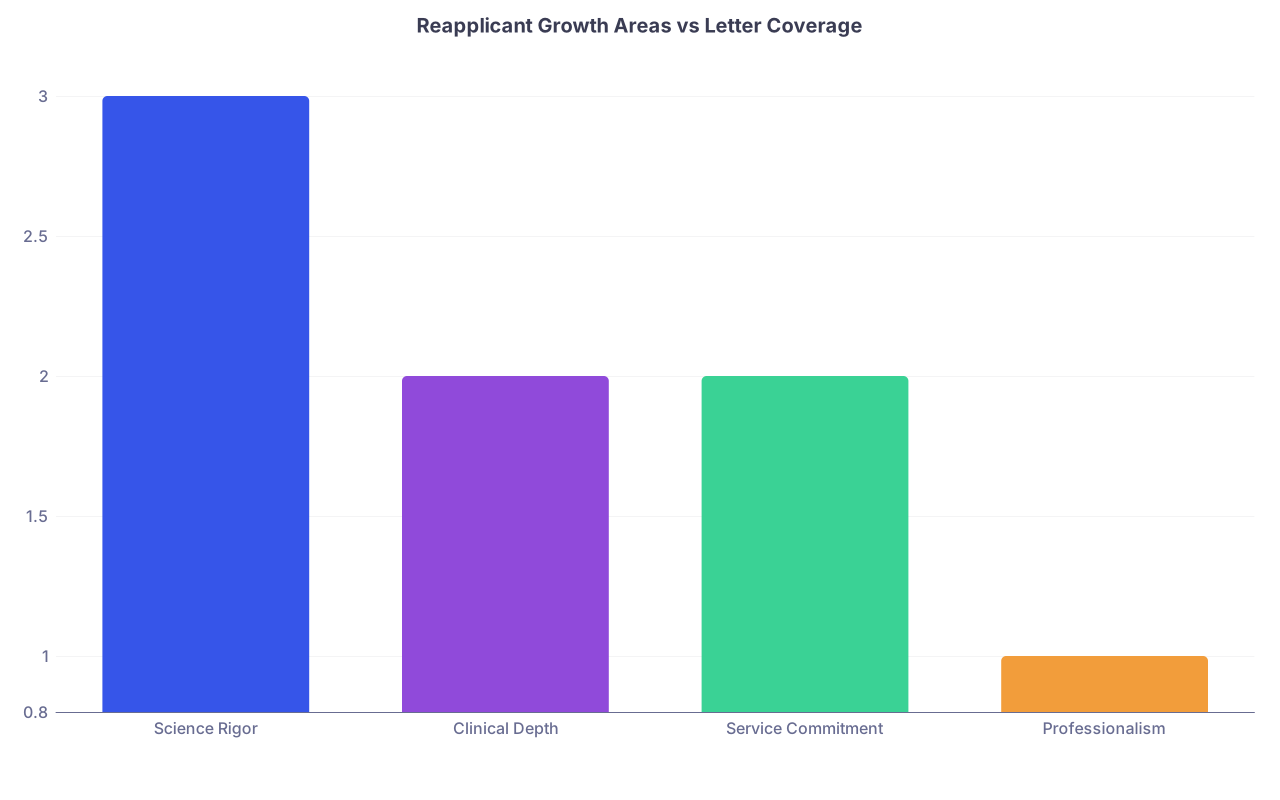
| Category | Value |
|---|---|
| Science Rigor | 3 |
| Clinical Depth | 2 |
| Service Commitment | 2 |
| Professionalism | 1 |
In that simple framework, you want each major growth area backed by at least one strong letter, and your primary growth area usually by two.
Step 7: Timing and Logistics – Avoid the Common Traps
Some straightforward but often ignored logistics that hurt reapplicants:
Letters must be recent and reflective of your growth period.
- If your biggest change was in the last 18–24 months, a letter entirely based on experiences from 4–5 years ago undercuts the reapplication narrative.
Space your experiences so mentors actually see your evolution.
- If you join a new lab in February and ask for a letter in April, do not expect depth. For major file weaknesses, you want mentors who have known you for at least one full semester or ~6 months of consistent work.
Use letter services wisely.
- Interfolio or your institutional letter service can store old letters, but do not just “recycle” your previous exact letter set unless:
- It was already strong
- Your main changes are elsewhere (e.g., MCAT)
- You are adding new, targeted letters on top
- Interfolio or your institutional letter service can store old letters, but do not just “recycle” your previous exact letter set unless:
For committee letters:
- If your school offers an updated committee letter for reapplicants, meet with your prehealth office early and make sure:
- They are aware of your prior weaknesses
- They know about the new mentors you are adding
- They can integrate that into a revised committee narrative
- If your school offers an updated committee letter for reapplicants, meet with your prehealth office early and make sure:
Step 8: Red Flags and Mistakes I See Reapplicants Make
Let me be blunt about what does not work.
Asking for “character letters” without domain relevance
- Your old high school teacher who loves you is not the best person to validate your readiness for medical school unless they supervised a unique, long-running project that is clearly still relevant.
Choosing “big-name” faculty who barely know you
- A generic letter from a chair who cannot spell your name without looking at the roster is worse than a rich letter from the less famous lecturer who saw you grind through a brutal semester.
Hiding your reapplicant status from mentors
- If you do not tell them you are reapplying and what went wrong last cycle, they will not address it. And adcoms can smell when letters are copy-paste generic.
Overloading on one category
- Four science letters and zero clinical/supervisor letters when your main deficit was “limited patient contact” is misaligned. Balanced does not mean symmetric; it means strategic.
Not checking institutional letter caps
- Some schools cap letters they will read (e.g., “Committee letter + 3 individuals” or “Max 5 letters”). If you send 10, some will never be opened. You must decide which letters speak most directly to your rehabilitated weaknesses.
A Simple Framework to Sanity-Check Your New Mentor Set
Before you lock in your list, ask yourself:
- If I were an adcom reading my prior file’s concern list, would my new letters convincingly respond to each major doubt?
- For each key growth claim I make in my personal statement, can I point to at least one letter that backs it up?
- Are my letter writers recent, specific, and positioned to comment with authority?
If the answer is no to any of those, you are not done with mentor selection yet.
To see the overall flow of what you should be doing as a reapplicant with respect to mentors and letters, here is a clean outline:

| Step | Description |
|---|---|
| Step 1 | Review Prior Application |
| Step 2 | Identify Key Weaknesses |
| Step 3 | Map Weaknesses to Mentor Types |
| Step 4 | Engage in Targeted Experiences |
| Step 5 | Build Relationships with Supervisors |
| Step 6 | Request Letters with Clear Context |
| Step 7 | Align Letters with New Narrative |
| Step 8 | Submit Updated Application |
That is the process. Most reapplicants try to jump from A to F. Then wonder why nothing changed.
FAQ (Exactly 6 Questions)
1. Should I reuse any of my old letters as a reapplicant, or start completely fresh?
Reuse a letter only if three conditions are met: it was strong and specific, the writer still represents an important domain of your application (for example, a core science professor or PI), and the letter is not badly outdated relative to your major growth period. For many reapplicants, keeping 1–2 high-quality legacy letters and adding 2–3 new, targeted letters is ideal. If the old letters were generic or misaligned with your weaknesses, replace them.
2. How recent do my new letters need to be for a reapplication?
For a reapplicant, recency is less about the calendar and more about whether the letter captures who you have become since your last cycle. If your major improvements are in the last 18–24 months, your most important letters should come from that time frame: recent coursework, new clinical work, or service roles. A stellar letter from four years ago that does not reflect your current growth is auxiliary, not core.
3. What if my best new mentor is not in science or medicine (for example, a job supervisor)?
That can be an asset if it addresses a real prior weakness, such as professionalism, maturity, reliability, or handling stress. A non-medical supervisor who has seen you manage conflict, show up consistently, and take responsibility can write a powerful letter. You still need appropriate academic and clinical letters, but one well-chosen non-medical supervisor can strongly support your reapplicant narrative.
4. How do I avoid getting a generic letter from a professor in a big course?
You avoid it by not being anonymous. That means office hours, active participation, meaningful email exchanges, and, ideally, a semester-long pattern of engagement. If the course is already over and you were just a face in the crowd, you are usually better off investing in a smaller, more interactive course or postbac/SMP environment where you can build a real relationship, rather than chasing a lukewarm letter from a high-profile name.
5. Is it appropriate to tell a mentor exactly what weaknesses I am trying to address?
Yes. In fact, for reapplicants, it is necessary. You should succinctly explain that you are reapplying, what feedback or concerns likely limited you last cycle, and why you believe their perspective can speak directly to those gaps. Then provide a short list of suggested focus areas. Strong mentors appreciate the clarity and will still write in their own voice. You are guiding aim, not dictating content.
6. What if a mentor hesitates when I ask for a “strong and detailed” letter?
Take that hesitation seriously. If they respond with, “I can write you a letter, but it may be more general,” or seem lukewarm, you should not use them as a primary recommender. That usually signals limited familiarity or reservations about your performance. Better to thank them and pivot to someone who has both the material and the enthusiasm to advocate for you. A mediocre letter is not neutral for a reapplicant; it can reinforce doubts you are trying to dispel.
Key points:
You are not just collecting more letters; you are deliberately recruiting mentors whose credibility lives exactly in the domains where your prior file was questioned. And you are not hiding your reapplicant status from them; you are naming your weaknesses so they can frame your growth. Done correctly, your new letters will not just “support” your application. They will argue that the version of you applying now is a fundamentally stronger, better‑documented candidate than the one schools saw last cycle.