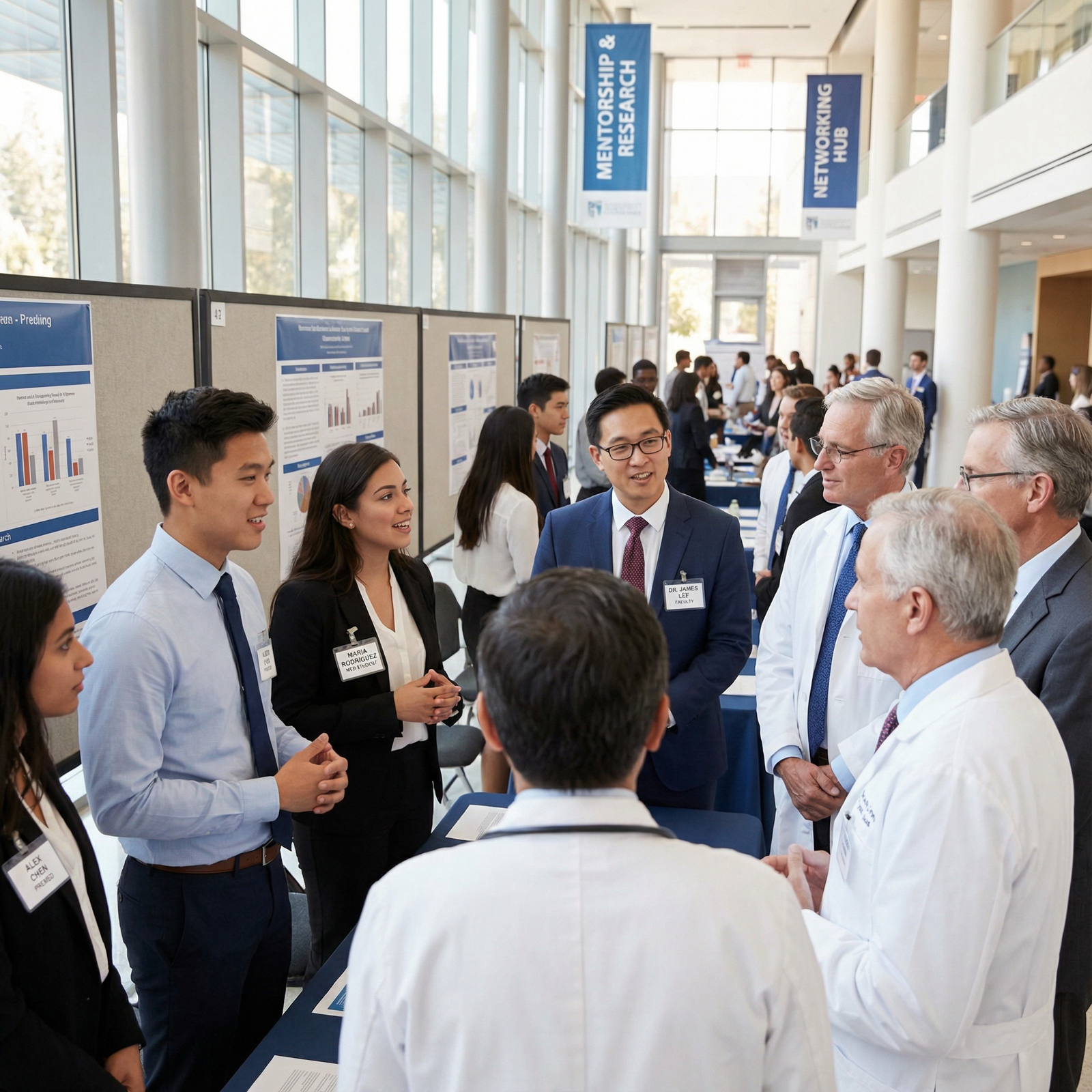
You are standing in the hospital parking lot after another shadowing shift. You watched a couple of interesting cases, the attending nodded at you once or twice, maybe even let you listen to a heart murmur. But now you are in your car thinking: “If I asked this physician for a letter of recommendation, would they even remember my name?”
That is the problem.
Most premeds “collect” shadowing like baseball cards. Twenty hours here. Ten hours there. A week-long experience over winter break. Then they are shocked when:
- Nobody knows them well enough to write a strong letter.
- The letters they do get are vague, generic, and basically useless.
- Their application looks “fine on paper” but lacks voices that actually advocate for them.
You do not need more shadowing. You need to turn your existing (or upcoming) experiences into relationships. Relationships that produce sponsors, not spectators. People who will fight for you in their letters, not just confirm you existed.
Here is how you fix that.
Step 1: Stop “Drive‑By” Shadowing
The first correction is mindset: shadowing is not a checkbox. It is a long interview for a future letter.
Most students do shadowing like this:
- Email a bunch of doctors.
- Get 8–20 hours total with each.
- Stand silently in the corner.
- Say “thank you” at the end.
- Disappear.
Then, a year later, send an email: “Dear Dr. X, I shadowed you last summer and was wondering if you could write me a letter of recommendation…”
That is how you get a four-sentence letter that admissions committees skim and forget.
You want this instead: a physician who knows how you think, how you show up, and what you care about. A sponsor.
To do that, you need to:
Choose depth over breadth.
It is better to have:- 1–2 physicians who know you well
than - 8 physicians who vaguely recognize your face.
- 1–2 physicians who know you well
Commit to continuity.
Aim for:- At least 30–50 hours with a single physician or team, ideally spread over multiple weeks.
- Regular, predictable presence (e.g., every Tuesday afternoon for 8–10 weeks).
Pick the right environments.
Better for relationship-building:- Outpatient clinics with recurring patients.
- Longitudinal preceptorships.
- Hospital services where you can show up repeatedly (e.g., same ward, same team).
Worse for relationship-building:
- One-day OR marathons with rotating surgeons.
- Massive teaching rounds with 15 students, 10 residents, and 4 attendings.
- “Shadow one random doctor each day” programs with zero continuity.
If you already did fragmented shadowing, fine. Do not panic. Start now with one or two sustained experiences. Those are your letter targets. The rest are “exposure,” not “advocacy.”
Step 2: Behave Like a Future Colleague, Not a Tourist
You are not there to gawk. You are there to quietly audition.
What impresses physicians is not that you know every metabolic pathway. They barely remember most of them. They care about how you function around patients and a team.
Here is the basic behavior standard if you want someone to sponsor you:
Be absurdly reliable.
- Show up early. Every time.
- Confirm the schedule by email the day before.
- If you are sick or delayed, notify them as early as possible with a short, professional message.
Look like you belong.
- Conservative, clean, pressed clothes.
- Closed-toe shoes. No perfume. Minimal jewelry.
- Hospital-appropriate demeanor: calm, attentive, not hyper.
Engage without being needy. During patient care:
- Do not interrupt.
- Watch their body language; if they are in “rush mode,” be invisible.
- If there is downtime, that is when to ask 1–2 thoughtful questions.
Good questions:
- “What was your thought process when you chose X over Y for that patient?”
- “For someone at my stage, what would you recommend I read about what we saw today?”
- “I noticed you spent extra time explaining the diagnosis to that patient—was that because of X?”
Bad questions:
- “What’s your salary?”
- “Is this going to be on the MCAT?”
- Anything that sounds like you want a shortcut or an advantage.
Take notes. Seriously. Carry a small notebook (yes, paper) or use a discreet phone note after clinic:
- Interesting cases.
- Questions you want to look up.
- Things you noticed about how they talk to patients.
- Specific moments where you contributed or learned something.
Those notes will be gold later when you ask for a letter and need to remind them what they saw in you.
Step 3: Make Yourself Useful (Within Limits)
You are an observer. But that does not mean you need to be dead weight.
No, you cannot take histories independently or write notes without explicit permission and oversight. But there are plenty of ways to stand out as the rare premed who actually contributes to the clinic or team.
Things that are usually acceptable (ask first, obviously):
- Room preparation: Straighten up after the patient leaves, wipe down exam tables if appropriate, reset chairs.
- Logistics: Help move charts, bring forms, grab educational handouts, restock gloves or wipes.
- Patient comfort: Offer patients water (if allowed), help them find the restroom, hand them a blanket, adjust the chair.
What this signals to the physician:
- You see needs without being told.
- You understand that medicine is work, not just intellectual entertainment.
- You are comfortable serving, not just “observing.”
I have seen attendings remember the premed who quietly wiped down exam tables between patients more than the one who asked the “smartest” pharmacology question.
You are training them to see you as a future team member. Not a high school tour group.
Step 4: Turn Shadowing into Ongoing Mentorship
You will not get a strong letter from someone who only knows you in a white coat, following 3 feet behind them in silence.
You need to become a person to them. With a story, goals, and progress they can comment on.
Here is a basic “relationship-building” protocol that works:
Early in the experience (first or second day):
- After clinic (not during the chaos), ask:
- “Would it be alright if I asked you a few questions about your career path and what you think premeds often misunderstand about medicine?”
- Keep it short. 10–15 minutes. They are tired.
- After clinic (not during the chaos), ask:
Share a brief, clear version of your story. No life saga. Just:
- Where you are in training (e.g., sophomore, post-bac).
- Why medicine, in a sentence or two that is not cliché.
- Any particular interests (primary care, underserved, surgery, do not over-promise).
Example:
- “I am a junior at [School]. I originally got interested in medicine after translating for my grandparents at their appointments. I am especially interested in how primary care can work better for immigrant families.”
Ask for advice that invites investment, not flattery. Instead of, “What do you think of my application?”
Try:- “Based on what you see from students, what do you think distinguishes the ones who do well in medical school from those who struggle?”
- “If you were in my shoes, how would you use the next 1–2 years before applying?”
Follow up on their advice. This is where most students fail. The physician says:
- “You should try to get some longitudinal clinical experience, maybe in a free clinic,”
and the student nods and never mentions it again.
Your move:
- A month later: “You suggested I look for longitudinal clinical work. I started volunteering at X clinic every Saturday. It has been eye-opening especially around [specific thing].”
- “You should try to get some longitudinal clinical experience, maybe in a free clinic,”
That follow-through builds a narrative. Shows growth over time. That is exactly what you want someone to write about in a letter.
Step 5: Expand Beyond Shadowing When Possible
The strongest letters rarely come from pure shadowing alone. They come when you cross the line from observer to contributor in a concrete project.
If you have a physician who is even mildly interested in teaching, there are usually ways to expand your role.
Here are options to raise the relationship from “shadowing” to “sponsorship territory”:
Quality improvement or small research project.
- Ask: “Are there any small projects in clinic or your practice where a student could help collect data or organize something?”
- Examples:
- Tracking no-show rates and helping test a reminder system.
- Creating a patient education handout and informally evaluating its use.
- Retrospective chart review if IRB allows and they are active in research.
Repeat/longitudinal experiences.
- Return to the same clinic each semester.
- Show that you choose continuity with them over random new opportunities.
Teach-back and prep.
- Ask: “Would it help if I drafted a brief summary of what I am seeing each week for your students or for myself?”
- Then send a 1-page “this week I learned X about Y” email. Short, thoughtful, concrete.
If they say no or seem uninterested, do not push. You do not need a project with everyone. Just recognize that these “extra” layers create the stories that lead to persuasive letters.
Step 6: Know What a Strong Letter Actually Looks Like
You cannot convert someone into a sponsor if you do not even know what you are aiming for.
A strong letter of recommendation for premed or early medical school stages has a few recognizable features:
Specificity.
Not: “She is hard-working and caring.” Everyone writes that.
Instead: “Over six months, Alex arrived early to every clinic, often setting up rooms before the medical assistant. He noticed when a patient was anxious before a biopsy and took the initiative to bring a warm blanket and quietly explain what would happen next.”Comparisons.
- “Among the premedical students I have worked with in the last 10 years, he ranks in the top 5% in maturity and insight.”
- “Compared to the average third-year medical student, she already demonstrates…”
Context and duration.
- How long they have known you.
- In what capacity (shadowing, project, volunteer, class).
- How frequently they worked with you.
Clear endorsement.
- “I give her my highest recommendation for medical school.”
- “I would be delighted to have him as a medical student or resident on my team.”
Your job is to create the raw material that makes those statements honest. Consistency. Noticeable acts. Growth over months, not hours.
Step 7: Ask for the Letter the Right Way (And at the Right Time)
This is the part most people butcher. They wait too long, ask too vaguely, or give the writer nothing to work with.
Here is the protocol that works.
A. Time it correctly
Ideal timing:
- After you have spent substantial time with them (30+ hours over multiple weeks at minimum).
- Before the chaos of application crunch (for premed, late spring before you submit primaries is often ideal).
- While they have fresh memories of you actually being there.
Do not wait a year and then cold-email.
B. Ask for a strong letter, not “a” letter
Yes, you use the word “strong.” That gives them an honorable escape hatch if they cannot do it.
Template (email or brief in-person conversation, followed by email):
“Dr. [Name],
I have really appreciated the chance to work with you in clinic over the past [X months]. I am planning to apply to medical school this upcoming cycle and I am hoping to ask for a strong letter of recommendation from a few physicians who know me well.Based on our work together, would you feel comfortable writing a strong letter on my behalf?”
If they hedge—“I can write a letter, but I do not know how helpful it will be”—take that at face value. You just avoided a weak letter that would drag you down.
C. Hand them everything they need to advocate for you
Once they say yes, your next move is to make their job nearly painless.
Send an organized packet (PDF or a single well-structured email). Include:
- CV or resume.
- Unofficial transcript (if asked or relevant).
- Draft of your personal statement (even if rough).
- A short “brag sheet” focused on what they saw.
Keep the brag sheet to 1–2 pages max. Use bullets with specific examples:
- Dates you were with them.
- Number of hours per week / approximate total hours.
- Specific cases, tasks, or moments they might remember:
- “The day with the new diabetes diagnosis patient when you let me explain the glucose meter and I stayed after to help them practice.”
- “The QI project where I helped track no-show rates for 6 weeks and present the data to your team.”
You are not writing the letter for them. You are jogging their memory. You are feeding them stories.

Step 8: System for Tracking and Managing Your Letter Writers
If you are serious about this, treat your letter writers like a small, high-value project. Not an afterthought.
Create a simple tracking sheet:
| Writer Name | Role | Start Date | Hours/Week | Total Hours (Est.) | LOR Asked? | LOR Submitted? |
|---|---|---|---|---|---|---|
| Dr. Smith | Internist | 2025-01 | 4 | 40 | Yes | Pending |
| Dr. Lee | Surgeon | 2024-09 | 3 | 36 | Planned | No |
| Prof. Chen | Biology Prof | 2023-09 | - | 1 year course | Yes | Submitted |
Update monthly:
- Who knows you well enough yet?
- Who still needs more contact before you ask?
- Which letters are in and which are pending?
Medical schools and later residency programs will expect you to manage multiple letters, sometimes across different platforms (AMCAS, AACOMAS, Interfolio, school-specific portals). Build the skill now.
Step 9: Keep Them Warm Over Time
Your best letters will often come from people you knew a year or two ago. If you vanish completely, you are forcing them to write about a ghost.
Here is how to maintain those relationships without being annoying:
Periodic, meaningful updates. Every 4–6 months, send a brief email. Not a newsletter. Just:
- 2–3 sentences on how you are doing (“Finished organic chemistry, started volunteering in X clinic…”).
- 1–2 sentences connecting back to something they said or taught you.
- A thank-you, explicitly acknowledging their influence.
Example:
“Dr. Patel, I wanted to let you know I started working at the same community clinic you recommended. I keep thinking about how you handled that challenging end-of-life discussion we saw last spring; it has shaped how I approach patients who are afraid. Thank you again for allowing me to learn from you.”
Close the loop when big things happen.
- When you submit apps: “I submitted my applications to [X schools]. Thank you again for your support and letter.”
- When you get accepted: “I wanted you to be among the first to know I was accepted to [School]. Your letter and early mentorship made a real difference.”
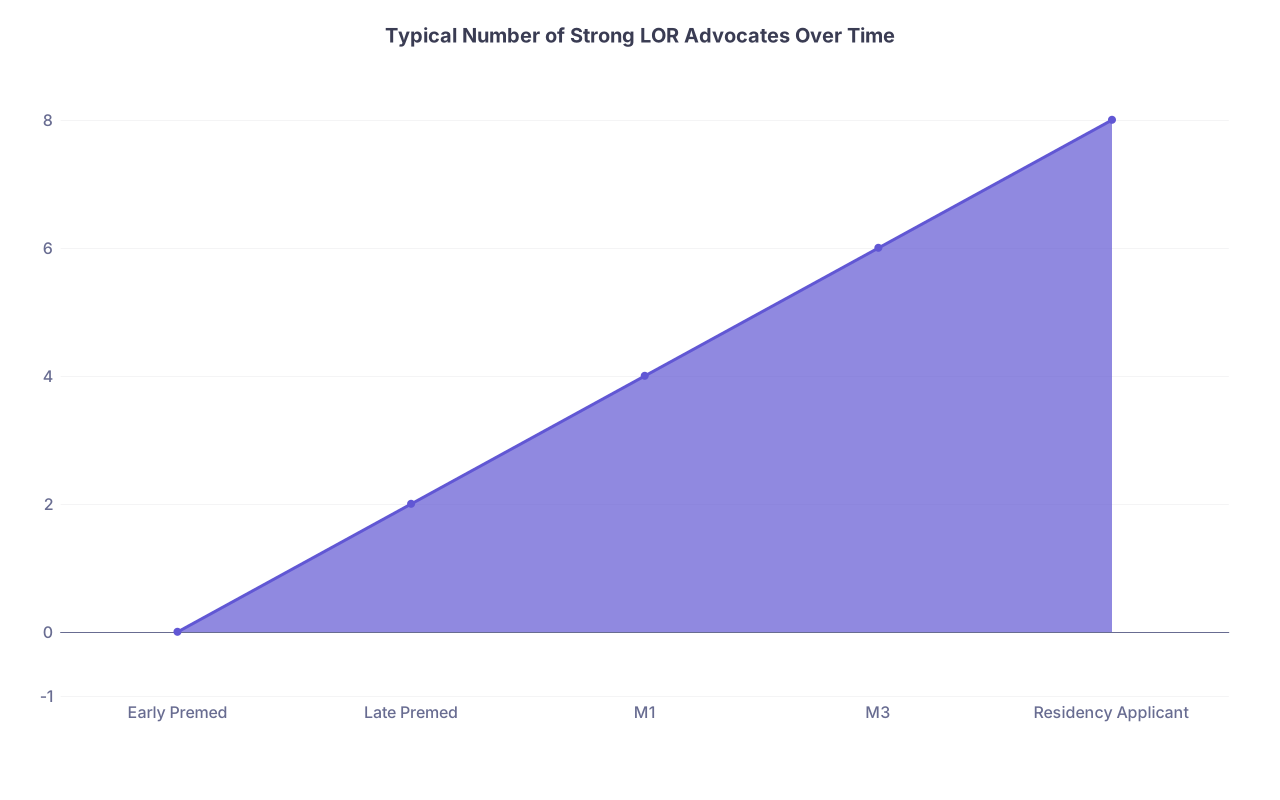
This is not just about being polite. This is about building your long-term professional network. These same people may write letters for:
- Scholarships.
- Post-bac programs.
- Research positions.
- Residency applications later.
| Category | Value |
|---|---|
| Early Premed | 0 |
| Late Premed | 2 |
| M1 | 4 |
| M3 | 6 |
| Residency Applicant | 8 |
Step 10: What To Do If You Already Shadowed and Blew It
You might be reading this thinking: “Well, I already did 60 hours of shadowing and did none of this. Now what?”
You still have options.
Option 1: Re-engage honestly
Pick 1–2 of your better shadowing experiences and send an email:
“Dr. [Name],
I shadowed you in [clinic/department] during [month/year] as a [school, year]. That experience had a big impact on me, especially [specific memory]. Since then, I have [brief update: finished X, started Y].I am wondering whether it would be possible to return to your clinic for a few more sessions this [semester/summer]. I realized in hindsight that I mostly stood in the background and did not take full advantage of the opportunity to learn from you. I would like to correct that if your schedule allows.”
If they say yes, treat it as a reboot. This time, use everything above.
Option 2: Cut losses and start fresh the right way
If the prior experiences were:
- Extremely short (1–2 days).
- Impersonal (huge teams, they barely spoke to you).
- Or the physician was clearly disinterested in teaching.
Let it go. Do not try to squeeze a letter out of a weak foundation. Invest your energy in building one or two strong anchors now.
A Simple Flow: From Shadowing to Sponsorship
Here is the process in one visual, so you can see the whole pipeline.

| Step | Description |
|---|---|
| Step 1 | Start Shadowing |
| Step 2 | Show Up Consistently |
| Step 3 | Engage Professionally |
| Step 4 | Build Personal Connection |
| Step 5 | Expand Role or Project |
| Step 6 | Ask for Strong Letter |
| Step 7 | Provide Packet & Updates |
| Step 8 | Maintain Long-term Relationship |
If you are missing steps D or E, your letters will be weak. If you are missing G and H, your network will evaporate.
Common Dumb Moves That Cost You Strong Letters
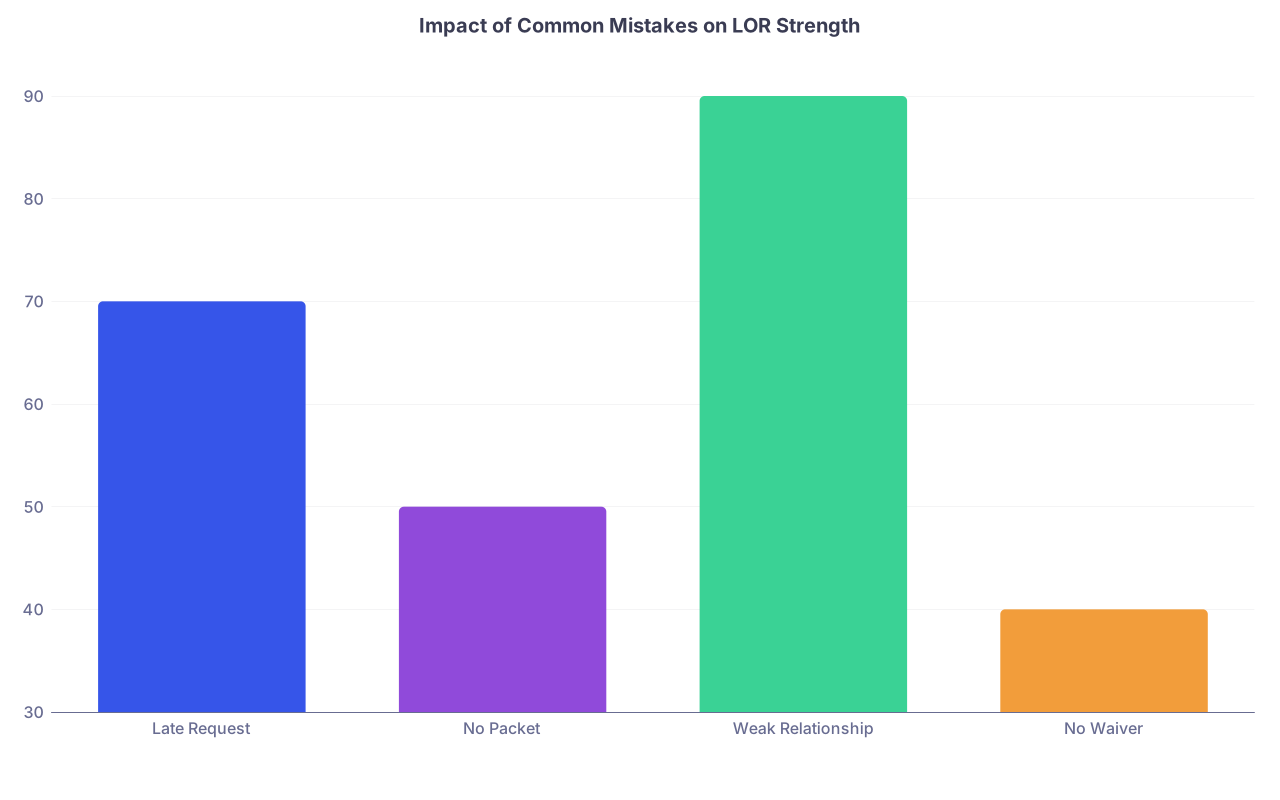
Let me be blunt. I have watched students sabotage perfectly good potential sponsors with a few avoidable mistakes:
- Treating shadowing as a photo-op for Instagram instead of an apprenticeship.
- Asking for a letter via a two-line text message.
- Giving a physician three days’ notice before a major deadline.
- Never once asking for feedback during months of contact.
- Not waiving their right to see the letter (admissions committees see that and immediately downgrade trust).
Avoid these, and you are already ahead of a big chunk of applicants.
| Category | Value |
|---|---|
| Late Request | 70 |
| No Packet | 50 |
| Weak Relationship | 90 |
| No Waiver | 40 |
(Scale: higher value = bigger negative impact.)
Two Quick Scripts You Can Steal
1. Mid-shadowing “upgrade the relationship” script
Use this when you have been shadowing a few weeks and want to deepen the connection:
“Dr. [Name], I have really appreciated being able to observe your clinic over these past few weeks. I am learning a lot about how you approach [specific type of patient/case]. I know you are very busy, but if you ever see small ways that I could be more helpful or areas where you think I should focus my learning, I would really value your feedback.”
This flags you as coachable. That is gold.
2. LOR request email + packet outline
Subject: Request for Strong Letter of Recommendation
Dear Dr. [Name],
I hope you are doing well. I have really valued the opportunity to work with you in [clinic/department] from [start date] to [end date], typically [X hours/week]. Seeing how you [specific trait: communicate with complex patients / balance teaching with patient care] has strongly reinforced my interest in medicine.
I am applying to [medical school / post-bac program] this cycle and am hoping to request a strong letter of recommendation from a few mentors who know me well. Based on our work together, would you feel comfortable writing a strong letter on my behalf?
If so, I would be glad to send a brief packet with my CV, draft personal statement, and a summary of the activities and cases we worked on together to make the process as easy as possible for you.
Thank you again for the time and guidance you have already given me.
Sincerely,
[Name]
[School, Year]
[Phone]
[Email]
Then you attach:
- CV
- Personal statement draft
- 1–2 page “what you saw me do” summary

Final Check: Are You Building Sponsors or Just Collecting Hours?
If you want to know whether you are on track, ask yourself, honestly:
Is there at least one physician (or professor) who:
- Knows me by first and last name without prompting?
- Could describe specific moments where I impressed them?
- Has seen me over months, not just a weekend?
Have I:
- Asked anyone for feedback on how I am doing?
- Followed up on advice they gave me and told them about it?
- Made myself visibly useful, even in small ways?
If the answer is no, your job for the next 3–6 months is simple: fix that.
Key Takeaways
- Shadowing is not a checkbox; it is an audition. Depth, continuity, and usefulness beat scattered hours every time.
- Strong letters come from people who have stories about you. Your job is to create those stories: reliability, initiative, follow-through, and growth over time.
- Ask early, ask clearly for a strong letter, and make it easy for your writers with a tight, specific packet. Then keep them updated and keep the relationship alive.
Do this, and you stop being “the quiet kid in the corner” and start building actual sponsors who will put their name behind yours. That is the difference admissions committees can feel when they read your letters.