
The blunt truth: PhD letters can absolutely help you. But if none of your strongest letters are from physicians, your application is weaker than it needs to be.
You’re not applying to a PhD program. You’re applying to medical school. Admissions committees want at least some people vouching for you who actually do the job you say you want.
Let’s break this down so you can stop guessing and start planning.
The Core Answer: No, They Don’t Have to Be Doctors… But You Probably Need One
Most MD and DO schools do not explicitly require your letter writers to be physicians.
What they do care about is this:
- Are the writers credible evaluators of your academic ability and professionalism?
- Do they know you well enough to write a detailed letter, not a template?
- Do your letters, as a set, show you can handle:
- Rigorous science coursework
- Clinical work and patient care
- Professional behavior in real-world settings
PhD faculty—especially those in basic science or research where you’ve actually worked closely with them—can absolutely check those boxes.
But here’s where people get burned:
If your entire letter packet is from non-clinicians (all PhDs, no MD/DO, no clinical supervisors), admissions folks start asking:
- Has this person really seen medicine up close?
- Who has actually seen them with patients or in a clinical environment?
- Why is there no physician willing to put their name behind this applicant?
That’s not where you want their minds going.
So the practical rule:
- PhD letters will “suffice” as part of your set.
- For most applicants, at least one strong letter from a physician or clinical supervisor is a strategic must, even if not technically required.
What Different Schools Actually Expect
This isn’t theoretical. Schools spell some of this out in their requirements, even if they’re a little vague about titles.
| School Type / Category | Typical Expectation |
|---|---|
| Many MD schools | 2 science faculty, 1 non-science, 1–2 others (research/clinical) |
| Some highly selective MD programs | Strong preference for research letter (often PhD) plus clinical exposure letter |
| Many DO schools | Letters from physicians (DO strongly preferred), plus academic letters |
| BS/MD or early assurance programs | Heavy emphasis on teacher/faculty letters, often + 1 healthcare provider |
| Committee letter schools | Committee letter substitutes for multiple individual letters, but you can still add physician letters |
Key details:
- When schools say “science faculty,” they usually include PhD professors in biology, chemistry, physics, etc. Those are valid and often ideal.
- Some DO schools explicitly ask for a letter from a DO. In that case, a PhD letter will not substitute. You still need the DO letter.
- Many schools say something like “up to X additional letters from supervisors, research mentors, or healthcare professionals.” That’s where physician letters fit nicely.
Bottom line: Read each school’s website carefully. But even if they don’t require an MD/DO letter, it’s still in your best interest to have at least one.
When PhD Letters Are Powerhouse Letters (and When They’re Not)
PhD faculty letters are often the best letters in your file—if you’ve actually worked with them in a meaningful way.
They’re especially strong when:
- You did a research project with them for at least a semester or a summer.
- You had multiple advanced classes with them.
- They’ve seen you handle failure, revisions, and long-term work.
- They can write specifics:
“She independently designed a troubleshooting plan for our CRISPR experiment and presented her data at our departmental research day.”
That kind of detail is gold. It shows perseverance, curiosity, intellectual maturity—things medical schools love.
Where people go wrong:
- Letter from a professor whose class you took once, sat in the back, got an A, never spoke.
- Letter clearly written from a template: “He was a good student and regularly attended class.”
- Letter from the PI who barely knows you because you mostly worked with a postdoc.
Those letters are technically from PhDs. They just… don’t help.
Strong PhD Letter Scenario
- You work in a neuroscience lab for 1.5 years.
- You present a poster with your PI at a conference.
- The PI is a PhD, not an MD.
- They’ve seen your work ethic, your problem-solving, how you respond to feedback.
That letter can carry serious weight. Some top schools basically expect a research letter like this (Harvard, UCSF, Stanford, etc.).
Weak PhD Letter Scenario
- You had one huge intro chem class with a professor.
- You got an A.
- You never went to office hours.
- You email them two years later asking for a letter.
They have nothing real to say except “did well on exams.” That’s not a selling point; that’s just you meeting the baseline.
So the real question isn’t “PhD or MD?”
It’s: Who can write the strongest, most specific letter about me?
The Role of Physician Letters: Why They Still Matter
You’re asking medical schools to picture you as a future colleague. Someone has to connect that dot for them.
That’s where a physician or clinical supervisor comes in.
What a strong clinician letter does that most PhD letters can’t:
- Describes you interacting with patients and families.
- Talks about your professionalism in messy, real-world situations.
- Comments on your emotional maturity and bedside manner.
- Confirms you’ve seen what medicine actually looks like—and you still want in.
Examples of good sources for clinical letters:
- The MD you shadowed long-term (not 2 afternoons… more like weekly for months).
- A physician you worked with as a medical assistant, scribe, or EMT.
- A clinic director or nurse manager who supervised you extensively in a free clinic or hospital volunteer role.
These people answer questions adcoms worry about but can’t ask directly:
- Will this person crumble the first time they see a bad outcome?
- Are they respectful to staff?
- Are they coachable when corrected?
- Do they actually like being around patients?
PhD mentors usually can’t speak to that. That’s not their environment.
So if your letter set is:
- Two science PhDs (class only)
- One humanities PhD
- One research PhD
That’s academically solid, but clinically thin. You’re asking med schools to take your word for it that you belong in medicine.
Ideal Mix: What a Strong Letter Set Looks Like
Here’s a structure that works for most traditional applicants.
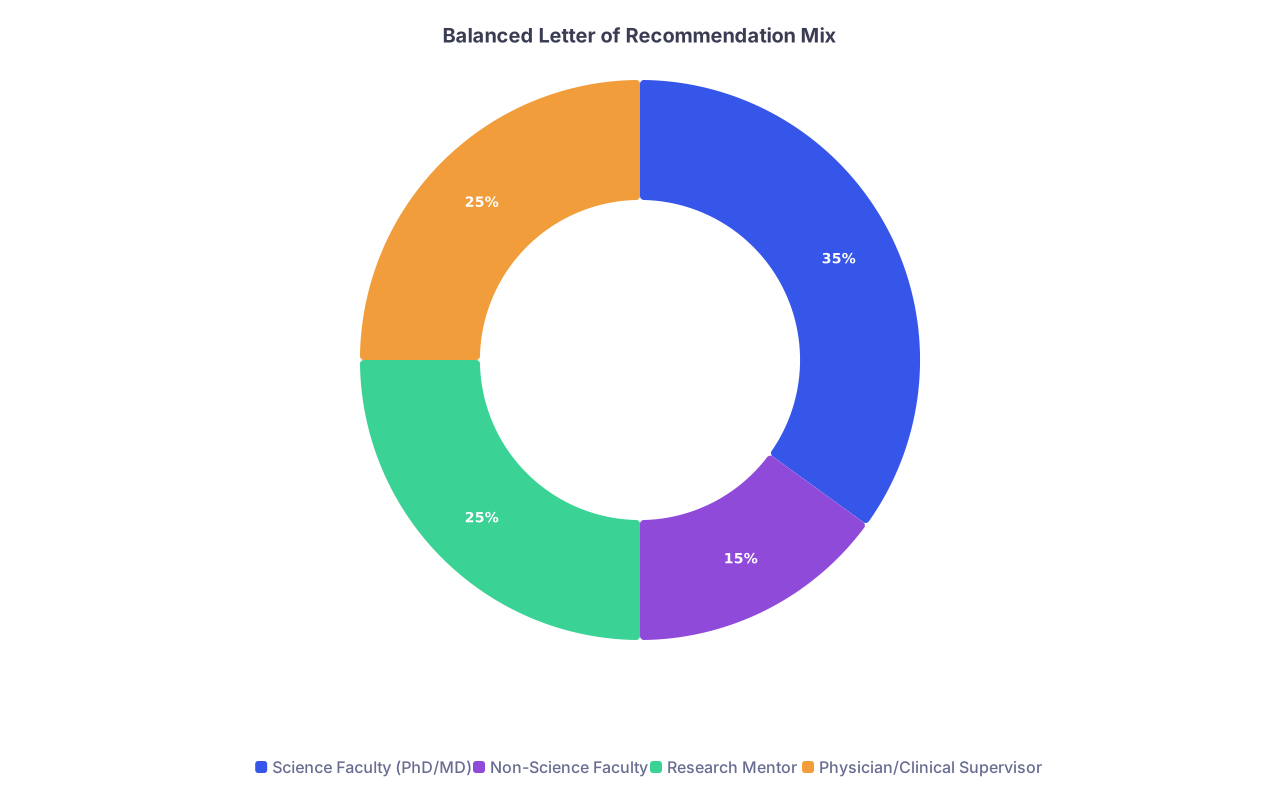
| Category | Value |
|---|---|
| Science Faculty (PhD/MD) | 35 |
| Non-Science Faculty | 15 |
| Research Mentor | 25 |
| Physician/Clinical Supervisor | 25 |
Translated into actual people:
Two science faculty (often PhDs)
- Biology, chemistry, physics, etc.
- At least one who actually knows you, not just your multiple-choice scores.
One non-science faculty (often PhD or MA)
- Humanities, social science, or writing-intensive course.
- Shows you can think, write, and engage beyond memorization.
One research mentor (PhD or MD)
- If you did any serious research.
- Could overlap with your science faculty if that’s the same person.
At least one physician or clinical supervisor
- Ideally MD/DO who directly observed your patient-facing work.
- If not a physician, a senior nurse/NP/PA/clinic manager who supervised you clinically can still be valuable.
You don’t need every category for every school (some limit letters). But this is the blueprint.
If you’re forced to prioritize because a school caps letters:
- Keep: strongest two science letters, best clinical letter, and best research or non-science letter.
- Drop: generic or weak letters, regardless of title.
Special Situations: Nontraditional, No Physician Access, or Heavy Research
1. Nontraditional Applicants
If you’ve been out of school, adcoms know your letters will lean more toward work and clinical supervisors than professors.
In that case:
- A strong letter from a PA or NP clinic supervisor can sometimes carry more weight than a weak, forced letter from an MD you barely know.
- Still, if you work around physicians, you should try to earn one meaningful MD/DO letter over time.
2. Heavy Research / MD-PhD Track
If you're MD-PhD or extremely research-focused:
- A glowing letter from a PhD PI is non-negotiable. That’s your backbone.
- You still benefit from a letter that shows you as a capable future clinician, not just a lab creature.
For MD-PhD, best case is:
- PhD PI letter (very strong)
- Another research faculty letter (if applicable)
- At least one letter showing clinical exposure or strong interpersonal skills (could be MD, could be non-research professor who saw you in group projects, leadership, etc.)
3. You Literally Can’t Get a Physician Letter
Sometimes students have only short-term, passive shadowing and no real physician relationship.
You’ve got two choices:
- Apply anyway with what you have (heavy PhD/academic letters) and accept the risk that your clinical side feels thin.
- Delay a cycle, or at least delay applying to certain schools, and build a real clinical role (scribe, MA, EMT, hospice volunteer) where someone can actually evaluate you.
I’ve seen people get in with zero MD letters, but they usually have:
- Extremely strong academics
- Outstanding research
- Very solid, long-term clinical volunteering with strong supervisor letters (even if non-physician)
If that’s not you, I wouldn’t gamble.
How to Choose Between a Strong PhD Letter and a Weak MD Letter
If you learn nothing else from this article, remember this:
A strong letter from a PhD beats a weak letter from an MD every single time.
You’re much better off with:
- A detailed, enthusiastic, 2-page letter from a PhD mentor who has seen you struggle, improve, lead, and think…
than:
- A bland, 1-paragraph letter from a physician who barely remembers your name.
If your only MD option is clearly weak—generic language, minimal contact—it should be secondary or dropped, not central.
The goal isn’t “have an MD letter.” The goal is “have multiple people who can credibly argue that you’ll be an excellent medical student and future physician.”
Title helps. Content wins.
Concrete Next Steps: What You Should Do This Week
Here’s what to do so you’re not stuck with “will PhD letters suffice?” as a last-minute panic question.

| Step | Description |
|---|---|
| Step 1 | Map Current Mentors |
| Step 2 | Secure Commitment for Letter |
| Step 3 | Find Long-term Clinical Role |
| Step 4 | Strengthen Relationships with 2-3 Faculty |
| Step 5 | Ask for Letters 2-3 Months Before Apps |
| Step 6 | Do you have a strong MD/DO or clinical supervisor? |
Today (not next month):
List all potential letter writers
Mark for each: PhD, MD/DO, other. Then mark: Strong / Medium / Weak based on how well they know you.Check your mix
- At least 2 strong science faculty?
- At least 1 person who’s seen you clinically?
- At least 1 mentor who can speak to your character and reliability?
Identify your gap
If your only clinical exposure is shadowing with no relationship, that’s your weak point.Plug the gap intentionally
- If you’re early: find a sustained clinical role where someone can genuinely get to know you.
- If you’re close to applying: lean into your strongest letters (even if PhD-heavy) and consider targeting schools that don’t insist on physician letters or DO letters, if you don’t have them.
Then, pick one potential strong letter writer right now—PhD or MD—and send them an email asking to meet to discuss a future letter of recommendation and your career goals. That conversation is how strong letters actually start.