
What’s the very first email you should send when you start chasing med school letters: your orgo professor, your PI, or the doctor you shadowed?
Here’s the answer up front:
For most applicants, science letters come first, then research/longitudinal mentors, then clinical.
But there are exceptions, and if you get those wrong, you can absolutely weaken an otherwise strong application.
Let’s walk through this like an actual decision, not vague “get strong letters” nonsense.
Step 1: Know What Med Schools Actually Require
Most people screw this up because they start with, “Who knows me best?”
That’s the second question. Not the first.
First question: What do the schools on your list require or strongly prefer?
Typical patterns:
Many MD schools:
- 2 science faculty (biology/chem/physics/math)
- 1 non-science faculty
- Optional or recommended: research or clinical letter
Many DO schools:
- 1 science faculty
- 1 physician (often DO preferred)
- Optional others
Research-heavy schools (Harvard, UCSF, Penn, etc.):
- Strong preference for at least 1 research letter if you’ve done meaningful research
So before you touch your inbox, do this once:
| School Type | Science Letters | Non-Science | Research | Physician/Clinical |
|---|---|---|---|---|
| Typical MD | 2 | 1 | Optional | Optional |
| Research-heavy MD | 2 | 1 | Strongly Favored | Optional |
| Typical DO | 1 | 0–1 | Optional | Often Required |
| BS/MD / Early Assurance | 1–2 | 0–1 | Helpful | Sometimes |
Now, with that in mind, the “who first?” question starts to actually make sense.
Step 2: The Default Priority Order (For Most Applicants)
If you’re a classic premed (4-year college, applying MD/DO, some research, some clinical), the default order to secure letters should be:
- Core science faculty (required)
- Primary research mentor (if you have one)
- Clinical/physician letter (if needed or particularly strong)
- Non-science / humanities letter
- Optional extras (mentors, coaches, supervisors) only if allowed
Why this order? Because:
- Science letters are both required and harder to get right (big classes, less personal interaction).
- Research mentors often need more lead time and may be slow responders.
- Clinical letters are helpful, but if your GPA and science credibility aren’t backed by professors, a glowing physician letter won’t save you.
Let’s break each group down and talk about who in each category should be first.
Step 3: Start With Science Letters – But Not Just Any Science
If you’re asking, “Who should I ask first?” the real question is “Which letter is the hardest to replace if something goes wrong?”
That’s science faculty.
Who should be your first science letter?
Prioritize in this order:
Professor who can say you’re top X% in a rigorous class
Example: “She earned the highest score in my 250-student Organic Chemistry II course and consistently led her lab group.”Professor from a challenging, recent course with personal interaction
Smaller upper-level classes (biochem, physiology, cell biology, physical chemistry) are gold mines here.Professor who knows you across multiple contexts
For example, you took their class, then did a teaching assistantship or independent study with them.
Who should you email first?
- The one who can most honestly say something like:
- “Top 5–10% of students I’ve taught in the last 5 years”
- “Stood out in both academic performance and class leadership”
- AND who responds to your emails like a functioning adult.
If you’re at a big state school with 300-person lectures, that likely means:
- The professor whose office hours you actually attended
- Or the one whose lab section you crushed and whose TA knows you well (TA can help them write specifics)
Why science first?
Because:
- Many schools won’t consider your app complete without required science letters.
- If a science professor says no or ghosts you, you need time to pivot to a backup.
- You often need two science letters; coordinating that takes time.
So yes, lock down at least one science letter as soon as you can, ideally while you’re still in the class or right after.
Step 4: Next Up – Research Mentors (If You’ve Done Real Research)
If you’ve done anything more substantial than “washed beakers for one semester,” your research mentor is extremely high-value.
For research-heavy schools, it can be the second-most important letter after your best science professor.
Who should be your first research letter writer?
Pick the mentor who can say:
- They supervised you directly (not just knew your name in the lab).
- You contributed in a real way (experiments, analysis, writing, posters, not just busywork).
- They’ve seen you over time (at least one full semester, ideally a year or more).
Typical strong options:
- PI you worked with for multiple semesters or summers
- Postdoc or senior researcher who directly supervised you, backed by a co-sign from the PI
- Research mentor from a thesis or capstone project
If you’re serious about MD/PhD or top-tier research programs, this letter becomes almost mandatory, not optional.
Why research second?
Research mentors:
- Often take longer to respond, longer to write
- Are more likely to ask for a draft or bullet points
- Can write uniquely powerful letters because they see your curiosity, grit, and problem-solving over time
So after you’ve got your first science letter committed, your next email should usually be to your primary research mentor.
Step 5: Then Clinical / Physician Letters – But Only the Right Ones
Here’s where a lot of premeds mess up: they overvalue generic clinical letters.
A mediocre “He shadowed me for 20 hours and seemed interested in medicine” letter is useless.
When should a clinical or physician letter be high priority?
- You’re applying DO and programs require/prefer a DO letter.
- You’ve worked closely with a physician in:
- A scribe role
- A long-term MA/clinical assistant role
- A substantial volunteer position (months, not days)
Who should you ask first on the clinical side?
Pick the person who can say:
- They saw you repeatedly over time (months, not a one-off week)
- They watched you interact with patients or staff
- They can comment on your professionalism, empathy, and reliability specifically
So a physician you scribed for 6 months beats:
- A famous surgeon you shadowed for 10 hours
- A random attending from a 2-week experience
Make this your third wave of letters after science and research, unless a program explicitly requires a physician letter.
In that case, move this up in priority, but never at the expense of required science letters.
Step 6: Non-Science and “Character” Letters – When To Slot Them In
Non-science letters can be surprisingly strong if they’re from:
- A humanities or social science professor who saw your writing, discussion, critical thinking
- A mentor for your thesis in history, philosophy, sociology, etc.
- Someone who can say you’re a thoughtful human, not just a test-taking machine
Where do they fit in priority?
- After your first science and research letters are committed.
- Before optional extra letters from random supervisors.
If a school requires a non-science letter, that person should move up the priority list, right after you lock in one strong science recommender.
Step 7: If You Don’t Have “Ideal” Letter Writers
Let me be blunt: you probably don’t have a Nobel laureate who knows you personally. That’s fine.
Here’s who you prioritize if you’re not in a perfect world:
Science Letters
- The professor who at least recognizes you and your work ethic, even in a larger class.
- Go to office hours now and build that relationship if you’re still in the class.
Research or Longitudinal Supervisors
- Even if it’s not bench research: long-term community service, tutoring, leadership roles where someone has seen you grow.
Clinical Supervisors
- Charge nurse, clinic coordinator, or physician you’ve worked with regularly.
Between a “famous but distant” letter and a “less impressive but detailed” letter, choose detailed every time.
Visual: Who To Ask First, By Letter Type
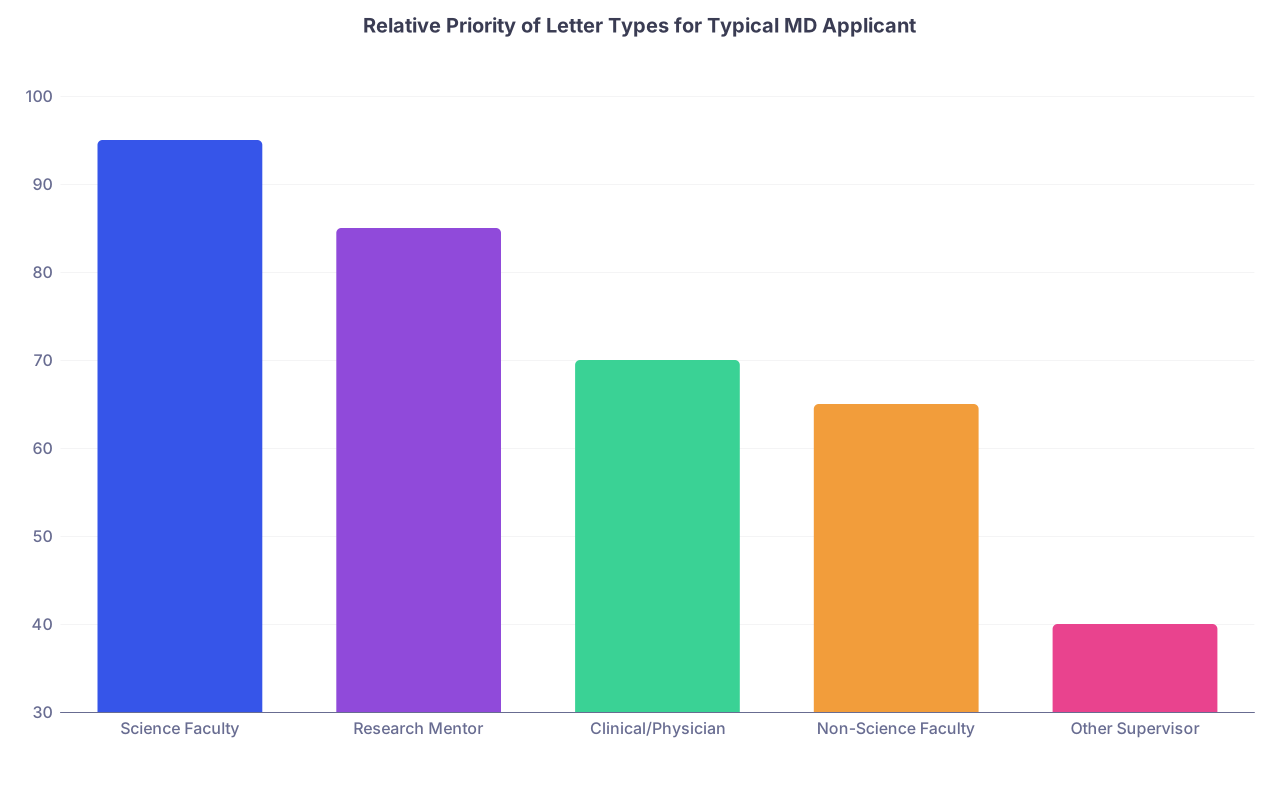
| Category | Value |
|---|---|
| Science Faculty | 95 |
| Research Mentor | 85 |
| Clinical/Physician | 70 |
| Non-Science Faculty | 65 |
| Other Supervisor | 40 |
Step 8: Timeline – When To Ask Whom
If you’re applying in a typical June cycle, a sane timeline looks like this:
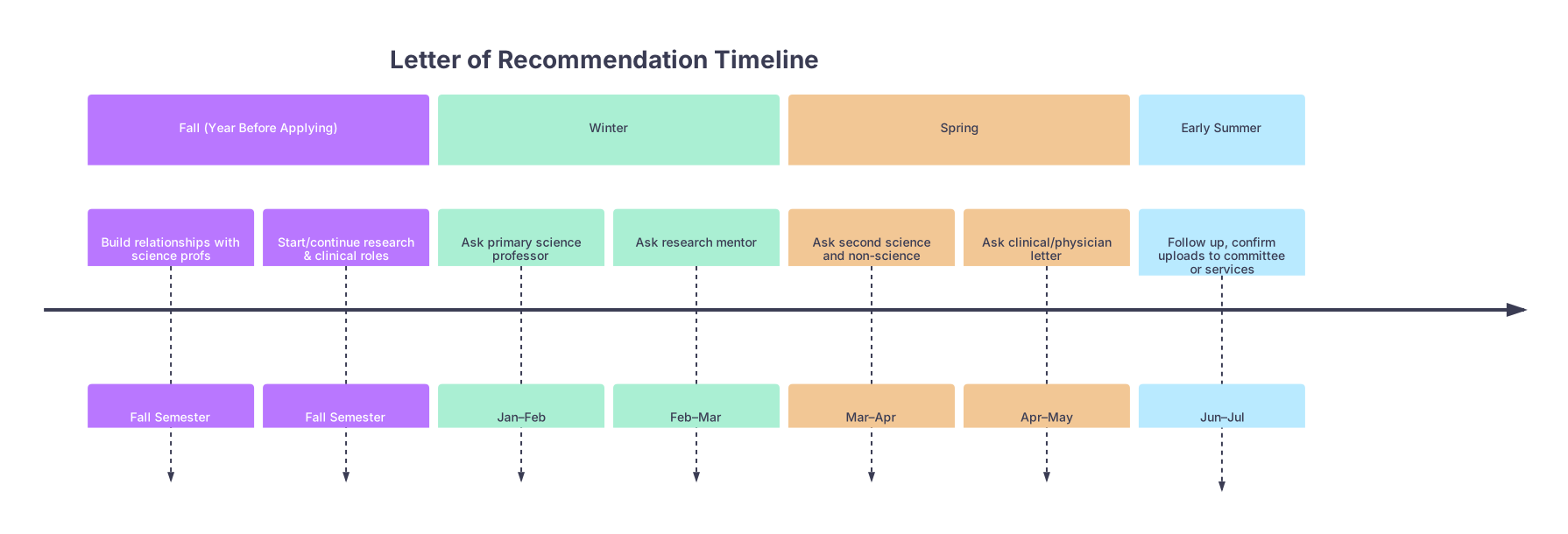
| Period | Event |
|---|---|
| Fall (Year Before Applying) - Build relationships with science profs | Fall Semester |
| Fall (Year Before Applying) - Start/continue research & clinical roles | Fall Semester |
| Winter - Ask primary science professor | Jan–Feb |
| Winter - Ask research mentor | Feb–Mar |
| Spring - Ask second science and non-science | Mar–Apr |
| Spring - Ask clinical/physician letter | Apr–May |
| Early Summer - Follow up, confirm uploads to committee or services | Jun–Jul |
If you’re asking in April for June letters and no one really knows you, you’re late. Not doomed, but late. You’ll need to be extra organized and very explicit in what you provide them.
Step 9: How To Actually Decide: A Simple Framework
When you’re staring at a list of names thinking, “Who first?”, run them through this filter:
Ask yourself for each potential writer:
- Category Match
- Does this person satisfy a requirement? (science, non-science, physician, research)
- Depth of Relationship
- Have they seen you across time and contexts?
- Specific Evidence
- Can they give concrete examples of your work, growth, or character?
- Responsiveness
- Do they reply to emails and meet deadlines?
- Reputation & Role
- Tenured vs adjunct isn’t everything, but a known, respected professor who knows you well is ideal.
Who do you ask first?
- The highest-priority category (usually science),
- With the deepest relationship,
- Who’s also reliable and responsive.
Then move down the list.
Common Letter Priority Mistakes (Don’t Do These)
You’re smarter than this, but just to be clear:
Leading with the “famous doctor” you shadowed for a weekend
Name recognition isn’t magic. Vague letters can hurt you.Ignoring a strong non-science professor because “it’s not science”
If schools want a non-science letter, this can be one of your best.Leaving science letters for last
Then you’re stuck asking someone who barely knows you, right before the deadline.Collecting 7–8 mediocre letters because “more is better”
No. More is just more reading for admissions, and they don’t thank you for that. Quality > quantity.
Quick Comparison: Who You Ask First, By Scenario
| Applicant Type | First Ask | Second Ask | Third Ask |
|---|---|---|---|
| Typical MD | Best science prof | Research mentor | Second science / clinical |
| Research-heavy target | Best science prof | Research mentor | Second science |
| DO-focused | Science prof | DO physician | Research or non-science |
| Low research, strong clinical | Science prof | Clinical supervisor | Non-science faculty |
| Non-trad, few science contacts | Recent science prof | Supervisor (work/clinical) | Second science or non-science |
FAQ: Letters of Recommendation Priority (7 Key Questions)
If I can only ask one person this week, who should it be?
Your strongest science professor who actually knows you. Required letters come first. Lock in that commitment, then move to research and clinical mentors.Is a research mentor more important than a second science letter?
For research-heavy MD programs or MD/PhD? Often yes, or at least equal. For typical MD/DO with weak or no research? The second science letter usually matters more because schools require it and use it to judge academic readiness directly.What if my research mentor isn’t a physician or an MD/PhD?
Doesn’t matter. A PhD who supervised you closely and can write a detailed, enthusiastic letter is far more valuable than an MD who barely knows you. Content beats credentials.How many letters should I actually aim for?
Most people land around 3–5 strong letters:- 2 science
- 1 research or clinical
- 1 non-science (if required) Don’t chase 7–8 letters “just in case.” Admissions won’t read them all carefully, and some schools cap how many they accept.
Should I prioritize a physician letter if my schools don’t explicitly require one?
Not over required science or a great research letter. If you have a truly strong clinical letter from a long-term supervisor, it’s a valuable addition. But it doesn’t replace core academic letters.My best relationship is with a non-science professor. Where do they fit?
After your first science letter ask. If schools require a non-science letter, that professor should be your first and only choice. They can sometimes write the most human, memorable letters—just don’t neglect your science requirements.How early is “too early” to ask for a letter?
It’s very hard to be too early. I’ve seen students ask in January–March for a June submission, and that’s smart. The only caveat: make sure the writer knows your application timeline and where the letter will go (committee, AMCAS, AACOMAS, etc.), and send a reminder 4–6 weeks before your deadline.
Open your school list right now and mark, next to each school, how many science, research, and clinical letters they want or strongly prefer. Then write down the one science professor you’ll email today to get that first critical “yes.”