
It’s January, second semester is ramping up, and you’re staring at your CV. You’ve shadowed three doctors, done research in two labs, joined a new volunteering gig, and your premed advisor just said, “Make sure you’re building relationships for letters of recommendation.”
And now you’re wondering: am I supposed to keep collecting new mentors like Pokémon, or should I double down on the 2–3 people who already know me pretty well?
Here’s the answer you’re looking for:
For letters of recommendation, depth beats breadth. But you still need strategic breadth.
Let’s break down what that actually means.
The Core Principle: Strong LORs Come From People Who Really Know You
Admissions committees are not impressed by a long list of fancy titles on weak letters. They’re impressed by:
- Specific stories
- Clear comparison to peers
- Evidence that you’re reliable, curious, and good to work with
You only get that from people who’ve seen you over time.
So if you’re deciding between:
- Adding a 6th “mentor” who barely knows your name, or
- Investing more time with 2–3 people who can actually talk about your growth
Choose the second. Every time.
Think of it like this: your eventual LOR writers should be able to answer, in detail:
- “Tell me about a time this student handled a setback.”
- “What makes them stand out from other students you’ve worked with?”
- “Would you want this person taking care of your family as a doctor one day?”
If someone can’t answer those without guessing? They’re not a real mentor for LOR purposes.
First, Know What Types of Letters You Actually Need
You can’t make a strategy if you don’t know the target.
For Premed (MD/DO applications)
Most medical schools expect some version of:
- 2 science faculty letters (biology, chemistry, physics, math)
- 1 non-science faculty letter (humanities, social sciences, etc.)
- 1–2 optional/extra letters (research PI, physician, long-term volunteer supervisor)
For Medical School (for future residency planning)
You’ll eventually need:
- Clinical faculty letters (attendings who supervised you on rotations)
- Possibly a department letter (e.g., Internal Medicine, Surgery)
- 1+ from your chosen specialty
- Sometimes a research PI or sub-internship attending
So your goal isn’t “as many mentors as possible.”
Your goal is: a small, reliable set of people who can cover these boxes with strong, detailed letters.
Depth vs Breadth: What’s the Right Balance?
Here’s the simple framework.
Prioritize depth with:
- Your future letter writers in required categories
- Anyone who can speak to you in multiple settings (e.g., class + research, clinic + project)
- People who’ve seen you over time (more than one semester, one project, or one shift)
Maintain smart breadth by:
- Not putting all your hopes into just one person (PIs retire, physicians move, people get sick)
- Having at least 2–3 strong options in each key category where possible
- Occasionally adding a new mentor when you’ve maxed out what a prior one can genuinely say about you or when you need a letter type you don’t yet have
So no, you shouldn’t stop meeting new mentors altogether. But you absolutely should stop casually adding new “mentors” if you’re not investing in the relationships you already have.
A Concrete Target: How Many Deep Mentors Do You Actually Need?
Let’s make this painfully clear. Here’s a solid target for most people.
| Stage | Deep Academic Mentors | Deep Clinical/Service Mentors | Research Mentor |
|---|---|---|---|
| Premed (college) | 2–3 | 1–2 | 1 |
| Med school pre-clinical | 2–3 | 0–1 (early exposure) | 1–2 |
| Med school clinical | 2–3 | 2–3 (attendings) | 1–2 |
“Deep” here means:
- You’ve worked with them for a semester or more (or an equivalent intensive experience)
- You’ve had 1:1 conversations more than once
- They know your goals, not just your face
If you don’t have that yet, your problem isn’t “add more mentors.” Your problem is “actually talk to and work with the people in front of you.”
When You Should Stop Adding Mentors (At Least for Now)
Here’s when I’d tell a student to stop chasing new mentors and double down.
You already have:
- 2 science professors who know you reasonably well
- 1 non-science professor
- 1 research PI or long-term supervisor
But:
- None of them really know your story, long-term goals, or why you want to be a physician
- You haven’t met with any of them outside required class/lab times
- You’ve never actually said, “I’m hoping to apply to med school and would appreciate your guidance”
In that situation, adding a 7th person who barely knows you is pointless. You’re diluting your time and attention.
Your move should be:
- Set up 1:1 meetings with the people you already have
- Start updating them every 1–2 months by email or in person
- Ask for feedback, not just favors
When It Is Smart to Add a New Mentor
There are times when expanding your circle is the right call.
You should look for new mentors if:
- You’re missing a required letter category
- Example: you have no strong science faculty who know you at all
- Your current “mentors” are:
- Disengaged, unreliable, or consistently unresponsive
- Unable to speak to your clinical or research abilities because they’ve never seen them
- You’re changing direction
- New specialty interest, new research area, new school, etc.
Also smart: adding a mentor in a setting where you’re already spending time anyway.
- You’re in a clinic every week → build a relationship with one physician there
- You’re in a lab → deepen your connection with the PI or a senior postdoc
- You’re at a volunteering site → seek out a supervisor who actually sees your work
You don’t need “brand new worlds” all the time. You need real relationships in the worlds you’re already in.
What a “Deep” Relationship Actually Looks Like (For LOR Purposes)
If a student tells me they have “lots of mentors,” I ask them 3 questions:
- Who could write you a letter right now that includes a specific story about how you handled a mistake or setback?
- Who knows your actual background and long-term goals, not just “wants to go into medicine”?
- Who’s seen you work in at least two different contexts (e.g., class + office hours, lab bench + presentation, clinic + follow-up email)?
If you can’t name at least 2–3 people who check those boxes, you don’t have a strong LOR bench yet.
Here’s what building that depth looks like in practice:
- Regular contact: seeing or emailing them every few weeks/months
- Substance: sharing updates, asking real questions, seeking feedback
- Visibility: taking on responsibilities where they can observe your work (present a paper, lead a small project, organize something for the team)
- Story: letting them see your trajectory—struggles, improvements, decisions
That “story” piece is what turns a generic letter into a powerful one.
Avoid the Trap: The “Mentor Collector” Syndrome
I’ve seen this a lot: students bragging, “I have 10 mentors.”
Translation: “I’ve spread myself so thin that no one knows me well enough to write a great letter.”
Common signs you’re in this trap:
- You’ve shadowed 6+ doctors, but none know your last name without a badge
- You worked in 3 different labs for short periods to “diversify experience,” but never stayed long enough to lead anything
- Your volunteer roles are all 1–2 hours/week across five different sites, and you’re invisible in all of them
Admissions readers can smell this in letters. They get flooded with LORs that say:
- “Pleasure to have in clinic.”
- “Arrived on time and was polite.”
- “Asked good questions.”
You want letters that say:
- “Over 18 months, I saw this student go from hesitant to leading complex tasks.”
- “When a project fell apart, they were the one who stayed late to fix it.”
- “They are in the top 5% of students I’ve worked with in the past decade.”
You don’t get that in three weeks of shadowing.
How to Actually Deepen a Few Key Relationships (Step-by-Step)
Here’s a practical script for what you should do this month.
Step 1: Choose your “core 3–5”
Pick:
- 2–3 faculty (prioritize science and non-science professors for premeds)
- 1 research PI or major supervisor
- 1 clinical or service mentor (if you have one already)
These are your “inner circle” for letters and long-term advice.
Step 2: Schedule brief check-ins
Send something like:
“Hi Dr. Smith,
I really appreciated your [class/lab/mentorship] last semester. I’m working towards medical school and would love 15–20 minutes to get your advice on my path and how I can continue to grow in [your setting]. Would you be open to a quick meeting sometime in the next few weeks?”
Show up with:
- 1-page resume or activities list
- 2–3 questions (about your performance, what to improve, how to get more involved)
Step 3: Ask for feedback and responsibility
In the meeting, ask:
- “Are there ways I could take on a bit more responsibility?”
- “What would a top student or volunteer in your eyes be doing that I’m not doing yet?”
- “How can I better contribute to your lab/clinic/class?”
Then follow through. Consistently.
Step 4: Keep them updated
Every 1–2 months, a short email:
- What you’ve been doing
- Something you learned or tried based on their feedback
- Any significant news (MCAT scheduled, research poster coming up, application timeline)
You’re not spamming them. You’re letting them see your progression.
Visual: Depth vs Breadth Over Time
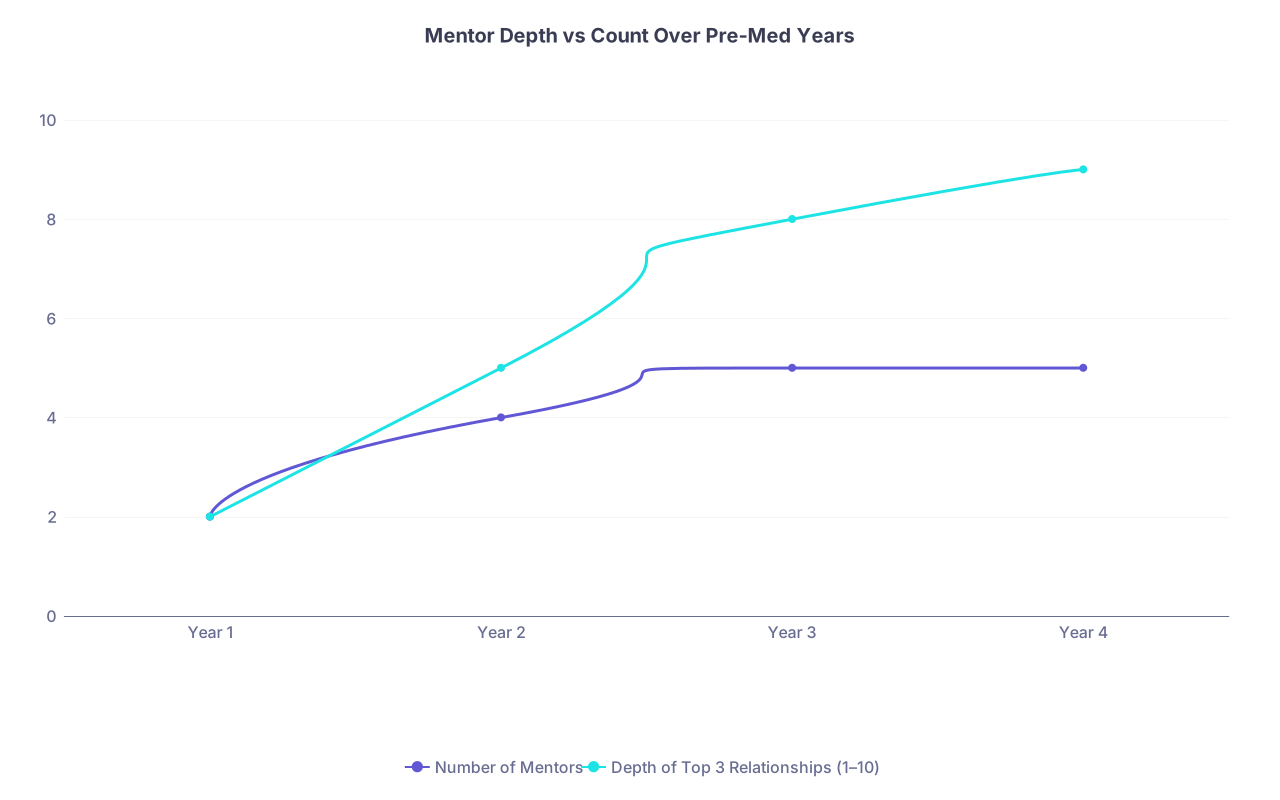
| Category | Number of Mentors | Depth of Top 3 Relationships (1–10) |
|---|---|---|
| Year 1 | 2 | 2 |
| Year 2 | 4 | 5 |
| Year 3 | 5 | 8 |
| Year 4 | 5 | 9 |
The goal isn’t for the “number of mentors” line to shoot to the sky.
The goal is for the depth of your best relationships to grow steadily.
How This Plays Out Later (Med School & Residency)
The same logic repeats when you’re in med school:
- You don’t need to impress every attending on every rotation equally.
- You need 2–4 attendings who’ve seen you consistently show up, own your mistakes, improve, and care about patients.
I’ve watched this on medicine rotations: one student tries to “network” with every attending, does okay work everyone vaguely remembers. Another latches on to one or two teams, shows up early, stays late, reads about every patient, and asks for feedback constantly.
Guess who gets the lines like “I would take this student as a resident in my program without hesitation”?
So, Should You Keep Adding New Mentors or Deepen a Few?
Here’s the clean answer:
- If you don’t have the basic required letter types covered yet → add mentors strategically in missing categories.
- Once you do have coverage → stop chasing new names and deepen relationships with 3–5 key people.
- Your goal isn’t to maximize the number of people who kinda know you.
- Your goal is to have a handful of people who can vouch for you, with specifics, without hesitation.
FAQ (Exactly 7 Questions)
1. How many mentors should I have for strong LOR options as a premed?
Aim for about 4–6 total, with 3–4 “deep” mentors: 2 science faculty, 1 non-science faculty, and 1 research or clinical/service supervisor. You can know more people loosely, but your letters will come from that core group.
2. Is it okay if I only get letters from people I worked with for one semester?
It’s not ideal, but it can work if you made yourself visible: went to office hours, participated a lot, and followed up. However, anytime you can stretch that into a multi-semester or multi-role relationship, the letter usually gets significantly stronger.
3. Do I need a letter from every research PI or doctor I’ve worked with?
No. Don’t hoard letters just because you can. Get letters from the few who know you best and can speak to your work ethic, growth, and character. A lukewarm letter from a “big name” is weaker than a detailed letter from someone less famous who watched you grind.
4. How do I know if a mentor actually likes me enough to write a strong letter?
Ask them directly, but phrase it so they can be honest:
“Would you feel comfortable writing me a strong, positive letter of recommendation for medical school?”
If they hesitate or qualify it heavily, that’s a red flag. Better to know now than get a mediocre letter.
5. Should I keep shadowing new physicians just to have more possible letter writers?
No. Shadow for exposure and learning, not just letters. Once you’ve shadowed a few physicians, focus on finding one who’s willing to let you come regularly and actually get to know you. One physician who sees you consistently is better than six who saw you once.
6. What if my school is large and it’s hard to build close relationships with professors?
You’ll have to be more intentional. Sit in the same spot, go to office hours early in the semester, ask follow-up questions by email, and look for smaller classes, seminars, or research groups where faculty naturally see you more. Big schools aren’t an excuse; they just make the “depth” part require more effort.
7. When should I actually ask someone for a letter?
For premeds, usually late junior year or early senior year, once you’ve had enough time with them to build a track record. For med students, ask near the end of a rotation or research block while the experience is still fresh. But the relationship-building needs to start months before that ask.
Today, do this:
Write down the names of the 3–5 people who are most likely to write your letters. For each one, schedule a short meeting or send a thoughtful update email this week. Start turning “people you sort of know” into real mentors who can actually vouch for you.