
The blunt answer is this: a strong teaching assistant (TA) letter is good, but on its own it usually is not enough. You should not rely only on a TA if there’s any realistic path to getting the professor’s letter or a professor‑level equivalent.
Let me walk you through why, when TA letters help, when they hurt, and exactly what to do if the professor barely knows your name.
How Medical Schools Actually View TA Letters
Admissions committees care about three things with letters:
- Who is writing (their role and credibility)
- How well they know you (depth of observation)
- What they actually say (specific evidence, not fluff)
TAs usually nail #2 and #3. They know how you work, how you think, how you respond to feedback. They’ve seen your quiz corrections and your panicked pre-exam office hour visits.
But they’re weaker on #1. Like it or not, a letter from a TA or graduate student carries less institutional weight than a letter from a faculty member with an advanced degree and a formal academic title.
That doesn’t mean a TA letter is useless. It means:
- TA letters are strong supplements
- Professor letters are still the currency of record
If you send only TA letters when schools clearly ask for “science faculty” or “professors,” you’re making admissions do extra mental gymnastics on your behalf. Some will be generous. Some won’t.
When a TA Letter Can Be Enough (And When It Absolutely Isn’t)
Let’s split this into realistic scenarios.
Scenario 1: School Requirements Are Strict
Many medical schools say something like:
- “Two letters from science faculty who have taught you in a graded course”
- “At least one letter from a professor in biology, chemistry, physics, or math”
- “Letters must come from individuals with a doctoral degree (PhD, MD, DO, etc.)”
If a school’s website says “professor,” “faculty,” or “course instructor,” they typically do not mean “TA only,” unless they explicitly say TAs are acceptable.
In those cases:
- A TA letter alone is not enough.
- The TA can absolutely write the content of the letter.
- But it should usually be co-signed or submitted under the professor’s name, or paired with a short professor endorsement.
More on how to engineer that in a bit.
Scenario 2: Large Course, Professor Doesn’t Know You At All
This is the classic premed problem:
- 400–600 person intro bio or chem
- You only interacted with the TA
- The professor might recognize your face at best
If you do nothing, your “professor letter” becomes a useless paragraph of generic praise pulled from your grade and maybe one sentence about your “participation.”
In this case, best setup:
- Primary author: TA, who knows you well
- Official recommender: Professor, who reviews and signs/submits
That way, admissions sees: letter from “Dr. Smith, Professor of Biology,” but the content reads like someone who actually watched you work. Committees know exactly how this works. They’re fine with it.
Pure TA-only letter with no professor connection? Only acceptable if:
- The school website explicitly allows TA/grad student letters as “science faculty,” or
- You have multiple other strong professor-level letters (PI, small seminar prof, research mentor with title) and this TA letter is clearly extra.
Scenario 3: Small Class, The TA Is Practically a Co‑Instructor
Some upper-level or lab courses function like this:
- TA runs the lab every week
- TA grades everything
- Professor shows up to lecture but doesn’t interact deeply
Here the TA’s credibility is higher, especially if:
- They have an advanced degree (PhD candidate, post-doc, MD/PhD student)
- They’ve taught the course multiple times
- They can comment in detail on your performance compared to other cohorts
Still, for medical school purposes, a TA-only letter is better as:
- A 3rd or 4th letter that adds color and concrete detail
- Not as one of the “required science faculty” letters unless the school allows it
The Ideal Setup: TA + Professor Combo Letter
If you’re in a big lecture with a strong TA relationship, this is usually the best play.
Here’s what it looks like in practice:
You ask the TA first:
“You know my work well — would you be comfortable writing a strong letter of recommendation for my medical school applications?”If they say yes, you follow with:
“Some schools prefer letters from professors. Would you be willing to draft the letter, and I can ask Professor X if they’d be open to reviewing and submitting it under their name, mentioning your role in teaching me?”
Most TAs have seen this done. Many will say yes.
Then you approach the professor. Your script can be direct:
“Professor X, I’m applying to medical school this upcoming cycle. I’ve really appreciated this course, and I’m hoping to fulfill one of my required science letters from it.
I worked very closely with [TA Name], who’s agreed to write a detailed evaluation of my work. Would you be willing to review and endorse that letter and submit it on my behalf, so schools receive it from you as the course instructor?”
- You’re respecting their time
- You’re acknowledging that the TA knows you better
- You’re still giving them the official authority
What admissions sees:
- A letter from the course professor, often with a line like:
“I co-taught with and supervised [TA Name], who worked closely with [Student] and drafted the following evaluation, which I fully endorse.”
Totally fine. Common. Credible.
What If the Professor Says No or You Can’t Reach Them?
This happens. Sabbatical, retired, left the university, or just not responsive.
If you’re stuck with a TA-only option, answer these questions:
- Do the schools explicitly say “professors” or “faculty” letters only?
- Do they list “TAs, graduate students, or instructors” as acceptable?
- How many other professor-level letters can you get (research PI, small class faculty, thesis advisor, physician mentor with academic rank)?
If the school is vague (“science faculty who taught you”), you can:
- Email the admissions office:
“In my 300-person General Chemistry course, the primary feedback and evaluation of my work came from a graduate teaching assistant, who supervised my lab and graded my assignments. Would a letter from this TA, who can comment in detail on my academic performance, be acceptable as one of my science letters, or do you require a letter from the course professor?”
Get their answer in writing and follow it.
If they say TA is okay: great. If not: you need to prioritize getting another qualifying science faculty letter from a different course, even if that means waiting a cycle or leaning heavily into a smaller class.
How to Maximize a TA Letter So It Actually Helps You
Whether or not you get the professor’s co-sign, you want the TA letter to hit certain points hard. “Hardworking and smart” means nothing by itself.
Here’s what a useful TA letter usually includes:
Specifics:
“Top 5% of 300 students; scored in the 90th percentile on every midterm; highest lab report grade out of my 4 semesters of TAs.”Behavior under pressure:
“Came regularly to office hours not just before exams, but throughout the semester; revised work thoughtfully; asked questions that pushed beyond the syllabus.”Comparison:
“Among the 150+ undergraduates I’ve taught, she is one of the 3 or 4 I would most strongly recommend for medical school.”Evidence of skills physicians need:
- Teaching/helping peers
- Intellectual curiosity
- Integrity (no cutting corners, no cheating)
- Communication skills
- Resilience after a poor exam or lab
You can help your TA write this kind of letter by giving them:
- Your CV or resume
- A short “brag sheet” or bullet points of things they saw you do
- Your personal statement draft (if it is not terrible)
- A reminder of specific episodes: difficult lab, group work you led, times you came to office hours
You are not writing the letter for them. You are just reminding them of the concrete things you did so they can write a sharp, specific letter instead of generic fluff.
How Many TA Letters Are Too Many?
One TA letter can be a strong part of your packet. Two is pushing it. Three is overkill and starts to scream: “I never built relationships with actual faculty.”
General rule:
- 0–1 TA letters as supplements: Fine, often helpful
- 1 TA letter functioning as a co-authored professor letter: Strong
- More than 1 TA letter, no strong professor letters: Red flag for some committees
Aim for a mix like this:
| Letter Type | Count | Ideal Role |
|---|---|---|
| Science Professor (lecture/lab) | 1–2 | Core required letters |
| Research PI / Faculty Mentor | 1 | Academic depth & initiative |
| TA (co-authored or solo) | 0–1 | Specific classroom insight |
| Non-science / Character letter | 1 | Communication & professionalism |
Concrete Game Plan: What You Should Do Right Now
Stop wondering “is a TA enough?” and actually map your situation.
- Make a list of every course where a TA knew you well.
- Next to each, write the professor’s name and how well they know you (0–10).
- Identify at least two courses or experiences where a professor or PI could plausibly write you a letter.
Then:
- For big lectures with strong TA connection: pursue the TA + professor endorsement model.
- For most important science letters: prioritize professor or PI level writers.
- Use TA letters as supplements, not primary pillars, unless a school explicitly says otherwise.
And do not wait until application season. You should be having these conversations with TAs and professors within a semester of taking the class, while they still remember you.
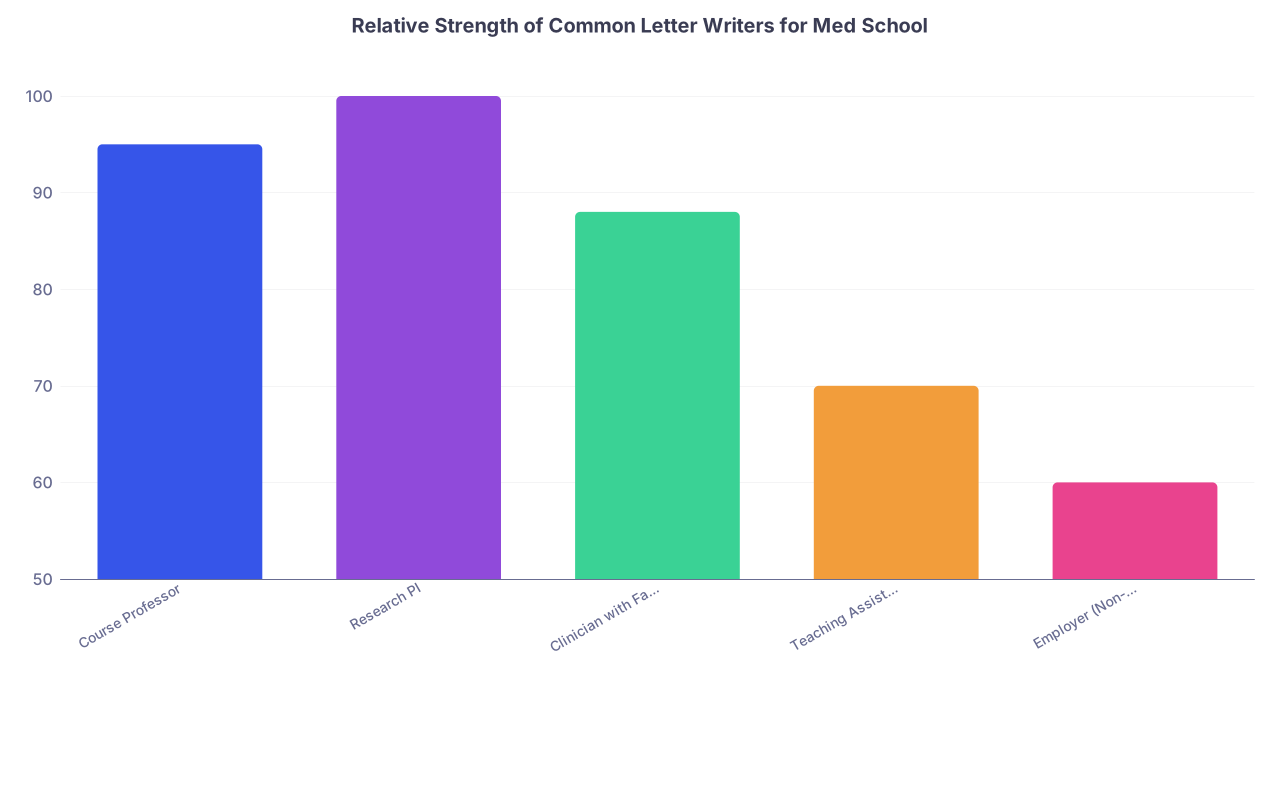
| Category | Value |
|---|---|
| Course Professor | 95 |
| Research PI | 100 |
| Clinician with Faculty Title | 88 |
| Teaching Assistant Only | 70 |
| Employer (Non-Clinical) | 60 |

| Step | Description |
|---|---|
| Step 1 | Need Science LOR |
| Step 2 | Use TA+Prof Combo Letter |
| Step 3 | Get Letter from Other Prof/PI |
| Step 4 | Email School to Ask About TA |
| Step 5 | Use TA Letter as Supplement |
| Step 6 | Prioritize Building Prof Relationships |
| Step 7 | School Require Professor? |
| Step 8 | Can Prof Co-Sign TA Draft? |
| Step 9 | Other Prof/PI Available? |
| Step 10 | Have Strong Prof Letters Elsewhere? |

FAQs: TA vs Professor Letters for Premed Students
1. If I have an amazing TA letter and a generic professor letter, which should I send?
Send both if the school’s letter limit allows. Let the professor letter fulfill the technical “science faculty/professor” box, and let the TA letter carry the real narrative. If you’re forced to choose and the school accepts TA letters, pick the one that is clearly stronger and more detailed. Weak professor letters do not impress anyone.
2. Can a TA upload the letter directly to AMCAS or AACOMAS?
Yes, mechanically they can, but the issue is not the upload. The issue is how the school categorizes that writer. The system won’t block a TA, but the admissions committee might downgrade the letter if they expect professors. This is why a TA + professor combo letter is smart — professor listed as author, TA named within the text.
3. My TA is a current MD/PhD student. Does that make their letter stronger?
Yes, somewhat. An MD/PhD or senior PhD candidate who has taught extensively is more credible than a first-year graduate TA. They understand what medical schools want and can compare you to other premeds. But they’re still not equivalent to a full faculty member in the eyes of many schools. Treat their letter as a strong supplement or co-authored option, not necessarily your only science letter.
4. What if my professor refuses to co-sign because they never observed me directly?
Then you do not push it. Get the TA’s letter on its own, and simultaneously line up other letters from people with professor-level or PI roles who have directly observed you — research mentor, small seminar instructor, thesis advisor. And email individual schools asking if a TA letter can count as a science instructor letter in your specific situation.
5. How many letters should I have total for medical school?
For most MD programs, 3–5 total letters is the sweet spot. For example: two science professors (or professor+PI), one non-science/character letter, and optionally one strong TA or clinician letter as a bonus. Beyond 5, committees start skimming — extra letters only help if they add genuinely new information.
6. Is it bad if my only strong science letter is from a TA?
It’s not ideal, but it is not fatal if you handle it intelligently. You must: confirm with each school whether they will accept a TA as a science instructor; strengthen your other letters (research, non-science, clinical); and be ready to explain your situation if asked. Long term, you should deliberately take at least one course where you can build a real relationship with a professor.
7. When should I ask a TA or professor for a letter?
Ask near the end of the course when you’ve already proven yourself but while they still remember you — often 4–8 weeks before you actually need the letter. For TAs graduating or moving on, earlier is better. And always ask, “Would you be comfortable writing me a strong letter?” You’d rather hear a polite no than get a lukewarm, generic review.
Open a blank document right now and list every TA and professor who could plausibly vouch for you. Next to each name, write “TA,” “professor,” or “PI,” and how well they know you (1–10). Then decide, concretely, who you’ll ask for your two science letters — and whether any TA needs a professor co-sign — before another semester slips by.