
You’re staring at your application checklist. GPA, MCAT, activities, personal statement… fine. But the “Letters of Recommendation” section feels like a trap. People keep telling you: “Get strong letters from different types of mentors.”
What does that actually mean? How many “types” do you really need? And do you really need a whole committee of people who “know you well” when half of them barely know your last name?
Let me answer this the way adcoms actually think about it, not the way Reddit mythology explains it.
The Short Answer: You Need 3–4 Functional “Types,” Not 10 Different Titles
Here’s the core truth:
You do not need ten different mentor archetypes. You need 3–4 functional perspectives on you as a future physician.
For most premeds applying to medical school, a balanced LOR set usually means:
- Science faculty mentor – evaluates academic ability in rigorous science coursework
- Non-science or second academic mentor – shows broader intellect/writing/communication
- Clinical mentor (physician or clinical supervisor) – comments on patient-facing qualities and professionalism
- Research mentor (if you did substantial research) – comments on curiosity, persistence, and work ethic in a scholarly setting
Most applicants will have 3–5 letters total. You want those letters to cover those 3–4 roles or perspectives, not to collect different job titles just to “look varied.”
If you try to get a unique mentor type for every activity, you’ll end up with a bloated packet full of weak, generic letters. That’s worse than having fewer, stronger ones.
What Admissions Committees Actually Want Your Letters To Do
Think of letters as verification and illustration. They should:
- Confirm that your application is not exaggerated
- Provide specific examples of your behavior, character, and performance
- Cover the main “zones” where future physicians need to excel: academic rigor, human skills, professionalism, and (optionally) scholarship/research
They care far more about content and credibility than about whether the person is called “Director,” “PI,” “Chief Resident,” or “Adjunct Assistant Something.”
So instead of asking “How many types of mentors?” ask:
- Who has seen me work hard over time?
- Who has seen me interact with others in real situations (patients, teams, classmates)?
- Who can describe growth or resilience, not just raw talent?
Those answers lead you to the right mix.
The Core Four Mentor Types (and When You Actually Need Each)
Let’s go one by one.
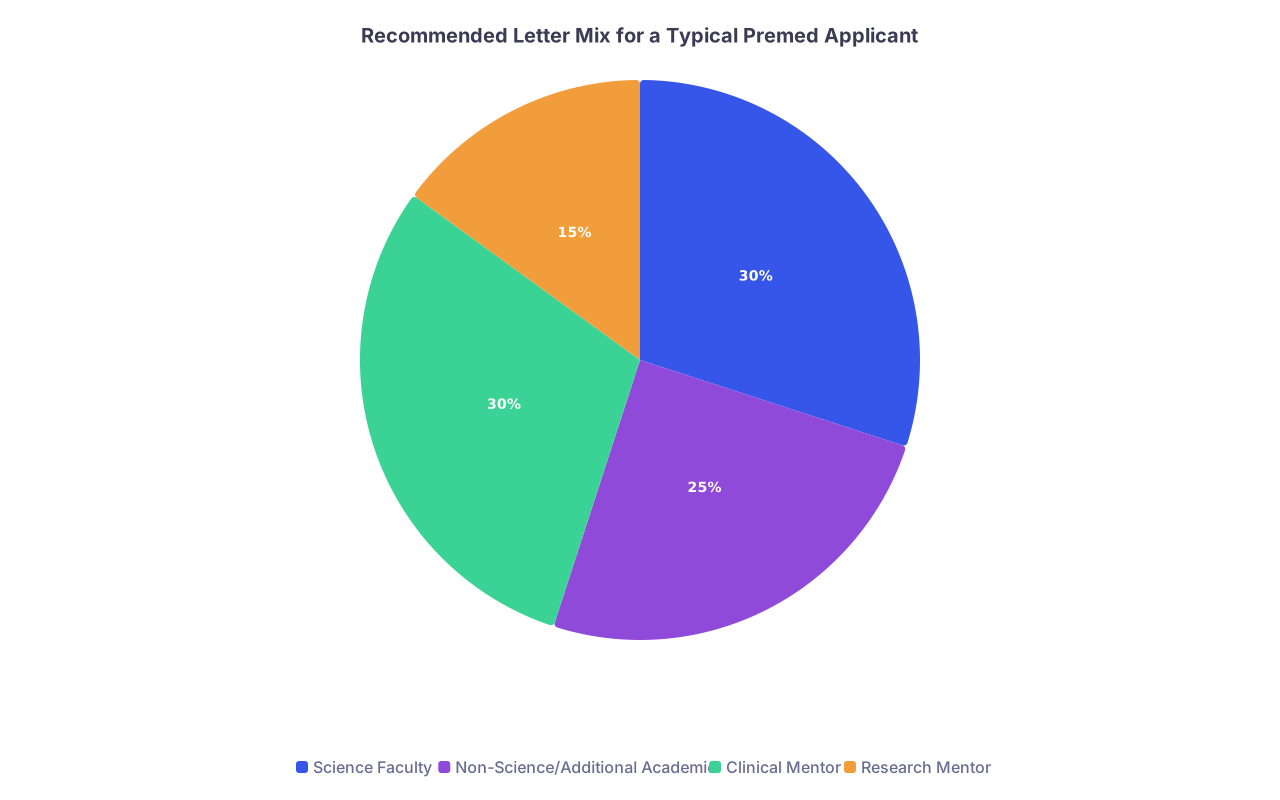
| Category | Value |
|---|---|
| Science Faculty | 30 |
| Non-Science/Additional Academic | 25 |
| Clinical Mentor | 30 |
| Research Mentor | 15 |
1. Science Faculty Mentor – Non-Negotiable
If you are applying to MD or DO programs, you need at least one strong letter from a science faculty member (biology, chemistry, physics, biochemistry, sometimes engineering depending on school rules).
Why it matters:
- Proves you can handle rigorous, technical material
- Speaks to your work ethic in a high-expectation environment
- Often compared with other premeds the professor has seen
Good signs this person is a solid choice:
- You took a small or mid-sized class (or multiple classes) with them
- You spoke to them in office hours, worked on a project, or TA’d for them
- They’ve commented on your work quality, not just your grade
If you only have one genuinely strong science faculty letter, that’s enough for most schools. Two is fine, as long as they’re both real and not generic.
2. Non-Science or Additional Academic Mentor – Strongly Recommended
This might be an English professor, a history lecturer, a philosophy instructor, or a second science prof. The point isn’t the label “non-science.” The point is:
- Shows you can write, think, and engage broadly
- Confirms you’re not just a test-taking robot
- Often can talk about your participation, communication style, and curiosity in more human terms
This matters a lot if:
- You wrote a major paper or did a seminar-style course with discussion
- You had graded presentations or projects involving teamwork
- You want to emphasize communication, ethics, humanities, or public service in your narrative
If you’re tight on LOR slots, a second science prof can fill this “academic” role too—especially if they knew you in a more interactive context (lab, small class, advanced seminar).
3. Clinical Mentor – Mandatory for Most Strong Applications
You’re applying to be a physician. Schools want someone to say:
“I saw this person in a clinical environment with patients, staff, and a real system. They acted like someone I’d trust on my team one day.”
This can be:
- A physician you shadowed extensively
- A nurse manager or clinic supervisor where you volunteered
- A medical assistant supervisor, scribe supervisor, hospice coordinator, etc.
Do not overcomplicate the title here. A non-MD clinical supervisor who really knows you is better than a famous MD who barely remembers your face.
They should be able to speak to:
- Reliability (showing up, following rules, being prepared)
- Professionalism (confidentiality, boundaries, respect)
- Compassion and communication with patients and families
If your application has zero clinical letters, programs may reasonably wonder whether your clinical experience was shallow or purely observational.
4. Research Mentor – Optional but Major Plus if You Did Significant Research
If your “research” was a couple months of dishwashing in a lab, skip the letter.
If you:
- Spent a year or more in a lab
- Took ownership of a project
- Presented a poster or co-authored something
…then a research PI, postdoc, or senior lab mentor can be incredibly valuable.
They highlight:
- Problem-solving under uncertainty
- Resilience when experiments fail (they almost always do)
- Initiative, independence, and intellectual curiosity
For MD/PhD, heavy-research schools, or anyone pitching a “physician-scientist” angle, this type of mentor letter shifts from “nice” to “essential.”
So How Many Letters Total—and How Do These Types Fit?
Typical U.S. MD applicant patterns:
| Applicant Type | Total Letters | Common Mix |
|---|---|---|
| Standard Premed | 3–4 | 1 science, 1 other academic, 1 clinical, +/– 1 research |
| Research-Heavy Premed | 4–5 | 1–2 science, 1 research PI, 1 clinical, +/– 1 non-science |
| Non-Trad with Work Exp | 3–4 | 1 academic, 1 clinical, 1 supervisor/employer |
| DIY Post-bacc Student | 3–4 | 2 science post-bacc faculty, 1 clinical, +/– 1 research or employer |
Most schools let you submit 3–5 letters. Many say “we require 3 and accept up to 5 or 6.” More is not better once you’ve covered the key roles.
Your realistic target:
- 3 letters if they’re all excellent and cover science + academic + clinical
- 4 letters if you have a meaningful research experience or unique perspective that adds something new
If you’re going above 5, you’re probably compensating for weak content. That rarely works.
Bad Ways to Think About “Different Types of Mentors”
Let me be blunt about a few common mistakes.

Mistake 1: Collecting Titles Instead of Perspectives
Students chase:
- The “famous surgeon” letter
- The “Dean of Something” letter
- The “Hospital CEO” letter
If these people did not work closely with you, their letters are usually worthless. They either ghostwrite something generic or sign a template someone else wrote. Adcoms can smell that a mile away.
One strong letter from a mid-career associate professor who actually taught you and can tell three stories about you > five letters from Very Important People you barely interacted with.
Mistake 2: Duplicating the Same Perspective Three Times
Three big-class science prof letters that all say “A student, did well on exams, quiet but nice” is not diversity. It’s redundancy.
You want:
- At least one letter that comments on your real-time behavior with patients or teams
- At least one that focuses on your intellectual performance and discipline
- If possible, one that hits growth, resilience, or character from a different angle
If everyone is just rehashing your transcript and MCAT stats, your letters are wasted space.
Mistake 3: Using “Backup” Letters That Are Obviously Weak
You know the difference between:
- “Sure, I guess I can write you a letter”
and - “Yes, I’d be happy to. I’ve seen you do X, Y, Z; I can speak to your strengths.”
If your gut says a letter will be lukewarm, do not include it just to “add another mentor type.” A lukewarm letter can quietly drag you down.
Choosing Your Actual People: A Simple Framework
Here’s a clean way to decide who to ask.

| Step | Description |
|---|---|
| Step 1 | List everyone who supervised/taught you |
| Step 2 | Do NOT ask |
| Step 3 | Science Academic Letter |
| Step 4 | Additional Academic Letter |
| Step 5 | Clinical Letter |
| Step 6 | Research Letter |
| Step 7 | Professional Letter |
| Step 8 | Can they describe you with examples? |
| Step 9 | What context? |
Then ask yourself:
- Do I have at least one strong science academic letter?
- Do I have at least one other academic letter (science or non-science)?
- Do I have at least one strong clinical letter?
- If I did serious research, do I have one research letter from someone who actually supervised my work?
If all four are covered, you’re done. Anything else has to justify its existence by adding a truly different angle (for example, a long-term community service supervisor who’s seen major personal growth).
Special Cases: Non-Trads, Committee Letters, and DO Programs
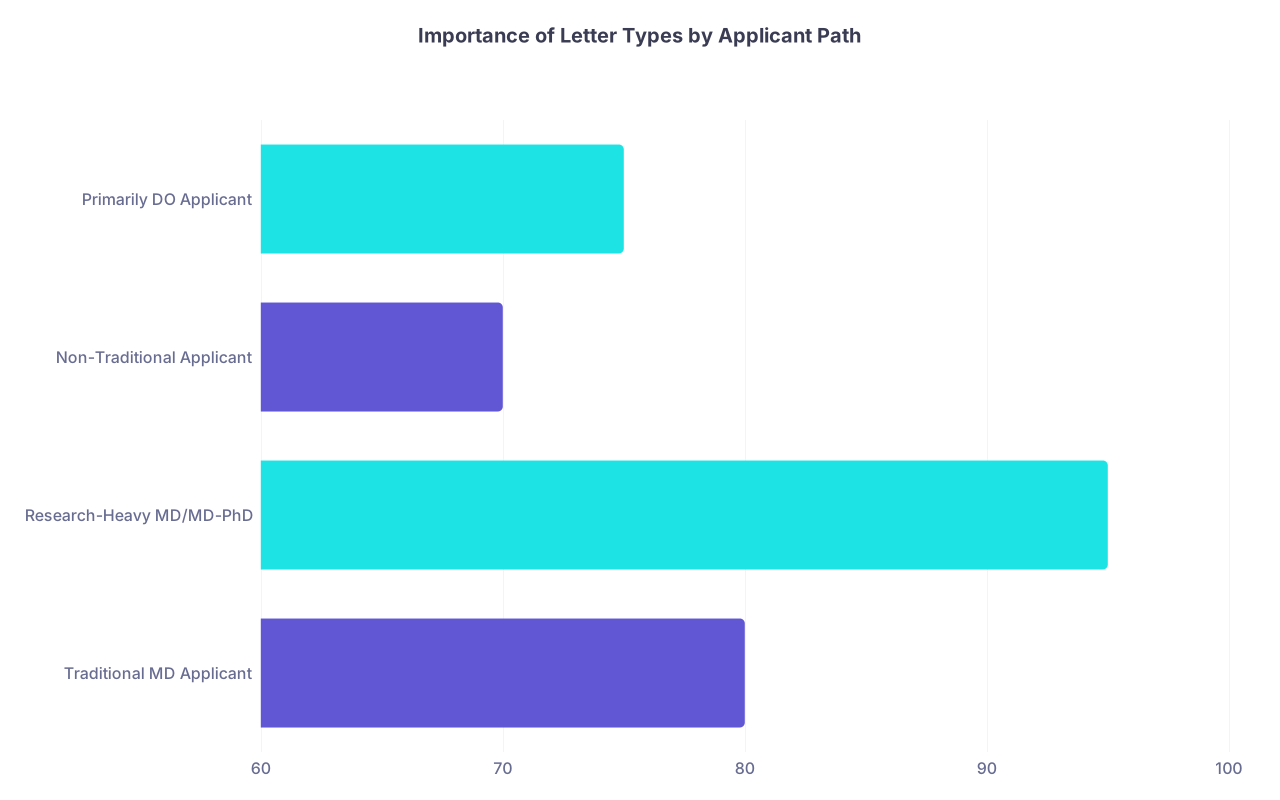
| Category | Value |
|---|---|
| Traditional MD Applicant | 80 |
| Research-Heavy MD/MD-PhD | 95 |
| Non-Traditional Applicant | 70 |
| Primarily DO Applicant | 75 |
Non-Traditional Applicants
If you’ve been out of school for years, you may not have recent academic mentors.
Aim for:
- 1–2 recent academic letters from post-bacc or community college science courses
- 1 strong work supervisor letter (shows reliability, maturity, leadership)
- 1 clinical supervisor (to prove you’ve actually seen modern healthcare up close)
Adcoms understand that your 2011 organic chem professor does not remember you. Do not force that letter.
Committee Letters
Some schools give you a “committee letter” that bundles or summarizes multiple writers.
In that case:
- The “types” of mentors still matter inside that packet
- You still want professors and supervisors from different contexts contributing
- If the committee letter is mandatory, aim for variety among the people who submit to the committee
Committee letter + 1–2 additional individual letters (often clinical or research) is common.
DO Programs
Many DO schools specifically like:
- At least one letter from a DO physician (if possible)
- Science faculty letters similar to MD programs
Here, your “clinical mentor” might strategically be a DO physician you shadowed extensively. Same functional role, slightly different label.
How Early to Start Building These Relationships
You can’t fix LOR problems in the month before AMCAS opens. Relationships take time.
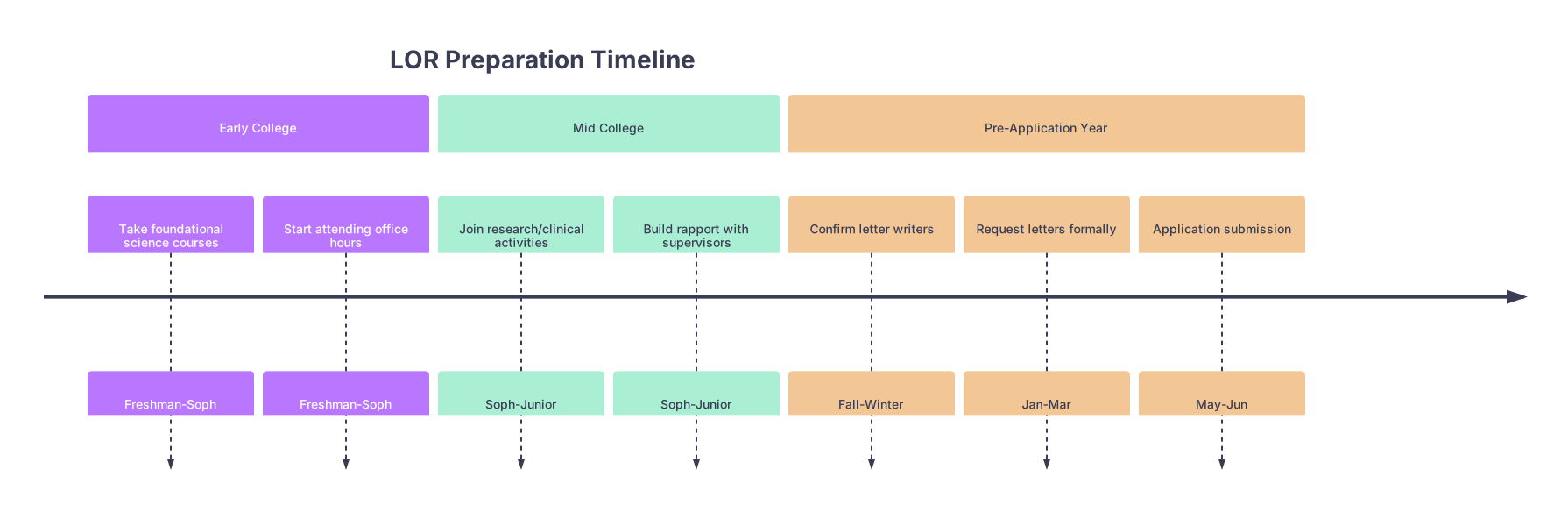
| Period | Event |
|---|---|
| Early College - Take foundational science courses | Freshman-Soph |
| Early College - Start attending office hours | Freshman-Soph |
| Mid College - Join research/clinical activities | Soph-Junior |
| Mid College - Build rapport with supervisors | Soph-Junior |
| Pre-Application Year - Confirm letter writers | Fall-Winter |
| Pre-Application Year - Request letters formally | Jan-Mar |
| Pre-Application Year - Application submission | May-Jun |
If you’re early in the process:
- In every major science course, pick one professor to get to know better: office hours, questions, small project, etc.
- In every long-term activity (clinic, lab, service), ask yourself: “If I needed a letter from here, who would it be? What do they currently know about me?”
You are not faking relationships. You’re being deliberate about letting people actually see you work.
FAQs
1. Is it bad if two of my letters are from science professors and I have no non-science letter?
Not automatically. Many applicants submit:
- 2 science prof letters
- 1 clinical letter
- +/– 1 research letter
That’s acceptable at most schools, especially if one of those science letters involved close interaction (small class, lab, project). But if you have a strong non-science academic mentor who knows you well, that can round out your file nicely.
2. Do I really need a research letter if I only did a summer program?
Only if:
- You had real responsibilities
- You were there long enough for them to actually see your work
- The mentor is enthusiastic about you
If your research was minimal and the PI barely knows your name, skip it. Use that slot for a clinical or academic letter from someone who actually supervised you.
3. Can a TA write one of my academic letters?
TA alone? Usually not ideal. But a hybrid works well:
- TA writes detailed comments and feedback about you
- Professor co-signs or formally submits the letter incorporating the TA’s perspective
Many adcoms are fine with this, because the professor is still vouching for the content.
4. Is a boss from a non-clinical job useful (e.g., Starbucks manager)?
Potentially very. If:
- You worked there for a long time
- They saw you handle stress, customers, conflict, leadership
This kind of letter is particularly valuable for non-trads or students with major work responsibilities. It should not replace your science or clinical letters, but it can be an excellent “extra perspective.”
5. What if my clinical experience was limited and I don’t have a strong clinical mentor?
Then you have two problems: weak clinical experience and lack of a clinical recommender. The fix is the same: get more substantive clinical exposure now. Even 6–12 months with consistent hours in one setting can create a credible letter. Do not try to force a letter from a physician you shadowed twice.
6. How do I know if someone’s letter will be strong or just generic?
Ask directly:
“Would you feel comfortable writing me a strong letter of recommendation for medical school?”
If they hesitate or rephrase it as “I can write you a letter,” that’s a yellow flag. People who are genuinely enthusiastic usually say something like, “Yes, I’d be happy to. You’ve done great work in X and Y.”
Key Takeaways
- You don’t need a circus of different mentor “types.” You need 3–4 functional perspectives: science academic, other academic, clinical, and research (if significant).
- Prioritize depth of relationship and specific examples over fancy titles. One strong letter from someone who truly knows you beats three generic “A student” letters.
- Plan early so each major environment—classroom, clinic, lab, work—has at least one person who’s seen you consistently and can vouch for who you really are.