
The biggest lie about letters of recommendation is that they’re only for the “favorites.”
If you’re at a giant school where every class is 300 people, and you’re sitting there thinking, “None of my professors even know my name—how am I supposed to get meaningful letters for med school?” you’re not crazy. You’re just in the situation almost nobody talks about honestly.
I’m going to be blunt: most premeds at big universities feel exactly like you do. They just don’t admit it out loud.
You imagine everyone else has three physicians, two PhDs, and a Nobel Prize winner ready to write them glowing, personalized letters about their leadership, character, and how they cured cancer in Sophomore Spring. Meanwhile you’re replaying every lecture wondering if your orgo professor would even recognize you without the gradebook.
Let’s sort this out. Because you absolutely can get solid letters from a big, impersonal school. But it’s not automatic, and it’s not what your premed office makes it sound like.
Reality Check: You Are Not the Only One They Don’t Remember
Here’s the ugly truth: in a 300–500 person lecture, your professor doesn’t remember almost anyone.
Not the kid who sat in the front row every day.
Not the one who asked ten questions a class.
Definitely not the one who turned off their camera in Zoom class for a year straight.
Most professors at huge state schools live in survival mode during the semester. Three courses, multiple TAs, 800+ students, grants to write, their own research, maybe a family, maybe admin work tossed on top. They barely remember what they lectured on last Tuesday.
So no, you’re not uniquely forgettable. You’re just one of many.
And that actually helps you, because it means the bar to becoming “memorable enough” is a lot lower than you think. You don’t need to be a prodigy. You need to be visible, consistent, and intentional.
But if you’re already past those classes, already got the grades, and did none of that? You’re probably panicking: “Too late. I’m screwed.”
You’re not. But you’re going to have to be proactive in a way that feels awkward and forced at first.
First Question: Do You Actually Need Professors, Or Just Strong Letter Writers?
Before you start spiraling about “no professors remember me,” you need to clarify what kind of letters you actually need.
Most med schools want something like:
- 2 science faculty letters
- 1 non-science or humanities/social science faculty letter
- 1–2 “other” letters (research PI, physician, employer, etc.)
If your school has a premed committee letter, they might “bundle” your letters, but they’ll still usually want faculty behind it.
Here’s the thing nobody explains well: they rarely say those letters must be from full professors who know your soul. “Faculty” usually includes:
- Lecturers
- Adjuncts
- Instructors
- TAs (often co-writing under a professor’s name)
So if your anxiety is specifically: “The giant famous professor doesn’t know me,” that’s not the end of the story. You might be able to lean on:
- A TA who actually talked to you
- A lab instructor who graded your work and saw you in person
- A smaller discussion section leader
- A PI in a lab (even if not MD or not in a textbook-class you took)
You’re allowed to get creative, as long as the letter writers can reasonably speak to your academic ability, work ethic, or character.
Okay, But My Professors Really Don’t Know Me. Now What?
Let’s walk the worst-case scenario you’re imagining:
- You took all your prereqs in giant lectures
- You never went to office hours
- You did fine or even very well, but you were anonymous
- It’s now application year (or right before), and you need letters yesterday
That pit in your stomach? Totally rational. But this is still salvageable.
Step 1: Stop Waiting for Some Magical “Stronger Connection” to Appear
You’re probably waiting for the moment when you feel close enough to ask someone. That moment almost never comes. Faculty don’t wake up one morning and go, “Wow, I suddenly understand this kid’s character and journey. I hope they ask me for a letter.”
You ask first. Then you build the connection around that.
Backwards from what your brain wants. But it’s what people actually do.
Step 2: Identify Every Possible Academic Person Who’s Met You
This includes:
- TAs for labs or discussions
- Instructors for upper-level seminars (even if not “premed” classes)
- Small elective course professors
- Research supervisors (even if they’re postdocs)
- Course coordinators who answered multiple emails from you
If someone has seen your work, graded your work, or supervised your work, they’re fair game. Does your anxiety scream “They barely know me”? Sure. But you’re not asking them to write your eulogy. You’re asking them to honestly describe what they do know.
You can combine 1–2 detailed, stronger letters (from research / work / volunteering) with 1–2 more “traditional” faculty letters that lean heavily on your academic performance.
How to Ask a Professor Who Doesn’t Really Remember You
This is the part where you probably want to disappear.
You’re thinking, “They’ll think I’m using them. They’ll think I’m arrogant. They’ll say no. Or worse, they’ll say yes and secretly hate me and write a lukewarm letter that ruins my chances.”
I’ve seen all of that anxiety before. Here’s the reality.
Professors at big schools fully expect to be asked for letters by students they barely know. That’s…their normal. They survive it using structure.
What they need from you is enough information to fake knowing you better than they do, in a way that’s still honest. That’s where you help them.
How to write the email (even if it makes you cringe)
You’re not pretending you were their favorite student. Don’t lie. Don’t say “As you may remember…” when you know they don’t.
You do this:
- You introduce yourself with concrete anchors: semester, course, your grade.
- You say what you’re applying for and when.
- You ask if they’d feel comfortable writing a strong letter.
- You offer a “letter packet” so they’re not starting from zero.
Something like:
Dear Dr. Smith,
My name is [Name]. I took your BIOL 202 (Cell Biology) course in Fall 2023 and earned an A in the class. I really appreciated your lectures on cell signaling and attended several of your review sessions before the midterms.
I’m currently preparing my application to medical school for the 2025 cycle and am hoping to secure a science faculty letter of recommendation. Would you feel comfortable writing a strong letter on my behalf, focusing on my performance and work ethic in your course?
To make this as easy as possible, I can send you a brief packet with my CV, personal statement draft, unofficial transcript, and a short summary of my work in your class (exam scores, any participation, etc.). I’d be grateful for any support you’d be willing to provide.
Thank you for your time and consideration,
[Name]
[ID if needed]
Yes, you’re giving them language like “strong letter” on purpose. It gives them an easy exit if they actually can’t endorse you.
Most of the time, especially if you did well, they’ll say yes.
The Secret Weapon: The “Letter Packet” That Makes You Memorable After the Fact
Your letter packet is how you turn “some kid in a huge class” into an actual person in their head.
It should include:
- Your resume/CV
- Draft of your personal statement (even if messy)
- A short “brag sheet” specific to their class or your work with them
- A bullet list (yes, here bullets are actually necessary) of traits you hope they’ll highlight: work ethic, resilience, improvement, curiosity, reliability, etc.
- A clear deadline
That “brag sheet” can feel like self-promotion hell, but it’s just data they can plug into a letter. For a class professor, it might look like:
- BIOL 202 grade: A
- Exam scores: midterm 1: 92, midterm 2: 89, final: 94
- Attended 3 office hours/review sessions (list dates if you have them)
- Group project on [topic], contributed [what you did]
- Specific time you asked a question / showed initiative (if any)
They’re going to write something like: “In my large-enrollment BIOL 202 course (~350 students), [Student] distinguished themselves by consistently earning top exam scores (92, 89, 94) and actively engaging during review sessions.”
Do they “remember” you now? Sort of. But more importantly, they have concrete facts that adcoms care about.
If You Still Have Time Before Applying: Manufacture Smaller Spaces
If you’re not applying this cycle, you’ve got more room to fix this.
At a giant school, you almost have to engineer environments where someone can see you as a human being rather than a student ID number.
That can look like:
- Taking 1–2 smaller upper-level science courses (even if they’re harder) and intentionally going to office hours 3–4 times
- Joining a research lab and getting facetime with your PI or senior postdoc
- Taking a seminar in a humanities/social science where discussion is required
- Doing an independent study or honors thesis where a faculty member meets with you regularly
You don’t need 10 faculty who know you. You need 2–3 people who can write more than “This student received an A and seemed pleasant.”
And no, you don’t need to be fake-extroverted. You just need consistent presence:
Showing up to office hours. Asking one real question per visit. Sending one follow-up email about something that genuinely interested you. That’s often enough.
Alternative Letter Writers: Who Counts and Who Doesn’t
There’s a hierarchy here, whether schools say it out loud or not.
Let me simplify it with a quick comparison.
| Letter Writer Type | Typical Strength for Med Apps |
|---|---|
| Research PI (MD or PhD) | Very strong |
| Science course professor | Very strong |
| Non-science professor | Strong |
| Clinical supervisor (MD/NP/PA) | Strong to very strong |
| TA / Postdoc (co-signed) | Moderate to strong |
So if you’re short on “traditional” faculty who know you, it’s smart to compensate with really solid letters from:
- A research PI who’s seen you show up for months or years
- A physician you’ve worked closely with (scribe, MA, long-term volunteer)
- A boss from a consistent job (even non-clinical) who can talk about reliability and maturity
Med schools absolutely care what non-academic supervisors think about you, especially for professionalism, work ethic, and how you function on a team.
You just have to follow instructions: if they say “2 science faculty letters required,” you still have to hit that number. But the other slots can and should be filled by people who actually know your character.
If You’re Already in Crisis Mode: Timeline vs. Panic
You may be here because you’re 4–8 weeks away from wanting everything in. That’s when the dread peaks.
Let me show you something to calm your brain just a little:
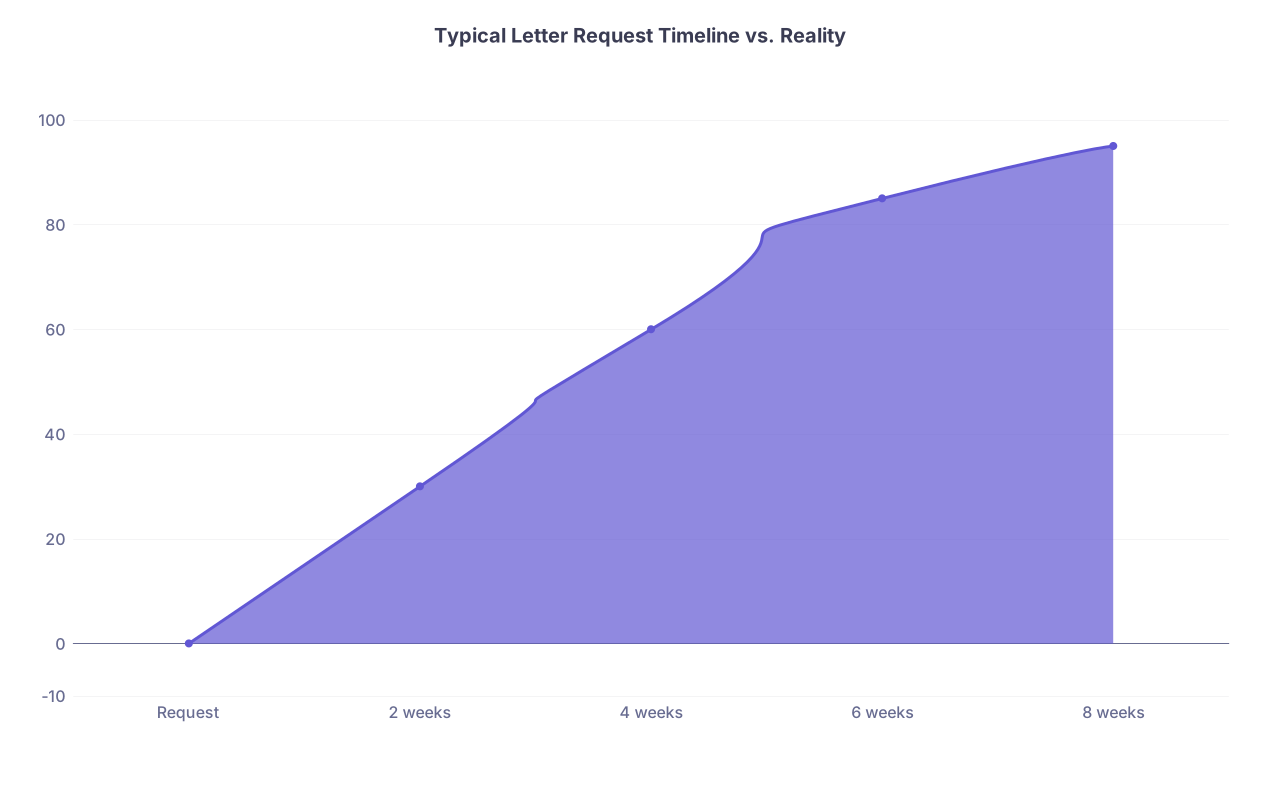
| Category | Value |
|---|---|
| Request | 0 |
| 2 weeks | 30 |
| 4 weeks | 60 |
| 6 weeks | 85 |
| 8 weeks | 95 |
Translation: even if you ask now, most writers will take weeks. That’s normal. Your job is to:
- Ask early from this moment forward
- Give a clear deadline (ideally 4–6 weeks out)
- Send one polite reminder about a week before the deadline
You’re not the annoying exception. You’re exactly like every other panicked premed in their inbox.
What If The Letters End Up “Generic”?
Here’s the fear under all of this: “What if I go through all this hassle and my letters are just…meh? And everyone else’s are glowing and detailed and my file screams ‘mediocre human’?”
Some hard truth: tons of accepted students have pretty generic letters.
Adcoms see the pattern. They know which schools are huge and impersonal. They know which classes enroll 600 kids. They can tell when a professor is writing the same paragraph for 30 students with name-swaps.
And they don’t hold you personally responsible for your institution’s structure.
Where it does hurt you is if:
- The letter is lukewarm or negative
- The letter contradicts what you say elsewhere (e.g., about your work ethic)
- You have no one, anywhere, who can speak specifically about your character or reliability
So your real goal is not “three love letters from world-famous scientists.” It’s:
- No weak/negative letters
- At least 1–2 letters with specific, concrete examples of you being competent and not a disaster
- Enough academic backing to show you didn’t fluke your grades
That’s achievable, even from a huge school, even starting late.
You Are Not Disqualified Just Because You Were Invisible For a While
Here’s what I want you to hear clearly: your anonymity in those giant classes doesn’t mean you’re not cut out for medicine.
It means you were doing what most first- and second-year students at large universities do: surviving. Trying not to drown. Showing up when you could. Sitting in the back because everything felt overwhelming.
That story is way more common than the “I built a deep mentoring relationship from day one of Chem I” fantasy.
Is it ideal? No. Can you fix it? Largely, yes.
How?
By being ruthlessly practical:
- Ask for letters even if you feel “unworthy” of asking
- Give your writers what they need to write something decent
- Create smaller academic spaces going forward where someone can actually know you
- Use non-faculty supervisors to show your character where faculty can’t
You don’t need to feel 100% comfortable to do any of this. You just need to be uncomfortable and send the emails anyway.

| Step | Description |
|---|---|
| Step 1 | Realize professors dont know you |
| Step 2 | List all possible academic contacts |
| Step 3 | Email 3-6 faculty/mentors with clear ask |
| Step 4 | Send letter packet: CV, PS, brag sheet |
| Step 5 | Follow up once before deadline |
| Step 6 | Supplement with research/clinical letters |


FAQ (Exactly 4 Questions)
1. What if my professor says, “I don’t remember you well enough to write a strong letter”?
First, good. That’s an honest answer. A weak “sure, I guess” is worse than a no. You can reply with something like: “Thank you for your honesty. I really appreciate your time,” and move on. Then lean harder on finding people who’ve supervised you more directly—research, work, smaller classes, clinical roles. You can also ask that same professor if they’d recommend any colleague (like a TA or lab instructor) who interacted with you more.
2. Is it bad if my letter is mostly about grades and performance, not personality?
It’s not ideal, but it’s not catastrophic. An academic letter that clearly states you’re in the top X% of a big class, did well on exams, completed everything on time, and were reliable is still useful. You then balance that with at least one other letter that focuses more on your personality and character—often from a PI, physician, or employer who’s seen you over time.
3. Can a TA actually write my letter, or does it have to be the professor?
Many schools are fine with a TA or postdoc drafting or co-writing a letter, as long as it’s on departmental letterhead and signed or co-signed by a faculty member. The usual move: you ask the TA who knows you best. If they agree, they either write it under their name or as a draft for the professor to approve. Always check each med school’s requirements, but this is very common in big universities.
4. What if I have one amazing letter and two very generic ones—am I doomed?
No. One truly strong, detailed letter can pull a lot of weight. Tons of accepted applicants have exactly your mix: 1–2 glowing, specific letters and a couple of bland-but-positive academic letters. If the generic ones are still positive (no red flags, no faint praise), and your overall app (GPA, MCAT, activities) is solid, you’re fine. Focus your energy on maximizing the quality of the letters that can be strong—usually research, clinical, and long-term supervisors—and stop obsessing about making every single letter perfect.
Key points:
You don’t need professors to “remember” you spontaneously; you can give them what they need to write decent letters.
Generic-but-positive academic letters are normal from large schools; balance them with 1–2 specific, relationship-based letters from research or work.
Feeling invisible in huge classes isn’t disqualifying—it just means you have to be more intentional now about asking, following up, and creating smaller spaces where someone can actually know you.