
It’s April. You just walked out of your “big” pre‑health committee meeting—the one everyone says is critical—and your stomach is in knots.
Instead of the encouraging, strategic conversation you imagined, you got: thin smiles, vague criticism, maybe even, “We recommend you wait a year,” or “We don’t feel comfortable strongly supporting your application.”
Now you’re sitting somewhere on campus—library, empty classroom, your car—refreshing SDN, Reddit, and school websites trying to answer the question that’s now screaming in your head:
Is my entire application screwed because my pre‑health committee isn’t backing me?
And can strong individual letters actually offset a lukewarm or missing committee letter?
Let me say this out loud because I know you’re thinking it:
“I worked this hard, for this long, and my fate might be decided by a handful of people who barely know me?”
Yeah. I’ve seen that exact sentence thrown around in hallways outside pre‑health offices.
Let’s walk through this without sugarcoating—but also without catastrophizing more than necessary (you’re already doing plenty of that on your own).
What It Actually Means To Have An “Unsupportive” Committee
First, you need to be specific about what “unsupportive” means in your case. Because there’s a big difference between:
- They won’t write any committee letter for you
vs. - They’ll write one, but they’re “recommending” you delay or aren’t giving you their “highest endorsement”
Those are not the same level of disaster.
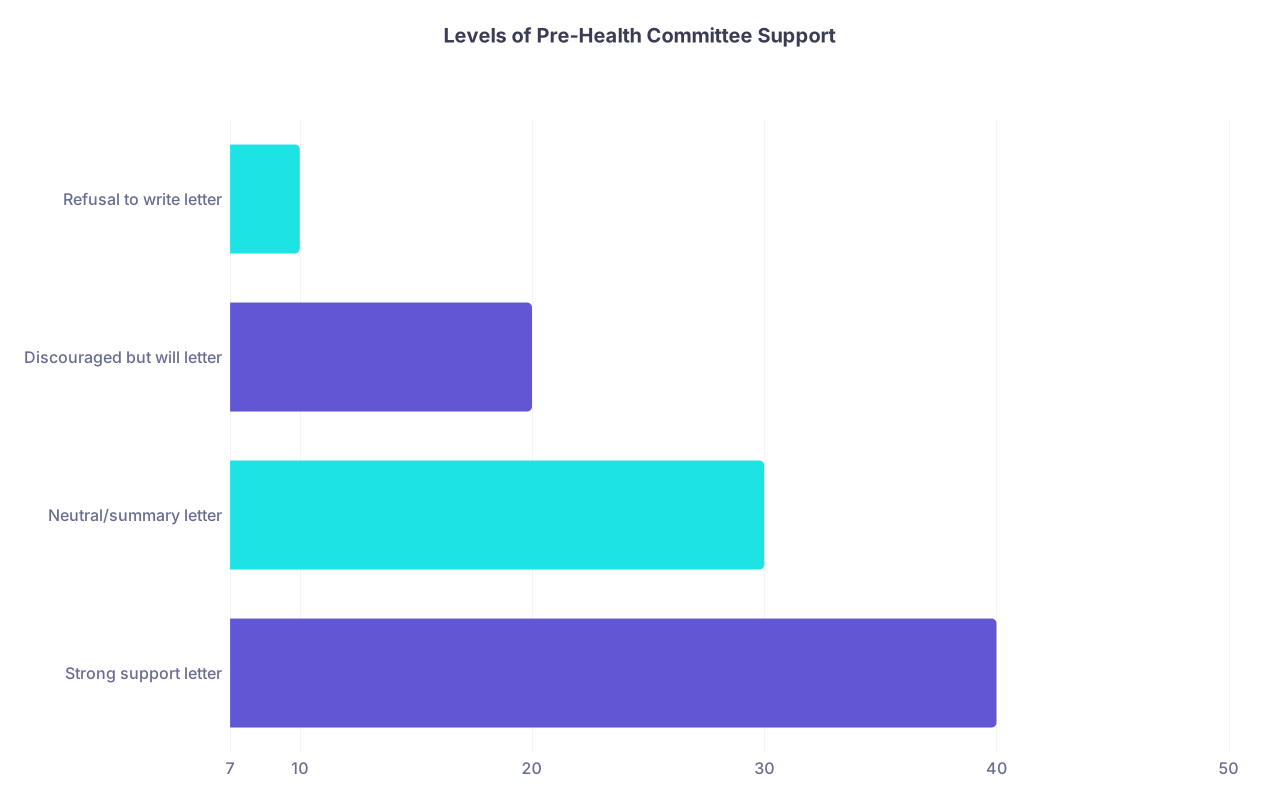
| Category | Value |
|---|---|
| Strong support letter | 40 |
| Neutral/summary letter | 30 |
| Discouraged but will letter | 20 |
| Refusal to write letter | 10 |
I’ve seen:
- Schools where “not recommended” = they literally refuse to write you a letter.
- Schools where “not recommended” just means you won’t get their internal “gold star” rating, but the actual letter is bland and non‑damaging.
- Committees who dramatically overestimate their own importance and use that to pressure students to follow their timeline, not yours.
You need to know which situation you’re in. That determines how much individual mentors can realistically offset this.
Ask yourself:
- Are they refusing to assemble/send a committee letter packet at all?
- Or are they just making you feel small, but will still do the packet?
- Do they use explicit “ratings” in their letters (e.g., “strongly recommend,” “recommend with reservations”)?
If you don’t know, you need to quietly find out. Talk to older students who’ve already applied, especially those who weren’t 3.9/520 robots. They usually have the real story.
Because your worst fear is probably: “They’re going to torpedo my app with a negative letter and I’ll never know.”
That’s the nuclear scenario. Let’s address that head-on.
Can A Committee Letter Be So Bad It Kills Your Application?
Yes. And usually you’ll never see it, because most committees/letter services require you to waive access.
I’m not going to pretend it never happens. I’ve heard of:
- Backhanded phrases like “with guidance, they may mature into a successful medical student”
- Emphasis on weaknesses: “had to repeat organic chemistry,” “struggled with time management”
- Obvious lack of enthusiasm: “X completed required coursework and shadowing experiences.”
But here’s the thing: most committees are bureaucratic, not vindictive. They like checkboxes. If they’re uneasy about you, they’re more likely to write a bland, generic summary than an actively hostile letter. Why? Because hostile letters create problems for them too.
So, worst-case isn’t usually “poison letter.” It’s “weak, generic, irrelevant letter that doesn’t help you at all.” That kind of letter can be partially offset by excellent individual letters.
If you truly think your committee might be actively negative, you need to ask a blunt question:
“Is your policy that you only write supportive letters, or will you write letters that express serious reservations?”
If they say “we will not write a letter if we can’t support you,” that’s awful to hear, but paradoxically safer for your actual applications. At least then they’re not sending a subtle hit piece behind your back.
OK, So Can Strong Individual Mentors Offset A Weak Or Missing Committee Letter?
Short answer: yes, to a point. And for DO schools, some MD schools, and especially for post‑bac / SMP / reapp cycles, individual letters can carry a ton of weight.
But the impact depends heavily on what type of school you’re applying to and what their policies are.
| School Type | Committee Letter Required? | Can Individual Letters Substitute? |
|---|---|---|
| Many mid/top MD programs | Preferred/Requested | Sometimes, with explanation |
| Some state MD schools | Preferred but flexible | Often yes |
| DO schools | Usually flexible | Yes, commonly used |
| Caribbean / offshore schools | Generally flexible | Yes |
| Special master’s / post-bac programs | Flexible | Yes |
Here’s the blunt truth:
- If a school requires a committee letter when available, and your school offers one, you’re already playing defense if you apply without it.
- But if you provide a clear, calm explanation and back it up with 3–5 very strong, specific individual letters, many schools will absolutely still take you seriously.
What they care about:
- Do multiple independent people say you are reliable, bright, and good with patients/peers?
- Do your recommenders know you well, not just “Student X got an A in my class”?
- Do your letters show upward growth if your stats aren’t flawless?
If you can’t change the committee, you’ll have to overcompensate with the people who actually believe in you.
How To Build A “Mentor Shield” Around A Weak Committee
This is the part that actually gives you some control back.
If the committee is shaky, you need:
- At least one letter from a science faculty who knows you well
- At least one from a clinical supervisor or physician who has actually seen you with patients
- Ideally, one more from a PI, non‑science prof, or meaningful long‑term activity supervisor
And these can’t be “I met this person once in office hours” letters. They need depth.
Here’s how you push that—even if you feel annoying and needy doing it.
Step 1: Be brutally honest with at least one trusted mentor
You don’t have to rant about the committee, but you can say:
“I’m worried my pre‑health committee won’t be able to strongly support my application this cycle because of [brief, factual reason: GPA trend, timing, school policy]. Your mentorship has been the most meaningful consistent support I’ve had. Would you feel comfortable writing a strong letter that highlights my strengths and growth?”
People who actually care about you usually step up harder when they know you’re not getting a fair shake elsewhere.
Step 2: Give them ammunition
Don’t just send them your CV and personal statement and hope for the best. That’s how you get vague letters.
Give them:
- A short paragraph with 3–4 key themes you hope their letter will highlight (e.g., resilience after academic setback, leadership, clinical maturity).
- Specific stories you shared (the time you stayed late with that non‑English speaking patient, the failed experiment you redesigned).
- Updates: “Since we last worked together, I’ve done X, Y, Z.”
You’re not “writing the letter for them.” You’re reminding them of details they already know so they can advocate more strongly.
Step 3: Diversify where your support comes from
If your entire application rests on one letter? Terrifying. If you have 4–5 coherent, aligned voices backing you up? Very different story.
Think:
- Research mentor from your lab of two years
- Clinician from your long-term volunteering or scribing
- Non-science professor who saw your growth in a writing-intensive or ethics course
- Supervisor from a job where you were actually responsible for things
That mix can absolutely offset a bland committee letter, especially if your narrative and activities list line up with what they say.
What If I Skip The Committee Letter Entirely?
This is the nightmare scenario looping in your brain: “If I don’t use them, every school will assume I’m hiding something.”
Not universally true.
There are three semi-sane paths:
- Use the committee letter, accept it’ll probably be meh, and overload on strong individual letters to drown it out.
- Skip the committee, apply with individual letters only, and explain briefly in secondaries.
- Delay a cycle to build your profile until the committee is willing to support you.
All three have downsides. None of them are automatic death.
Schools that “prefer” committee letters often have a secondary prompt like, “If your school offers a committee letter and you’re not using one, explain why.”
Your explanation needs to be calm and boring, not emotional and accusatory.
Something like:
“I attended X University, which offers a pre‑health committee letter. Based on my individual circumstances, including my academic trajectory and timing, I made the decision to apply with individual letters from mentors who know my work and growth best. These include [briefly list: research PI, clinical supervisor, science faculty]. I’m happy to provide further context if needed.”
That’s it. Not: “The committee is unfair and biased and torpedoing people.” Even if that’s how it feels.
Schools know some committees are… let’s say, “overly gatekeep-y.” They’ve seen this before.

| Step | Description |
|---|---|
| Step 1 | School offers committee letter |
| Step 2 | Use committee + individual letters |
| Step 3 | Use committee + strong individuals |
| Step 4 | Skip committee, explain briefly |
| Step 5 | Committee supportive? |
| Step 6 | Letter required by target schools? |
Will Programs Blame Me For Having A Weak Committee Letter?
You’re probably imagining an adcom sitting there saying, “Wow, if their own school didn’t support them, why should we?”
Reality: adcoms know committees can be political, risk‑averse, or just bad at spotting late bloomers.
What they actually look at:
- Does your file tell a coherent story?
- Do your individual letters contradict the committee’s lukewarm tone?
- Do your numbers and experiences align more with “ready” or “not remotely ready”?
If your committee says nothing exciting, but your PI writes:
“X is easily in the top 5% of undergraduates I’ve mentored in 15 years, and I would trust them with complex patient-facing research tasks that we usually reserve for graduate students.”
…that makes people sit up.
If your clinical supervisor writes:
“I have watched X calm intensely anxious patients, coordinate with nurses and physicians, and consistently volunteer for the less glamorous tasks. Our staff routinely request to work with them.”
…that offsets a ton of institutional blandness.
You’re not powerless here. But you do have to hustle for those kinds of letters. They don’t fall out of the sky.
How Much Does This Actually Affect My Chances?
You want numbers. Everyone wants numbers. “How much will this lower my chances—10%? 50%? 100%?”
No honest person can give you a percentage, but I’ll give you ranges.
If you’re a borderline applicant (e.g., GPA 3.3–3.5 with an upward trend, MCAT 508–512, decent but not insane ECs):
- Strong committee + strong individuals = you’re in the running at a lot of MD and DO schools.
- Weak committee + excellent individual letters = you’re still in the running, especially at DO, mid-tier MD, and your state schools.
- No committee + excellent individual letters + clear explanation = slight handicap at some MDs, but not a total block.
If you’re already a long shot on paper (low GPA and low MCAT with minimal upward trend), the committee letter isn’t your main problem. It’s just another obstacle on top of the others.
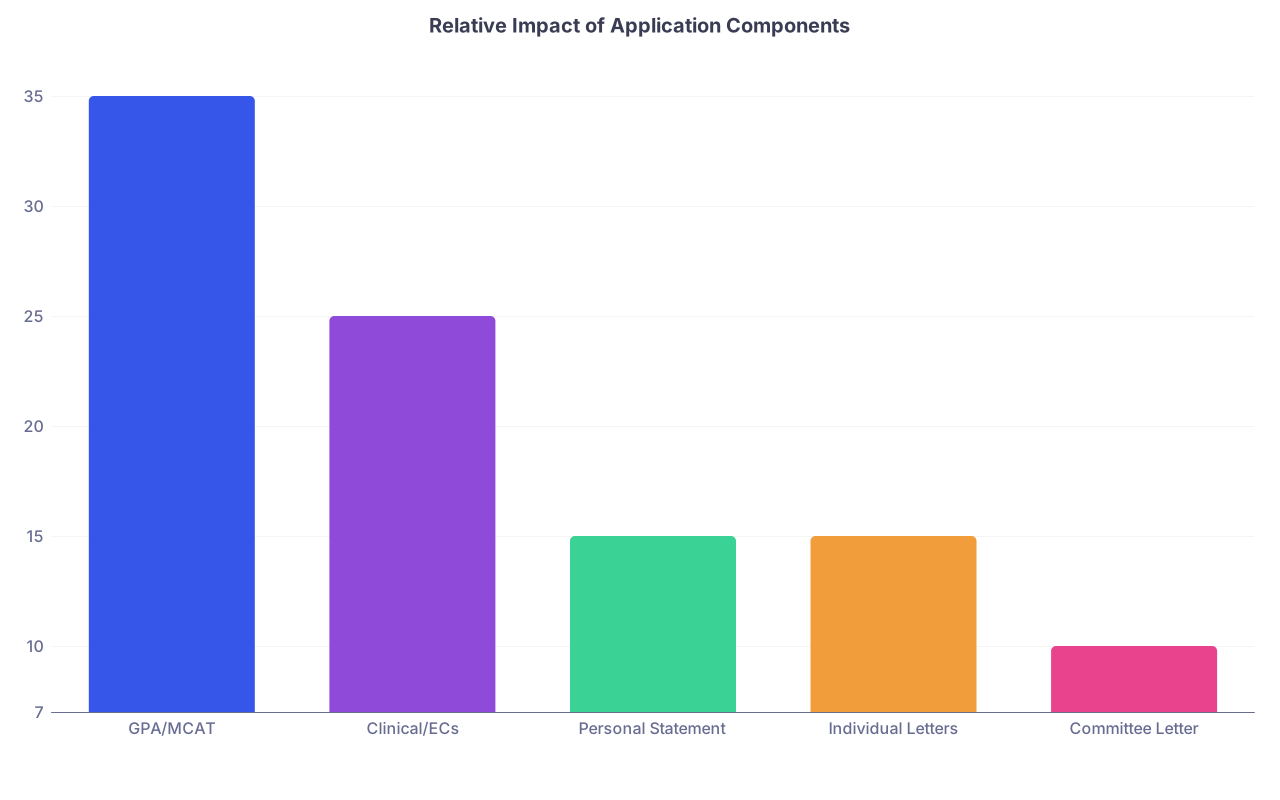
| Category | Value |
|---|---|
| GPA/MCAT | 35 |
| Clinical/ECs | 25 |
| Personal Statement | 15 |
| Individual Letters | 15 |
| Committee Letter | 10 |
That 10% for “committee letter” is not nothing. But it’s also not the whole story.
How To Keep This From Completely Destroying Your Mental Health
Right now, you’re probably doing the thing where you replay the committee meeting in your head 50 times a day, adding new humiliating details each time.
A few practical things to keep you functional:
Separate “unfair” from “impossible.”
The committee being unsupportive is unfair. It does not automatically make acceptance impossible.Anchor your self-worth somewhere other than their opinion.
These people might have met you for 30 minutes and glanced at your GPA graph. Your research PI who’s seen you troubleshoot experiments at midnight? That person probably knows more about who you actually are.Control the controllable:
- Lock in your best possible MCAT (or retake if truly needed and feasible).
- Polish your personal statement so it doesn’t sound like a defensive rant.
- Make your experiences section read like the letters you want them to write about you.
Have a plan B that doesn’t feel like failure.
“If this cycle doesn’t work, I’ll do an SMP/post‑bac/scribe year and reapply with stronger letters and more distance from my committee.”
Just having a plan B calms things down. It’s not over if this year isn’t the one.
One More Hard Truth (That Might Actually Help)
Sometimes a hostile or dismissive committee is a useful signal—not that you should give up, but that you may need another year to become the version of yourself that’s genuinely competitive.
Not because they’re always right. They’re absolutely not. But if multiple people (PI, clinical supervisor, trusted faculty) quietly echo some of their concerns—like professionalism, reliability, or academic readiness—it’s worth listening.
There’s a difference between:
- “They don’t like my 3.4 GPA even though I’ve grown a ton”
vs. - “Three different people have told me I struggle to follow through and I keep hand‑waving that away.”
If it’s the first: push forward, use your mentors, and don’t let the committee define you.
If it’s the second: you might actually feel less anxious in the long term if you fix the underlying issue before med school, not during.
FAQ (Exactly 5 Questions)
1. Will schools automatically assume I’m a weak applicant if I don’t submit a committee letter?
Not automatically, no. Many adcoms know committees can be political or rigid. They will notice the absence and may look for an explanation, but if your individual letters are strong and your file is coherent, they won’t instantly bin your app. Your explanation on secondaries should be short, factual, and non-dramatic.
2. Can I ask my committee what they plan to say in my letter?
You can, but most won’t tell you much. You can ask general questions like, “Is your letter typically a summary of my file, or does it include a rating?” or “Are there any concerns you have that I should be aware of before moving forward this cycle?” Their tone and responses can give you clues. If they say, “We generally only write letters we feel are supportive,” that’s better than, “We’ll document our reservations.”
3. How many individual letters do I need if my committee is weak or absent?
Aim for at least 3 strong ones, 4–5 if schools allow it. One from science faculty, one from a clinical supervisor or physician, and one more from research/long‑term activity is a solid core. More is not automatically better if the extras are generic. Quality and depth matter way more than raw count.
4. Should I delay applying a year just because my committee doesn’t support me?
Not automatically. You delay if your overall application isn’t ready—weak GPA trend, rushed MCAT, shallow clinical exposure—and the committee’s stance is just a symptom of that. If your PI and clinical mentors strongly believe you’re ready now and your stats/experiences are at least in range for the schools you’re targeting, applying without full committee enthusiasm can still be reasonable.
5. What if my individual mentors are supportive but not “famous” or from big‑name institutions?
That’s fine. Adcoms care far more about what the letter actually says than the prestige of the letter writer. A detailed, specific letter from a community clinic doctor who watched you grow for two years is far more powerful than a vague one‑paragraph note from a department chair who barely remembers you. Depth, concrete examples, and genuine enthusiasm win every time.
Today, do one concrete thing:
Email one mentor you actually trust and ask if they’d be willing to write you a strong letter of recommendation—and attach a short bullet list of moments or projects you worked on together that you’re proud of.
Get at least one person firmly in your corner. Then build from there.