
It’s May. Everyone around you is casually dropping lines like, “Yeah, my biochem PI said she’ll write me a strong letter,” or “My orgo professor already wrote my rec for the committee.”
You?
You’re staring at your email drafts, realizing the one person who actually knows you well enough to write something meaningful… teaches history. Or ethics. Or philosophy. Or is your writing tutor.
And suddenly your brain goes straight to:
“I’m screwed. Med schools want science letters. I have one real champion and they’re the ‘wrong’ kind of recommender. I’ve already messed this up.”
Let’s walk through this. Because I’ve seen people in exactly this spot still get into very good schools. But you do need to be strategic.
First: No, a non‑science mentor isn’t “useless”
Let me be blunt: a strong, specific, detailed letter from a non‑science mentor is objectively better than a generic “A‑student, came to class” note from a random science professor you barely spoke to.
Admissions committees are not stupid. They can absolutely tell when a letter writer actually knows you versus when they’re writing Mad Libs with your name in it.
Here’s what your non‑science mentor can probably do that many science professors can’t:
- Talk about your growth over time
- Describe real conversations you’ve had about hard topics
- Give concrete stories where you handled challenge, feedback, or leadership
- Show that you can write, communicate, and think like an adult human
Those things matter a lot more to adcoms than premed Reddit will admit.
Are there schools that strongly prefer or require science letters? Yes. And that’s the annoying part. But your non‑science mentor can still be:
- One of your core letters
- Your best letter
- The letter that gets mentioned in committee when they’re arguing for you
So no, this relationship is not a waste. It just can’t be your only academic relationship forever.
The ugly reality: what schools often want vs. what you actually have
Let’s look at what most med schools say they want in letters.
| School Type | Common Requirements |
|---|---|
| Many MD Programs | 2 science faculty, 1 non-science faculty |
| Some MD/DO Programs | Committee letter OR 3 faculty total |
| Research-heavy MD | Science letters + strong research letter |
| DO Programs | Sometimes prefer/require DO letter |
| Flex schools | More open: academic + supervisor/mentor |
Now, compare that to your reality:
- 1 strong non‑science mentor
- Maybe 1–2 science professors who know your face but not your story
- A research PI who is… “fine” with you but you mostly talked to the postdoc
You’re probably stuck in this unhelpful loop:
“I could ask my orgo professor, but they’ll write something generic. But if I don’t have a science LOR, schools will toss my app. But if I do have a science LOR and it’s weak, that’ll hurt me. So there’s no winning.”
Here’s the actual hierarchy of bad-to-good options:
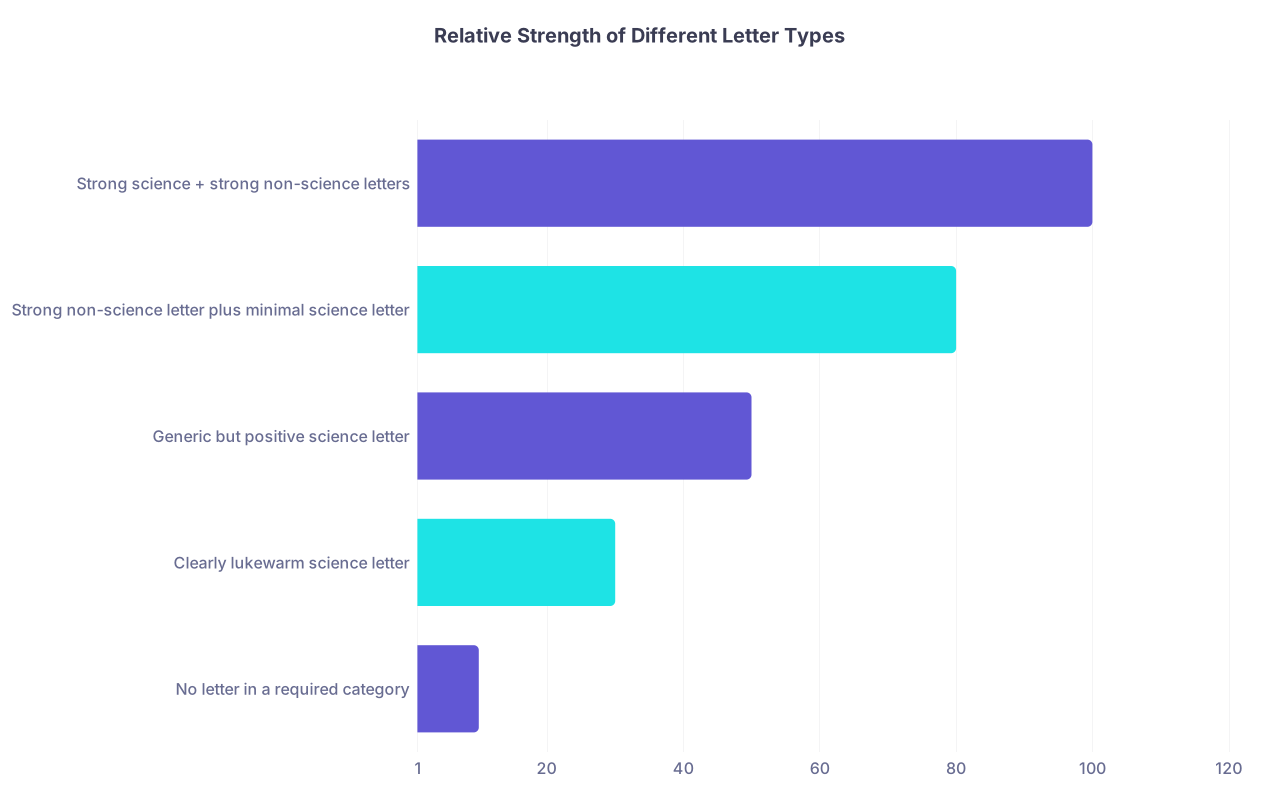
| Category | Value |
|---|---|
| No letter in a required category | 10 |
| Clearly lukewarm science letter | 30 |
| Generic but positive science letter | 50 |
| Strong non-science letter plus minimal science letter | 80 |
| Strong science + strong non-science letters | 100 |
So, what does that mean?
- Worst: Missing a required science letter for a school that explicitly demands it
- Slightly better: A lukewarm science letter that hints you’re not great
- Better: A generic but positive science letter with no red flags
- Actually decent: Strong non‑science letter + okay science letter that meets the checkbox
- Ideal: Yeah, strong across the board. But that’s not your current life.
Your goal?
Move yourself from “missing requirement” to at least “generic but positive” for science, and let your non‑science mentor carry the narrative of who you are.
How to make this non‑science mentor your secret weapon
If this is the one person who truly knows you, maximize it.
1. Have an honest conversation
You don’t just shoot off a casual email like, “Hey can you write a letter?” You sit down with them.
If possible, go in person. If not, Zoom. Say something like:
“I’m applying to medical school. Of all my professors, I feel like you know me best as a student and as a person. Would you feel comfortable writing me a strong letter of recommendation?”
Use the word strong. It gives them a graceful exit if they can’t.
Then be honest about your situation:
“I know you’re not in the sciences, but you’ve seen me think, write, and handle feedback more than almost anyone else here. Most schools want a non‑science letter as part of their academic letters, so yours would be very important for me.”
Most good mentors will appreciate the honesty instead of feeling like a backup plan.
2. Give them real material
Don’t just send a CV and say “thanks!!”
Give them:
- Your personal statement draft
- Your activities list with short descriptions
- A short “greatest hits” page: 3–5 stories or moments from their class or your work together that really mattered
You can literally write:
“Here are a few moments from your course that really impacted me and might give you ideas for specific examples in the letter.”
You’re not writing the letter for them; you’re jogging their memory. This helps avoid the “X was in my class and got an A” nonsense.
But what about the science letters I don’t have?
This is usually where the panic sets in. You realize:
- You sat in the back of bio
- You never went to office hours
- Your science profs saw you as another username on the LMS
So your brain says: “It’s too late. I should just not apply this year.”
Not necessarily.
Here’s what I’ve seen work for people who were in your boat:
1. Reconstruct whatever relationship you can — fast
You can still do damage control, even if it feels awkward. Email a science professor you did decently with and say something like:
“I was a student in your [course name] in [semester/year] and really enjoyed [specific thing]. I’m currently applying to medical school and am hoping to strengthen my academic letters. Would you be open to meeting briefly so I can reintroduce myself, share what I’ve been doing since, and see if you’d feel comfortable writing a positive letter for me?”
Then at the meeting, bring:
- A copy of your transcript (highlight their course + your grade)
- Your CV
- Personal statement draft
- A short summary of what you remember from the class and why it mattered
You’re basically giving them ammo to write something competent and positive, even if not glowing.
2. Use “composite” or committee letters if your school has them
If your undergrad has a premed committee letter, that can save you a bit. Often, they:
- Collect 2–3 shorter professor comments
- Wrap them into one big letter
- Add their own institutional summary of you
That means your science letters don’t all have to carry the weight individually. Your non‑science mentor might still be the star inside that packet.
If your school does that, talk to them now. Ask:
- “What’s the minimum you need for science letters?”
- “Can my non‑science mentor be one of the main writers you highlight?”
- “Have you worked with students before whose best letter was from a non‑science faculty member?”
Spoiler: yes, they have.
Picking schools that won’t punish you for this
There’s a quiet part no one says out loud: school list strategy is where you compensate for less-than-textbook letter situations.
Look for schools that:
- Accept “academic” letters broadly (not strictly “two science”)
- Explicitly value humanities, ethics, writing, communication
- Are known for non-traditional or diverse applicant backgrounds
You’ll usually see this kind of language on their sites:
- “At least one letter from a professor who has taught you” (no science specified)
- “We welcome letters from non-science faculty who can speak to your communication and critical thinking”
- “Letters may be from individuals who have supervised you in academic, clinical, or service settings”
Versus harsh wording like:
- “REQUIRED: Two letters from science faculty”
- “Applications without two science letters will be considered incomplete”
For those strict schools, you either:
- Meet the minimum with whatever generic science letter you can get, or
- Take them off your list for now instead of letting them drain your energy
You do not have to build a school list that maximizes pain.
When your non‑science mentor is actually the best lens on your story
Here’s a thing people forget: the story you’re selling might not be “I’m a perfect little biochem machine.”
Med schools admit:
- Philosophy majors who wrote a thesis on medical ethics
- History majors who researched health policy
- English majors who built patient narrative projects
- Sociology majors who studied health disparities
If your mentor is in one of those areas and has seen you think deeply about health, illness, justice, suffering, or human behavior, their letter could actually be the most relevant to the kind of physician you want to be.
You just have to help connect the dots. In your personal statement and secondaries, it can look like:
- Talking about how their course changed how you see patients’ stories
- Mentioning a project or paper you did with them that shaped your interest in medicine
- Showing how your “non‑science” work influences how you’d practice
Then their letter becomes:
“This is who this person is when they think about humans and complexity and hard stuff.”
Which med schools actually like.
Concrete plan if this is you
Here’s what I’d do in the next 4–6 weeks if I were sitting where you are:
Step by step:
Lock in your non‑science mentor first.
Ask directly. Use the word “strong.” Have the conversation.Salvage 1–2 science letters.
Even if they’re not amazing. Aim for positive and specific enough to not hurt you.Talk to your premed office / committee.
Explain: “My strongest relationship is with a non‑science professor. How have you handled this for past applicants?” Let them troubleshoot with you. This is literally their job.Build your school list with letter requirements in mind.
Don’t apply to 20 places that will just bin you because of a checkbox.Align your personal narrative.
If your best letter is from a non‑science mentor, lean into that. Tell a cohesive story: “My understanding of people, ethics, and communication is a core part of why I want to be a doctor.” Let your file feel intentional, not accidental.
Quick reality check on your worst-case fears
Let’s hit the big catastrophizing thoughts head-on.
“I’ll get automatically rejected if my best letter is non‑science.”
No. You’ll get rejected if you’re missing required letter types or have bad letters. A strong non‑science letter helps you. It doesn’t hurt.
“Adcoms will think I’m not serious about science.”
They’re going to look at your GPA, your prereq grades, your MCAT. If those are fine, they’re not going to infer a character flaw from the fact that your most invested mentor teaches ethics.
“Everyone else has amazing science letters and I don’t.”
No, they don’t. Many applicants have mediocre letters across the board. You having one excellent letter — even from a non‑science field — is an advantage.
“I should just wait a year until I build up better science relationships.”
Sometimes that’s actually the right call. But if your stats are ready, your clinical is solid, and the only missing piece is “my best mentor isn’t in science,” that alone is not a strong reason to delay. If your science letters are truly nonexistent or likely to be negative, different story. But that’s not what you described.
FAQ (You’re probably still spiraling, so let’s hit the common questions)
1. Can I get into medical school if my strongest letter is from a non‑science professor?
Yes. I’ve seen it. Committees care much more about how strong a letter is than whether it comes from the “perfect” department. As long as you meet minimum science letter requirements somewhere (generic but positive is fine), a stellar non‑science letter can absolutely be a highlight of your file.
2. Is it worse to have a weak science letter or to skip that school entirely?
If a school requires a science letter and your only option is from someone who barely knows you and might damn you with faint praise (“did fine, nothing stood out”) or subtle negativity, I’d strongly consider skipping that school this cycle. A truly lukewarm/negative letter is poison. A trimmed school list is not.
3. Should I tell my non‑science mentor they’re my “best” recommender?
Yes — in a tactful way. Something like: “You’re the professor who knows me best as a thinker and a person, and your perspective will probably be the most important in my application.” That both flatters them and signals that you trust them a lot, which often leads to a better letter.
4. How do I help a science professor who barely remembers me write a decent letter?
Meet with them. Bring a one-page summary: your grade in their course, what you learned, any projects you did, and what you’ve done since (research, volunteering, jobs). Politely say: “I know it’s been a while, so I put together a short summary to jog your memory in case it’s helpful.” You’re trying to move them from “template filler” to “mildly specific and positive.”
5. What if my school doesn’t have a premed committee and I feel totally on my own?
Then your job is to assemble your own “committee” out of real humans: your non‑science mentor, a science professor or two, maybe a research PI or clinical supervisor. Email them, meet, be honest about where they fit into your application. You’re not the first applicant to do this without a formal committee. Med schools are used to it.
6. What’s one thing I can do today to feel less behind on letters?
Email your non‑science mentor and ask to meet about a potential med school letter. Just that. One email. Subject line: “Could we meet to discuss a possible med school recommendation?” Get that conversation on the calendar. Once your strongest recommender is locked in, the whole situation feels less like freefall.
Open your email right now and draft that message to your non‑science mentor. Don’t overthink the wording for an hour. Just ask for a quick meeting. Getting that on the calendar is your first concrete step out of panic mode and into actually building a file that works for you.