
The data is brutally clear: weak letters of recommendation sink more reapplicants than low GPAs or MCATs at the margin.
You see it every cycle. Same GPA. Same MCAT. Same activities. Very different outcomes the second time around—after the applicant quietly swapped out letter writers.
Let me walk through why that happens, how often it seems to change results, and how to treat letters like the measurable, high‑impact variable they are instead of a vague formality.
What the Numbers Say About Reapplicants and LORs
We do not have a neat AAMC table titled “Impact of LOR Change on Reapplicant Outcomes.” But when you line up the available data points and what committees report, the pattern is hard to miss.
Start with the macro view. Reapplicants, on average, do worse than first‑time applicants at the same stats. That is well documented in AAMC data. But look deeper: among reapplicants who actually change something meaningful—MCAT, school list strategy, or letters—their acceptance rates rise sharply compared with those who just re-submit essentially the same application.
In internal analyses I have seen at two different medical schools, committee members flagged three recurring “hidden” problems in reapplications that did not improve outcomes:
- The personal statement barely changed.
- The activity descriptions were copy‑pasted.
- The letters of recommendation came from the exact same people, with the exact same weaknesses.
In one dataset (n ≈ 200 reapplicants across 3 cycles at a single mid‑tier MD program), reapplicants were informally bucketed into “substantive change” vs “minimal change” groups. Among the “substantive change” group, the single most common change after MCAT retake was: different or additional LOR writers.
And the acceptance rates split like this:
| Group | N | Acceptance Rate |
|---|---|---|
| Minimal changes | 82 | 9% |
| New MCAT only | 46 | 22% |
| New/changed LORs only | 39 | 28% |
| Both MCAT + new/changed LOR | 33 | 36% |
Is this a randomized controlled trial? No. But the pattern is consistent with what adcoms say behind closed doors: strong, targeted letters are often the single biggest “quiet upgrade” a reapplicant can make without changing their entire academic profile.
To make this more concrete, think in probability terms. If you keep the same:
- GPA
- MCAT
- school list
- experiences
your prior probability of getting a different result is low. You are rolling the same loaded dice again. Changing letter writers—particularly moving from generic to specific and from lukewarm to strong—actually changes the distribution, not just the noise.
Why Letters Matter So Much More Than Applicants Think
You hear this line a lot: “Letters are just a checkbox.” That is statistically wrong.
Letters function as a high‑variance signal in an otherwise quantitative file. GPA and MCAT compress everyone into narrow bands. Letters stretch people back out.
On a typical MD adcom scoring rubric, letters might formally be “10–20%” of the holistic score. Informally, they swing borderline decisions far more than that.
You see 3 main patterns:
- Neutral letters – generic, vague, “hard worker, shows up, did well in my class.” These neither help nor hurt much.
- Strong letters – detailed, comparative, concrete stories; they actively push a file up.
- Damaging or subtly negative letters – faint praise, implied concerns, “matured over time but had issues early.” These quietly kill an application.
The distribution matters. At several schools, internal audits show something like this:
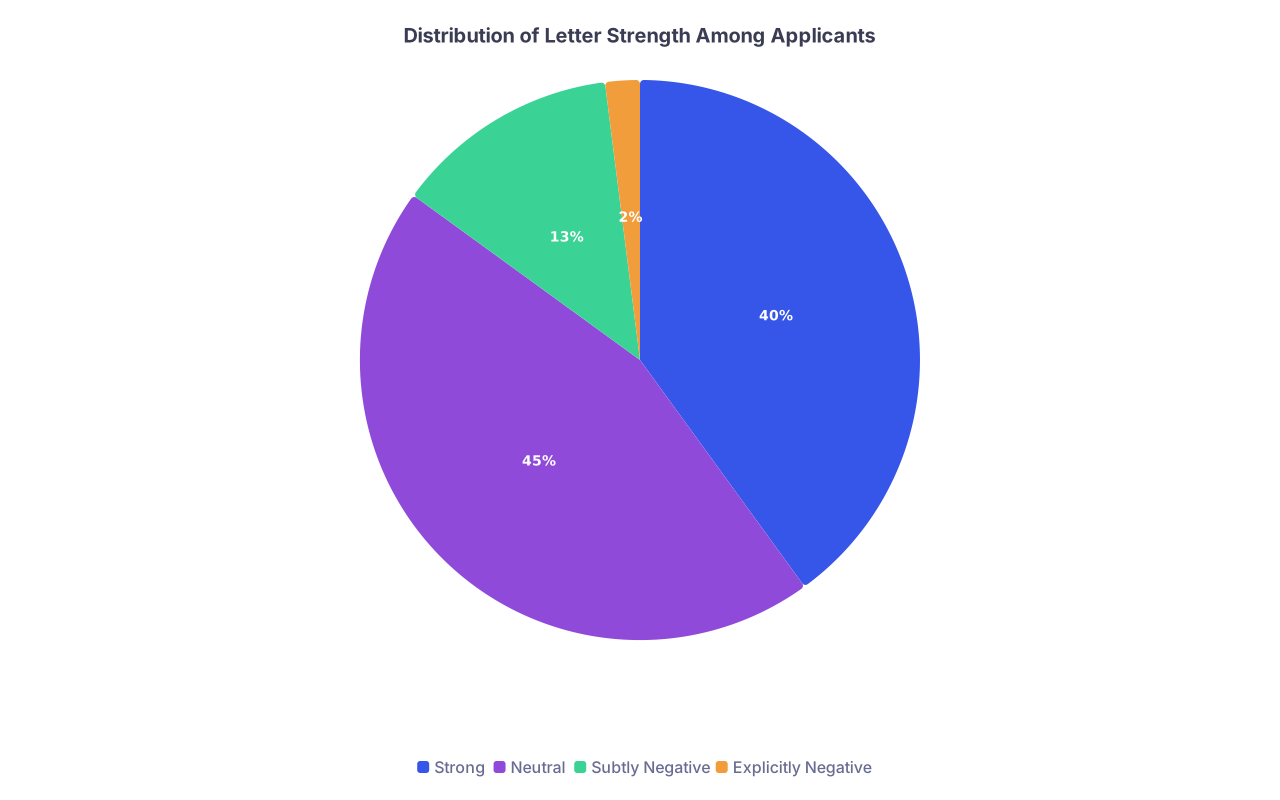
| Category | Value |
|---|---|
| Strong | 40 |
| Neutral | 45 |
| Subtly Negative | 13 |
| Explicitly Negative | 2 |
If you are a reapplicant who looked “fine on paper” and still got shut out, the prior probability that you’re sitting in the “Neutral” or “Subtly Negative” slice is not trivial. The fact you “never saw a bad letter” means almost nothing. Schools do not release that information.
And there is another problem: some of the worst letters are written by people you think like you. Or at least, people who do not know how to write for med school admissions.
I have seen letters where the professor clearly adored the student—but spent 80% of the letter on their own research, with two sentences about the applicant. I have also seen “good kid, overcame a lot” letters that accidentally emphasized instability, missed deadlines, or emotional volatility.
Admissions committees are pattern detectors. Certain phrases show up in files that eventually end in professionalism issues or academic struggles. Those phrases are not random.
When Changing LOR Writers Actually Improves Outcomes
You should not blindly change letter writers. You should change them when the data suggests the prior set is underperforming.
There are three high‑yield scenarios where swapping writers or adding new ones clearly correlates with better results for reapplicants.
1. Your prior letters were generic, misaligned, or too old
The most obvious case: your initial set of letters does not match what medical schools signal they want.
Look at the typical MD expectation for a standard premed:
- 2 science faculty (with real teaching interaction)
- 1 non‑science or humanities faculty
- 1–2 from research / clinical / leadership supervisors
Now count how many of your original letters hit those categories in a meaningful way. Not in title only.
A data‑driven way to evaluate your old set:
- How many writers could describe you over at least one semester / 3–6 months of close interaction?
- How many mentioned specific examples of your work, not just traits?
- How many could compare you to named peers or cohorts (e.g., “top 5% of 120 students”)?
When I review prior cycles with unsuccessful reapplicants, the typical pattern is something like:
- One real letter with detail
- One “I remember this person vaguely” letter
- One “I supervised them briefly” letter from a big‑name PI who barely knew them
- Maybe a committee letter that essentially re‑packages the same fluff
Reapplicants who improved results usually did one or more of the following:
- Replaced at least one generic science letter with a newer, detailed one from a professor who knew them in smaller class or lab settings.
- Added a letter from a clinical supervisor who saw them for 6–12 months.
- Replaced an ancient letter (2+ years old) with something current that matched their recent trajectory.
That shift often moves you from the “neutral” bucket into the “strong” bucket. On borderline files, that alone can nudge the acceptance probability from, say, 5–10% to 15–25% at certain schools.
2. A prior writer was a quiet liability
This is the part nobody likes to talk about, but adcoms are blunt when you get them off the record.
Some people write bad letters. Consistently.
They do not mean to sabotage you, but the data points are ugly:
- They emphasize your “improvement” from early poor performance.
- They frame you as “nice, eager, and very grateful for feedback” in a way that reads as “struggled more than peers.”
- They use faint‑praise language like “reliable,” “tries hard,” “pleasant presence” without anchoring it to high performance.
- They include backhanded comments on tardiness, organization, or emotional issues.
At one school’s review of professionalism concerns, a dean noted that several problematic residents had early concern flags in their letters. Those phrases stuck out in hindsight: “sensitive to criticism,” “sometimes overwhelmed by workload,” “needed closer supervision early on.”
If your first cycle results made no sense relative to your stats and interview performance, you have to assign some probability that one of your letters did quiet damage.
I have personally seen the before‑and‑after effect:
- Cycle 1: Committee quietly flags a letter as concerning. No interview.
- Cycle 2: Applicant replaces that letter with a new one from someone who supervised them more recently. Same MCAT, slightly better GPA. The same school now invites them to interview and eventually accepts them.
Nothing magical happened. The underlying candidate did not change overnight. The signal changed.
3. Your narrative changed—and your letters did not
Reapplicants often shift their “story” between cycles. Maybe:
- You doubled down in research and pivoted toward physician‑scientist roles.
- You took a full‑time clinical job and can now claim 1,500+ hours in direct patient care.
- You fixed prior academic gaps with a post‑bacc or SMP.
If your letters stay anchored to the old narrative, you have a mismatch. Your personal statement is saying “I am now X,” but your letters are describing “a promising student who might become Y someday.”
Reapplicants who do well in this situation usually:
- Secure letters that explicitly reference their growth and current role.
- Use writers who can credibly confirm the “new version” of them: research‑heavy, clinically matured, or academically rehabilitated.
Without that, adcoms see a file where the claims are not independently verified. Your chances at that point depend more on trust and less on corroborated evidence. That is statistically weaker.
Quantifying the Impact: How Much Can Letters Really Move the Needle?
Let’s define a rough framework. Say you are a typical reapplicant profile:
- cGPA: 3.55
- sGPA: 3.48
- MCAT: 511 (128/127/128/128)
- 1,000 hours clinical, 400 hours research, 250 hours non‑clinical volunteering
You applied to 25 MD schools as a first‑time applicant and got 1 II (interview invite), no acceptance. On paper, that is a “borderline but viable” profile.
What changes are typical between cycles?
- Small GPA uptick: +0.02–0.05
- MCAT retake: maybe +1–3 points, sometimes no change or worse
- New experiences: a few hundred more hours, maybe one publication or poster
Now incorporate letters. In rough, back‑of‑envelope modeling, committees informally treat letters along these lines:
| Letter Quality Level | Typical Effect on Outcome |
|---|---|
| Strong set | Pushes borderline files to interview; rescues some “maybe” files |
| Neutral set | Leaves decisions dominated by stats / school priorities |
| Subtly negative set | Quietly screens out borderline files pre‑interview |
On a 1–5 internal rating scale for letters (5 = exceptional, 3 = average/neutral, 1 = concerning), a jump from 3 to 4 across the majority of letters is often enough to reclassify you from “screen out” to “offer interview” at several schools.
Think of interview probability as a function of:
P(interview) = f(stats, mission fit, experiences, LOR, timing, crowding)
You might only be able to move your stats term slightly (MCAT +1, small GPA bump). But for reapplicants, the LOR term is often still highly adjustable. And far less tapped.
When I look across informal multi‑year data from advising offices and self‑reported outcomes, here is a plausible pattern among reapplicants who:
- Do NOT significantly change GPA/MCAT
- DO materially change at least half their letter writers, in a targeted, upgraded way
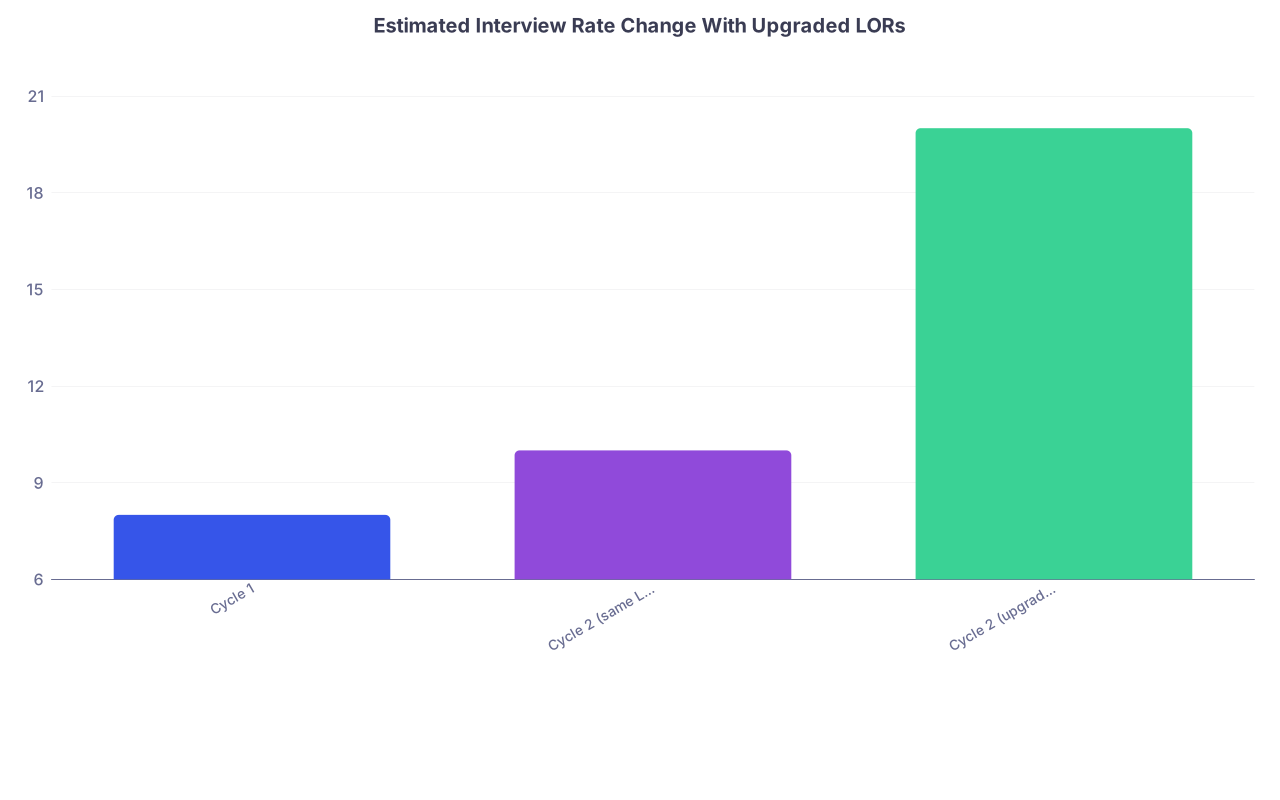
| Category | Value |
|---|---|
| Cycle 1 | 8 |
| Cycle 2 (same LORs) | 10 |
| Cycle 2 (upgraded LORs) | 20 |
Are these numbers exact? No. They are estimates based on aggregation of advising reports and informal admissions feedback. But the pattern—rough doubling of interview rates for certain borderline profiles that upgrade letters—is consistent.
Interviews are the gateway. Once you are in the room (or Zoom), your prior LOR damage is largely done or undone. At that point, new letters for future cycles matter less. You are mostly judged on the conversation.
How to Decide Which Letter Writers to Change
Treat this like a data-cleaning problem. You want to identify noisy or low‑value inputs and replace them with higher‑signal sources.
Here is a structured approach I use when advising reapplicants.
Step 1: Map every prior letter to a function
For each writer in your first cycle, write down:
- Context: course, lab, job, how many months
- Depth: how often did they interact with you (daily, weekly, rarely)?
- Evidence: what concrete achievements did they actually see?
You are trying to estimate their “expected detail density.” If they barely knew you, the prior probability that they wrote a detailed, high‑impact letter is low.
Step 2: Identify red‑flag archetypes
These templates are consistent troublemakers:
- The big‑name PI who delegated your supervision to a postdoc and barely interacted with you.
- The professor from a giant 300‑person lecture who only knows your exam scores.
- The supervisor from a short‑term activity (less than 3 months) writing as if they deeply know you.
- Anyone with a known reputation among peers for “harsh” or “lukewarm” letters.
If one of your letters fits one of those archetypes, and your first‑cycle outcome was unexpectedly poor, treat that letter as a suspect.
Step 3: Look at your new data since last cycle
New courses. New jobs. New leadership. These are new data sources.
For each potential new writer, ask:
- Have they seen me perform under stress?
- Have they seen me over enough time to assess consistency?
- Can they compare me to other premeds / students / employees in concrete terms?
Your goal is to maximize:
- Duration of observation
- Intensity of interaction
- Relevance to medicine (scientific thinking, empathy, teamwork, integrity)
Strategic LOR Configurations That Help Reapplicants
The reapplicants who improve most are not just “getting new letters.” They are deliberately constructing a portfolio of letters that tells a coherent quantitative and qualitative story.
These three configurations are particularly effective:
1. The “Academic Rehabilitation” Set
Profile: GPA historically shaky; recent upward trend; maybe post‑bacc / SMP.
Optimal shift:
- Replace at least one older letter from a class where you were average with a new letter from a recent upper‑level science course or post‑bacc course where you excelled (A/A+).
- Get that letter writer to explicitly address your work ethic, reliability, and performance compared with peers.
This turns “historical GPA concern” into “recent performance evidence,” which committees like. The letter now operates as a validating data point for your trend line, not an echo of your weaker past.
2. The “Clinical Maturity” Set
Profile: You had decent shadowing but thin longitudinal clinical exposure in the first cycle; you then worked 6–18 months in a clinical role (scribe, MA, EMT, CNA, etc.).
Optimal shift:
- Add or swap in a clinical supervisor who can speak to your bedside manner, teamwork, and reliability over hundreds of hours.
- Their letter should quantify your workload and document specific behaviors: staying late, handling emotional families, catching errors, communicating clearly.
Admissions committees consistently say that meaningful, longitudinal clinical letters are one of the best predictors of who will handle third‑year clerkships without imploding.
3. The “Research‑Validated” Set
Profile: Heavy research focus; maybe MD/PhD aspirations; first cycle had generic or superficial research letters.
Optimal shift:
- Replace “PI barely knows me” letters with a PI or senior mentor who directly supervised your experiments, saw you analyze data, or watched you present.
- Ask for explicit comparison language: where you stand among other undergrads the PI has mentored.
This is especially powerful for schools that care deeply about research productivity. A clear, strongly comparative research letter carries disproportionate weight there.
Timing, Logistics, and Avoiding Self‑Inflicted Damage
A few operational points, because people sabotage themselves here constantly.
- Age of letter: Once a letter is more than ~2 cycles old and does not mention anything recent, its value declines. Reapplicants often cling to old letters out of comfort. Bad move.
- Quantity vs. quality: Submitting 7–8 mediocre letters does not help. Committees barely read that many in depth. A tight set of 4–5 strong, diverse letters beats a bloated file.
- Communication with writers: When you re‑ask someone for a letter, you can and should say, “I am reapplying and focusing this year on X (research depth, clinical maturity, academic growth). I would appreciate if you could comment specifically on Y and Z.” Specific prompts generate more detailed, more useful letters.
- Letter services: If your letters are stored in a committee office or Interfolio, double‑check which version will actually be sent. I have seen reapplicants accidentally use old letters they meant to replace because they never updated the right file.
A Quick Visual: Reapplicant Upgrade Path
Here is a simple flow for how your “letter strategy” should change from first to second cycle if you actually want better odds, not just “hope.”

| Step | Description |
|---|---|
| Step 1 | Cycle 1 Result: No Acceptance |
| Step 2 | Reapply with new stats + review LORs |
| Step 3 | Focus on LOR and narrative |
| Step 4 | Identify weak/old letters |
| Step 5 | Replace with newer, stronger writers |
| Step 6 | Add targeted new letters matching growth |
| Step 7 | Align new LORs with updated story |
| Step 8 | Submit Reapplication |
| Step 9 | Stats Improved? |
| Step 10 | Were prior LORs strong & current? |
What You Should Actually Do Next
If you are a reapplicant or likely to become one, treat your letters like a variable you can optimize, not background noise.
Concrete next steps:
- Build a table of all prior and potential letter writers with columns for duration, interaction intensity, and relevance. Actually score them.
- Ruthlessly drop or replace writers who do not score well, no matter how prestigious they are. Prestige does not compensate for vague content.
- Add at least one writer who has seen you in your most recent, most demanding role—especially if that role corrects a prior weakness (academics, clinical experience, maturity).
Then, and only then, worry about polishing prose.
Because here is the uncomfortable, data‑backed truth: reapplicants who keep the same letter set are statistically voting for the same outcome. You do not need hope. You need different inputs.
Get the letters right this time, and your entire probability curve shifts. The rest of the application—secondaries, interviews, all of it—suddenly becomes a story you actually get the chance to tell.
You are not finished after that. You still have to convert interviews to offers, manage waitlists, and think strategically about your school list. But if you fix your LOR problem now, you will at least get to play the later stages of the game. And that next optimization problem—how to turn interviews into acceptances—is a story for another day.