
You hit submit on your application. Maybe you even felt a little relief for about six minutes. Then your MCAT score came back, and now you're staring at the screen thinking, That is not going to carry this school list.
This is a miserable spot to be in. I've seen it over and over: someone applies with a hopeful list, expecting a 512, and the score lands at 506. Or the total is technically usable, but there's a brutal 123 in CARS or Chem/Phys that sticks out like a warning flare. Or the score is old enough that a few schools on the list may not even accept it much longer. Suddenly the question isn't just "Should I retake?" It's "Did I just tank my cycle, and can I fix it fast enough?"
Here's the straight answer: sometimes a retake after you've already applied is smart. Sometimes it's a panic move that burns time, money, and what little emotional stability application season leaves you. The difference is timing and impact.
When a Retake Becomes the Right Move After You’ve Already Applied
A retake becomes the right move when your current score is clearly pulling your application down, not just bruising your ego.
That distinction matters. A lot of applicants want to retake because the score feels disappointing. That's not enough. If your score is still within range for most of your school list, retaking mid-cycle may be a bad trade. You'd be better off crushing secondaries, getting updates in on time, and preparing for interviews. But if your score lands below the usual range for your schools, or your section breakdown creates a real admissions problem, then yes, you may need to move.
The most common reasons I see people retake after applying are pretty predictable:
- The total score came in meaningfully below practice-test performance.
- One section is weak enough to create concern even if the composite score looks okay.
- The score is aging out for certain schools.
- The score makes you noncompetitive for the kind of programs you applied to, especially if your list leans heavy toward higher-median MD programs.
Here's the uncomfortable part: a late retake often helps your next cycle more than your current one. Medical schools don't pause their review process and wait for your comeback story. If your new score is released after schools have already screened your file, sent rejections, or filled interview slots, the retake may not do much. That's the reality. Brutal, but useful.
So don't make this decision emotionally. Make it based on whether the new score can arrive in time to change how your application is actually read.
Decide Fast: Retake or Move Forward?
You need a decision framework, not vibes.
Start with four things:
- Your score versus your school list
- Your GPA and overall academic profile
- Your section balance
- Your timing in the cycle
If your MCAT is clearly below the median or even below the 10th percentile range at a big chunk of your list, that's not a subtle problem. That's a major one. If your GPA is average or below average too, the MCAT matters even more. On the other hand, if your score is a little lower than hoped but still squarely within range for many schools, don't create a second problem by disappearing into retake prep and neglecting the active cycle.
A retake is usually justified when:
- Your score is well below the realistic range for your target schools.
- You have a large section weakness, especially a subsection that may trigger screening concerns.
- Your application is otherwise solid, and the MCAT is the obvious weak link.
- You have a real reason to believe you can improve. Not wishful thinking. Evidence.
That last part is where people get sloppy. If your first attempt came after poor timing, weak strategy, burnout, or obvious content gaps that you now understand how to fix, a retake can make sense. If you already studied hard, used strong materials, and your full-lengths weren't much higher than your official score, don't assume attempt two will magically jump 6 points because you want it to.
When not to retake:
- Your score is already in range for most of your list.
- The retake would gut your ability to finish secondaries well and on time.
- You're working full-time, exhausted, and trying to study from pure panic.
- Your projected improvement is tiny. A one-point bump late in the cycle is rarely worth the disruption.
Ask yourself one question and answer it honestly:
Will a higher score change how this cycle plays out?
If the answer is yes — because the current score is holding you back and the new score will arrive while schools are still reviewing — retake.
If the answer is no — because the score is already serviceable or the new score will come too late — move forward and stop torturing yourself.
How to Retake Without Derailing Your Current Application
If you're going to retake, do it like an adult with a calendar. Not like someone lighting their week on fire.
Map out the timeline first. I mean literally write this down:
- Application submission date
- Secondary receipt dates
- Secondary deadlines
- MCAT retake test date
- Score release date
- Typical interview season timing for your schools
This timeline tells you what the retake can realistically affect. If your new score comes back while schools are still actively reviewing and before many interview decisions are made, good. If it returns when most of your schools have already moved on, then the retake is mostly insurance for a reapplication.
Next: communicate with schools the right way. Not a dramatic email essay. Just a short update if the school accepts updates.
Something like:
I am writing to share that I am scheduled to retake the MCAT on [date]. My updated score will be released on [date], and I would be grateful for its consideration if permitted by your review process.
That's it. No apology spiral. No paragraphs about how test day was unfair. Admissions offices read thousands of files. Clear and factual wins.
Then keep the rest of your application moving. This is where people sabotage themselves. They decide to retake and suddenly use it as an excuse to delay secondaries, ignore portal requirements, or postpone school-specific essays because they want the new score first. Bad move. A better MCAT does not rescue sloppy application behavior.
If you're in this situation, your priorities should look like this:
- Submit secondaries quickly and thoughtfully
- Make sure letters are complete
- Update activities or grades if relevant
- Keep checking school portals
- Study for the retake in a contained, scheduled way
Not random. Contained.
A realistic mid-cycle retake schedule often means 2 to 3 focused hours on weekdays and longer blocks on weekends, with full-length exams planned carefully rather than impulsively. If your secondary volume is heavy, there will be weeks when the application gets priority. That's normal. The retake doesn't get to consume everything.
Timing strategy matters too. If your retake is late, prioritize schools that:
- Review applications later
- Accept update letters
- Explicitly state they will consider future MCAT scores
- Haven't made a decision on your file yet
And be realistic about school-by-school impact. One school may hold for a new score. Another may review immediately based on what they already have. Another may reject before the new score even posts. That's not unfair. That's just how rolling admissions works.
Here's a scenario I see all the time: applicant takes a September retake, score comes back in October, but several early schools already screened them out in August. That score may still help at later-reviewing schools, but it won't resurrect every file. Don't build your plan around fantasy admissions timing.
The big rule: don't let the retake become your reason for going half-speed everywhere else. A retake can help. A stalled application absolutely hurts.
Study Smarter the Second Time: Fix the Problem, Not Just the Score
Your second study plan should not be "do everything again, but in a more panicked mood."
That's dumb, and it usually produces the same outcome.
Start with diagnosis. Pull up your AAMC materials, your full-length score trends, your section breakdown, and whatever notes you have from the first round. You need to identify what actually went wrong.
Common retake problems look like this:
- You knew content broadly but missed too many passage-based questions.
- Your timing collapsed in one section.
- You overstudied content review and understudied AAMC-style reasoning.
- You had one chronically weak subject area you never fixed.
- Your test-day stamina was bad.
- Anxiety or poor logistics wrecked performance.
Those are different problems. They need different fixes.
Your retake plan should be narrower than your first plan. Not broader.
If CARS was the issue, don't waste three weeks rewatching biochem videos. If Chem/Phys timing killed you, practice under timed conditions and review wrong answers by pattern. If Psych/Soc was weaker than expected because you relied on familiarity instead of recall, drill that content with intention. Be specific.
A practical retake structure might look like:
- Week 1: Postmortem review and weakness mapping
- Weeks 2–4: Targeted content repair plus passage sets in weak sections
- Weeks 5–6: Full-lengths and intense review of error patterns
- Final stretch: Timing, stamina, and high-yield cleanup
If you have less time, compress intelligently. Don't pretend you can rebuild your whole MCAT foundation in two chaotic weeks while also writing eight secondaries and working shifts. That's how people end up with the same score again, or worse.
And yes, burnout matters. If you're writing essays all day and trying to study all night, your brain will eventually revolt. Protect sleep. Protect some structure. Protect at least one block each week where you're not staring at a portal, Anki deck, or question bank like a haunted Victorian child.
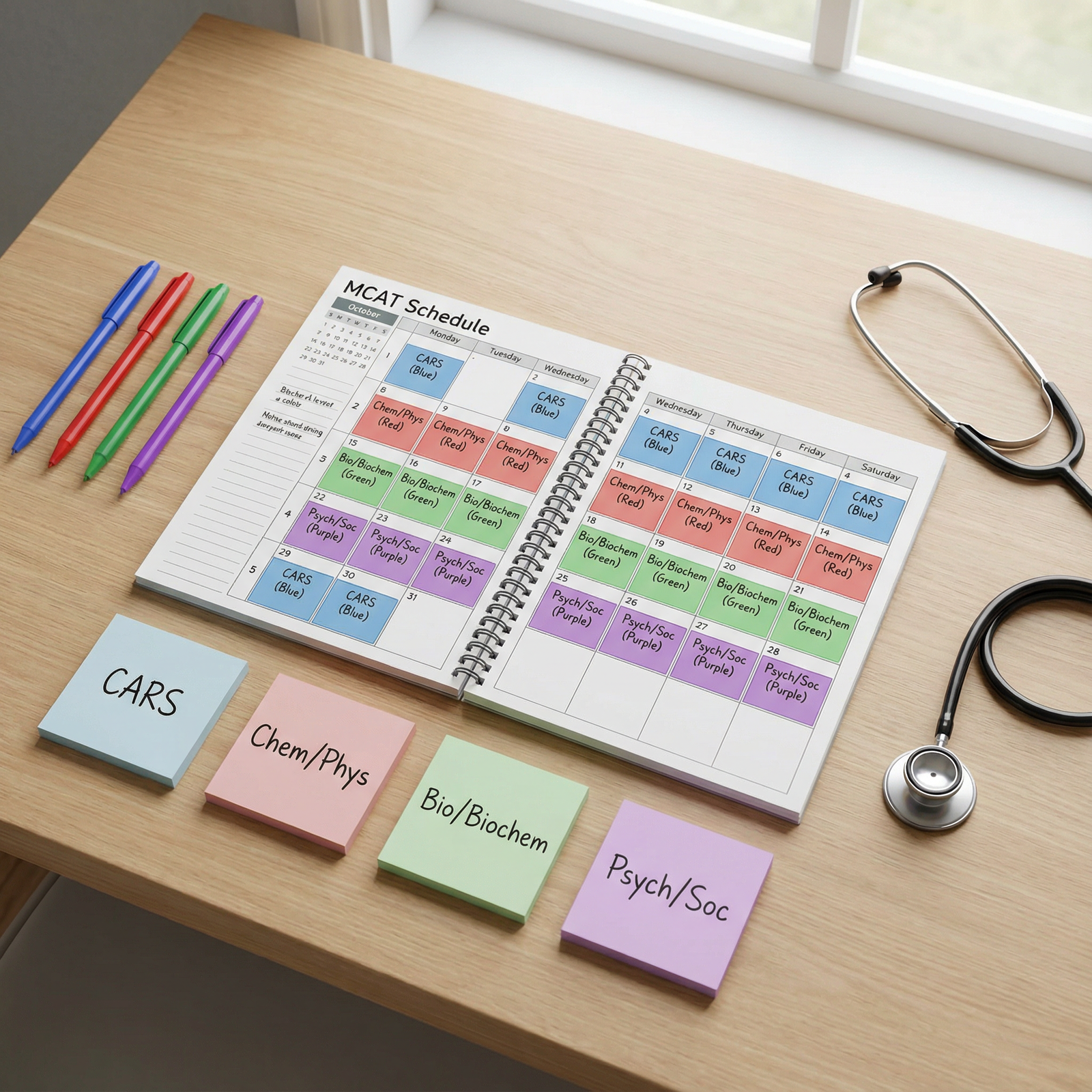
The retake works best when you treat it as a correction, not a replay.
What to Expect If the New Score Helps — or Doesn’t
If the new score improves meaningfully, that's good news. Schools may see it as evidence that the earlier result wasn't your ceiling. A real jump can strengthen your file, support reconsideration at some places, and make you more viable for this cycle or the next one.
But don't be naive. A better score doesn't guarantee schools will forget the earlier one, and it doesn't force every committee to reopen your file. Some will care a lot. Some won't care enough. That's admissions.
If the new score is flat or lower, that's tougher. Admissions committees may read that as a sign the first score was accurate. It also raises questions about judgment if the retake seemed unnecessary. That's why I push hard on making this choice carefully the first time.
If this cycle still doesn't work out, use the retake strategically in the next one. Rebuild the school list. Apply earlier. Tighten the writing. Show a stronger academic story instead of recycling the same application with a new layer of frustration baked into it.
One score doesn't define your whole candidacy. That's true. But don't abuse that phrase as comfort fluff. Scores matter. Timing matters. School-specific policy matters. Make this decision with your eyes open.
What to Do Next
If you're sitting on a disappointing MCAT after applying, here's your move:
- Compare your score to your actual school list today. Not your dream list. The one you submitted.
- Check whether the problem is total score, section balance, or both.
- Map your retake and score-release timeline against secondary deadlines and interview season.
- Decide whether a new score could still change this cycle.
- If yes, retake with a narrow, targeted plan.
- If no, stop spiraling and put your energy into secondaries, updates, and school strategy.
- If you retake, tell schools briefly if their policies allow it.
- Do not let the retake freeze the rest of your application.
Fast decision. Clear plan. No drama.