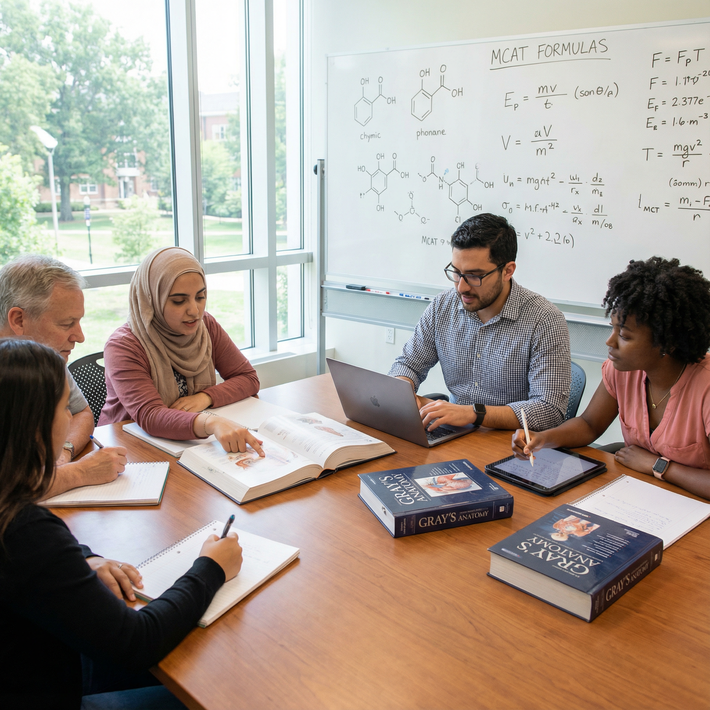
The MCAT is more than a content exam—it’s a reasoning and application test that evaluates whether you can think like a future medical student. Understanding MCAT question types and the overall exam structure is one of the most powerful ways to guide your MCAT preparation, refine your exam strategies, and ultimately improve your score.
This expanded guide explains the MCAT exam format, breaks down question types in each section, and provides targeted study tips and examples so you can approach every passage and problem with confidence.
Understanding the MCAT Exam Structure and Question Formats
The Medical College Admission Test (MCAT) is a standardized, computer-based exam required by most medical schools in the United States and Canada. It is designed to assess problem-solving, critical thinking, and foundational knowledge in the natural, behavioral, and social sciences.
The Four MCAT Sections
The MCAT is divided into four main sections:
- Biological and Biochemical Foundations of Living Systems (Bio/Biochem)
- Chemical and Physical Foundations of Biological Systems (Chem/Phys)
- Psychological, Social, and Biological Foundations of Behavior (Psych/Soc)
- Critical Analysis and Reasoning Skills (CARS)
Each science-based section (Bio/Biochem, Chem/Phys, Psych/Soc) includes:
- 59 questions total
- 10 passages with 4–7 questions each
- 15 discrete (stand-alone) questions
- 95 minutes per section
The CARS section includes:
- 53 questions total
- 9 passages, each with 5–7 questions
- No discrete questions (100% passage-based)
- 90 minutes for the section
Across the exam, you will encounter two core MCAT question types:
- Discrete (stand-alone) questions
- Passage-based questions
Mastering how these question types behave—and how they test your reasoning—should be a central part of your MCAT Preparation and Study Tips.
MCAT Question Types: Discrete vs. Passage-Based Questions
All MCAT questions are multiple-choice with four answer options. However, the way questions are presented—and the skills they emphasize—vary between discrete and passage-based questions.
Discrete Questions: Targeted Content and Concept Checks
What they are:
Discrete questions are stand-alone MCQs that do not depend on a passage. They typically test:
- Core definitions
- Fundamental relationships
- High-yield formulas
- Isolated concepts or simple applications
What they look like:
A patient with a mutation causing nonfunctional voltage-gated Na⁺ channels in neurons is most likely to experience which of the following?
A. Increased nerve conduction velocity
B. Decreased action potential frequency
C. Increased resting membrane potential
D. Decreased Na⁺/K⁺ pump activity
To answer, you must understand how voltage-gated Na⁺ channels function during action potentials.
Key skills tested:
- Rapid recall of high-yield facts
- Basic conceptual understanding
- Simple application of formulas or definitions
- Quick reasoning under time pressure
How to approach discrete questions:
- Identify the topic immediately. Label it mentally (e.g., “action potentials,” “acid-base,” “Piaget,” “social norms”).
- Rephrase the question in your own words before looking at answer choices.
- Predict an answer when possible to avoid being distracted by plausible but incorrect options.
- Use elimination aggressively—it is often easier to cross out 2–3 wrong answers than to select the right one immediately.
Passage-Based Questions: Interpretation, Integration, and Application
What they are:
Passage-based questions (PBQs) present you with a text passage—often with charts, figures, graphs, or experimental setups—followed by multiple questions. These are the heart of the MCAT and dominate each section.
Common passage styles:
- Experimental research studies
- Clinical or physiological scenarios
- Data-heavy figures and tables
- Theoretical or conceptual explanations
- For CARS: humanities and social science essays
Example passage themes by section:
- Bio/Biochem: A study on hemoglobin’s oxygen-binding under different pH levels.
- Chem/Phys: An experiment manipulating solution pH to observe enzyme activity.
- Psych/Soc: A longitudinal study on socioeconomic status and health outcomes.
- CARS: An editorial discussing ethical frameworks in medical resource allocation.
Each passage is followed by 4–7 questions that may require you to:
- Interpret data or graphs
- Apply foundational science concepts
- Critique experimental design or controls
- Infer implications or predictions
- For CARS: Analyze arguments, tone, and author’s purpose
How to approach passage-based questions:
Skim with a purpose.
- For science sections, focus on experimental design, variables, hypotheses, figures, and key results.
- For CARS, focus on the author’s main argument, tone, and structure.
Note the “big picture.”
Ask yourself: What is this passage mainly about? Is it describing an experiment, explaining a process, or arguing a viewpoint?Use the passage as a resource, not a memory test.
You are allowed to look back. Efficient navigation is key to good Exam Strategies.Treat each question independently.
Don’t assume later questions depend on your answer to an earlier one unless explicitly stated.

Section 1: Biological and Biochemical Foundations of Living Systems
This section blends biology, biochemistry, organic chemistry, and some general chemistry. It evaluates whether you understand how living systems operate at the molecular and cellular level and whether you can apply this knowledge to novel scenarios.
Core Content Domains
- Cell structure and function
- DNA replication, transcription, translation
- Enzymes and metabolism (e.g., glycolysis, TCA cycle, oxidative phosphorylation)
- Homeostasis and organ systems
- Molecular biology techniques
- Amino acids, proteins, and macromolecules
Question Types in Bio/Biochem
1. Discrete Questions
These often test:
- Amino acid structures and properties
- Enzyme classifications and kinetics
- Basic genetics terminology and patterns of inheritance
- High-yield physiology (e.g., hormone actions)
Example:
Which of the following best describes the primary function of hemoglobin in red blood cells?
A. Buffering blood pH
B. Transporting oxygen from the lungs to tissues
C. Generating ATP for erythrocytes
D. Catalyzing the breakdown of carbonic acid
Study Tip:
Use flashcards and spaced repetition for topics like amino acids, metabolic pathways, and key physiological hormones and their effects.
2. Passage-Based Questions
Passages frequently involve experimental data:
- Enzyme inhibition and kinetics
- Gene expression modulation
- Physiology or pathophysiology case studies
- Molecular biology experiments (e.g., PCR, Western blots)
Example passage style:
A passage describes a study investigating different mutations in the hemoglobin gene and their effects on oxygen affinity, providing curves and tables. Questions may ask about:
- Interpreting shifts in an oxygen dissociation curve
- Predicting physiological outcomes (e.g., tissue hypoxia)
- Applying Le Châtelier’s principle to CO₂ and O₂ binding dynamics
Strategies to Master Bio/Biochem
- Integrate memorization with application. Don’t just memorize pathways; practice questions that require predicting what happens if one step is upregulated or inhibited.
- Practice interpreting biological figures. Focus on axes, trends, and controls.
- Teach concepts aloud. Explaining metabolism or signal transduction to someone else (or to yourself) reveals gaps in understanding.
Section 2: Chemical and Physical Foundations of Biological Systems
Chem/Phys emphasizes how physical and chemical principles underlie biological systems and processes. It integrates:
- General chemistry
- Physics
- Organic chemistry
- Some biochemistry
Core Content Domains
- Atomic and molecular structure, bonding
- Thermodynamics and kinetics
- Fluids, pressure, and circulatory analogies
- Electricity, circuits, and neuron analogies
- Light and optics
- Acids, bases, and buffers
- Electrochemistry and equilibrium
- Basic lab techniques and instrumentation
Question Types in Chem/Phys
1. Discrete Questions
These often require calculations or conceptual understanding of formulas.
Example:
What is the pH of a solution with a hydrogen ion concentration of 1 × 10⁻⁷ M?
A. 5
B. 6
C. 7
D. 8
Here, you must recall that pH = −log[H⁺].
Other common topics:
- Kinematics and forces (F=ma, kinematics equations)
- Circuits (Ohm’s law, power)
- Gas laws
- Equilibrium constants and Le Châtelier’s principle
2. Passage-Based Questions
Passages frequently involve:
- Experimental setups with instruments (spectrophotometers, chromatography, NMR)
- Data tables with concentrations, absorbance, or voltage measurements
- Applied physics in biological contexts (e.g., fluid flow in vessels, optics in the eye)
Example passage style:
A passage presenting an experiment on enzyme activity under different pH and temperature conditions, with graphs of reaction rate vs. pH and temperature. Questions might ask:
- Which variable acts as a control?
- How does a shift in pH affect ionizable amino acid residues in the active site?
- Which equation best describes the initial rate?
Strategies to Master Chem/Phys
- Build a formula sheet early and understand what each variable represents and units used.
- Practice dimensional analysis. Many questions become easier when you check units.
- Regularly practice mental math. The MCAT prohibits calculators; estimate and approximate.
- Link physics and chemistry to physiology. For example, apply Poiseuille’s law to blood flow, or optics to the eye and lenses.
Section 3: Psychological, Social, and Biological Foundations of Behavior
The Psych/Soc section evaluates your understanding of how psychological, social, and biological factors influence behavior and health—essential knowledge for future physicians working with diverse patient populations.
Core Content Domains
- Major psychological theories (learning, cognition, motivation)
- Developmental psychology (Piaget, Erikson)
- Social processes, attitudes, and behavior
- Identity, personality, and mental disorders
- Social institutions, stratification, and inequality
- Health disparities and demographic variables
- Research methods and statistics
Question Types in Psych/Soc
1. Discrete Questions
These often test:
- Definitions (e.g., schema, social capital, anomie)
- Matching theories to examples (e.g., classical vs. operant conditioning)
- Research design terminology (e.g., independent variable, confounding variable)
Example:
Which of the following theories best explains the concept of cognitive dissonance?
A. Drive reduction theory
B. Social learning theory
C. Festinger’s theory of conflicting cognitions
D. Maslow’s hierarchy of needs
2. Passage-Based Questions
Passages typically resemble:
- Summaries of psychological experiments
- Sociological observational studies
- Discussions of public health and health disparities
- Reports using statistical outcomes (e.g., odds ratios, p-values, confidence intervals)
Example passage style:
A study examines how stereotype threat affects test performance among different demographic groups. Questions may test:
- Identification of independent vs. dependent variables
- Understanding of stereotype threat as a concept
- Application of social identity and labeling theories
Strategies to Master Psych/Soc
- Use concise outlines and concept maps. Organize theories by names, definitions, and classic examples.
- Rely on mnemonics. For example, for Piaget’s stages (Sensorimotor, Preoperational, Concrete operational, Formal operational).
- Practice research methods questions. Many students lose easy points here despite the material being highly learnable.
- Connect to real-world examples. Think in terms of patient interactions, public health campaigns, and healthcare disparities.
Section 4: Critical Analysis and Reasoning Skills (CARS)
Unlike the science sections, CARS does not test factual content. Instead, it assesses your ability to:
- Comprehend complex passages
- Analyze arguments and reasoning
- Infer implied ideas and attitudes
- Apply information and evaluate claims
Nature of CARS Passages
CARS passages usually come from:
- Humanities (philosophy, ethics, art, literature)
- Social sciences (history, political science, cultural studies)
- Essays, opinion pieces, and analyses
CARS Question Types
While all questions are passage-based, they fall into broad categories:
- Main idea/primary purpose: What is the author’s central thesis?
- Detail retrieval: What does the author state about X?
- Inference: What can be logically inferred from the passage?
- Author’s tone and stance: How does the author feel about the topic?
- Function questions: Why did the author include a specific example or paragraph?
- Application: Apply the passage’s ideas to a hypothetical scenario.
Example passage theme:
An essay discussing the ethical challenges of allocating scarce medical resources during a pandemic.
Questions might ask you to:
- Identify the central argument
- Determine which statement the author would most likely agree with
- Evaluate a hypothetical policy using the author’s framework
Strategies to Master CARS
- Read daily from CARS-like sources. Philosophy essays, high-level news analysis, and humanities articles build the exact skills tested.
- Avoid outside knowledge. CARS is a closed-book reasoning task—base answers only on what is stated or implied in the passage.
- Practice active reading. After each paragraph, pause to summarize it in your own words: “What did that paragraph add?”
- Identify the author’s perspective. Ask: Is the author advocating, criticizing, neutral, or analyzing?

Practical MCAT Preparation and Exam Strategies for All Question Types
Knowing the MCAT question types is only useful if you tie that knowledge to your daily Study Tips and practice routines. Here’s how to do that effectively.
1. Build a Study Plan Around the Exam Structure
- Map content to sections. Align your content review with Bio/Biochem, Chem/Phys, Psych/Soc, and CARS.
- Allocate time based on your baseline. If your CARS is lagging on practice exams, increase reading practice and timed CARS sets.
- Rotate section practice. Avoid studying only one section for weeks; mimic the variety of test day.
2. Practice Mixed Question Sets
On test day, discrete and passage-based questions are interwoven. Simulate this in your MCAT Preparation by:
- Doing timed sets with a mix of passages and discrete questions.
- Practicing under exam-like timing (e.g., 59 Chem/Phys questions in 95 minutes).
- Training your brain to shift quickly between calculation-heavy discrete questions and data-heavy passages.
3. Use Active Review of Practice Questions
Every missed question is a chance to improve your strategy and content.
For each incorrect or guessed question:
Identify the error type:
- Content gap
- Misread question stem
- Poor time management
- Overthinking or second-guessing
Write a brief correction.
Explain why the correct answer is right—and why each incorrect option is wrong.Add to an error log.
Track recurring issues (e.g., missing units in Chem/Phys, misinterpreting experimental controls in Bio/Biochem, confusing similar psychology terms).
4. Develop Strong Time Management
- Pacing check-ins. For 95-minute sections with 59 questions, aim to be around:
- ~30 questions completed at 45–50 minutes
- ~45 questions completed at 70–75 minutes
- Don’t get stuck. If a passage or discrete is taking too long, guess strategically, mark it, and move on.
- Use the process of elimination quickly. Even eliminating one option increases your odds.
5. Take Full-Length Practice Exams
Full-lengths are critical for:
- Building mental stamina for a ~7.5-hour testing day
- Refining timing across sections
- Testing your ability to apply Exam Strategies consistently
Prioritize AAMC official practice exams first, supplemented by reputable third-party resources.
6. Take Care of Your Health and Mindset
Your ability to reason under pressure depends heavily on your physical and mental state:
- Sleep regularly, especially in the week before the exam.
- Exercise moderately to boost focus and mood.
- Simulate test day conditions for at least 2–3 practice exams (time of day, breaks, no distractions).
- Develop a pre-test routine (light breakfast, breathing exercises, reviewing formulas/notes lightly the day before, not cramming).
MCAT Question Types and Exam Strategies: Frequently Asked Questions
1. How many question types are on the MCAT, and which are most important to master?
There are two main MCAT question types: discrete (stand-alone) questions and passage-based questions. Passage-based questions make up the majority of the exam in all four sections, so they are most critical to master. However, discrete questions often test very high-yield concepts directly, so they can be “easy points” if you know the material. Effective MCAT Preparation should include dedicated practice with both.
2. What is the best way to balance content review with practice questions?
Aim for a content-to-practice ratio that shifts over time:
- Early phase (first 1–2 months): 60–70% content review, 30–40% practice questions.
- Middle phase: 50/50 split between studying content and doing mixed question sets.
- Final phase (last month): 70–80% timed practice and full-length exams, 20–30% targeted content review based on your weaknesses.
Always review questions in depth—this is where your understanding and Exam Strategies really improve.
3. How long should I study for the MCAT, and how does that relate to question types?
Most students study for 3–6 months, depending on their background and schedule. Early in your timeline, focus on understanding the structure of each section and question types, then gradually increase:
- Timed passage practice (especially CARS and science passages)
- Mixed sets combining discrete and passage-based questions
- Full-length exams that mimic real test conditions
Aligning your study duration with incremental exposure to real MCAT-style Question Types is more important than the absolute number of hours.
4. Are certain MCAT sections more important than others for medical school admissions?
Medical schools typically look at the total score and may have section minimums. Some schools pay particular attention to:
- CARS, because it predicts success with dense medical school readings.
- Science sections, as indicators of readiness for preclinical coursework.
You should aim for balance: large disparities between sections can raise concerns. Check individual schools’ policies if you have a specific target list.
5. What are the best resources specifically for mastering MCAT question types and exam strategies?
- AAMC official materials:
- Section banks (great for tough passage-based practice)
- Question packs (especially for CARS and sciences)
- Official full-length exams
- Third-party practice: Kaplan, Princeton Review, Blueprint, and other established MCAT resources offer passage-heavy practice and explanations that help refine strategies.
- CARS reading practice: Articles from The Atlantic, The New Yorker, philosophy or history essays, and high-level opinion pieces.
Select a primary resource set and stick to it; depth of practice in one system is usually better than hopping between many.
Mastering MCAT question types—and understanding how they fit within the exam’s overall structure—will transform your MCAT Preparation from passive memorization to strategic, exam-focused learning. By combining targeted content review, deliberate practice with discrete and passage-based questions, and strong Exam Strategies for timing and analysis, you’ll be well-positioned to earn a competitive score and move one step closer to medical school.
For more guidance on your premed journey, explore related resources on preparing for medical school and developing the core skills every future physician needs.