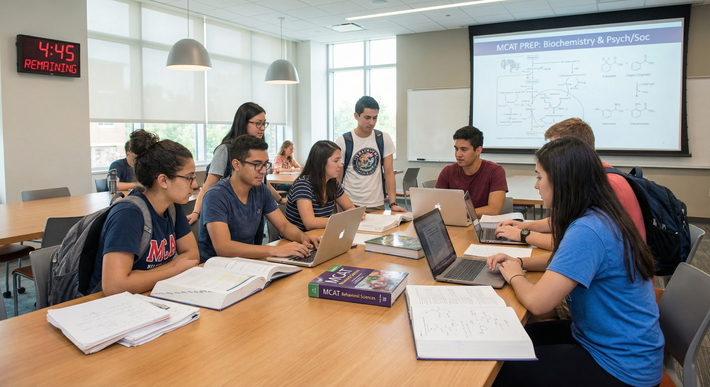
Mastering MCAT test day is about far more than memorizing facts. It’s about executing a smart, well-rehearsed plan under pressure. With the right MCAT preparation, test day strategies, and exam anxiety management techniques, you can walk into the testing center with confidence and leave knowing you performed near your true potential.
Below is an expanded guide that builds on core principles you may already know, but adds depth, structure, and actionable pre-med tips to help you translate months of studying into peak performance.
Understanding the MCAT as a Performance Test
The MCAT isn’t just a content exam—it’s a high-stakes, seven-and-a-half-hour performance. Your score reflects not only what you know, but how well you can think, reason, and manage yourself under time pressure.
The Four MCAT Sections and What They Really Test
The exam is divided into four sections:
- Biological and Biochemical Foundations of Living Systems (Bio/Biochem)
- Chemical and Physical Foundations of Biological Systems (Chem/Phys)
- Critical Analysis and Reasoning Skills (CARS)
- Psychological, Social, and Biological Foundations of Behavior (Psych/Soc)
Beyond content, each section evaluates:
- Critical reasoning: Interpreting data, evaluating arguments, and applying principles to new situations
- Stamina and focus: Sustaining concentration over multiple long passages and questions
- Strategic decision-making: When to move on, when to guess, and how to manage limited time
- Emotional regulation: Managing anxiety, frustration, and self-doubt in real time
Approaching the MCAT with a performance mindset—like an athlete preparing for a major competition—helps you design a preparation plan that goes beyond memorization and builds the habits you’ll need on test day.
Why Targeted Preparation Matters for Test Day Performance
Strong academic performance in your pre-med courses is important, but it doesn’t automatically translate into a strong MCAT score. High scorers:
- Know the format and timing of each section cold
- Regularly simulate test conditions with full-length practice exams
- Build a repeatable test day routine from sleep schedule to breakfast
- Practice exam anxiety management techniques well before test day
The following sections walk through what you should do in the days leading up to the exam, on the morning of the test, and during the exam itself to maximize your score.
The Final Countdown: What to Do Before MCAT Test Day
This period—roughly the last 7–10 days before your exam—is less about learning new material and more about sharpening your execution, consolidating knowledge, and stabilizing your mindset.
1. Strategic Review and High-Yield Practice
Focus on High-Yield Topics and Weak Areas
In the final week, your MCAT preparation should be deliberate and efficient:
- Prioritize high-yield concepts: amino acids, endocrine pathways, fluids, optics, electrochemistry, research methods, study design, psychological theories, and major sociological constructs.
- Use a “weakness list”: Keep a running list of topics or question types you consistently miss (e.g., electrochemistry, experimental design, inference questions in CARS). Review this list daily.
- Condense your notes: Create or refine 1–2 pages of “essentials” for each science section and Psych/Soc—just core formulas, relationships, and definitions.
Full-Length Practice Exams: How Many and How to Use Them
In the last 2–3 weeks, most students should aim for 3–5 full-length practice exams, with at least 2 official AAMC exams close to test day. In the final 7–10 days:
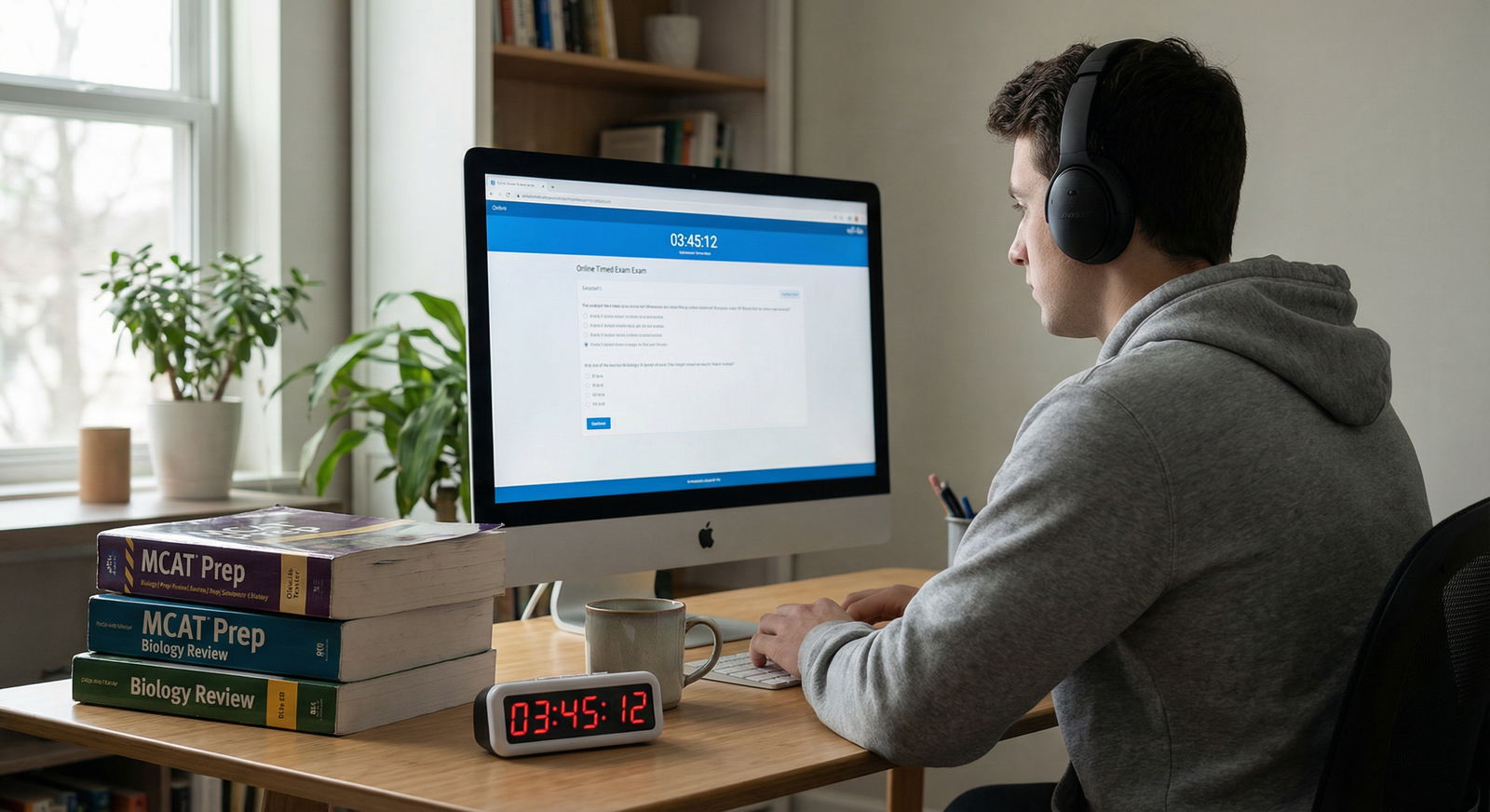
- Take your last full-length no later than 3–4 days before your actual exam. You want time to recover mentally.
- Simulate the real test day environment:
- Same start time as your scheduled exam
- Same breaks and timing
- Earplugs or noise-canceling headphones if you plan to use them
- Review is more important than the score:
- For every missed question, identify:
- Was it a content gap?
- A reading/interpretation error?
- A time-management mistake?
- An anxiety or rushing issue?
- Write down your insights and how you’ll adjust your approach.
- For every missed question, identify:
This “meta-analysis” of your practice exams is one of the most powerful ways to boost test day performance.
2. Build a Personalized Test Day Strategy
Your test day strategy is like a playbook: it tells you exactly what to do in each section and how to react when things don’t go as planned.
Time Management Plans by Section
While every student is different, you need a clear pacing plan going in.
Example pacing targets (adapt to your style):
- Chem/Phys & Bio/Biochem
- ~59 questions in 95 minutes
- Aim for ~1.5 minutes per question, with flexible time for reading passages
- Checkpoint at halfway: ~47–50 minutes remaining when you’re around question 30
- CARS
- 9 passages, 53 questions in 90 minutes
- ~10 minutes per passage (reading + questions)
- Decide ahead: Will you start with the passage that looks easiest or go in order?
- Psych/Soc
- Similar timing to Chem/Phys and Bio/Biochem
- Often slightly faster due to more definition-based questions, so you may “bank” a few extra minutes here.
Use your practice tests to refine these targets until they’re realistic for you.
Decide Your Approach to Guessing and Flagging
Create rules like:
- If you’re stuck for more than 60 seconds, eliminate what you can and guess—then flag and move on.
- If you hit a passage that feels impossible, don’t let it rattle you:
- Complete it as best you can within your pacing limit.
- Remind yourself: One hard passage does not determine my entire score.
The goal is to avoid panic and protect your timing across the whole section.
3. Mental and Emotional Preparation for Test Day
MCAT success is tightly tied to exam anxiety management and emotional resilience.
Practice Calm Under Pressure
Start at least 1–2 weeks before test day:
- Mindfulness practice (5–10 minutes daily)
- Focus on your breathing: Inhale for 4 seconds, hold for 4, exhale for 6–8.
- Notice anxious thoughts and let them pass without engaging them.
- Visualization
- Close your eyes and walk through a successful test day:
- Waking up on time
- Arriving calmly at the center
- Handling a difficult passage and moving on confidently
- This trains your brain to see test day as familiar and manageable, not threatening.
- Close your eyes and walk through a successful test day:
Constructive Self-Talk and Reframing
Replace vague fears with grounded affirmations:
- Instead of “I’m going to bomb this,” use:
- “I’ve taken multiple full-lengths. I know the timing.”
- “I’ve missed questions before and still scored well. One question doesn’t define me.”
- “I can always improve, but today I’m aiming to perform at the level I’ve trained for.”
This type of mental conditioning boosts performance and protects your confidence when the exam feels difficult—as it does for almost everyone.
Test Day Execution: From the Night Before to the Final Question
Your MCAT test day routine should be rehearsed, not improvised. Aim to practice your exact schedule at least once on a full-length exam day before the real test.
1. The Night Before the MCAT
Treat the night before as the beginning of performance mode—not a last-ditch study session.
What to Do (and Not Do)
Do:
- Light review only:
- Skim 1–2 page summary sheets
- Review high-yield formulas and volatile facts (e.g., amino acids, key hormones)
- Prepare all materials:
- Valid ID (double-check expiration date)
- AAMC admission ticket (printed or accessible as required)
- Approved snacks (nuts, fruit, granola bars, simple sandwiches)
- Water in appropriate containers per test center rules
- Light sweater or comfortable layers
- Confirm:
- Exact testing center address
- Parking or public transit plan
- Required arrival time (usually 30–45 minutes before the scheduled exam start)
Avoid:
- Learning new topics or cramming complex content
- Late-night problem sets or full passages
- Heavy meals, caffeine overload, or new supplements/energy drinks
- Staying up late. Aim for 7–9 hours of sleep, even if it means going to bed earlier than usual.
Think of this as “mental tapering” just like athletes ease up their training right before a race.
2. The Morning of the Exam: Setting the Tone
The morning routine should be calm, predictable, and familiar.
Pre-Test Rituals That Help Performance
- Wake up at least 2–3 hours before your test time
- Gives your brain time to fully “wake up”
- Eat a predictable, balanced breakfast:
- Complex carbs: oatmeal, whole grain toast, fruit
- Protein: eggs, yogurt, nut butter
- Avoid: heavy, greasy foods or anything that commonly upsets your stomach
- Hydrate, but don’t overdo it
- Drink enough water to feel comfortable, not so much that you need the restroom constantly.
- Use a short mental warm-up:
- Do 4–6 practice questions (not full passages) just to get into “MCAT mode”
- Review a few flashcards if that calms you, but no heavy studying.
Build in extra time for travel so unexpected delays don’t spike your anxiety.
3. At the Testing Center: Managing Nerves and Staying Grounded
Once you arrive:
- Expect security procedures: check-in, fingerprints or palm vein scans, photograph, locker assignment.
- Use any waiting time to:
- Practice deep breathing
- Review a short confidence statement:
- “I’ve prepared thoughtfully. I’ve seen hard questions before and managed them.”
Accept that feeling nervous is normal. The goal isn’t zero anxiety; it’s functioning well despite the nerves.
During the MCAT: In-Exam Strategies for Peak Performance
Once the test begins, your job is to execute the strategies you’ve practiced—not to evaluate how you’re doing in real time.
1. Reading and Answering Questions Strategically
Read Questions with Intent
- Under exam pressure, your brain is more likely to misread qualifiers like:
- “EXCEPT”
- “NOT”
- “Most likely” vs “Least likely”
- When you see these, mentally highlight them and re-check before choosing your answer.
Use Process of Elimination Aggressively
Even on questions you’re unsure about:
- Eliminate answers that:
- Contradict information in the passage
- Misuse a core concept (e.g., osmosis, charge, acid-base, classical conditioning)
- Are extreme when the passage tone is moderate
- Often you’ll narrow to two plausible choices—choose the one more consistent with passage logic or core scientific principles.
2. Time Management in Real Time
Maintain Section-Level Pacing
Use the on-screen timer strategically:
- Check your progress every 10–15 questions.
- If you’re behind pace:
- Slightly speed up your reading of easier passages.
- Guess and flag truly stuck questions after ~60 seconds.
- If you’re ahead of pace:
- Don’t relax too much—use that time to carefully consider harder questions or recheck a flagged one or two.
Think of your time as a resource you allocate, not just something that happens to you.
3. Handling Difficult Passages and “Panic” Moments
You will almost certainly encounter:
- A passage with unfamiliar terminology or a niche topic
- A question stem that makes no sense on first read
- A section that feels like it’s going badly
Your response in these moments is critical for your overall academic performance on the exam.
In the moment:
- Pause for 10 seconds of slow breathing.
- Tell yourself: “This feels hard because it is hard, not because I’m failing.”
- Focus on what you do know:
- Identify relationships in the passage
- Use basic principles (e.g., conservation of energy, Le Chatelier’s principle, conditioning paradigms)
Then, commit to an answer, flag if necessary, and move on.
4. Using Breaks to Recharge, Not Ruminate
You will have designated breaks between sections. Use them strategically:
- Step away from the computer: physically move, stretch, roll your shoulders, or lightly walk in the hallway.
- Eat and drink intentionally:
- Small, familiar snacks that keep your energy stable
- Water in modest amounts
- Avoid post-mortems:
- Do not replay previous sections or review missed questions in your mind.
- Use a mental script: “That section is done. My job now is to focus entirely on the next one.”
Treat each new section as a fresh start, regardless of how the last one felt.
Targeted Strategies for the CARS Section
The CARS section is unique: it doesn’t reward memorization at all. It’s a pure test of reading, reasoning, and textual analysis.
1. Active Reading and Passage Mapping
As you read:
- Mentally summarize each paragraph:
- “What is the main point here?”
- “How does this relate to the previous paragraph?”
- Identify:
- Author’s thesis (overall main idea)
- Supporting arguments and evidence
- Counterarguments or alternative views
You don’t need to memorize details; you need a mental map of the argument.
2. Understanding Argument Structure and Question Types
Common CARS question types:
- Main idea: “Which statement best captures the author’s central claim?”
- Detail: “According to the passage…” (answer must restate or closely match text)
- Inference: “The author would most likely agree that…” (requires reading between the lines)
- Function: “The primary purpose of the third paragraph is…”
- Tone or attitude: “The author’s attitude toward X is best described as…”
For each question, ask:
- “Is this testing main idea, detail, inference, or tone?”
- “Does my selected answer align with the author’s perspective, not my own?”
3. Tone, Purpose, and Avoiding Outside Knowledge
- Pay attention to word choice:
- Positive: “compelling,” “insightful,” “elegant”
- Negative: “naive,” “problematic,” “oversimplified”
- Neutral/analytical: “examines,” “considers,” “describes”
- Always answer within the passage’s universe. Even if you know more about a topic (history, philosophy, ethics), CARS rewards passage-based reasoning only.
CARS success often improves with consistent, focused practice—even 30–45 minutes daily can steadily build your performance.
After the Exam: Recovery, Reflection, and Next Steps
Once you click “Submit” on the final section, your work is done for the day—regardless of how you feel it went.

1. Immediate Post-Exam: Let Yourself Decompress
- Do something non-academic:
- See friends, watch a movie, go for a walk, cook a favorite meal.
- Avoid obsessively:
- Comparing answers with others
- Trying to reconstruct passages or questions from memory
- Searching forums for “how hard was today’s MCAT?”
You cannot change your answers. Your priority now is mental recovery.
2. Thoughtful Reflection (After a Day or Two)
Once the initial emotion fades:
- Reflect briefly on:
- What you felt went well (timing, breaks, specific sections)
- What you would change about your preparation or test day routine if you had to retake
- Write these insights down while they’re fresh. Whether or not you retake, this self-awareness strengthens your approach to medical school exams and other standardized tests.
Frequently Asked Questions About MCAT Test Day
1. What should I bring on MCAT test day?
You should bring:
- Required:
- A valid, unexpired government-issued photo ID
- Your AAMC admission ticket (printed or accessible as instructed)
- Strongly recommended:
- Snacks and water (in compliance with testing center rules; usually stored in your locker)
- A light sweater or jacket, as testing rooms can be cold
- Any permitted comfort items (e.g., non-electronic earplugs if allowed by the test center)
Check the official AAMC guidelines before test day for the most up-to-date list of permitted and prohibited items.
2. How can I reduce anxiety before and during the MCAT?
Effective exam anxiety management involves both preparation and in-the-moment techniques:
- Before the exam:
- Practice mindfulness or breathing exercises daily in the weeks leading up to the MCAT.
- Take multiple full-length practice tests to make the exam format feel familiar.
- Use visualization to rehearse a calm, successful test day.
- During the exam:
- Use a brief breathing pattern during breaks or when stuck on a question: inhale 4 seconds, hold 4, exhale 6–8.
- Remind yourself that everyone finds the MCAT challenging—difficulty does not mean failure.
- Focus on one question at a time and avoid thinking about your overall score during the test.
3. Should I study the night before the MCAT?
Heavy studying the night before usually hurts more than it helps. Instead:
- Do only light review (flashcards, summary sheets) for no more than 1–2 hours.
- Prioritize sleep, nutrition, and relaxation over cramming.
- Use the time to finalize logistics (materials packed, transportation planned, alarms set).
Well-rested, calm thinking will help you far more than a few extra facts crammed at midnight.
4. How many full-length practice tests should I take before the real exam?
Most students benefit from:
- At least 3–5 full-length practice exams, with:
- 2–4 from reputable third-party companies (e.g., Kaplan, Blueprint, Examkrackers)
- 2 or more official AAMC full-lengths, as these most closely mimic the real exam’s style and difficulty.
The exact number depends on your schedule and starting point, but the key is thorough review of each exam, not just accumulating test attempts.
5. What should I do if I’m running out of time during a section?
If time is short:
- Quickly move through remaining questions, using your best educated guesses.
- Still apply basic process of elimination—eliminate obviously wrong options even if you can’t fully reason out the right one.
- Avoid leaving any questions blank; there is no penalty for guessing.
To prevent this in the future, analyze your practice tests to pinpoint whether time is being lost on:
- Over-reading passages
- Spending too long on a single hard question
- Getting stuck on calculations without estimating
Adjust your pacing strategy and practice accordingly.
Unlocking peak performance on MCAT test day is about more than knowledge. It’s about translating your months of MCAT preparation into a calm, confident, strategic performance. By planning your test day routine, practicing realistic exams, using targeted section strategies (especially for CARS), and managing anxiety intentionally, you give yourself the best possible chance to earn a score that truly reflects your potential—and move one step closer to your goal of becoming a physician.