Here's the direct answer: the myth is wrong.
A lower score in one MCAT section on a retake does not automatically mean the retake was a failure. That's premed panic talking, not admissions logic. I've watched students obsess over one dip, say, a CARS drop from 128 to 126, while ignoring that their total score rose, their science sections improved, and their overall testing pattern became more convincing. That's backwards.
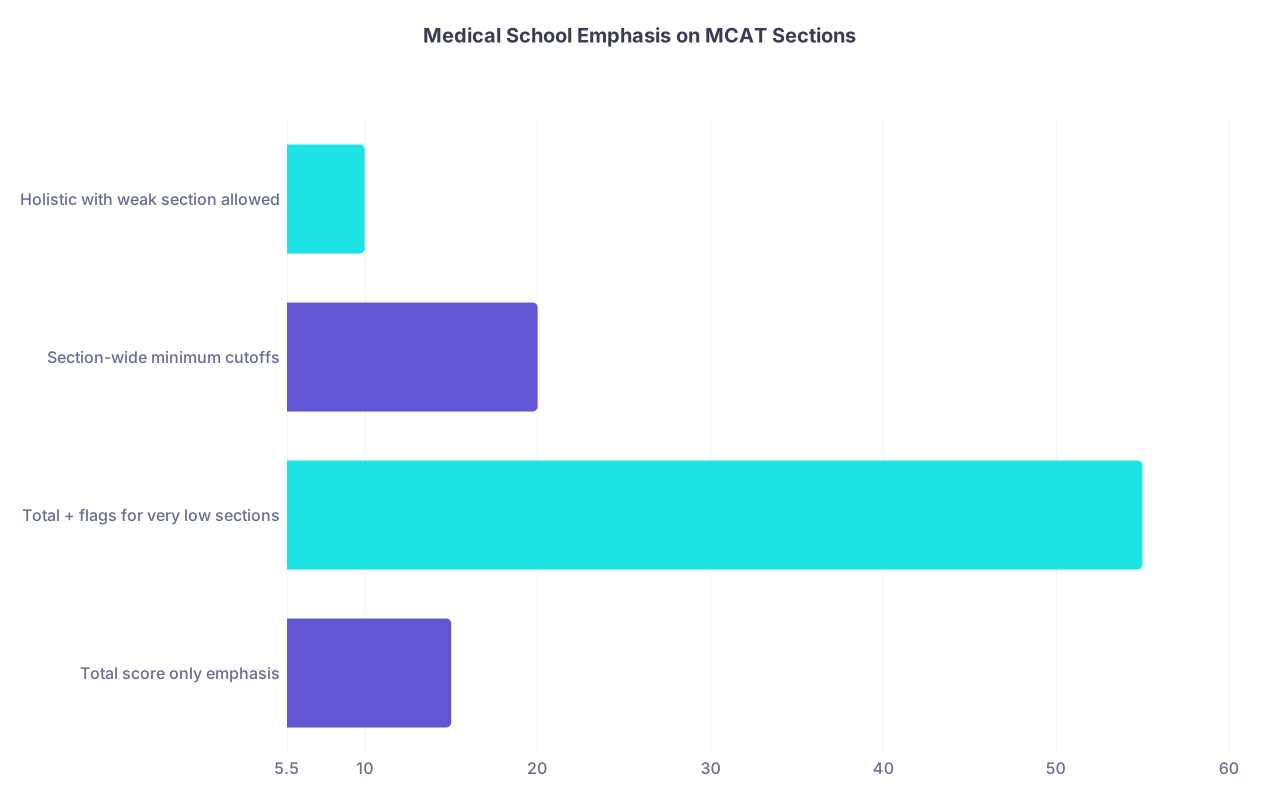
Admissions committees don't read MCATs like anxious applicants do. They don't stare at the single ugliest number and declare the whole file doomed. They look at patterns, subscores, trends, timing, and context. They ask better questions:
- Did the applicant improve in meaningful areas?
- Is the lower section an isolated dip or part of a broader problem?
- Does the score pattern suggest stronger readiness overall?
- Did the applicant actually fix the weakness that caused the first problem?
That's the real frame.
A one-section drop can still be part of a net positive retake if the rest of the score tells a stronger story. Especially if the dip is small, explainable, and not repeated everywhere else. One point? Two points? Annoying, yes. Fatal? No.
The wrong move is emotional overreaction. The right move is diagnosis. Figure out what happened, decide whether the retake improved your position overall, and build your next step around evidence, not fear.
Why This Myth Persists, and Why It's Not How Admissions Reads Scores
This myth sticks around because applicants anchor on the lowest number. Hard. You see one section drop and your brain starts writing a horror story: They'll think I'm inconsistent. They'll think I cracked under pressure. They'll think I'm weaker than before. That spiral is common, and honestly, it's usually nonsense.
I've seen students open a retake score and miss the obvious. Their Chem/Phys jumps 2 points. Bio/Biochem jumps 3. Psych/Soc holds steady. CARS slips 1. And they act like the whole exam exploded. It didn't. They got better where they needed to get better.
Admissions committees aren't looking for perfection. They're looking for signs of readiness.
That means they tend to care about:
- Overall trajectory: Are you trending up?
- Breadth of competence: Are your strengths expanding?
- Consistency: Is one bad number isolated, or is there a bigger instability issue?
- Root-cause correction: Did you address the weakness behind the first score?
- Decision-making: Did you retake with a plan, or just hope for magic?
Hope is not a strategy. Adcoms know that.
What actually worries schools is not "one section dipped." What worries them is a sloppy pattern:
- multiple sections falling,
- repeated retakes with no strategic change,
- practice scores that never supported the retake,
- or a weak section that remains weak because the student never diagnosed the real issue.
That's the difference.
If your retake shows stronger overall readiness, even with one lower section, that can still help you. Full stop. The job now is to read the score like an adult, not like a catastrophizing group chat.
The "Dip" Isn't Always a Failure: 6 Reality Checks to Interpret Your Retake
Before you label the retake a mistake, run these six reality checks.
1. The dip may be measurement noise
Small section shifts happen. The MCAT is standardized, not robotic. A 1-point swing, and sometimes even 2 points, can reflect normal exam variation rather than a dramatic change in ability. That matters even more if your first score sat near a threshold where tiny differences in raw performance can change the scaled score.
2. Look at the full section, not just the headline number
A lower section score doesn't always mean you performed worse in every skill inside it. Ask:
- Was the drop driven by passage-heavy sets?
- Certain content domains?
- Specific reasoning styles?
- A brutal opening block that wrecked pacing?
One section score is a summary. Summaries hide useful details.
3. Check the score distribution within the section
Not all misses are equal. If most wrong answers clustered in one content band or one passage type, that's a targeted repair problem. Good. Targeted problems are fixable. Broad collapse is worse. A concentrated weak spot is annoying but manageable.
4. Test-day variance is real
Bad sleep. Slow start. Bathroom timing. Overcaffeinated hands shaking through the first passage. I've seen all of it. Students love pretending test day is some pure expression of academic truth. It isn't. It's performance under conditions. If one section got hit by stamina, nerves, or timing disruption while the rest of the test improved, that's not the same as "I know less now."
5. Separate content gaps from strategy gaps
This one matters. A content gap means you didn't know enough. A strategy gap means you knew enough but executed badly, poor timing, bad passage triage, weak elimination, overthinking, rushing late. Those are different problems and need different fixes. Don't throw biochemistry flashcards at a pacing problem. That's dumb and common.
6. Compare the real exam to your practice-test trend
Your full-length practice history tells the truth better than your panic does. Review:
- Was the dipped section already volatile in practice?
- Did timing repeatedly break down there?
- Were you plateaued?
- Did your retake happen before your practice trend stabilized?
If the official dip matches a pattern from practice, it's not random. It's diagnostic.

Bottom line: a dip is data. Not a verdict. Read it carefully and it becomes useful.
Fix the Root Cause: Diagnose What Actually Went Wrong in the One Section
Here's how to fix this properly. Do a post-mortem. Not a vague "I need to study harder" speech. A real breakdown.
Use this six-part template for the section that dropped:
1. Timing
Ask:
- Where did time break?
- Did you start strong and fade?
- Did one passage eat 12 minutes?
- Were the last 10 questions rushed?
Fix: Run timed sets with hard checkpoints. Example:
- Question 15 by minute 25
- Question 30 by minute 50
- Final review buffer: 3-5 minutes
If you miss checkpoints, stop pretending it's a content issue.
2. Content
List the exact topics you missed. Not "physics." That's lazy. Write:
- fluids
- circuits
- amino acid properties
- endocrine experiments
- sociology theories
Fix: Create a micro-list of weak topics and drill only those for 5-7 days before reassessing. Short bursts. High repetition. Then test again.
3. Passage strategy
This is where a lot of smart students bleed points. They read too slowly, highlight everything, reread entire paragraphs, or treat every passage like a PhD defense.
Ask:
- Did you lose the main idea?
- Did data interpretation slow you down?
- Did you confuse outside knowledge with passage-based reasoning?
Fix: Rebuild your approach:
- Read for structure, not trivia.
- Identify author/viewpoint or experiment purpose fast.
- Predict before looking at answer choices.
- Eliminate aggressively.
Messy strategy creates fake "knowledge problems."
4. Question types missed
Sort errors by type:
- content recall
- graph/data interpretation
- experiment design
- inference
- passage main idea
- application of formulas
- answer-choice traps
Fix: Train the weak question type directly. If graph interpretation is slow, do graph-heavy drills. If inference is weak, annotate reasoning in review. Don't just take another full-length and hope.
5. Accuracy by difficulty
You need to know whether you're missing:
- easy questions from carelessness,
- medium questions from shaky process,
- or hard questions that are simply beyond current mastery.
Fix:
- If easy questions are wrong: slow down and improve verification.
- If medium questions are wrong: strengthen reasoning framework.
- If hard questions dominate misses: content depth may be the issue.
This matters because not all score gains come from "harder studying." Often the fastest improvement is cleaning up dumb losses on medium questions.
6. Stamina and review habits
A lot of one-section dips are fatigue problems in disguise. Especially if the section appears later in the exam or after a stressful early block.
Ask:
- Did you mentally crash?
- Did your review process actually change behavior?
- Were you taking full-lengths under real conditions?
Fix: Build stamina intentionally:
- one full-length each 1-2 weeks,
- same start time as exam day,
- same break timing,
- strict review within 24-48 hours,
- error log updated every time.
If you do this honestly, the next move becomes clearer. Apply now? Retake later? Hold. Push. Adjust. The answer is in the pattern.
A Practical Plan: How to Prepare Your Next Steps (Even If the Dip Stays on Your Record)
You have two paths: you're either done retaking, or you're considering another one. Don't blur them.
If you are done with retakes
Then your job is to frame the result correctly and apply strategically.
Focus your narrative on:
- overall score movement,
- stronger sections,
- what you corrected,
- and what the full record says about readiness.
Do not write a melodramatic explanation about how one section ruined your life. Nobody wants that. Keep the interpretation clean:
- I identified the weakness.
- I changed my preparation.
- My broader performance improved.
- I'm better prepared now than before.
That's enough.
Also be realistic with your school list. If the dipped section leaves you weak relative to ultra-selective programs, don't build a fantasy-heavy list and call it optimism. Build a smart list.
If you are considering another retake
Use a decision rule. Not vibes.
Retake only if these three things are true:
1. Your practice-test trend supports it
You want multiple recent full-lengths in or above your target zone. Not one lucky Saturday score and two mediocre ones. I like to see:
- at least 2-3 full-lengths showing stability,
- no repeated collapse in the dipped section,
- and a believable average, not a peak-chasing fantasy.
2. You've hit pacing and accuracy milestones
Set measurable standards for the problem section:
- pacing checkpoints met in at least 80% of timed sets,
- accuracy improved in the weak question categories,
- fewer careless misses,
- stamina preserved through the final third of the exam.
If the old failure mode still appears in practice, you are not ready.
3. You are not repeating the same prep conditions
This is the part students hate hearing. If your first retake plan failed because you rushed, overworked, ignored full review, or relied on passive content review, then doing "basically the same thing but with more hours" is garbage strategy.
Change the system:
- different study calendar,
- more timed work,
- stricter error logging,
- more full-length simulation,
- or outside accountability if you clearly keep lying to yourself about progress.

A simple next-step protocol
Use this if you're stuck:
Step 1: Score audit Write down:
- first attempt section scores,
- retake section scores,
- total score change,
- strongest and weakest movement.
Step 2: Error audit For the dipped section, categorize 30-50 recent misses:
- content
- reasoning
- pacing
- fatigue
- careless error
Step 3: Practice audit Look at your last 3-5 full-lengths:
- average score,
- section stability,
- pacing behavior,
- whether test-day result matched the trend.
Step 4: Decision
- Apply now if overall readiness is stronger and the dip is isolated.
- Retake later if you have a clear fix and can prove it in practice.
- Do not retake yet if your evidence is weak.
That last category matters. An unsupported retake is where applicants do real damage.
The Admissions Narrative: How to Write the Story Without Over-Explaining
If you need to address the dip in secondaries, interviews, or an academic explanation section, keep it short. Factual. Improvement-focused. No whining.
Use this four-part structure:
1. What you saw
"One section on my retake underperformed relative to my practice trend."
Neutral. No drama.
2. What you identified
"Review showed that timing and passage pacing, not broad content weakness, drove most of the missed questions."
Specific beats vague every time.
3. What you changed
"I rebuilt my preparation around timed section checkpoints, targeted passage drills, and a structured error log."
That tells them you're coachable and analytical.
4. What improved
"My subsequent practice performance became more stable, with better pacing and fewer misses in the same question categories."
Evidence matters. Claims alone don't.
That's the whole story. Don't over-explain. Don't blame the test. And definitely don't write like you're trying to cross-examine the AAMC. That tone never helps.
CTA: Turn Your Retake Into a Strategy Win, Start With One Action Today
Here's what to do today. Not tomorrow. Today.
Your 30-minute action
- Open a spreadsheet.
- Create columns for:
- question source
- section
- topic
- error type
- why you missed it
- fix
- Enter your last 20-30 missed questions from the dipped section.
- Count how many are:
- content,
- reasoning,
- pacing,
- fatigue,
- careless.
Then pick one measurable target for your next practice block. Example:
- "Hit 70% accuracy on graph-analysis questions."
- "Reach question 30 by minute 50."
- "Cut careless errors from 5 per set to 2."
One target. Clear target. That's how control comes back.
Your 7-day verification plan
For the next week:
- do 4 targeted timed sets,
- review every miss the same day,
- update the error log,
- track both accuracy and time per question,
- and compare day 1 to day 7.
If the numbers improve, good. You've got evidence. If they don't, even better, you've learned what still needs fixing before making another high-stakes decision.
A retake dip is not the end of the story. It's just where the story gets honest. Use it. Diagnose it. Fix it. Then move like someone who actually has a plan.