You've done the annoying part already. AMCAS submitted. AACOMAS submitted. Secondaries maybe trickling in. And now you're staring at portal statuses while your MCAT score is still pending, trying to decode whether MD schools and DO schools are treating you differently.
Here's the straight answer: usually, not as differently as applicants think.
Most schools, MD and DO, can start working with your file before the MCAT arrives. But they usually won't finish evaluating you without it. That's the key distinction. "MCAT pending" often means your file can move through early steps, then pause before final ranking, interview prioritization, or acceptance decisions. Not dead. Not doomed. Just not fully sortable yet.
The useful question isn't "Is MD better than DO at reviewing pending MCAT files?" That's too simplistic. The better question is: what tends to happen operationally, and what should you do next based on where your application sits right now?
That's where the data helps. Not because it gives a magical rule. It doesn't. But because it shows patterns, timing patterns, screening patterns, and outcome patterns, that let you make smarter moves while everyone else is refreshing portals and spiraling.
What "MCAT Pending" Usually Means in Admissions Review (MD vs DO)
Here's the workflow most applicants never see, but admissions offices live in every cycle:
- Application submitted
- Completeness and eligibility check
- Preliminary screen using what's already available
- Hold, secondary review, or queue placement if MCAT is missing
- Re-review once score arrives
- Interview or no interview
That's the real machine.
A school does not need your MCAT to notice obvious things:
- your overall GPA
- your science GPA
- whether your coursework was light or legitimately rigorous
- whether your trend is improving or ugly
- whether you fit their mission
- whether you're in-state, regional, or tied to their service priorities
- whether your writing sounds mature or canned
That means your file can absolutely be reviewed in a meaningful way before the score posts.
What schools usually can't do well without the MCAT is the final quantitative sorting. Admissions committees need a way to compare hundreds or thousands of qualified students. GPA alone doesn't do it. The MCAT often becomes the common yardstick. So a pending score usually delays the "where does this applicant rank against the rest of the pool?" step.
Does MD handle this differently from DO?
A little. But applicants exaggerate it.
My read: DO schools often show more willingness to keep a file moving holistically while waiting for the MCAT. That's real. But people turn that into a fantasy that DO schools don't care about the MCAT much. Wrong. They care. A lot. They may just delay using it as the hard sort point.
MD schools also vary widely. Some will send secondaries broadly and sort later. Others are more aggressive about screening. Some won't seriously consider interview timing until the score lands. Some review in waves after score release. There is no universal MD rule, and there is no universal DO rule either.
Timing also matters:
- Early in the cycle: pending MCAT is less fatal because there's still runway.
- Later in the cycle: pending MCAT costs more because rolling admissions is already moving.
- After a known score release date: some schools re-open batches of files and re-rank quickly.
That's why two applicants with the same GPA and same pending status can have very different experiences. One submitted in June and gets a smooth review after release. Another submitted late, score posts after interview spots are already tightening, and suddenly the delay hurts.
What the Data Can Tell You: Timing Patterns, Not One-Size-Fits-All Conclusions
Here's the mistake applicants make: they want "data" to answer a question that schools don't publish cleanly.
Most public admissions data tells you things like:
- median MCAT and GPA of matriculants
- acceptance or interview patterns at a broad level
- overall cycle timing
- school policies on deadlines and score acceptance
What you usually don't get is a neat spreadsheet showing exactly how long a pending-MCAT file sat before someone looked at it. Admissions offices don't publish that because they don't track it publicly in a way that helps applicants.
So use the data correctly. Use it for patterns, not false certainty.
Patterns that matter:
- interview activity tends to build after score release windows
- stronger MCAT scores still correlate with better interview and acceptance outcomes
- rolling admissions means queue position matters
- a missing MCAT doesn't always stop review, but it often delays competitive sorting
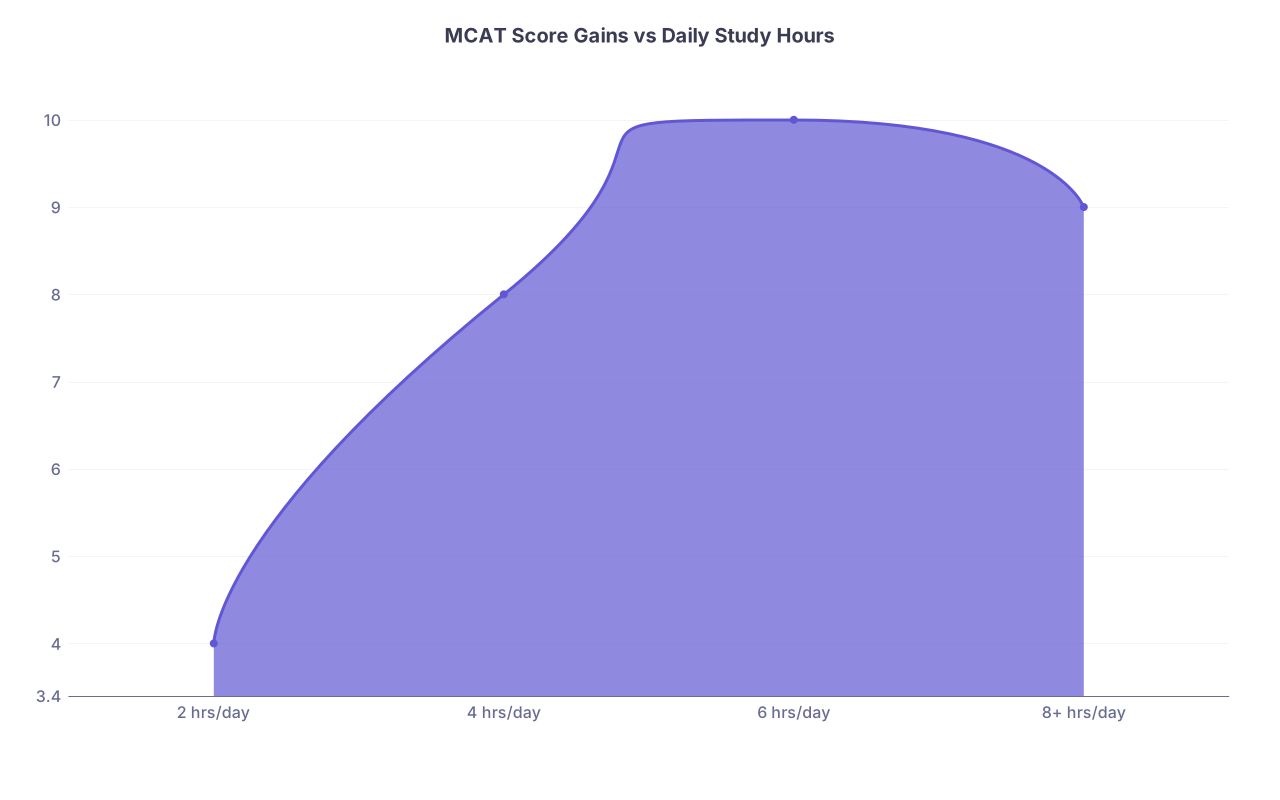
That chart is illustrative, not predictive. But the shape is the point. Once scores are available, schools can place you more confidently. That often increases movement.
You need to separate two different questions:
Will a pending MCAT stop review entirely? Usually no.
Will a pending MCAT reduce interview or acceptance odds compared with having a strong score already posted? Usually yes, at least temporarily.
That's not unfair. It's just how screening works.
Screening Signals When MCAT Is Pending: What Gets More Weight (and Why)
If your MCAT is pending, the rest of your file has to do more work. Simple.
The strongest pre-MCAT signals are:
- Overall GPA
- Science GPA
- Course rigor
- Academic trend
- Consistency over time
A 3.8 with strong science work and a clean upward trend buys you patience. A shaky GPA with grade volatility and weak recent science performance does the opposite. I've seen applicants talk themselves into "holistic review" like it's a rescue boat. It's not. Holistic review doesn't erase thin academics. It just means you're not reduced to one number.
Schools still need enough confidence to ask: is this file worth keeping alive until the MCAT arrives?
That's the real pre-MCAT question.
Your non-academic work matters too, especially when the file is waiting for final academic ranking:
- sustained clinical exposure
- meaningful service
- leadership with actual responsibility
- research, if relevant to the school's mission
- coherent motivation for medicine
- secondaries that sound specific, not copied and pasted from the same tired template
And yes, letters matter. Not generic "she is hardworking" nonsense. Strong letters are specific. They describe judgment, reliability, communication, resilience, and whether people trust you around patients or teams. That kind of detail helps committees feel less like they're betting blind while waiting on the MCAT.
For DO programs, mission fit can carry even more visible weight. If you're applying DO and your application gives zero evidence that you understand osteopathic principles, patient-centered care, or why that training model fits you, that's lazy. Fixable, but lazy. Schools notice.

Should you send updates while waiting?
Usually, less is more.
Good updates:
- new clinical role
- publication or poster acceptance
- completed degree or major academic milestone
- major service leadership development
- meaningful award or recognition
Bad updates:
- "Just checking in"
- "My MCAT is still pending"
- "I remain very interested"
- weekly portal-monitoring panic emails
That stuff doesn't help. It makes you look needy and distractible. Follow each school's policy. If they accept updates, send one concise, factual message when you actually have news.
MD vs DO: How Review May Differ When MCAT Is Pending (Evidence-Informed, Action-Oriented)
Here's the most defensible position: both MD and DO schools treat the MCAT as a major quantitative input, but they don't all use it at the same point in the process.
That timing difference is where most of the confusion comes from.
DO schools often have reputations for being more flexible and more holistic. That reputation isn't invented. Many are mission-driven, service-oriented, and willing to weigh lived experience, resilience, and clinical fit heavily. But don't twist that into "the MCAT barely matters." It does matter. A lot of applicants learn that the hard way.
MD schools, especially those with heavier applicant volume, may use a more formalized screening workflow. That can make the absence of an MCAT feel more restrictive because the score is part of a larger indexing system. But even then, many MD schools still move your file through early checks and mission review before the score posts.
What applicants misread all the time:
- "MCAT pending" is not a soft rejection.
- "Complete" does not mean fully evaluated.
- "Under review" does not mean interview decision tomorrow.
- No early interview before score release does not mean trouble.
It usually means your file is sitting where it belongs: alive, but not fully rankable.
The applicants who tend to hold their position best during this waiting period are the ones with:
- stronger GPA foundations
- evidence of academic readiness
- a coherent story that matches the school
- clear clinical maturity
- no obvious red flags
That last part matters. A pending MCAT is much easier for a committee to tolerate if the rest of the file feels stable and adult. If your writing is sloppy, your activities look inflated, your school list is random, and your academic record is uneven, the missing MCAT becomes more than a missing number. It becomes one more reason to hesitate.
That overlap is important. Applicants can still remain competitive before the score arrives. But once the score is in, schools can sort more confidently, and confidence changes action.
So if you want the blunt version:
- DO may feel a little more forgiving operationally.
- MD may feel a little more score-gated operationally.
- Neither system ignores the MCAT.
- Your strongest move is not guessing what the portal means. It's being ready when the score lands.
Decision Framework: What to Do While Waiting (MD and DO Strategies That Match the Data)
Here's the framework I'd use if this were my own application.
1) If you've submitted and you haven't received a secondary yet
Do this:
- confirm the school actually has everything it needs
- check whether the school screens before sending secondaries
- make sure your contact information and portals are clean
- stop sending unnecessary messages
Your goal is operational clarity, not emotional reassurance.
2) If your secondary is submitted and your MCAT is pending
This is the most common limbo zone.
Do this:
- track each school's status page
- know the score release date
- verify AMCAS/AACOMAS transmission after release
- keep a short update list ready in case a school accepts updates
- keep interview prep alive
Don't go dormant. I've seen applicants wait so passively that when invites finally came, they were rusty, disorganized, or weirdly shocked. Don't be that person.
3) If interview timing could happen soon after release
Assume movement can happen quickly.
Do this:
- practice your "Why medicine?" answer out loud
- tighten school-specific talking points
- review your own application so you don't contradict yourself
- plan your schedule so you can respond to invites fast
A lot of applicants obsess over review status and ignore interview readiness. That's backwards. The point of getting reviewed is to get invited. Be ready for the part that matters.
4) When your MCAT score posts
Immediately:
- Confirm the score is transmitted
- Confirm schools received it if their system requires verification
- Check whether any schools ask for score-update actions
- Reassess your school list honestly
This is where people either act like adults or start bargaining with reality.
If the score is strong:
- expect possible movement
- stay alert for portal and email changes
- continue interview prep
If the score is lower than expected:
- compare it to the realistic range of your list
- lean into schools where your GPA, mission fit, and experiences still make sense
- consider broader DO options or more appropriate MD fit
- think about retake timing early, not after the cycle has gone cold
Late retake fantasies are one of the dumbest habits in this process. If a retake is needed, face that early enough to make it useful.
5) Use calendar checkpoints
Set dates for:
- MCAT release
- one week after release
- one month after release
- major interview season milestones
That gives you structure. Otherwise you'll end up checking portals ten times a day and learning nothing.
Summary
Here's the answer you're looking for: a pending MCAT usually delays final ranking more than it stops review outright. That's true in both MD and DO admissions.
DO schools may sometimes appear more flexible while the score is missing. Fine. But don't romanticize that. Both MD and DO programs still use the MCAT as a serious academic signal. The real difference is often timing, not importance.
So your job while waiting is straightforward:
- keep your file complete
- avoid pointless update spam
- be ready for rapid movement after score release
- reassess your school list honestly once the number is real
- stay interview-ready the whole time
That's the data-aligned approach. Not glamorous. Just effective.