Opening Statement: The "Retake Penalty" Is Often Overstated
Let's kill the myth cleanly: there is no magical MD rule that says, "We forgive retakes," and no universal DO rule that says, "We punish them." That's applicant folklore. It spreads because nervous premeds love simple stories, and admissions is not simple.
Here's what the data actually shows: a small MCAT increase can matter, but only when it changes something real. Crossing a screening threshold. Fixing a bad subsection. Moving from "probably screened out" to "worth a serious read." That's different from the fantasy that one extra point somehow erases an average application or that one retake brands you forever.
I've seen applicants obsess over a 509 to 511 jump as if it were a moral victory the committee would applaud. Usually, they won't. Not because they're cruel. Because admissions readers are looking at the whole file: GPA trend, clinical work, service, writing, state ties, mission fit, and whether your MCAT profile actually solves a problem. A tiny increase only matters when it changes the math or the story.
That's the Myth Buster position. No superstition. No blanket retake penalty. Just context, thresholds, section balance, and school-specific behavior.
What Admissions Committees Actually See When They Notice a Retake
Applicants talk about MCAT retakes like committees only see the highest total score floating in space. They don't. They see the sequence.
They usually see:
- every attempt
- the test dates
- total scores
- section scores
- how much you improved
- how many tries it took to get there
And yes, that matters. But not in the cartoonish way premed forums describe it.
A retake can be read in at least three ways.
Neutral. This is the most common outcome. If your first score was decent, your second score is slightly better, and nothing dramatic happened, the committee just logs it and moves on.
Positive. If the first score was clearly below your demonstrated academic ability and the retake corrects it, improvement can help. Especially if your practice-test history, GPA, and coursework suggest the first sitting was the outlier. Committees do understand bad timing, poor strategy, illness, family disruption, and plain old underperformance.
Concerning. Multiple attempts with flat or trivial gains can create a bad signal. Not because admissions people hate effort. Because repeated retakes with weak returns raise an uncomfortable question: are you actually improving, or are you just taking the same swing again and again hoping for luck?
That's the part applicants don't like hearing.
A school may also care far less about the retake itself than about whether the final score clears its internal screen. Plenty of schools, MD and DO, use screening mechanisms before a human being reads your beautiful adversity essay. If your retake moves you above that line, great. If it doesn't, the "improvement" may be emotionally satisfying and operationally useless.
Resilience is good. But admissions is not a therapy session. The score has to do work.
Does a Small Increase Matter? Sometimes. But Not the Way Applicants Think.
A 1-3 point increase is not automatically meaningless. It's also not automatically impressive. Its value depends on what changed.
If you move from a 498 to a 501, that can matter a lot for certain schools and almost not at all for others. If you move from a 511 to a 513, that may slightly strengthen an already competitive file, but it usually won't rewrite your admissions destiny. If you move from a 507 to a 509 and your CARS stays ugly or one science section remains weak, that section problem can still drag your file down.
That's the real issue: individual meaning versus admissions meaning.
For you, a 2-point increase may represent months of better discipline and much stronger content mastery. Fair. For an admissions office, the question is colder: did those 2 points change your screening outcome, class-fit probability, or academic risk profile?
Often, the answer is no.
Here's the rough logic:
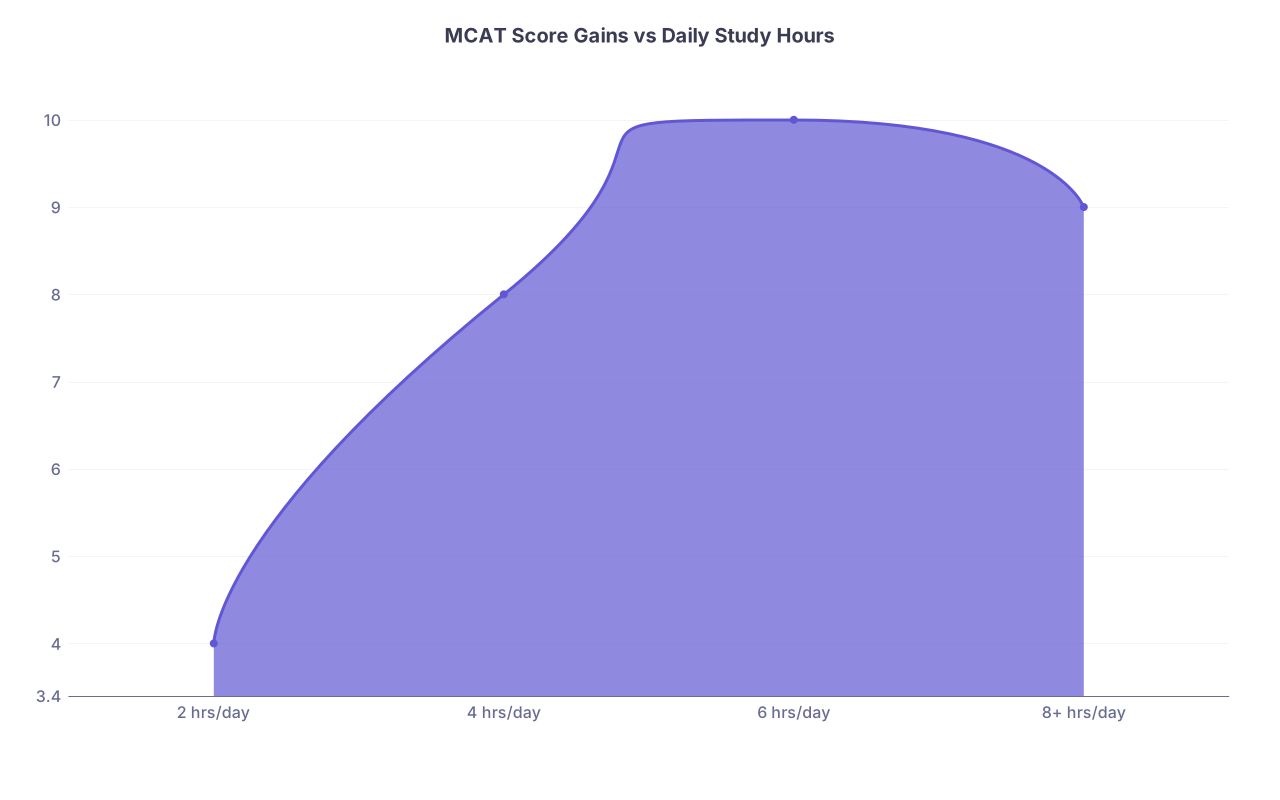
- 0-1 point increase: usually minimal impact
- 2-3 point increase: may matter if it crosses a cutoff or fixes a section floor
- 4-5 point increase: often meaningful because it suggests a true performance shift
- 6+ point increase: hard to ignore if the rest of the file is credible
But score movement has diminishing returns. Fast.
Once you are already in range for your target schools, a tiny bump rarely changes the core narrative. A strong applicant with a balanced 513 does not become a fundamentally different applicant at 515. Nice? Sure. Transformative? Usually not.
On the other side, small gains can be too small to rescue a weak file. If your target MD schools cluster around higher medians and your retake leaves you well below them, the committee is not going to pretend that a slight increase solved the problem. Same for DO schools with clear expectations around minimum sections or overall readiness. The number is better. The application may still not be competitive enough.
And let's talk about section scores, because this is where people fool themselves.
A total-score increase can hide a lopsided profile. I've seen a retake where the total rose by 2 points, but one section remained conspicuously low. Applicants celebrate the composite. Committees notice the weak link. If that section suggests reading trouble, reasoning trouble, or unstable science fundamentals, the total increase may not carry much weight.
This is why "small increase" is the wrong question. The right question is: did the retake fix the actual admissions problem?
If yes, great. If not, you may just be score-chasing.
MD vs DO: Where the Myth Breaks Down
Here's the lazy myth: MD schools are tougher about retakes, DO schools are more forgiving. Sounds neat. It's also wrong.
Both MD and DO schools are heterogeneous. Different missions. Different class profiles. Different state preferences. Different screening systems. Different levels of flexibility. Some schools care a lot about fit and service. Some are intensely numbers-aware. Some are happy to forgive an early stumble if the recovery is convincing. Others won't bother if the final metrics still don't land in range.
That's true on both sides.

What applicants call a "DO retake penalty" is often just screening mechanics. If a school uses hard or semi-hard cutoffs, then your file is filtered based on the final numbers and the broader pattern. That's not ideological hostility to retaking. That's administrative triage.
And what applicants call "MD forgiveness" is often just a stronger overall application surviving a retake because the rest of the file is excellent. Big difference.
Example. I've seen a student with a strong GPA, meaningful hospice volunteering, real physician shadowing, and compelling state-school alignment get serious MD attention despite a retake history, because the final score was solid and the application made sense. I've also seen applicants assume DO schools would overlook everything because "DO is more holistic," then get disappointed when a low section score or repeated marginal retakes still looked weak.
Mission fit matters. GPA matters. Clinical exposure matters. State residency matters. Writing matters. Interviewing matters. If you're applying to a public MD school where your state ties are strong, a small MCAT bump may be enough if the rest of the file is well-built. If you're applying to a DO school with a service-oriented mission and you've done almost no substantive patient-facing work, your 2-point increase won't magically fix that.
This is the part people resist because it's less comforting than myth. There is no single "MD vs DO retake rule." There are only schools, systems, and context.
When Retaking Is Worth It, and When It's Just Score-Chasing
Retake when the score is clearly below your realistic school targets. Retake when a subsection is dragging you under a floor. Retake when your full-length practice exams strongly suggest you underperformed and can gain meaningfully.
Don't retake because your ego wants a prettier number.
That's score-chasing. And it burns applicants every cycle.
Retaking is worth it if:
- your score is below the competitive range for your target list
- one section is low enough to trigger concern or screening problems
- your practice tests consistently sit several points higher
- you have a concrete new prep plan, not just vague determination
Retaking is a bad idea if:
- your practice scores are basically the same as your official score
- you're hoping for a miracle 1-point vanity bump
- your timeline will delay your application badly
- your weak spots are actually GPA, clinical depth, service, or writing
Repeated retakes with tiny gains can backfire. A lot. Not because committees are offended by persistence, but because they may conclude you're not preparing efficiently or not judging your readiness honestly. That's a professionalism signal, whether applicants like it or not.
There's also opportunity cost, and premeds routinely underestimate it. Three more months trying to squeeze out two points might be worse for your cycle than spending that time on:
- stronger clinical experience
- better school-list strategy
- GPA repair
- sharper essays
- earlier submission
I've told students not to retake when they desperately wanted permission to do it. Sometimes the smartest move is to apply with a solid score and improve the rest of the file. More test-taking is not always growth. Sometimes it's avoidance dressed up as ambition.
Bottom Line: The Data Favors Strategy Over Superstition
A small MCAT increase matters when it changes the admissions math. That's the rule. If it gets you over a screen, fixes a weak section, or materially improves your competitiveness for the schools you actually plan to apply to, it can absolutely be worth something.
If it doesn't do one of those things, don't romanticize it.
The contrarian takeaway is simple: there is no universal MD or DO retake penalty. There are school-specific thresholds, holistic review patterns, and context-sensitive interpretations. That's messier than the internet myth, but it's the truth.
So stop asking whether one more point will "look bad" because it came from a retake. Wrong question. Ask whether the retake solves a real problem in your file. Ask whether the time cost is justified. Ask whether your school list matches your actual metrics.
Build the strongest overall application you can. Don't build your strategy around admissions superstition. One more point is not magic. Sometimes it matters a lot. Sometimes it barely registers. Your job is to know the difference.