
The data show a hard truth: past a certain point, adding more medical school applications barely moves your odds but definitely empties your wallet.
The Core Question: Is 40+ Applications Rational?
The conventional premed wisdom says “apply broadly.” Many have translated that into “apply to 40–50 schools” or more, assuming a direct relationship between number of applications and probability of at least one acceptance.
The numbers do not support a simple “more is always better” model.
If we combine three data sources—AAMC national data, school-level interview/acceptance statistics, and applicant cost patterns—one pattern emerges clearly:
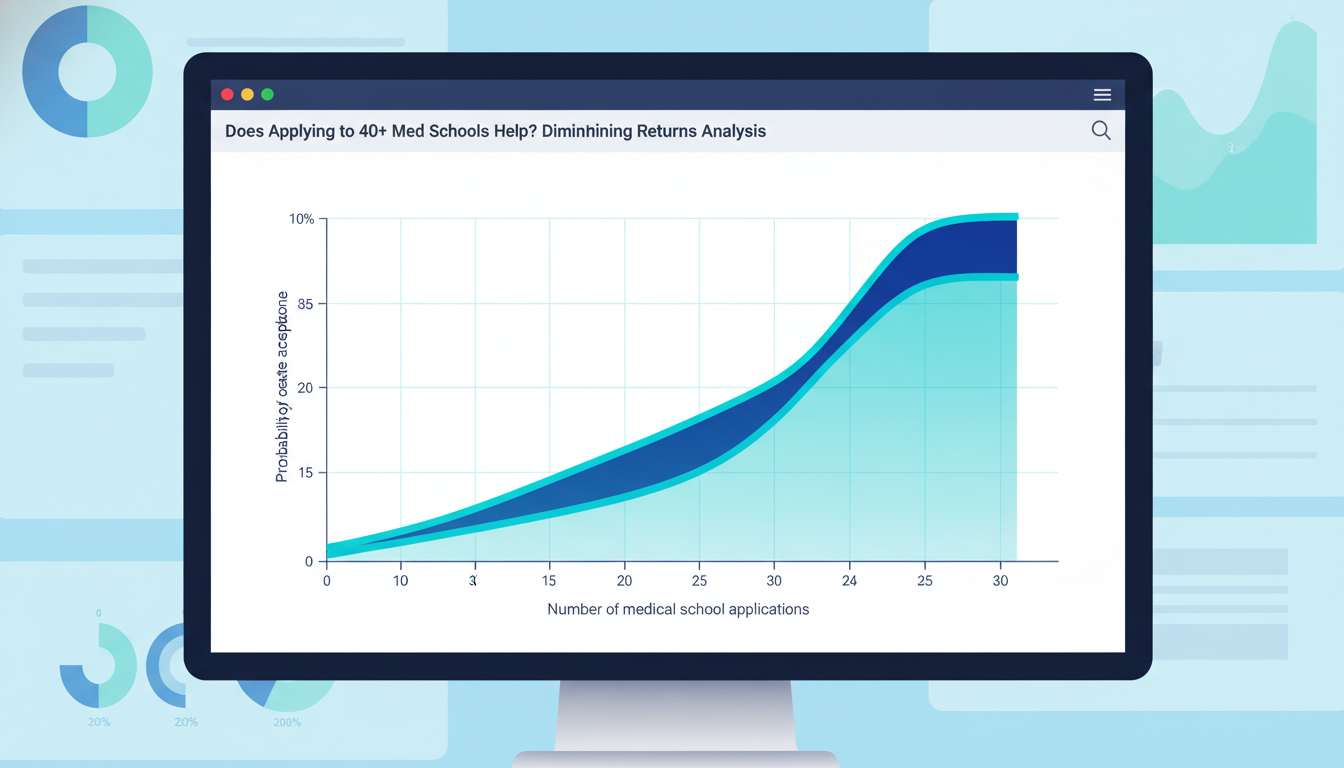
- The marginal benefit of each additional application drops sharply after roughly 20–25 schools for most applicants.
- Moving from 10 to 20 schools usually yields a large gain in acceptance probability.
- Moving from 30 to 40+ schools usually yields a small gain at high financial and time cost, unless you are in a high-risk applicant category.
To understand why, we need to quantify both the probability side and the cost side.
How Additional Applications Change Acceptance Odds
Let us start with a simplified probability framework and then adjust it to reality.
A simple independent-probability model
Assume that for each school you apply to, you have some probability ( p ) of being accepted if that school were your only application.
If decisions were independent (they are not fully independent in reality, but the directionality holds), the probability of no acceptance at all after applying to ( n ) schools is:
[ P(\text{zero acceptances}) = (1-p)^n ]
So the probability of at least one acceptance is:
[ P(\geq 1\ \text{acceptance}) = 1 - (1-p)^n ]
This function naturally produces diminishing returns as ( n ) increases.
What plausible values of p look like
Individual “per-school” acceptance probability varies dramatically:
- Strong applicant (e.g., 3.8+ GPA, 515+ MCAT, good activities):
Many target schools might yield effective per-school acceptance probabilities of 15–25%. - Average but competitive applicant (e.g., ~3.6 GPA, 508–512 MCAT):
Per-school probability might cluster around 5–12% at realistic targets. - High-risk applicant (low MCAT for target range, red flags, heavy upward trend needed):
Per-school probability might often be 2–6%.
Let us run simplified scenarios.
Scenario 1: Modestly competitive applicant (p = 0.08 per school)
Assume for a given set of target schools your effective per-school acceptance probability is 8%.
Then:
- 10 schools:
( P(\geq 1) = 1 - 0.92^{10} \approx 1 - 0.434 \approx 56.6% ) - 20 schools:
( 1 - 0.92^{20} \approx 1 - 0.188 \approx 81.2% ) - 30 schools:
( 1 - 0.92^{30} \approx 1 - 0.082 \approx 91.8% ) - 40 schools:
( 1 - 0.92^{40} \approx 1 - 0.036 \approx 96.4% )
Marginal gain examples:
- From 10 → 20 schools: acceptance chance rises about 24.6 percentage points.
- From 20 → 30 schools: gain of 10.6 points.
- From 30 → 40 schools: gain of 4.6 points.
Diminishing returns are evident: the first 10 extra schools do a lot of work; the fourth set of 10 barely moves the needle.
Scenario 2: Higher-risk applicant (p = 0.04)
Now assume a tougher situation where your effective per-school acceptance probability is 4%.
- 10 schools:
( 1 - 0.96^{10} \approx 1 - 0.665 \approx 33.5% ) - 20 schools:
( 1 - 0.96^{20} \approx 1 - 0.442 \approx 55.8% ) - 30 schools:
( 1 - 0.96^{30} \approx 1 - 0.294 \approx 70.6% ) - 40 schools:
( 1 - 0.96^{40} \approx 1 - 0.196 \approx 80.4% ) - 50 schools:
( 1 - 0.96^{50} \approx 1 - 0.129 \approx 87.1% )
Here:
- 10 → 20 schools: +22.3 points
- 20 → 30 schools: +14.8 points
- 30 → 40 schools: +9.8 points
- 40 → 50 schools: +6.7 points
The plateau is slower, so higher-risk applicants may justify more applications. But diminishing returns still exist: the 40th school increases your overall odds by under 10 percentage points.
Why the independent model overestimates the value of “spray and pray”
In reality, decisions are correlated, not independent:
- Your GPA and MCAT travel with you to every school.
- Your clinical exposure, research, and letters are common inputs.
- Schools with similar selectivity will tend to move together in evaluating you.
This correlation means the independent model overstates how much extra probability you gain from each added school, especially when the added schools are:
- Demographically similar (same region, same private/public profile).
- Statistically similar (same MCAT, GPA medians).
- Mission-similar (all research-heavy, or all community-focused, etc.).
So when the toy calculation suggests you gain, say, 5 percentage points from the 40th school, the real-world gain is likely smaller, unless that school is genuinely different in mission and selectivity.
The Financial and Time Cost of 40+ Applications
Probability is only half of the equation. The medical school application process is economically and cognitively expensive.
Primary application fees (AMCAS as baseline)
For AMCAS (MD) 2024–2025:
- First school: ~$175
- Each additional school: ~$45
So:
- 20 schools:
$175 + 19×$45 = $175 + $855 = $1,030 - 40 schools:
$175 + 39×$45 = $175 + $1,755 = $1,930
The jump from 20 to 40 primary applications alone is about $900.
For AACOMAS (DO) and TMDSAS (Texas), numbers differ but the pattern is similar: incremental costs mount quickly with each additional school.
Secondary application fees
Most schools charge $75–$125 per secondary application. Assume $90 as a conservative average.
- 20 secondaries: $1,800
- 40 secondaries: $3,600
Not all schools will send you a secondary, but many do. Many applicants complete nearly all secondaries they receive.
Total direct cost comparison
Let us approximate total cost for MD-only, no fee assistance, assuming you apply to 20 vs 40 schools and submit all secondaries.
20 schools:
- Primary: ~$1,030
- Secondaries: ~$1,800
- Total (apps only): ~$2,830
40 schools:
- Primary: ~$1,930
- Secondaries: ~$3,600
- Total (apps only): ~$5,530
So the jump from 20 → 40 schools:
- Extra 20 primary schools → ~+$900
- Extra 20 secondaries → ~+$1,800
- Total incremental cost ≈ $2,700
That $2,700 is the price tag of your marginal increase in probability going from 20 to 40 schools.
If the incremental gain is, for example, +8–10 percentage points in real-world acceptance odds (and often less), you are effectively paying $270–$340 per percentage point of extra acceptance probability.
This is a useful mental conversion.
Time and cognitive load
Secondary essays are not trivial.
- Assume 3–4 prompts per school.
- Average total word count per school: 1,000–2,000 words.
- Time per school (draft, edit, tailor, submit): 3–5 hours for most applicants.
Using a conservative 3.5 hours per secondary:
- 20 schools → ~70 hours
- 40 schools → ~140 hours
Those extra 20 schools demand ~70 additional hours in a very compressed July–September timeline.
This has downstream effects:
- Lower quality tailoring for each essay.
- Higher stress and burnout.
- Less time left for MCAT retakes, ongoing research, or clinical work.
- Increased risk of sloppy errors that can damage your application at multiple schools simultaneously.
You are trading one scarce resource (focused time) for another (slightly more coverage across schools). The data pattern from advising offices is consistent: above ~25–30 schools, personal statement and secondary quality often begins to degrade.
Where the Benefit of Extra Schools Peaks
The critical question is not “How many schools do top applicants apply to?” but “At what point do marginal returns no longer justify marginal cost for someone with my profile?”
Here we can synthesize probability math with empirical behavior patterns.
National behavior patterns
AAMC data in recent years show:
- Average number of MD schools applied to: typically ~16–18.
- Many successful applicants cluster around 15–25 schools.
- DO applicants often apply to 10–20 DO programs, sometimes overlapping with MD.
You also see different patterns among:
- In-state-advantaged applicants (e.g., strong in-state public systems):
Frequently successful with 10–20 well-targeted schools. - Geographically flexible, competitive applicants:
Commonly in the 20–30 range. - Reapplicants or low-stat applicants:
More often in the 30–40+ range, sometimes exceeding 45.
So how do we quantify the inflection point?
A conceptual “return on application” metric
Define a rough return metric:
[ \text{Marginal return per application} = \frac{\Delta P(\geq 1\ \text{acceptance})}{\text{Added cost and time}} ]
Cost per extra school (approximate, MD):
- Primary increment: ~$45
- Secondary: ~$90
- Time cost: 3.5 hours (assign a value; even at $20/hour opportunity cost = $70)
So:
- Monetary cost per school ≈ $135
- “Full” cost including time ≈ $205 per extra application
For a given applicant type, ask:
- How many percentage points of acceptance probability do you gain per extra $205?
Using Scenario 1 (p≈0.08, moderately competitive):
- From 10 → 20 apps: gain ≈ +24.6 points for +10 schools
≈ 2.46 points per app - From 20 → 30 apps: gain ≈ +10.6 points for +10 schools
≈ 1.06 points per app - From 30 → 40 apps: gain ≈ +4.6 points for +10 schools
≈ 0.46 points per app
Translate to cost:
- 20 → 30: 1.06 points per app → ~$193 per percentage point (205 / 1.06).
- 30 → 40: 0.46 points per app → ~$446 per percentage point (205 / 0.46).
Once you are paying roughly $400–$500 per marginal percentage point in theoretical, independence-assuming probability, the true real-world ratio is worse. Correlated decisions could push this to $600–$800 per point of actual gain.
This is where the diminishing returns become economically irrational for many.
Where different applicants should likely plateau
Using both the math and advising patterns, a data-informed guideline looks like this:
Strong applicants (e.g., 3.8+ GPA, 515+ MCAT, solid experiences)
- High per-school probability at selected targets (p often 0.12–0.25).
- Diminishing returns hit earlier.
- Data-aligned range: 15–25 schools, perhaps up to 30 if geography is very constrained or preferences are narrow.
Moderate applicants (e.g., 3.5–3.7 GPA, 505–512 MCAT)
- p often ~0.06–0.12 at realistic schools.
- Range where marginal returns still decent: 20–30 schools.
- Beyond 30–35, cost per extra percentage point becomes steep unless you are addressing specific risk factors (reapplicant, non-traditional, state constraints).
Higher-risk applicants (e.g., <3.4 GPA or <503 MCAT with some redeeming factors)
- p often 0.03–0.06 at carefully chosen schools; lower if choices are unrealistic.
- Reasonable range: 25–40 schools, sometimes more if the list is truly well-stratified and includes many realistic options (especially DO).
- However, this group frequently misallocates by overapplying to long-shot MDs instead of diversifying into DO or SMP/post-bacc, where ROI may be higher.
Even for the highest-risk group, 40+ MD applications alone usually represents a poor cost–benefit tradeoff if you have not first invested in strengthening your profile.
When 40+ Applications Might Actually Make Sense
There are specific scenarios where going to or beyond 40 applications can be strategically justifiable.
1. Limited in-state options plus moderate stats
If you live in a state with:
- Few public med schools
- Weak in-state preference
- No strong geographic ties elsewhere
and you have:
- Middle-of-the-pack stats
- Reasonably balanced experiences
then you may need to “buy” probability through more applications because you lack the built-in advantage many in-state applicants enjoy. A 30–40 school list, carefully stratified, can be logical.
2. Reapplicant with modest improvements, no major red flags
For a reapplicant who:
- Has improved MCAT or GPA somewhat
- Has significantly strengthened clinical or service hours
- Did not have professionalism issues previously
a broader net can sometimes reach programs that already rejected you once but might reconsider with a meaningfully stronger file. Here, 30–40+ applications might shift your overall acceptance odds enough to justify the cost, especially if last cycle’s list was too top-heavy.
3. Applicants willing to mix MD and DO heavily
If your goal is any U.S. medical school and you include:
- 15–20 MD schools
- 15–25 DO schools
then a 30–45 total application count can substantially increase your overall acceptance probability, particularly if DO schools are chosen realistically. The effective per-school probability may be significantly higher at DO programs for applicants whose stats are below MD medians, flattening the diminishing-returns curve somewhat.

When 40+ Applications Usually Reflect Panic, Not Strategy
From an advising and data perspective, certain patterns suggest that a 40+ strategy is misaligned with expected returns.
1. Long list of “reach” schools
If your list looks like:
- Many schools with MCAT medians 3–5 points above your score
- Top-20 heavy with limited mission fit
- Few real “safety” or realistic target schools
then 40+ applications are essentially 40+ lottery tickets, not 40 opportunities with 5–10% probabilities. The expected gain per added application here is extremely low.
2. No underlying profile improvement vs prior cycle
Reapplying widely without:
- Improving MCAT
- Repairing GPA via post-bacc/SMP
- Adding substantial clinical or service hours
- Clarifying red flags
turns 40+ applications into an expensive repetition, not a new experiment. Correlation between cycles will be high; rejection patterns repeat.
3. Severe time crunch on essays
If you are submitting:
- Secondaries within 24 hours for dozens of schools
- Reusing essays with near-zero tailoring
- Making frequent proofreading mistakes
the quality cost may exceed the small probability gain from extra schools. A focused, well-executed 25-school list can easily outperform a rushed 45-school spree in real-world outcomes, even if the theoretical probability math suggests otherwise.
A Data-Driven Framework to Decide Your Number
Rather than copy a friend’s number or Reddit’s median, use a structured, quasi-quantitative approach.
Step 1: Estimate your effective per-school probability band
Benchmark yourself against school data:
- Compare your GPA/MCAT to MSAR medians and interquartile ranges.
- Weigh in-state boosts where relevant.
- Adjust for special strengths (e.g., strong research for research-heavy schools, high service for mission-driven schools).
Rough working bands:
- Likely >0.15 per school: very close to or above 75th percentile metrics at several targets, strong story.
- ~0.08–0.15 per school: near medians at realistic targets, balanced portfolio.
- ~0.04–0.08 per school: somewhat below medians, but in the competitive range.
- <0.04 per school: clearly below typical ranges for most MDs you are considering; DO may be your realistic sweet spot.
Step 2: Decide your target probability of at least one acceptance
Ask yourself what feels acceptable:
- 70%? 80%? 90%+?
Then use the formula:
[ n = \frac{\ln(1 - P_{\text{target}})}{\ln(1 - p)} ]
For example, suppose you estimate ( p = 0.08 ) and want an 85% chance of ≥1 acceptance.
- ( 1 - P_{\text{target}} = 0.15 )
- ( \ln(0.15) ≈ -1.897 )
- ( \ln(0.92) ≈ -0.0834 )
- ( n ≈ -1.897 / -0.0834 ≈ 22.7 \Rightarrow 23 ) schools (in the independent model).
Recognize that due to correlation, you may need to add 10–30% more schools than this idealized number for a buffer.
So you might aim for ~25–30.
Step 3: Overlay cost and time constraints
Calculate:
- Direct budget limit for the cycle (e.g., $3,000, $4,000).
- Time realistically available for secondaries across July–September.
Use the earlier cost/time estimates to test scenarios:
- If your maximum is 30 schools, but the math suggests you “need” 40, you might instead reconsider:
- School selectivity mix.
- Inclusion of DO.
- Timing of your application (perhaps strengthen then reapply).
Step 4: Optimize list quality, not just length
Even a mathematically calculated number fails if the list itself is poorly constructed. Ensure:
- Solid proportion of realistic targets (where you are at/near medians and fit the mission).
- Some true reaches, but not a majority.
- A few schools that are safer based on data (for DO especially).
The quality of matching between your profile and school priorities can raise your effective per-school ( p ), improving your overall odds without increasing ( n ).
Key Takeaways
- The data show a steep diminishing return curve: for many applicants, the large gains are between about 10 and 25 applications; gains beyond 30–35 are small relative to cost and time.
- A 40+ school strategy is justified only for specific, higher-risk or constrained applicants; for most, the incremental benefit is not worth the additional $2,000+ and 70+ hours.
- A data-driven approach—estimating your per-school probability band, targeting a realistic overall acceptance probability, and then optimizing list quality—beats both underapplying and panic-driven 40+ application sprees.