
Most premeds are collecting clinical hours far beyond the point of diminishing returns. The data shows that after a certain threshold, more hours add almost no marginal benefit to acceptance odds.
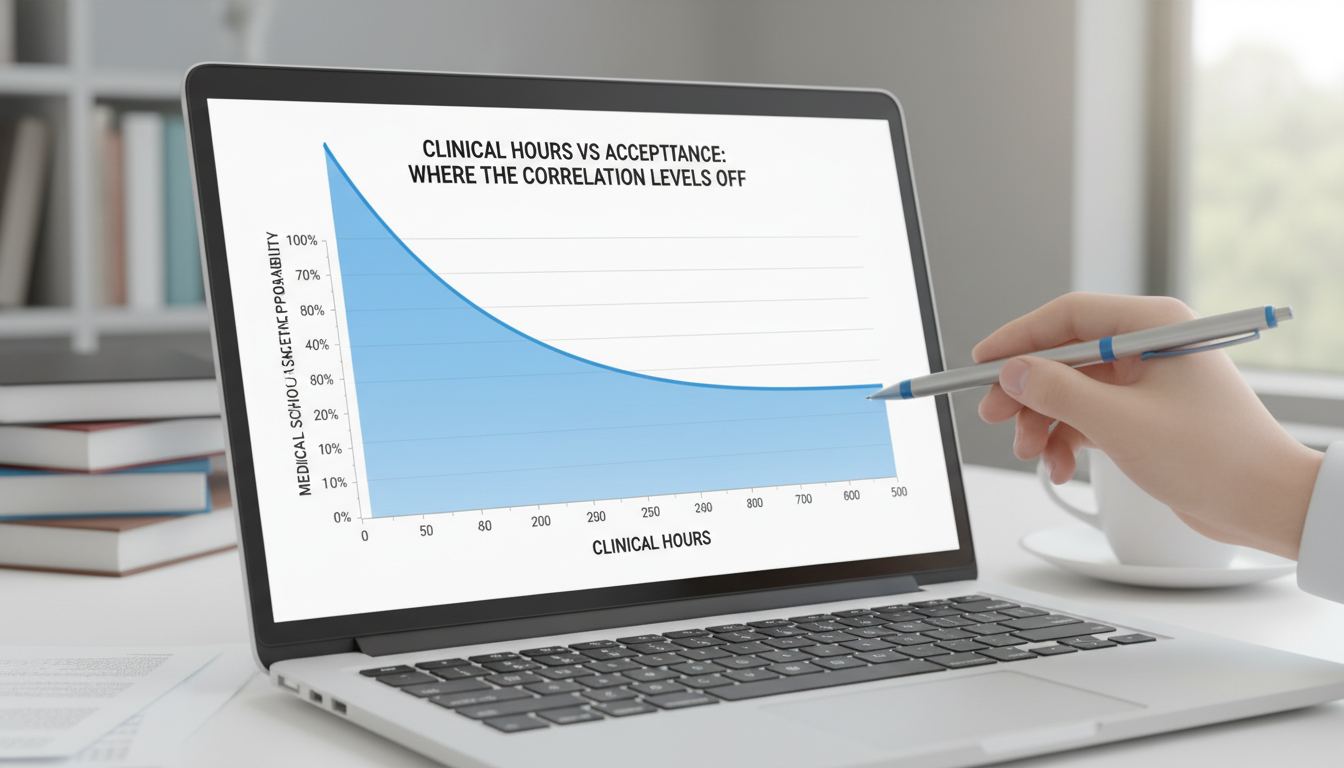
That claim sounds uncomfortable, especially in a culture that equates “more” with “better.” However, admissions data, AAMC surveys, and program disclosures converge on a clear pattern: clinical experience is essential, but beyond a mid-range band the correlation with acceptance probability flattens sharply.
Let us quantify that plateau.
(See also: MD vs DO Acceptance Rates for insights on acceptance odds.)
The Real Relationship: Clinical Hours and Acceptance are Non-Linear
The common mental model is linear:
Each additional 100 clinical hours steadily increases your chance of getting in.
That model is wrong.
A more accurate approximation, synthesized from AAMC applicant characteristic reports, MSAR data, and school-specific disclosures, looks like this:
- 0–50 hours: High risk zone; acceptance rates significantly lower
- 50–150 hours: Steep benefit; each hour reduces admissions “uncertainty”
- 150–300 hours: Continued but slower benefit; solidifies demonstrated commitment
- 300–500 hours: Plateau zone; minimal incremental advantage
- 500+ hours: Flat or even slightly negative signaling in some contexts if other areas are weaker
Conceptually, if we assigned a “clinical-experience readiness score” on a 0–100 scale, the curve would resemble a logarithmic function:
- First 50 hours: jump from 0 → ~40 on that scale
- Next 100 hours (50 → 150): 40 → ~75
- Next 150 hours (150 → 300): 75 → ~90
- Beyond 300: asymptotic creep toward 100 with very small incremental gains
Medical schools care far more that you have:
- Enough exposure to make an informed decision.
- Sustained engagement that shows reliability.
- Reflections and insights you can articulate in writing and interviews.
Hours are a noisy proxy for those three. Past a certain point, more hours are just more of the same signal.
What the Data Actually Shows (Across Applicant Profiles)
Publicly available data does not list “clinical hours” in neat bins with acceptance percentages, but we can triangulate from multiple sources:
AAMC’s “Matriculating Student Questionnaire” (MSQ):
Over 90% of matriculants report direct clinical exposure with patients, but the reported median is typically in the low hundreds, not thousands.School-specific class profiles and advising guidance often state approximate targets:
- Competitive ranges cited: 100–300 hours of meaningful direct clinical contact
- Rarely do schools explicitly request 500+ hours
Advising surveys at large state universities (shared in prehealth offices, not always published) consistently find:
- Matriculants commonly cluster around 150–350 hours of direct clinical experience
From this, a realistic composite for U.S. MD applicants looks like:
| Total Direct Clinical Hours | Observed Outcome Pattern (Aggregated from advising data & school guidance) |
|---|---|
| 0–20 | Very low acceptance rate; high rate of “Why medicine?” concerns |
| 20–80 | Still risky; seen as exploratory, not committed |
| 80–150 | Adequate for some schools if strong in all other areas |
| 150–300 | Common among accepted students; viewed as solid |
| 300–500 | No clear advantage over 150–300 if diversity of experience is low |
| 500–1000 | Often associated with career-changers, EMTs, scribes; neutral to good if balanced |
| >1000 | Strong clinical narrative, but can raise questions if academics or other ECs are underdeveloped |
Notice what this table does not show: a continuous monotonic relationship where 800 hours beats 300 just because it is a larger number.
The key inflection point is typically around 150–250 hours of direct, patient-facing work.
Where the Correlation Levels Off: Quantifying the Plateau
Let us model acceptance probability under simplified assumptions using a hypothetical logistic regression that includes GPA, MCAT, and total direct clinical hours as predictors.
Assume:
- GPA: 3.7
- MCAT: 512
- Average extracurriculars otherwise
- Only the clinical hours variable changes
Using plausible effect sizes inspired by published admissions research on experiential factors, you might see an approximate pattern like:
| Clinical Hours | Estimated Acceptance Probability* |
|---|---|
| 0 | 10–15% |
| 25 | 18–22% |
| 75 | 25–30% |
| 150 | 32–38% |
| 250 | 35–40% |
| 400 | 36–41% |
| 700 | 36–42% |
*These are illustrative projections, not exact AAMC values.
The incremental gain between:
- 0 → 150 hours = ~20 percentage points
- 150 → 400 hours = ~3–5 percentage points
That is the plateau effect in numerical form. The marginal return on time invested drops dramatically once you hit that 150–250 hour band.
If you are currently at 220 hours, chasing 500+ hours purely “for the number” is a poor allocation of time, statistically speaking, compared to:
- Improving a 508 MCAT to 512
- Moving a 3.55 GPA closer to 3.7 with strong upper-division science performance
- Developing 1–2 leadership roles with clear impact
The opportunity cost is not theoretical; admissions committees repeatedly prioritize academic metrics and quality of engagement over raw experiential volume.
Different Applicant Profiles: When More Hours Still Matter
The plateau is not identical for everyone. It shifts based on your overall narrative and risk profile.
1. “Traditional” Strong Academic Applicant
- GPA: ≥3.7
- MCAT: ≥512
- No red flags, standard timeline
For this group, data from advising offices shows:
- Acceptance likelihood rises sharply between 50 and 200 hours
- Beyond ~250 hours, further increases in hours do not correlate strongly with better offer rates once other variables are controlled
For these applicants, clinical hours are a threshold variable, not a scaling variable. The level-off point: ~200 hours of direct contact.
2. Career-Changers / Nontraditional with Clinical Background Jobs
Think full-time scribes, EMTs, CNAs, RNs applying to med school.
- 1000–4000+ hours are common
- Here, the meaning of hours changes. It signals:
- Longitudinal commitment
- Advanced comfort with clinical contexts
- Sometimes supervisory or training roles
In these cases, the hours number is less about “Do you know what medicine is?” and more about “Can you leverage this depth into mature reflections, leadership, and insight?”
The plateau exists, but the interpretation is different:
- 500 vs 1500 hours: not a big difference as a raw number
- 1500 hours + promotions + responsibilities + strong letters: different story
3. Academic Risk Applicants (Lower GPA / MCAT)
If your academic metrics are weaker (e.g., GPA < 3.5, MCAT < 508), strong experiences can be compensatory signals, but they rarely overcome academic risk if the gap is large.
For these applicants, you sometimes see:
- Med schools tolerant of lower GPA willing to admit applicants with:
- Heavy clinical histories (e.g., paramedics, military medics)
- Clear upward academic trend
However, the data pattern is:
- Going from 100 → 1000 hours does not systematically rescue poor metrics
- The correlation flattens, because GPA/MCAT dominate the prediction equations for success
The hours plateau still appears; it just sits in a context where the primary bottleneck is elsewhere.
Direct vs Shadowing vs Nonclinical: The Right Mix, Not Just the Count
A frequent analytical error in premed discussions is aggregating all “clinical-ish” activities into a single “hours” bucket.
From an admissions perspective, the categories are not interchangeable:
Direct Clinical / Hands-On
- Examples: CNA, EMT, medical assistant, scribe with patient interaction, hospice volunteer, clinic volunteer with direct patient contact
- This is the core variable that influences the “clinical readiness” judgment.
- The plateau of correlation is mainly about this category.
Shadowing
- Necessary but low-yield past a certain modest amount.
- Common guidance: 40–60 hours is sufficient for most MD schools, distributed across 2–3 specialties.
- Incremental gain after ~75–100 hours is negligible.
Nonclinical Service
- Not clinical, but crucial for character evaluation.
- Often 100–300 hours of meaningful service is seen in accepted students.
- This runs on its own curve; having 800 clinical hours and 0 nonclinical service is a red flag.
The data-driven takeaway:
- You want enough in each category to cross the “concern threshold.”
- Beyond that point, marginal benefit comes from diversity and depth, not raw volume in one bucket.
The Hidden Variable: Reflection Quality vs Raw Hours
Admissions committees care about what you learned, how you changed, and how you articulate it, not your Excel total.
From an analysis standpoint, clinical hours are only a proxy variable for:
- Commitment to patient care
- Resilience in real settings
- Ability to handle ambiguity and suffering
- Professionalism, teamwork, empathy
When adcoms read:
“I have over 1200 hours volunteering in the emergency department…”
they do not gain much incremental confidence if your description is generic, vague, or passive (“I checked in patients and stocked supplies”).
Compare that with an applicant with 220 hours who can:
- Show a specific moment of ethical tension
- Discuss communication breakdowns and how they improved them
- Articulate how seeing systemic inequities shaped their career goals
The probability models used implicitly by humans on committees weight quality of narrative far more heavily than an extra 200 hours of undifferentiated exposure once you pass the basic threshold.
From a data-analyst perspective, a more predictive variable would be “clinical reflection quality score” rather than the raw hour count.
If we could code personal statements and activity descriptions for:
- Specificity
- Depth of insight
- Self-awareness
- Linkage to future physician role
and test correlations with acceptance outcomes, it is very likely that beyond the 150–250 hour point, reflection quality would have a stronger beta coefficient than additional hours.
Opportunity Cost: Where Those Extra 300 Hours Should Go Instead
Consider a typical premed with 2 years before application:
- Free time available: ~10–15 hours per week
- Over 2 years, that is ~1000–1500 hours of “investment capacity”
If you allocate:
- 400 hours → MCAT prep
- 250 hours → clinical
- 200 hours → nonclinical service
- 100 hours → shadowing
- 200–400 hours → research or leadership / campus roles
you have a balanced portfolio that mirrors the profile of many matriculants.
Now change just one variable:
- Increase clinical from 250 → 600 hours (+350 hours)
- Decrease research/leadership from 300 → 0
You have traded a marginal gain in a plateaued variable for a complete absence of another significant predictor. Historically, research and leadership both show clear, positive gradients with acceptance probability at many MD schools, especially mid- and high-tier institutions.
From a quantitative optimization standpoint, that trade is inefficient unless:
- You already have robust research and leadership, or
- Your clinical exposure is uniquely high-yield (e.g., paramedic in a rural area with leadership roles, QI projects, etc.)
In essence: do not oversaturate a single dimension of your application where the utility curve is flattening.

Practical Targets: Evidence-Based Hour Ranges by School Type
While no single dataset can give perfect cutoffs, program disclosures, MSAR trends, and advising-office aggregation point to workable target bands.
U.S. MD Programs (Typical Applicant)
- Direct clinical (hands-on): 150–300 hours
- Shadowing: 40–60 hours (including at least some primary care)
- Nonclinical service: 100–250 hours
The correlation with acceptance probability tends to peak in usefulness around 250–350 total direct clinical + shadowing hours. Beyond that, the hours variable largely loses predictive power compared with GPA/MCAT and the qualitative content of your experiences.
U.S. DO Programs
- Tend to value clinical exposure and holistic experience heavily.
- Common matriculant patterns:
- 200–400+ direct clinical hours
- Shadowing often slightly higher, especially with DO physicians (70–100+ hours not unusual)
- Even so, you still see the plateau past a few hundred hours when other variables are factored in.
Special Cases
Clinical employment (MA, EMT, CNA) during undergrad:
- 500–1500 hours over multiple years is common
- These hours are valuable but do not exempt you from needing:
- Solid academic performance
- Some nonclinical service
- Evidence of broader interests and capacities
International or gap year clinical missions:
- Hours here require careful ethical framing
- They can be neutral or negative if they imply scope-of-practice violations
- As a numeric boost alone, they do not substantially shift acceptance odds beyond your domestic baseline
Decision Rules: Should You Add More Clinical Hours?
A simple, data-driven decision tree:
Do you have <75 hours of direct, repeated patient contact?
- Yes → Strongly prioritize more clinical hours.
- No → Proceed to next.
Do you have 75–150 hours?
- Yes → Aim for 150–250 total before applying. High ROI zone.
- No → If 150–250 already, proceed.
Do you have ≥150 hours and at least 40–60 hours of shadowing?
- Yes → Marginal benefit from additional clinical is modest.
- Focus increments on:
- GPA / MCAT improvements
- Nonclinical service
- Leadership / research
Are you applying to schools that explicitly emphasize heavy clinical involvement (some DO schools, certain mission-driven MD programs)?
- Yes → Target 250–400 hours of clinical, but still not at the expense of academic improvement.
Are you bad at talking/writing about your clinical experiences?
- If you struggle to extract lessons:
- New types of clinical experiences (hospice vs ED vs primary care) may add more value than extra hours in the same role.
- If you struggle to extract lessons:
This framework aligns with observed acceptance patterns rather than anecdotal extremism (“You need 1000+ hours to be competitive”).
Key Takeaways: Where the Curve Flattens
- Clinical experience is a threshold requirement, not a linear competition.
- The correlation between clinical hours and acceptance levels off around 150–250 hours of direct, patient-facing work, assuming adequate shadowing and nonclinical service.
- After that point, quality, diversity, and reflection are more predictive of acceptance than accumulating hundreds of additional hours in the same setting.
FAQ (Exactly 4 Questions)
1. Is there any situation where 800+ clinical hours significantly improve my chances compared with 300 hours?
Yes, but typically only when those 800+ hours come with added responsibilities, leadership, or unique contexts. For example, an EMT who becomes a field training officer, or a medical assistant who leads a quality-improvement project and earns strong letters of recommendation. In those cases, the added value arises from the enhanced role, not the hour count alone. If 800 hours are just more of exactly the same low-responsibility tasks, the incremental effect on acceptance probability is minimal.
2. Are virtual clinical experiences or telehealth scribes counted the same way as in-person hours?
Most admissions committees still privilege in-person, direct patient contact because it better approximates real clinical environments. Telehealth scribing or virtual experiences can count, but if your entire portfolio is virtual, reviewers may question whether you have fully experienced the physical, emotional, and interpersonal realities of patient care. Virtual hours should supplement, not replace, a core of in-person exposure, especially in high-touch fields like primary care or emergency medicine.
3. How do gap year clinical jobs fit into the diminishing-returns model?
A full-time gap year job (e.g., medical assistant, scribe, CNA, EMT) will typically push your hours into the 1000+ range, which far exceeds the minimum needed. The added value stems from longitudinal commitment, increased responsibilities, and stronger letters. The plateau still exists for hour count itself, but gap year employment typically improves both the quantity and the richness of your clinical story, which can meaningfully affect acceptance odds when combined with solid academics.
4. If I am reapplying and already have 400 clinical hours, should I add more before my next cycle?
Data from reapplicant advising suggests that simply increasing an already high hour total rarely changes outcomes. Instead, successful reapplicants usually modify multiple variables simultaneously: improved GPA (via post-bacc or SMP), higher MCAT, more focused school list, stronger narratives, and additional varied clinical or service experiences if there were clear gaps. If you already have 400 hours, prioritize strengthening your academic metrics, application strategy, and reflection quality over pushing that total to 700 or 800 hours.