
The biggest mistake premeds make about public medical schools is assuming “out-of-state friendly” means “you have a real shot.” The data shows that, for most public MD programs, in-state status is not a mild advantage—it is the single dominant admissions variable after academic metrics.
Public schools are not subtle about this. Their mandates, funding models, and legislatures push them to train physicians for their own state. The numbers reflect that pressure with brutal clarity.
Below is a data-driven breakdown of in-state vs out-of-state (IS vs OOS) acceptance dynamics across U.S. public MD programs, how large the actual advantage is, where exceptions exist, and how an applicant should strategically respond.
1. The Structural Reality: Why Public Schools Favor In-State
Public MD schools are not just educational institutions; they are state workforce pipelines. Legislatures subsidize tuition and operations with an explicit expectation: produce physicians who will practice in-state.
Key structural factors:
- Funding source: A significant portion of operating budgets at public schools is state-derived. Legislators expect a return in the form of local physicians.
- Mission statements: Many explicitly state “training physicians to serve [STATE]” or similar language.
- Physician shortage data: HRSA and AAMC workforce reports show persistent primary care and rural shortages in many states. States pressure their schools to address local gaps.
When you aggregate admissions data across public MD programs, this structural mission translates into striking ratios.
From multiple years of AAMC Medical School Admission Requirements (MSAR) and self-reported school data, a typical pattern emerges:
- Median public MD school:
- In-state acceptance rate: often 3–10%
- Out-of-state acceptance rate: often 0.5–3%
- Proportion of enrolled class:
- 60–90% in-state at many schools
- True “OOS-friendly” schools are the minority among public institutions
This is not a small edge. It often multiplies your probability of admission by a factor of 3–10x or more.
2. National Patterns: How Big Is the In-State Advantage?
To understand magnitude, it helps to view the data in ratios rather than raw percentages.
Across many public MD schools, several consistent patterns appear:
- Applicant volume skew:
- OOS applicants usually outnumber IS applicants by a wide margin.
- Example pattern: 3,000–9,000 OOS applications vs 1,000–3,000 IS applications.
- Seats skew:
- The majority of the class is IS, despite IS applicants often being a minority of the applicant pool.
Conceptually, suppose a hypothetical public school has:
- 4,000 in-state applicants, 12,000 out-of-state applicants
- 180 total seats, with 140 reserved or effectively targeted for in-state, 40 filled by OOS
Then, simplified:
- IS acceptance rate: 140 / 4,000 = 3.5%
- OOS acceptance rate: 40 / 12,000 = 0.33%
That is more than a 10x advantage for in-state.
Many real schools do not publish that exact breakdown, but where data are available, similar ratios often appear.
Several admission datasets and MSAR entries show:
- IS:OOS acceptance-rate ratios of:
- 2–4x at relatively OOS-friendly public schools
- 5–10x+ at more protectionist schools
- Near-infinite (i.e., de facto IS-only) at a few rural- or mission-focused campuses
In practical terms, this means that a 3.5 GPA/510 MCAT in-state may be competitive at a school that expects a 3.8/515 profile from out-of-state applicants just to get serious consideration.
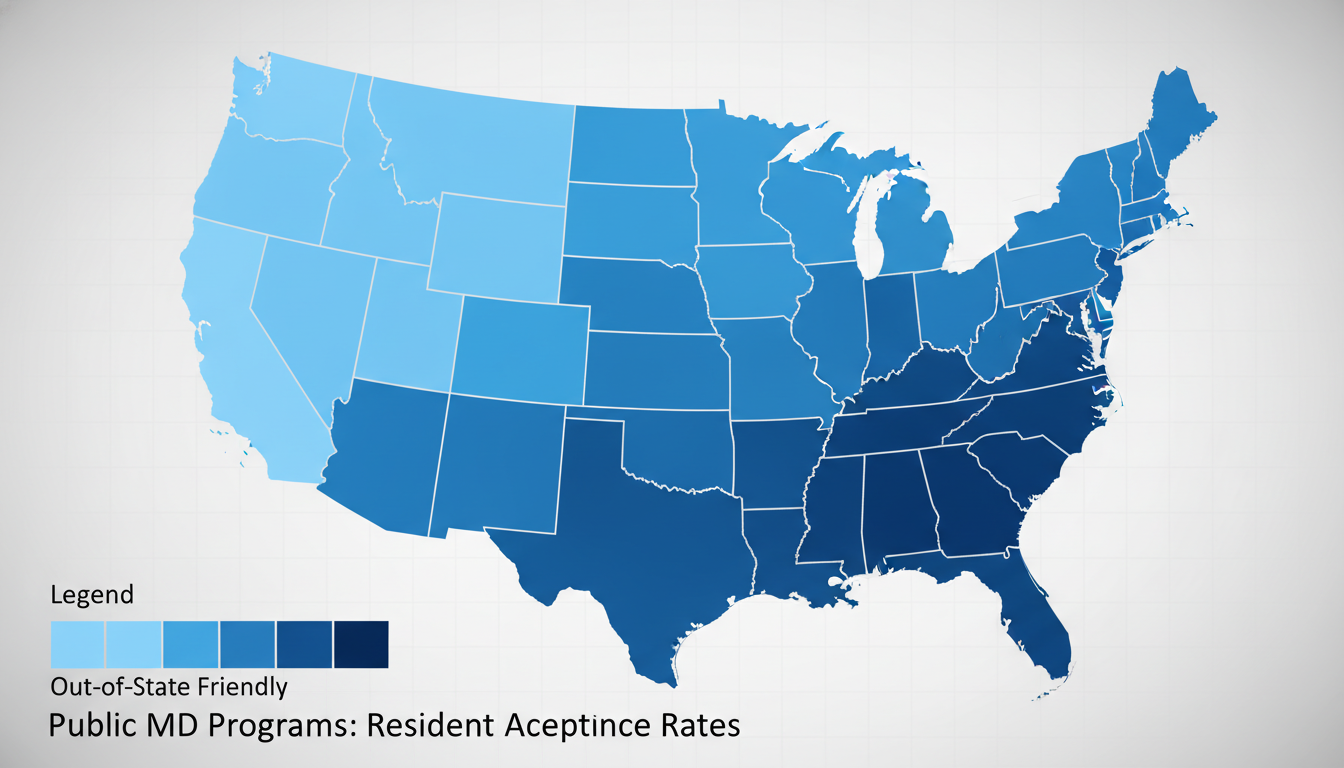
3. Categories of Public MD Programs by IS/OOS Behavior
Public MD schools are not homogenous. The data show several distinct behavioral categories when it comes to IS vs OOS:
3.1 Heavily In-State Dominant (Home-State First, Everyone Else Distant Second)
Characteristics:
- 70–90%+ of the class in-state
- OOS interview and acceptance rates far lower than IS
- Some states with only one main public MD program fall in this group
Data patterns often look like:
- IS applicants: ~2,000–4,000
- OOS applicants: ~6,000–12,000
- Matriculants: 130–200, with 100–170 IS
The ratio of IS to OOS admit rates can be extreme. OOS applicants may face sub-1% acceptance probability, even with strong stats.
Many state flagships fall here. Examples historically in this category (exact percentages vary by year):
- University of Alabama at Birmingham (UAB)
- University of Mississippi
- University of Oklahoma
- University of Arkansas
- Many smaller-population states with one main public MD
This group behaves like “quasi-closed” institutions for OOS. They usually admit some OOS applicants, but often with:
- Very strong metrics (often >515 MCAT, strong GPA)
- Clear connection to the state or mission fit (rural interest, primary care, underserved commitment)
3.2 Moderately In-State Leaning (IS-Favoring but Genuinely Accessible to OOS)
These schools show a significant in-state edge but still take a noticeable OOS share—often 30–45% of the class.
Patterns:
- IS share of class: 55–70%
- OOS share: 30–45%
- IS:OOS acceptance-rate ratio: commonly 2–4x
Example behaviors:
- State-funded, but in larger or more nationally oriented systems
- Mission includes state service, but with broad research or national reach
Representative programs frequently cited in this tier (again, numbers shift year to year):
- Many University of California campuses (though UC system has its own complexities)
- University of Colorado
- University of Wisconsin
- University of Minnesota – Twin Cities
Competitive OOS applicants here still need strong stats, but the door is realistically open. The data show a non-trivial OOS intake yearly, often several dozen or more.
3.3 OOS-Friendly Public Schools (Functionally National in Scope)
A small subset of public MD schools behaves more like private institutions in their OOS openness:
- OOS share of matriculants: sometimes 50% or higher
- IS:OOS acceptance-rate ratio closer to 1–2x
- Often large, research-heavy, or multi-campus systems
These are the schools premed forums frequently describe as “good bets” for strong OOS applicants. Historically, schools often mentioned in this conversation include:
- University of Vermont
- Wayne State University
- Eastern Virginia Medical School
- University of Louisville
- University of Toledo
- Some newer public schools in states actively trying to import talent
However, “OOS-friendly” does not mean easy. It usually means the school:
- Receives high OOS volume
- Does not cap OOS as aggressively
- Balances state mission with broader research or revenue goals
In data terms, their OOS acceptance rates may still be low (1–3%), but the ratio vs in-state is less dramatic.
3.4 De Facto In-State Only or Region-Locked Schools
A few public MD schools have explicit or near-explicit in-state-only or region-first policies:
- Some restrict interviews to in-state or to a set of surrounding states
- Others technically accept OOS applications but admit vanishingly few OOS students
These programs often:
- Serve heavily rural or underserved regions
- Operate with explicit legislative caps on OOS numbers
- State clearly on their websites: “We give strong preference to in-state applicants” with data showing >85–90% in-state enrollment
For a typical OOS applicant without ties or mission-aligned background, the expected value of an application here is close to zero.
4. Quantifying Advantage: How Much Does In-State Really Help?
The magnitude of IS advantage can be estimated from publicly listed MSAR data (where schools report both residency distribution and acceptance rates).
Typical numbers over recent cycles for many public schools:
In-State
- Interview rates: often 8–20%
- Acceptance rates (from applicants): 3–10% (sometimes higher at smaller-volume schools)
Out-of-State
- Interview rates: often 2–8%
- Acceptance rates: 0.5–3%
Interviews themselves are a major filter. At many schools:
- An in-state applicant might have a 2–3x higher chance of being interviewed than an OOS applicant with identical stats.
- Once interviewed, differences may narrow but do not always disappear; some schools still bend toward IS slightly even at the post-interview stage.
If you conceptualize admissions as:
- Probability of interview (P(interview))
- Probability of acceptance given interview (P(accept | interview))
Then total probability:
P(accept) = P(interview) × P(accept | interview)
In-state status often boosts both components to some degree. Even modest multipliers compound:
- Example:
- IS: P(interview) = 15%; P(accept | interview) = 30% → P(accept) = 4.5%
- OOS: P(interview) = 5%; P(accept | interview) = 20% → P(accept) = 1.0%
That is still a 4.5x advantage for in-state, even though each step individually looks “not that different.”
5. State-by-State Dynamics and Notable Patterns
While it is impossible to exhaustively list every school’s current numbers here, we can outline several clear regional patterns supported by admissions data trends.

5.1 States with Especially Strong In-State Protection
Several states have historically protected seats for residents aggressively:
- Smaller-population states with one main public MD program
- States with strong political pressure to address rural or primary care shortages
Common features:
- 70–90%+ in-state matriculants
- Very low OOS acceptance counts (sometimes <20 per year)
For a resident of these states, your home school might be one of your highest-yield options. For an OOS applicant, this is often a poor strategic choice unless you have:
- Very high metrics
- Direct ties (family, extended residence, college in-state)
- Strong, documented fit with that school’s mission
5.2 States with Larger Systems and More Balance
States with multiple public MD campuses often show more nuanced behavior:
- A flagship academic medical center with moderate OOS friendliness
- Regional campuses more locally focused
- Newer campuses sometimes courting OOS applicants to build numbers
Data from such systems often show:
- Overall class composition ~55–65% in-state, 35–45% OOS
- Some campuses with >70% in-state, others hovering near parity
Applicants need to drill down at the campus level rather than assume statewide behavior is uniform.
5.3 Border-State and Regional Preference Models
Some public schools use regional quotas or preference tiers:
- Priority 1: In-state
- Priority 2: Applicants from neighboring states (sometimes in formal consortia)
- Priority 3: All other OOS
In practice:
- The “regional” group may see moderately higher acceptance rates than generic OOS
- These schools sometimes serve as de facto public options for adjacent states lacking their own MD programs
If you live in such a neighboring state, your effective odds may be closer to in-state at those specific schools, even if you are technically classified as OOS.
6. Strategic Application Planning: How to Use This Data
The key value of understanding IS vs OOS patterns is not trivia; it is allocation of your limited applications and money.
6.1 Baseline Rule: Always Apply to Your In-State Publics
The data show that, for the vast majority of applicants, your highest-yield MD options are:
- Your public in-state MD school(s)
- Any regional-partner public schools where your state has special consideration
Most applicants should treat their in-state public(s) as near-mandatory targets. Skipping them because you “prefer” a coastal or prestige option conflicts with both data and probability.
6.2 OOS Targeting: Avoid Low-Yield Traps
A common error is shotgun applying to numerous public MD schools that are heavily in-state dominant.
From a numbers standpoint, that strategy is wasteful:
- If a school fills 85–90% of its class with IS and has thousands of OOS applicants, your OOS probability is often <1% unless you are in the top decile academically.
- A few $100 application fees in these environments have very little expected return.
Data-driven OOS strategy:
- Use MSAR (or equivalent) to check:
- % in-state matriculants
- IS vs OOS interview and acceptance rates
- Any explicit notes about state preference
- Prioritize:
- Public schools where OOS makes up at least 25–30% of the class
- Schools where IS:OOS acceptance-rate ratios are under ~4:1
- Programs explicitly described as OOS-friendly or national in scope
6.3 Evaluate Your Profile Relative to Each Category
The in-state advantage does not erase academic thresholds. For each school:
- Compare your GPA and MCAT to their reported matriculant medians or interquartile ranges.
- Then overlay residency status.
Rough decision framework:
- In-State + near or above median stats: Strong target, often one of your better bets.
- In-State + slightly below medians: Still viable if school admits a broad range; IS boost may carry some weight.
- OOS + near medians at heavily IS-focused school: Low yield; only worthwhile if strong mission fit or ties.
- OOS + above 75th percentile stats at OOS-friendly public: Reasonable target; IS preference less decisive.
6.4 Special Case: Multiple-State Residency Ties
Applicants sometimes have:
- Grew up in State A, went to college in State B
- Parents now live in State C
- Have lived and worked in multiple regions
The data show that some schools treat “ties” almost like a secondary preference category. It is not purely binary IS/OOS:
- “Ties” may improve your odds by moving you closer to the in-state group.
- Evidence: Adcom commentary, class profiles that note “significant number with state ties,” and internal screening practices.
For planning:
- Explicitly identify 1–3 states where you can truthfully claim strong ties (not just a vacation).
- Target public MD schools in those states with somewhat more optimism than generic OOS, but still less than true in-state options.
7. How This Interacts with Cost: Tuition and Debt Considerations
In-state status does not just affect acceptance probability. It also changes cost structures dramatically.
Typical patterns:
- In-state tuition at public MD: ~$20,000–$45,000 per year (broad range)
- Out-of-state tuition at the same school: often $10,000–$25,000 higher annually
Over 4 years, data from integrated cost-of-attendance tables show:
- In-state total cost can be $40,000–$100,000 less than OOS cost at the same institution.
- When coupled with higher acceptance odds, state residency becomes one of the highest-leverage variables in the entire application process.
For a rational applicant, this means:
- Maximizing probability at lower-cost in-state schools is usually more valuable than chasing prestige at more expensive, low-yield OOS publics.
8. What the Data Mean for Different Applicant Profiles
Different types of applicants should interpret the IS vs OOS landscape differently.
8.1 Strong Applicant in a State with Multiple Public MD Options
Example: 3.8 GPA, 517 MCAT, strong experiences; state with 2–3 public MD schools.
The data suggest:
- You likely have above-average odds at your in-state schools.
- You should apply broadly (in-state plus selected OOS) but treat your state schools as central to your strategy.
Outcome distributions in this group often show ≥1 acceptance at an in-state program, with OOS options as supplemental.
8.2 Strong Applicant in a State with a Single, Very Protectionist Public MD
Example: 3.8 GPA, 517 MCAT, home state school with 85–90% IS, but total seats limited.
Here:
- Your in-state status helps, but seat caps and high local competition still make acceptance non-trivial.
- You still must apply widely OOS, but focus on:
- Private MD schools
- OOS-friendly public MDs
- Possibly DO programs depending on risk tolerance
Even so, the in-state public remains one of your higher-yield MD targets compared with heavily IS-focused publics where you are OOS.
8.3 Average Applicant Hoping to “Outrun” Their State Profile by Applying OOS
Example: 3.5 GPA, 506 MCAT, from a competitive state.
The data are clear: most public MD schools will not be easier for you OOS than your in-state option.
- You gain no residency advantage elsewhere.
- You face stiff competition plus local-preference dynamics.
Strategically:
- Your home public MD may still be one of your best MD chances, even if your metrics are a bit below their median.
- Supplement with:
- An appropriate range of private MD programs (mission-fit and stats-aligned)
- DO schools if you want to maximize probability of a single acceptance
9. Key Takeaways: Turning Numbers into Decisions
Three central points emerge from the data on in-state vs out-of-state acceptance rates at public MD programs:
In-state preference at public MD schools is not subtle; it is often a 3–10x difference in acceptance probability. Residency status routinely outweighs minor differences in GPA or MCAT, particularly at schools with explicit state-service missions.
Public MD programs fall into distinct categories—heavily in-state, moderately IS-leaning, genuinely OOS-friendly, and near-closed. Successful applicants identify which category each school occupies and allocate applications accordingly, rather than blindly applying to “any public school.”
A rational, data-driven strategy maximizes applications to in-state and legitimately OOS-friendly publics, minimizes low-yield OOS shots at protectionist schools, and integrates cost. When you align your school list with these acceptance-rate patterns, you convert residency status from a source of frustration into a quantifiable advantage.