
You are staring at your unofficial transcript on one side of the screen and the AMCAS “Work & Activities” and Personal Statement sections on the other.
Overall GPA: 3.07.
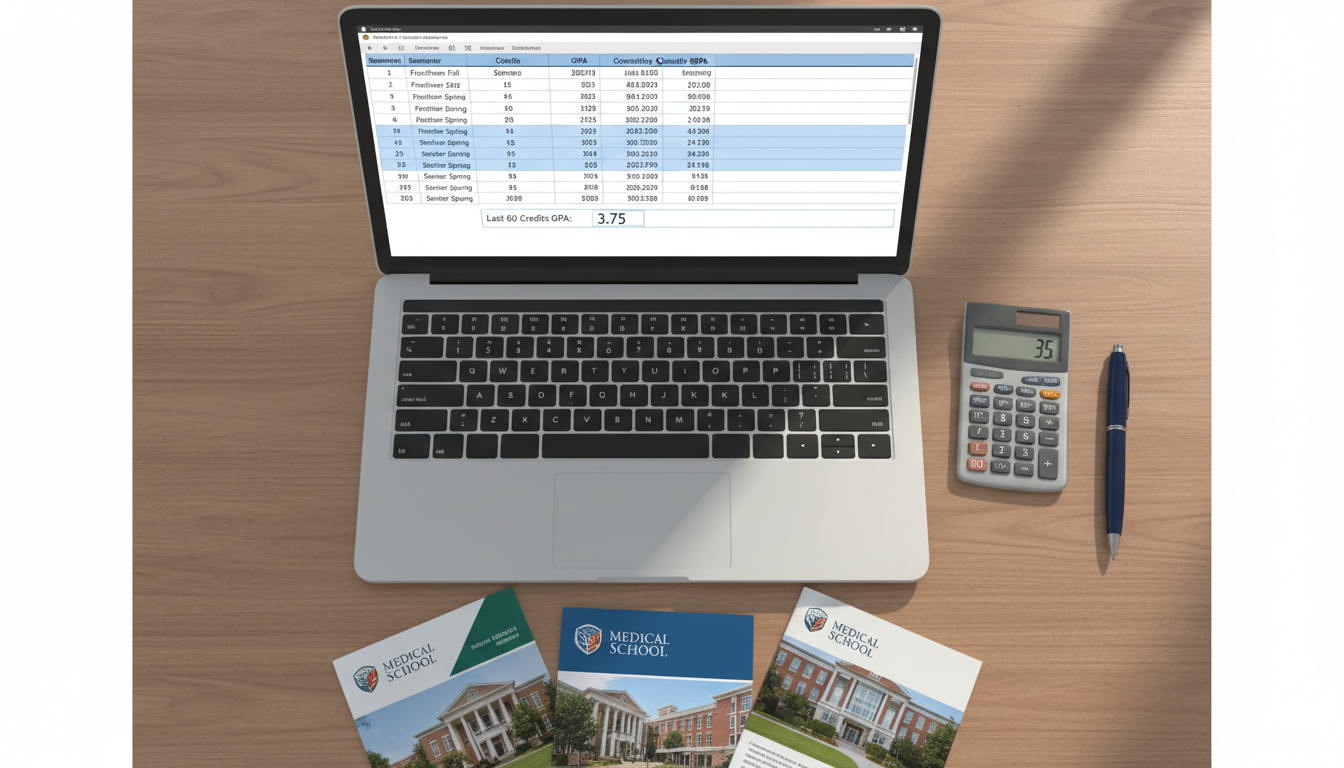
Last 60 credits GPA: 3.75.
(See also: Uneven Clinical Experience? Stepwise Fixes Before You Apply MD/DO for strategies to enhance your application.)
Your science grades from freshman year look like a car crash. C+ in General Chemistry I. B- in Calculus. Then a quiet turning point sophomore spring… and by senior year you were pulling straight A’s in Biochem, Physiology, and upper-level neuroscience.
You know you are not your freshman GPA. But AMCAS is going to spit out that cumulative number anyway. Admissions committees will see it in the first 10 seconds.
Your job is not to hide it. Your job is to frame it correctly—honestly, strategically, and with evidence that you are now ready for medical school.
This is exactly what we are going to fix.
Step 1: Get Clear on Your Numbers and Story
Before you write a single sentence for AMCAS, you need a precise understanding of your academic trajectory.
1. Map Your Actual GPA Trend
Do this on paper or in a spreadsheet:
List each academic term with:
- Term (e.g., Fall 2020)
- Credit hours
- Term GPA
- Science GPA (BCPM) that term
Highlight:
- The last 45–60 credit hours
- All upper-division science courses
- Any post-bacc or graduate coursework
Calculate:
- Cumulative GPA
- Cumulative science GPA
- GPA for your last 60 credits
- GPA for your last 30 credits
- GPA in upper-level sciences (300/400-level)
You want to be able to say things like:
- “My last 60 credit hours are a 3.78 GPA, with a 3.85 in upper-division biology courses.”
- “During my final four semesters, I consistently earned term GPAs above 3.7 while working 15–20 hours per week.”
These are concrete, defensible claims. Admissions committees respond to precision.
2. Identify the Turning Point
You need to understand when and why things changed. Look for:
- A specific semester when grades noticeably improved
- A change in:
- Study strategies
- Major
- Work hours
- Health situation
- Family responsibilities
- Mental health treatment
- Time management systems
Write out, in bullet points, what changed after that point. For example:
- Switched from engineering to biology after realizing misalignment with interests
- Reduced work from 30 to 15 hours per week by securing a scholarship
- Started using active recall and spaced repetition instead of rereading notes
- Began meeting weekly with a learning specialist
- Got formal evaluation and treatment for ADHD
This is not yet essay language. This is the raw material you will later refine.
Step 2: Decide Where to Address the Low GPA
You have three main writing “tools” on AMCAS that can help you frame an upward trend:
- Personal Statement (PS)
- Work & Activities (W&A) section
- Optional “Additional Comments” / “Other Impactful Experiences” / Secondary essays
You do not need to talk about GPA in all three. In fact, you should not.
Use This Simple Protocol
If your upward trend is strong and recent (e.g., 3.7+ over last 50–60 credits) and there were no major extenuating circumstances:
- Brief mention in Personal Statement or one activity, if relevant to your growth story.
- Possibly leave detailed explanation for secondaries if a school specifically asks.
If your GPA is below ~3.3 cumulatively but you have a dramatic last 60 credits (3.7+), or strong post-bacc/SMP performance:
- Address directly and concisely in the Personal Statement or in an “Additional Comments” section, not both.
- Use W&A to demonstrate sustained academic behaviors (tutoring, TA roles, research productivity).
If your GPA was affected by significant life events (illness, family crisis, financial hardship, military service, etc.):
- Use the “disadvantaged essay” (if applicable) or “Other Impactful Experiences”/additional comments to contextualize.
- Keep the PS less about excuses and more about your professional and personal development.
The key: pick one primary location for the explicit GPA narrative and support it indirectly everywhere else through evidence of maturity, reliability, and academic stamina.

Step 3: How to Talk About Your Upward Trend in the Personal Statement
If you are going to touch GPA in your PS, it must be:
- Tightly linked to your development as a future physician
- Concise (1–3 sentences, occasionally a short paragraph)
- Focused on actions and changes, not on excuses
Here is a practical approach.
1. Decide Your Primary PS Focus
Your personal statement is not “my GPA story.” It is:
- Why medicine
- How you have tested that interest
- How you have grown into someone readers can trust to finish medical school and care for patients
Let your GPA narrative be a supporting component, not the center.
2. Use One of These Structural Strategies
Option A: Integrate into a Growth Arc
Best when your academic turnaround is part of a broader pattern of growth.
Example structure:
- Early academic struggle tied to poor strategies or misplaced priorities
- Inflection point (realization or event)
- Concrete behavioral changes
- Demonstrable sustained success
Sample language (adapt, do not copy):
During my first three semesters, my academic performance did not match my potential. I approached college with high school habits—passive review, last-minute studying, and an overcommitted work schedule. After earning a C+ in General Chemistry I, I met with a learning specialist, overhauled my study methods, and adjusted my work hours.
Over the next five semesters, I implemented structured weekly planning, daily active recall, and group problem-solving sessions. My science GPA during this period rose to 3.78, with A grades in Biochemistry, Physiology, and Molecular Biology. This progression reflected more than higher grades; it showed me how to build disciplined, sustainable habits that I now apply to clinical work and research.
Why this works:
- Admits the problem without dramatizing
- Names specific interventions
- Gives specific, verifiable metrics
- Ties academic discipline to clinical/research behavior
Option B: Brief, Targeted Clarification
Use this if you have one anomalous period (e.g., one bad year surrounded by stronger performance).
Sample language:
My cumulative GPA includes a difficult sophomore year, during which I was working full-time night shifts while supporting my family financially. Once I transitioned to a part-time daytime position and established a structured study routine, my academic performance stabilized. My last 60 credits, including upper-division biology and chemistry, reflect this change with a 3.74 GPA.
Notice what this does:
- Names the factor (full-time night shifts) succinctly
- Emphasizes what changed
- Anchors the reader in current performance
3. What to Avoid in the Personal Statement
- Long explanations of every semester fluctuation
- Emotional venting about “unfair” professors or policies
- Vague claims like “I improved a lot” without numbers
- Overcompensating (“My grades do not reflect who I am at all”) – they do reflect past behavior; you are showing that behavior is now different
Aim for clinical, factual, and forward-looking language.
Step 4: Use the Work & Activities Section to Show Academic Maturity
You can reinforce your upward trend without ever writing “GPA” in Work & Activities. The trick is to choose and describe experiences that demonstrate the same skills you used to turn things around.
1. Highlight Academically Demanding Roles
Strong signals include:
- Teaching assistant (TA) in challenging courses you once struggled in
- Peer tutor in chemistry, physics, biology, or statistics
- Supplemental Instruction (SI) leader
- Research assistant with clear responsibilities and outputs
- Leadership roles in academic clubs (premed society, biology honor society)
When you describe these, focus on:
- Complexity of material you taught or used
- Systems you created (review sessions, problem banks, study guides)
- Outcomes (students’ improvement, abstracts, posters, publications)
Example: TA for Organic Chemistry
Instead of:
Helped students with organic chemistry concepts and graded assignments.
Write:
Led two weekly problem-solving sessions for 25 students in Organic Chemistry I, designing practice sets that emphasized mechanisms and synthesis pathways. I developed structured review guides that incorporated spaced repetition principles I adopted after my own academic struggles. Several students reported their exam scores increased by 10–20 points over the semester.
This frames you as someone who not only improved but now helps others improve using the same disciplined tools.
2. Use “Most Meaningful” Sections Strategically
If an academic experience (e.g., post-bacc, SMP, TA role) is one of your most meaningful, you can briefly reference your turnaround there too.
Sample language for a “Most Meaningful” reflection:
Serving as a physiology TA allowed me to return to a course that once challenged me and approach it from a position of mastery. I used the active-learning techniques that transformed my own performance—concept mapping, retrieval practice, and weekly planning—to help students who were at the point where I once struggled. This role reinforced that sustained effort and strategic practice can change academic trajectories, and it gave me confidence that I can manage the volume and complexity of medical school material.
You are not saying “please forgive my GPA.” You are saying “my current capabilities are demonstrably different than my past performance, and here is how I know.”
Step 5: When and How to Use an “Additional Comments” Section
On the primary AMCAS there is not a generic “explain your GPA” box, but schools often provide:
- Secondary essay prompts like “Is there anything else you would like us to know?”
- Spaces for “academic difficulties” or “unusual circumstances”
Use them if:
- There were discrete, significant events that affected performance (e.g., family death, illness, major housing instability)
- Your transcript shows withdrawals, repeats, or a prolonged gap that would raise questions
- Your GPA improved after graduation through post-bacc or SMP coursework
Structure for an Effective GPA-Focused Comment
Follow this 4-part formula:
- Brief context (1–2 sentences)
- Specific, non-dramatic explanation (2–4 sentences)
- Concrete evidence of improvement (2–3 sentences, include numbers)
- Current readiness statement (1–2 sentences)
Example:
During my sophomore year, my academic performance declined due to a combination of untreated depression and a 30-hour-per-week overnight work schedule. This led to lower grades in several foundational science courses and a semester of academic probation.
Following evaluation and treatment, I entered counseling, adjusted my work hours, and worked with an academic coach to redesign my study strategies. From junior year onward, my term GPAs ranged from 3.6–3.9, and my last 60 credits reflect a 3.78 GPA with A grades in Biochemistry, Physiology, and Cell Biology.
This period taught me to recognize when I need support and how to build sustainable systems to manage heavy workloads, which I have continued to apply in clinical volunteering and research.
Notice what is missing: blame, excessive detail about symptoms, or an attempt to milk sympathy. You are not asking for a pass; you are offering context and proof of repair.
Step 6: Use Numbers Strategically Without Overloading the Reader
You want the reader to remember two or three key facts about your academics, not a blur of decimals.
1. Choose Your Anchor Numbers
Typically:
- Overall cumulative GPA (because they will see it anyway)
- Last 45–60 credits GPA
- If clearly higher, upper-division science GPA or post-bacc/SMP GPA
Example set to repeat (in different words) across documents:
- “3.08 cumulative GPA”
- “3.72 GPA over last 60 credits”
- “3.81 in upper-division biology and chemistry courses”
Use these same numbers in:
- Personal statement (if you mention statistics)
- Secondary essays
- Any academic addendum
Consistency builds credibility.
2. Compare Yourself Only When Useful
Avoid vague comparisons (“above average,” “much stronger”). Instead, anchor:
- “My last four semesters ranged from 3.6 to 3.9, compared to a 2.8 GPA during my initial three semesters.”
- “My post-baccalaureate coursework (24 credits) in Biochemistry, Physiology, and Genetics was completed with a 3.86 GPA.”
You are drawing attention to the slope, not just the endpoints.
Step 7: Align Your Narrative with Your Letters and Activities
A well-framed upward trend is not just what you say about yourself. It is what others can corroborate.
1. Choose Letter Writers Who Have Seen the “New You”
Prioritize:
- Professors from upper-division science courses in your last 2–3 years
- Post-bacc or SMP faculty
- Research mentors who saw you handle complex projects
- Supervisors who watched you manage heavy responsibilities while in school
You can politely flag the narrative you hope they can support. For example, in your email requesting a letter:
Because my cumulative GPA is weighed down by early coursework, I am hoping your letter can speak to the level of preparation and academic maturity I demonstrated in your course, especially since it reflects my more recent performance.
You are not telling them what to write; you are giving context.
2. Make Your Application Internally Consistent
Ensure that:
- Your PS description of your academic struggles matches the semesters where grades dropped
- Any mention of work hours, illness, or family circumstances aligns with dates in your Work & Activities descriptions
- You do not tell one school “I was working 40 hours per week” and another “I was taking care of a sick parent full-time” for the same time period
Admissions committees notice coherence. Inconsistencies raise more concern than a low GPA does.
Step 8: Tailor Your Framing for Different School Types
Not all schools look at your GPA the same way. You can fine-tune your emphasis.
1. Schools That Emphasize Recent Performance
Some programs (including many DO schools and several MD schools) explicitly state they value upward trajectories. When writing secondaries:
- Reinforce your recent GPA with specific examples of challenging courses
- Highlight sustained performance rather than a single good semester
- Emphasize habits and systems you have built
2. Schools with Holistic Review and Context Emphasis
For schools that focus heavily on adversity, resilience, and context:
- Tie your academic turnaround to broader growth (resilience, self-advocacy, learning how to seek help)
- Use disadvantaged or impactful experience essays to provide fuller context about socioeconomic or family pressures that drove early struggles
3. Highly Competitive Research-Intensive Schools
Here you must show:
- That your current academic performance is at or above their typical matriculant level
- That you can handle intensive coursework and research
Emphasize:
- Upper-level science performance
- Any graduate-level or post-bacc coursework
- Research outputs that required sophisticated understanding (e.g., writing methods sections, statistical analysis, protocol design)
Step 9: Sample Before-and-After Framing
Sometimes it helps to see what not to do and how to fix it.
Weak Framing
I know my GPA is low, but I ask you to look past it. I had a lot going on in college and was not able to perform at my best. My grades improved over time and show my true abilities now.
Problems:
- Vague (“a lot going on”)
- Defensive (“look past it”)
- No numbers, no specifics
- No actions described
Strong Framing
My cumulative GPA (3.11) reflects an early period of uneven performance while I struggled to balance a full premed course load with significant work and family responsibilities. During my first three semesters, I worked 25–30 hours per week at a grocery store night shift and relied on inefficient study habits that had worked in high school.
After receiving feedback from my advisor, I reduced my work hours, enrolled in a learning skills course, and adopted a structured schedule emphasizing active recall and regular review. Over my last 60 credits, including Biochemistry, Physiology, and Microbiology, I earned a 3.76 GPA. This process taught me how to build systems to manage demanding workloads—skills I now apply consistently in clinical volunteering and research.
This version:
- Names the cumulative GPA so the reader is oriented
- Explains specific pressures and poor strategies
- Describes precise changes
- Highlights a sustained, quantifiable improvement
- Links to present-day behavior
That is the structure you want to emulate.
Step 10: Put It All Together into a Coherent Message
When an admissions committee member closes your file, you want them to walk away with a simple, accurate impression:
“This applicant started out rough academically, identified the problem, fixed it with sustainable strategies, and has been performing at or above medical-school-level expectations for several years now.”
To reach that outcome, your application components should collectively:
- Acknowledge the low GPA without overemphasizing it
- Provide concise, factual context for any major dips
- Emphasize the magnitude and duration of your upward trend
- Demonstrate academic maturity through roles and letters, not only through your own words
- Present a stable, coherent story across all documents
Your Next Concrete Step
Right now, before you do anything else:
- Open a blank document or spreadsheet.
- List each college term and calculate:
- Term GPA
- Cumulative GPA
- Last 60 credits GPA
- Upper-division science GPA
Once you have those four numbers, write a 3–4 sentence paragraph that:
- Names your cumulative GPA
- Names your last 60 credits GPA
- Briefly states what changed to produce that improvement
This paragraph becomes your core “upward trend” script. You will refine its tone and length for your personal statement, secondaries, and any additional comments, but the spine will stay the same.
Get that draft down today. Then you are no longer “the applicant with a low GPA.” You are “the applicant with a documented, disciplined academic turnaround”—and that is something you can confidently present in your AMCAS essays.