This article is for educational purposes only. It is not financial advice, not legal advice, and not tax advice. Figures vary by individual circumstances, so consult a qualified professional before acting.
The Direct Answer: Most OSCE Score Loss Is Predictable, and Fixable
Here's the answer you're looking for: you are not losing OSCE points because you don't know the medicine. You're losing them because of what you do, and don't do, inside the station.
I've watched students who could recite the entire TIMI risk score walk out of a chest pain station having skipped the actual task. I've watched a student deliver a flawless abdominal exam and forget to wash her hands. These aren't knowledge failures. They're behavior failures. And behavior is trainable.
The five mistakes that cost the most points, over and over:
- Skimming the station stem and tasks before entering
- Taking a rote checklist history with zero clinical reasoning
- Performing a disorganized, unverbalized physical exam
- Mismanaging time and getting caught mid-task at the buzzer
- Closing weakly, no summary, no safety net, no plan
Understand how you're being scored. Examiners work from checklists and global ratings that reward safety, organization, patient-centered communication, focused clinical reasoning, and clear closure. Nobody is scoring theatrical perfection. Nobody expects you to perform like an attending. They're checking whether you're safe, structured, and listening.
So here's the format: for each mistake, you get the warning sign, why it bleeds points, and a concrete fix you can drill before your next mock OSCE. By the end, you'll know exactly what to stop doing, what to script lightly, and what to practice with feedback.
Mistakes 1-3: The Communication, Reasoning, and Exam Technique Traps
Mistake 1: Skimming the Station Stem Before You Knock
The warning sign: You knock, walk in, and ninety seconds in, you still don't know whether this is a history station, a counseling station, or both. You're improvising. The patient can tell.
Why it hurts your score: OSCE checklists are task-specific. If the stem says "explain the next steps to the patient" and you only took a history, those points are gone, no matter how beautiful your OPQRST was. Missing a required task is the single most expensive mistake per second in the OSCE. I've seen a student nail a dyspnea workup and leave without doing the one thing the stem asked: counsel the patient about their new inhaler. An entire row of the checklist, zeroed out.
The fix: Take the 20-second pause outside the door. Every time. Use it like this:
- Read the stem twice. The first read is for content; the second is for tasks.
- Underline the verbs. Take, perform, explain, counsel, document. The verbs are the checklist.
- Name your top three tasks in your head before your knuckles touch the door.
- Note the setting. A headache in the ED has different red flags than a headache in a primary care clinic. The setting changes your questions.
- Check the time limit so you can plan your internal markers (more on that in Mistake 4).
Twenty seconds of reading buys you the entire architecture of the station. Students who skip this are doing the exam equivalent of starting surgery without a timeout.
Mistake 2: The Shotgun History
The warning sign: You ask every review-of-systems question you memorized, in order, regardless of the chief complaint. Head-to-toe questions for a sore knee. Ten questions about past medical history before you've characterized the pain.
Why it hurts your score: Examiners are listening for hypothesis-driven reasoning, prioritization, discrimination, red flags. Anyone can recite a checklist. That's data entry, not doctoring. Worse, the shotgun approach eats your clock and crowds out the patient-centered items that appear on nearly every rubric: exploring the patient's ideas, concerns, and expectations.
The fix: Reason early, out loud, and on purpose.
- Within the first 30-60 seconds, generate two or three working diagnoses. Chest pain? ACS, PE, reflux, musculoskeletal. Now your questions have a job: rule in or rule out.
- Ask discriminating questions. "Does the pain get worse when you breathe in?" separates pleuritic causes from others. One question, real information.
- Always hit the red flags for that presentation. Even if the answer is no, asking it is often a scored safety item.
- Ask one ICE question. "What were you worried this might be?" takes four seconds and checks the patient-centeredness box on almost every form.
- Think out loud, lightly. "Based on what you've told me, I want to make sure we rule out a few serious things first." The examiner can't score reasoning they can't hear.
The rigid, memorized script is dead weight. It collapses the moment the standardized patient says something unexpected, and they're trained to say something unexpected.
Mistake 3: The Silent, Scrambled Exam
The warning sign: You start palpating without saying anything. You jump from heart to abdomen to reflexes with no order. You forget hand hygiene. The patient looks startled; the examiner looks down at the checklist and starts leaving boxes blank.
Why it hurts your score: Two separate bleeding points. First, the professionalism and safety items, hand hygiene, consent, draping, asking about pain, are the easiest points on the entire sheet and the most commonly lost. Second, an unverbalized exam gives the examiner nothing to credit. Were you checking for hepatomegaly, or just poking? If you don't say it, they can't score it.
The fix: Run the same sequence every single time, until it's muscle memory.
- Wash hands. In view of the examiner. Non-negotiable.
- Introduce yourself, confirm identity, and ask permission before you touch the patient.
- Explain each step in plain language. "I'm going to press on your belly now, tell me if anything hurts."
- Position and expose appropriately, check for pain, respect comfort and draping.
- Verbalize findings as you go. "Normal S1, S2, no murmurs." "No rebound or guarding."
- Close the loop with interpretation: "Your exam makes me less worried about appendicitis, but I still want to check a urine test."
After every practice station, run this three-question self-audit:
- Did I name the task out loud?
- Did I ask at least one red-flag question?
- Did I explain each exam step and say my findings to the patient?
One "no" answers the question of what to drill next. Here's the whole flow, mapped:
Mistakes 4-5: Time Management and Weak Closure, Plus the Summary Fix
Mistake 4: The Time Sink
The warning sign: Six minutes into a ten-minute station, you're still taking the history. The examiner announces two minutes, and you haven't started the exam or the counseling task. Panic. You sprint. The ending is a blur.
Why it hurts your score: Unfinished required tasks are unearned points, period. And a rushed close reads as disorganization and poor prioritization, even when your medical knowledge is solid. Remember, the last thing the examiner watches is your ending. If your ending is chaos, that's the impression that sticks when they fill in the global rating.
The fix: Set internal time markers before you enter, based on the station length. For a standard ten-minute station:
- Minutes 0-4: Focused history
- Minutes 4-7: Targeted exam
- Final two minutes: protected. Summary, safety net, next steps. Non-negotiable.
When the two-minute warning comes, don't speed up, pivot. Say, "I want to make sure we have time to talk about what happens next," and close properly. Squeezing in two more questions at the cost of your entire close is a terrible trade. Two questions are worth a point or two. A structured close is worth a block of the checklist.
Mistake 5: The Mumbled Goodbye
The warning sign: You finish the exam, say "okay, um, we'll probably get some tests," and drift toward the door while the standardized patient stares at you.
Why it hurts your score: Closure items, summary, working diagnosis in plain language, checking understanding, safety netting, follow-up, often make up a meaningful chunk of the checklist, and they require zero medical knowledge. They're pure technique. Losing these points is like missing free throws.
The fix: Script the close lightly. Five moves, every station:
- Summarize the main concern in the patient's own terms: "So you came in because of this chest tightness that's been going on for two days."
- State key findings and your working diagnosis in plain language. No jargon. "Your exam and story make me concerned this could be reflux, but we need to make sure it's not your heart."
- Check understanding: "Does that make sense? What questions do you have for me?"
- Safety net: "If you get severe pain, shortness of breath, or sweating, go straight to the emergency room."
- Next steps and follow-up: "We'll get an ECG today, and I want you back in two weeks."
Ninety seconds. That's all a good close takes. Practice it until it's automatic, because this is the part of the station that falls apart first under stress.
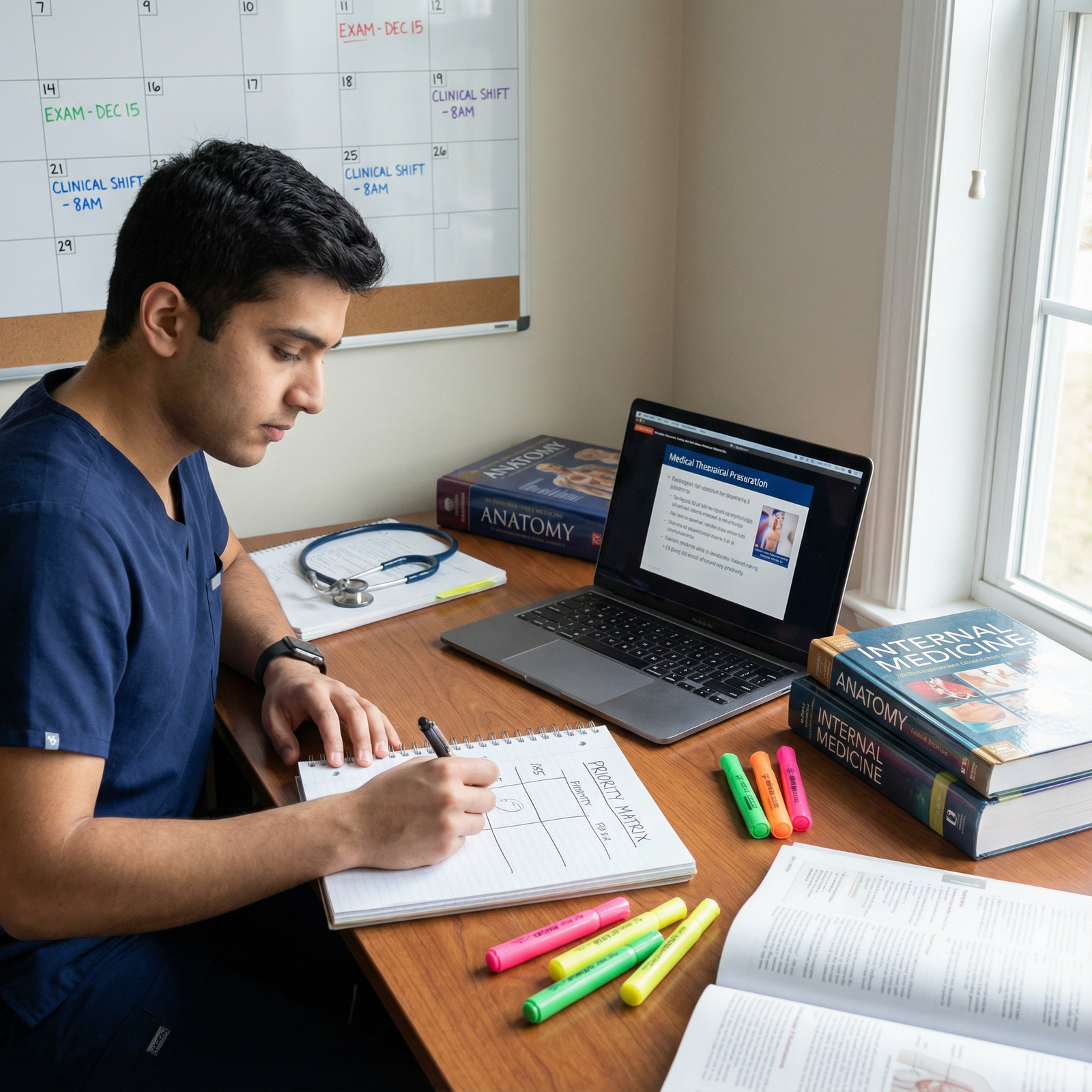
The practice loop that actually works: OSCE improvement is behavioral, which means you improve it the way you improve any skill, deliberate reps with feedback.
- Run one timed station. Real timer. Door closed.
- Score it against a checklist immediately after, yours, a classmate's, or a school rubric.
- Pick one behavior to change. Not five. One. "I will verbalize my exam findings."
- Repeat it in the next station the same week.
- Get feedback from a peer, a resident, or a standardized patient. And record yourself on video at least once. It's painful. It's also the fastest mirror you'll ever get.
The Bottom Line
- Most OSCE points are lost to missed station tasks and weak structure, not lack of medical knowledge.
- Read the stem, underline the required tasks, and name your top priorities before you knock.
- Use hypothesis-driven history questions and pursue red flags instead of reciting a rote checklist.
- Verbalize consent, exam steps, and findings so the examiner can actually credit your reasoning.
- Protect the final two minutes for summary, safety netting, next steps, and patient questions.
- Timed practice with video review and checklist feedback will raise your score faster than any amount of re-reading.